Since y$y$ is real, y² = 1 y = ± 1$y^2 = 1 \implies y = \pm 1$.
When y = ± 1$y = \pm 1$, x = (1)/(2)$x = \frac{1}{2}$.
Intersection points are ((1)/(2), 1)$\left(\frac{1}{2}, 1\right)$ and ((1)/(2), -1)$\left(\frac{1}{2}, -1\right)$.
Step 1: Set up and Compute Area Integral
Between y = -1$y = -1$ and y = 1$y = 1$, (1)/(1+y²) ≥ (y²)/(2)$\frac{1}{1+y^2} \ge \frac{y^2}{2}$.
Whenever curves are functions of y²$y^2$, integrating along the y$y$-axis avoids dealing with messy radical functions (square roots) and naturally accounts for symmetry across the x$x$-axis.
Chapter Mix
Class 12 Mathematics: Application of Integrals
More Area Under Curves Previous-Year Questions — Page 6
Q11jee_main_2024_31_jan_eveningArea Under Curves
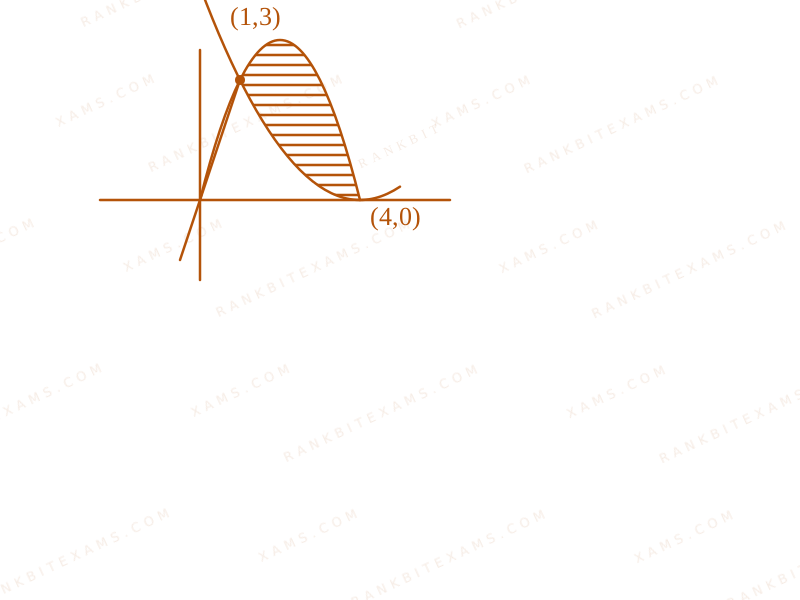
The area of the region enclosed by the parabola y = 4x - x²$y = 4x - x^2$ and 3y = (x - 4)²$3y = (x - 4)^2$ is equal to
Q5jee_main_2024_31_jan_morningArea bounded by Parabolas and Inequalities
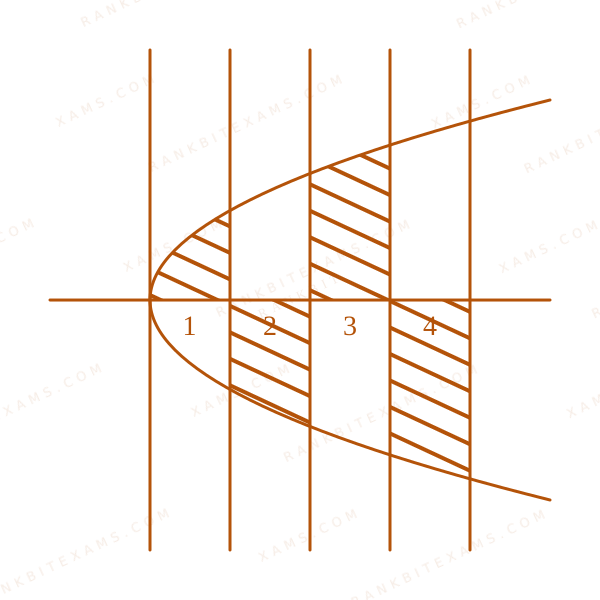
The area of the region (x,y): y² ≤ 4x, x < 4, (xy(x - 1)(x - 2))/((x - 3)(x - 4)) > 0, x ≠ 3$\left\{(x,y): y^2 \le 4x, x < 4, \frac{xy(x - 1)(x - 2)}{(x - 3)(x - 4)} > 0, x \neq 3\right\}$ is
A.(16)/(3)$$\frac{16}{3}$$
B.(64)/(3)$$\frac{64}{3}$$
C.(8)/(3)$$\frac{8}{3}$$
D.(32)/(3)$$\frac{32}{3}$$
Solution
Core Logic
Given y² ≤ 4x$y^2 \le 4x$ and x < 4$x < 4$.
Analyze the inequality (xy(x-1)(x-2))/((x-3)(x-4)) > 0$\frac{xy(x-1)(x-2)}{(x-3)(x-4)} > 0$ considering y > 0$y > 0$ and y < 0$y < 0$ separately.
Area bounded by Parabolas and Inequalities diagram for Q5 - JEE Main 2024 Morning
Step 1: Case I (y > 0)
If y > 0$y > 0$, the inequality reduces to (x(x-1)(x-2))/((x-3)(x-4)) > 0$\frac{x(x-1)(x-2)}{(x-3)(x-4)} > 0$.
Using wavy curve method and given x in (0, 4)$x \in (0, 4)$:
x in (0, 1) (2, 3)$x \in (0, 1) \cup (2, 3)$.
Step 2: Case II (y < 0)
If y < 0$y < 0$, the inequality reduces to (x(x-1)(x-2))/((x-3)(x-4)) < 0$\frac{x(x-1)(x-2)}{(x-3)(x-4)} < 0$.
Using wavy curve method and given x in (0, 4)$x \in (0, 4)$:
x in (1, 2) (3, 4)$x \in (1, 2) \cup (3, 4)$.
Step 3: Area Computation
Because the regions map perfectly without overlap in opposite quadrants relative to the x-axis, they form complete parabolic strips when combined:
Area = 2 ∫₀⁴ √(x) dx = 2 · (2)/(3)[x3/2]₀⁴ = (4)/(3) · 8 = (32)/(3)$= 2 \int_{0}^{4} \sqrt{x} dx = 2 \cdot \frac{2}{3}[x^{3/2}]_{0}^{4} = \frac{4}{3} \cdot 8 = \frac{32}{3}$.
Chapter Mix
Class 12 Maths: Area Under Curves
Class 11 Maths: Linear Inequalities
Practice past-year questions one chapter at a time. Pick an exam → subject → chapter and get every PYQ for that topic — pulled together from all past papers — with the chapter's key formulas alongside.