The area of the region bounded by the curves x(1+y²)=1 and y²=2x is :

Solution & Explanation

Related Formula

Area integrating with respect to y:

A = ∫y₁y₂ (xright - xleft) dy

Standard integral:

∫ (1)/(1+y²) dy = ⁻¹(y)
Core Logic

The boundary curves are:

  • x = (1)/(1+y²)
  • x = (y²)/(2)
  • Find intersection points by setting x equal:

(1)/(1+y²) = (y²)/(2) 2 = y²(1+y²) y⁴ + y² - 2 = 0 (y² + 2)(y² - 1) = 0

Since y is real, y² = 1 y = ± 1. When y = ± 1, x = (1)/(2). Intersection points are ((1)/(2), 1) and ((1)/(2), -1).

Step 1: Set up and Compute Area Integral

Between y = -1 and y = 1, (1)/(1+y²) ≥ (y²)/(2).

Area = ∫₋₁¹ ( (1)/(1+y²) - (y²)/(2) ) dy

Since the integrand is an even function of y:

Area = 2 ∫₀¹ ( (1)/(1+y²) - (y²)/(2) ) dy Area = 2 [ ⁻¹(y) - (y³)/(6) ]₀¹ Area = 2 [ ⁻¹(1) - (1)/(6) - (0) ] = 2 ( (π)/(4) - (1)/(6) ) = (π)/(2) - (1)/(3)
Pattern Recognition

Whenever curves are functions of y², integrating along the y-axis avoids dealing with messy radical functions (square roots) and naturally accounts for symmetry across the x-axis.

Chapter Mix

Class 12 Mathematics: Application of Integrals

More Area Under Curves Previous-Year Questions — Page 2

Q19 jee_main_2026_24_january_morning Area Under the Curve
Let A₁ be the bounded area enclosed by the curves y = x² + 2, x + y = 8 and y-axis that lies in the first quadrant. Let A₂ be the bounded area enclosed by the curves y = x² + 2, y² = x, x = 2, and y-axis that lies in the first quadrant. Then A₁ - A₂ is equal to
  • A. (2)/(3)(2√(2)+1)
  • B. (2)/(3)(4√(2)+1)
  • C. (2)/(3)(√(2)+1)
  • D. (2)/(3)(3√(2)+1)

Solution

Related Formula
Area = ∫ₐb (yupper - ylower) dx
Core Logic

For A₁: Intersection of y = x² + 2 and x + y = 8. x + (x² + 2) = 8 ⇒ x² + x - 6 = 0 ⇒ (x+3)(x-2) = 0. In first quadrant, x = 2. Intersection point is (2, 6).
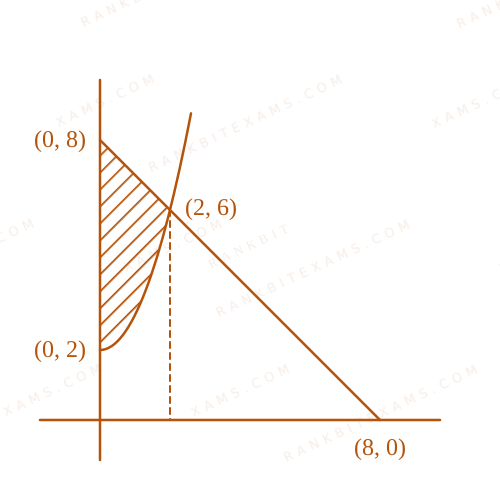
Area A1 boundaries visualization

Step 1: Calculate A1
A₁ = ∫₀² ((8 - x) - (x² + 2)) dx = ∫₀² (6 - x - x²) dx A₁ = [ 6x - (x²)/(2) - (x³)/(3) ]₀² = 12 - 2 - (8)/(3) = 10 - (8)/(3) = (22)/(3)
Step 2: Area A2 Definition

For A₂: Enclosed by y = x² + 2, y = √(x), x=2 and y-axis. Upper curve: y = x²+2, Lower curve: y = √(x).
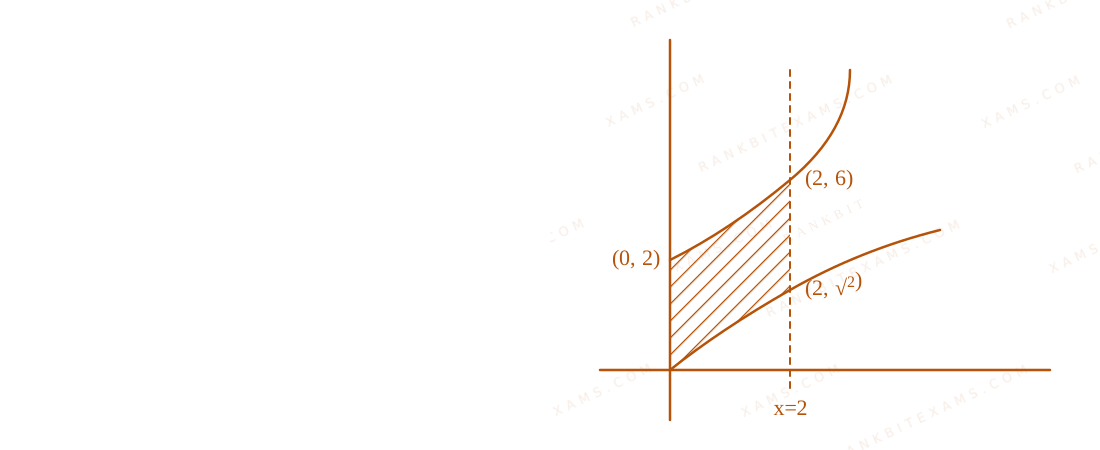
Area A1 boundaries visualization

Step 3: Calculate A2
A₂ = ∫₀² (x² + 2 - √(x)) dx A₂ = [ (x³)/(3) + 2x - x3/23/2 ]₀² A₂ = (8)/(3) + 4 - (2)/(3)(23/2) = (20)/(3) - 4√(2)3
Step 4: Difference of Areas
A₁ - A₂ = (22)/(3) - ( (20)/(3) - 4√(2)3 ) = (2)/(3) + 4√(2)3 = (2)/(3) (1 + 2√(2))
Pattern Recognition

Carefully identify the bounding regions. A₁ uses a line as the upper bound, A₂ strips away a root curve as its lower bound. Integrating separately before subtracting avoids algebraic alignment errors.

Chapter Mix

Class 12 Maths: Application of Integrals
Q12 jee_main_2026_24_january_evening Area bounded by Modulus and Parabola
Let f(α) denote the area of the region in the first quadrant bounded by x = 0, x = 1, y² = x and y = |α x - 5| - |1 - α x| + α x². Then (f(0) + f(1)) is equal to
  • A. 9
  • B. 14
  • C. 7
  • D. 12

Solution

Related Formula
Area = ∫x₁x₂ (yupper - ylower) dx
Core Logic

Evaluate f(0) by setting α = 0 in the function for y.

At α = 0 y = |0· x - 5| - |1 - 0· x| + 0· x²

y = |-5| - |1| = 5 - 1 = 4

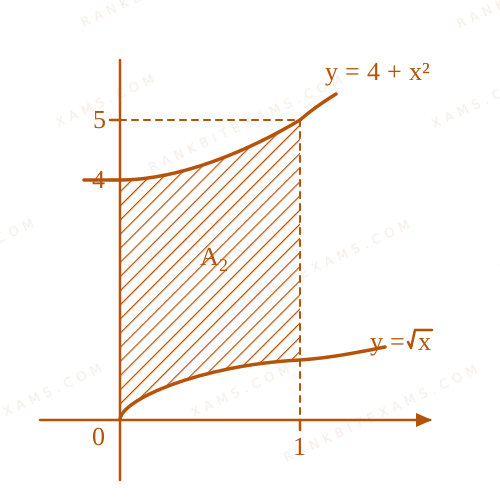
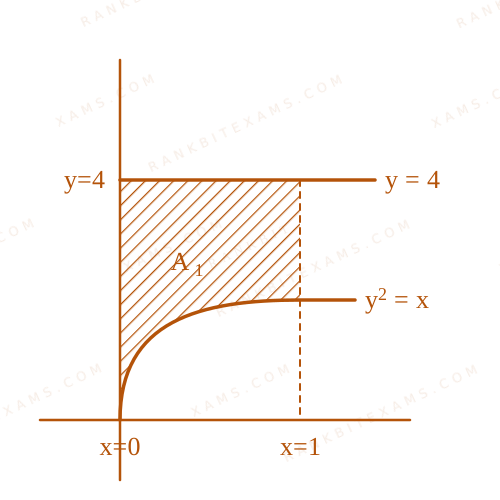
So for f(0), the bounded area A₁ is between y = 4, y = √(x), from x = 0 to x = 1.

Area bounded by Modulus and Parabola

Step 1: Calculating f(0)
A₁ = ∫₀¹ (4 - √(x)) dx = [ 4x - x3/23/2 ]₀¹ = 4(1) - (2)/(3)(1) = (10)/(3)

So, f(0) = (10)/(3).

Step 2: Determining curve for f(1)

Evaluate f(1) by setting α = 1 in the function for y.

At α = 1 y = |x - 5| - |1 - x| + x². Since the area is restricted to x in [0, 1]: x - 5 is negative, so |x - 5| = 5 - x. 1 - x is positive, so |1 - x| = 1 - x.

y = (5 - x) - (1 - x) + x² y = 5 - x - 1 + x + x² = 4 + x²

Area bounded by Modulus and Parabola

Step 3: Calculating f(1)

For f(1), the bounded area A₂ is between y = 4 + x² and y = √(x), from x = 0 to x = 1.

A₂ = ∫₀¹ ((4 + x²) - √(x)) dx = [ 4x + (x³)/(3) - x3/23/2 ]₀¹ = ( 4 + (1)/(3) - (2)/(3) ) = 4 - (1)/(3) = (11)/(3)

So, f(1) = (11)/(3).

Step 4: Final Sum
|f(0) + f(1)| = | A₁ + A₂ | = | (10)/(3) + (11)/(3) | = (21)/(3) = 7

Area bounded by Modulus and Parabola

Pattern Recognition

Modulus functions combined with parametric limits should be instantly resolved by plugging in the bounds of x (here [0,1]) to drop the absolute value signs before attempting any integral.

Chapter Mix

Class 12 Maths: Area Under the Curve Class 11 Maths: Modulus Function

Q13 jee_main_2026_28_january_morning Area under Curves
The area of the region R=(x,y):xy≤ 8, 1≤ y≤ x², x≥ 0 is
  • A. (1)/(3)(49 ₑ(2)-15)
  • B. (2)/(3)(20 ₑ(2)+9)
  • C. (2)/(3)(24 ₑ(2)-7)
  • D. (1)/(3)(40 ₑ(2)+27)

Solution

Core Logic

Area under Curves
Area under Curves
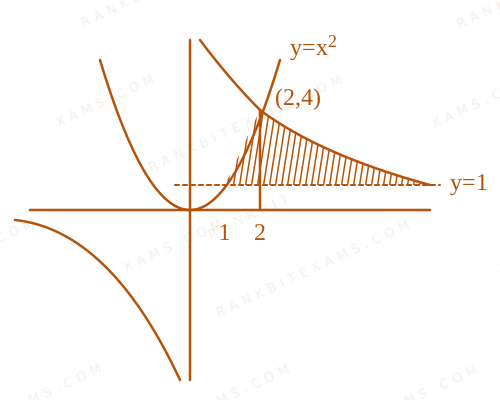
The region is bounded by three primary curves in the first quadrant (x≥0):

  • y ≥ 1 (horizontal line)
  • y ≤ x² (upward-opening parabola)
  • xy ≤ 8 y ≤ (8)/(x) (rectangular hyperbola)
  • Find points of intersection: Intersection of y = x² and y = (8)/(x):

x² = (8)/(x) x³ = 8 x = 2

At x = 2, y = 4. So they meet at (2, 4).

Intersection of y = x² and y = 1:

x² = 1 x = 1

Intersection of y = (8)/(x) and y = 1:

1 = (8)/(x) x = 8

The region spans from x = 1 to x = 8. The upper boundary changes at x = 2.

Step 1: Set up Integrals

For x in [1, 2], the upper curve is y = x² and the lower is y = 1. For x in [2, 8], the upper curve is y = (8)/(x) and the lower is y = 1.

A = ∫₁² (x² - 1) dx + ∫₂⁸ ((8)/(x) - 1) dx
Step 2: Integration

Calculate the first integral:

I₁ = [ (x³)/(3) - x ]₁² = ( (8)/(3) - 2 ) - ( (1)/(3) - 1 ) = (2)/(3) - (-(2)/(3)) = (4)/(3)

Calculate the second integral:

I₂ = [ 8 ln x - x ]₂⁸ = (8 ln 8 - 8) - (8 ln 2 - 2)

Since ln 8 = 3 ln 2:

I₂ = 24 ln 2 - 8 - 8 ln 2 + 2 = 16 ln 2 - 6

Total Area A:

A = (4)/(3) + 16 ln 2 - 6 = 16 ln 2 - (14)/(3) A = (48 ln 2 - 14)/(3) = (2)/(3)(24 ln 2 - 7)
Chapter Mix

Class 12 Mathematics: Application of Integrals

Q11 jee_main_2026_28_january_evening Area Bounded by Parabolas and Lines
Let P₁: y = 4x² and P₂: y = x² + 27 be two parabolas. If the area of the bounded region enclosed between P₁ and P₂ is six times the area of the bounded region enclosed between the line y = α x, α > 0 and P₁, then α is equal to:
  • A. 8
  • B. 15
  • C. 12
  • D. 6

Solution

Related Formula

Area enclosed by y = f(x) and y = g(x) from x=a to x=b:

A = ∫ₐ^b |f(x) - g(x)| dx

Area between x² = 4ay and line x = my is (8a²)/(3m³).

Core Logic

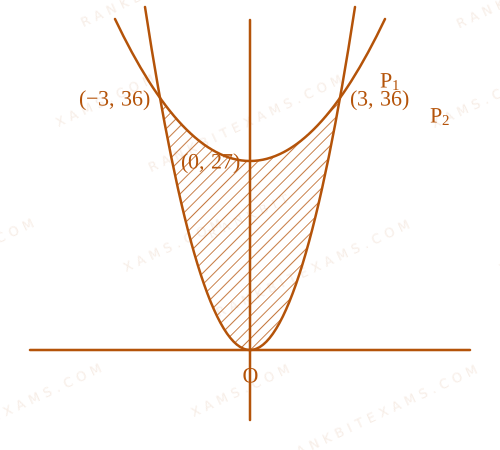
Find Points of Intersection for P₁ and P₂:

4x² = x² + 27 ⇒ 3x² = 27 ⇒ x = ± 3

Parabolas intersection bounds

Area bounded between P₁ and P₂:

A₁ = ∫₋₃³ ((x² + 27) - 4x²) dx = 2 ∫₀³ (27 - 3x²) dx A₁ = 2 [27x - x³]₀³ = 2(81 - 27) = 108 sq. units
Execution

Area between P₁ and y = α x is given as 108 / 6 = 18 sq. units. For x² = 4ay and x = my, area is (8a²)/(3m³). Here, the parabola is x² = (y)/(4) and line is x = (y)/(α). Thus, 4a = (1)/(4) ⇒ a = (1)/(16), and m = (1)/(α).

Parabolas intersection bounds

Applying the formula:

(8(1/16)²)/(3(1/α)³) = 18 (8 / 256)/(3 / α³) = 18 ⇒ (α³)/(96) = 18 α³ = 18 × 96 = 1728

α = 12

Pattern Recognition

Using the standard result (8a²)/(3m³) for the area bounded between x²=4ay and x=my avoids tedious integration for straight lines intersecting parabolas at the origin.

Chapter Mix

Class 12 Maths: Application of Integrals

Q73 jee_main_2025_02_april_morning Area Between Curves
If the area of the region (x, y): | 4 - x ^ 2 | ≤ y ≤ x ^ 2, y ≤ 4, x ≥ 0 is ( 80√(2)α - β), α, β in N, then α + β is equal to ________.
Numerical Answer. Answer: 22 to 22

Solution

Related Formula

Area bounded by functions integrated with respect to y axis:

Area = ∫cd (xright - xleft) dy
Core Logic

Identify the bounding graphs and intersection coordinates in the first quadrant, then construct standard definite integrals along the vertical axis.

Area Between Curves diagram for Q73 - JEE Main 2025 Morning

Step 1: Unpack Bounding Curves

The condition |4-x²| ≤ y splits into two sections at x=2:

  • For 0 ≤ x ≤ 2 4 - x² ≤ y x² ≥ 4 - y x = √(4-y)
  • For x ≥ 2 x² - 4 ≤ y x² ≤ 4 + y x = √(4+y)
  • Also bounded by y ≤ x² x ≥ √(y), and the outer cap constraint y ≤ 4.

Step 2: Construct the Integral Area Formula

Integrating with respect to y covers the region bounded on the left by √(y) and √(4-y), and on the right by √(4+y):

A = ∫₀⁴ √(4+y) dy - ∫₀² √(4-y) dy - ∫₂⁴ √(y) dy
Step 3: Evaluate the Definite Integrals
A = [ (4+y)3/23/2 ]₀⁴ + [ (4-y)3/23/2 ]₀² - [ y3/23/2 ]₂⁴

Evaluating these values precisely:

A = (2)/(3)(83/2 - 43/2) + (2)/(3)(23/2 - 43/2) - (2)/(3)(43/2 - 23/2) A = 80√(2)3 - 16
Step 4: Solve for Constants

Compare the final value expression to ( 80√(2)α - β):

α = 3, β = 16 α + β = 3 + 16 = 22
Pattern Recognition

Integrating along the vertical axis (y-direction) is significantly faster here because it avoids splitting the domain across multiple vertical segments on the horizontal x-axis.

Chapter Mix

Class 12 Mathematics: Application of Integrals

Rankbit System
JEE Physics: Waves (+15.5%) | Electrostatics: Concentric Shells (-29.7%) | Modern Physics: Photoelectric Clones (+34.2%) | Mathematics: Definite Integrals (+18.1%) | Chemistry: Coordination Splitting (-11.4%) | JEE Physics: Waves (+15.5%) | Electrostatics: Concentric Shells (-29.7%) | Modern Physics: Photoelectric Clones (+34.2%) | Mathematics: Definite Integrals (+18.1%) | Chemistry: Coordination Splitting (-11.4%)