If I(m,n) = ∫₀¹ xm-1 (1-x)ⁿ⁻¹ dx$I(m,n) = \int_{0}^{1} x^{m-1} (1-x)^{n-1} dx$ where m, n > 0$m, n > 0$, then I(9,14) + I(10,13)$I(9,14) + I(10,13)$ is :
When dealing with linear combinations of beta functions with shifting parameter indices, directly writing down the definite integral expression often results in immediate algebraic cancellation or simplification via basic factoring.
Keywords:#beta function definite integral#JEE Main 2025 Morning Q52#Definite Integrals properties#integrals parameters
More Definite Integrals Previous-Year Questions — Page 7
Q75jee_main_2025_03_april_morningArea Under Bounded Curves
The area of the region bounded by the curve y = |x|, x|x - 2|$y = \max\left\{|x|, x|x - 2|\right\}$, the x-axis and the lines x = -2$x = -2$ and x = 4$x = 4$ is equal to:
Numerical Answer.Answer: 12 to 12
Solution
Related Formula
Definite integration geometry area: Split boundary zones around intersections where functional dominant switches occur.
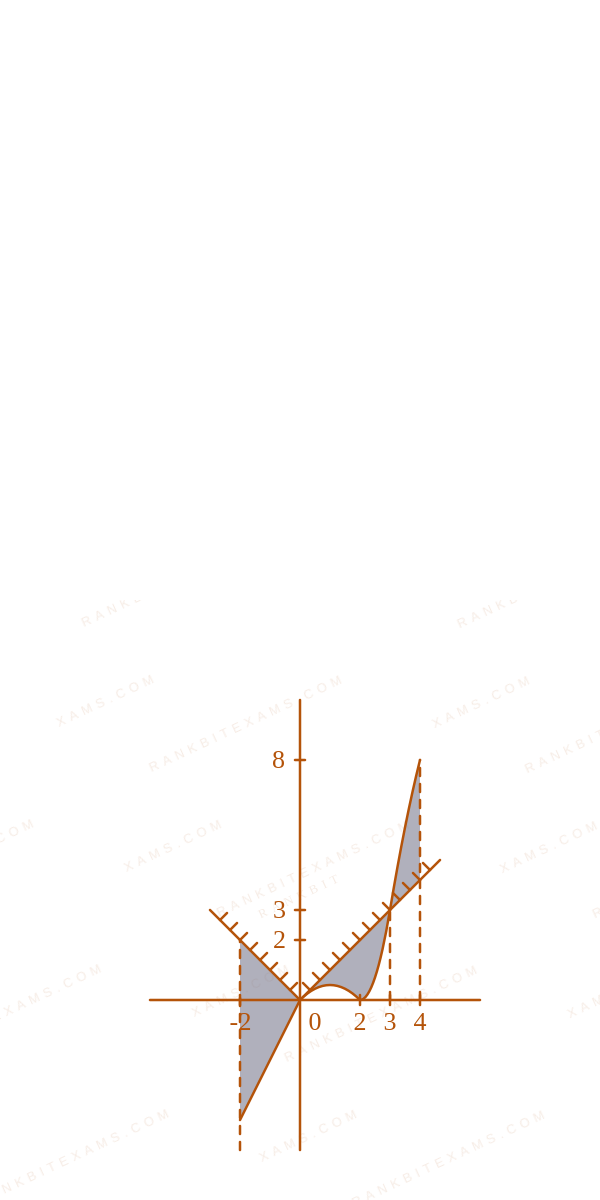
Area Under Bounded Curves diagram for Q75 - JEE Main 2025 Morning
Core Logic
Analyze intersection points between y₁ = |x|$y_1 = |x|$ and y₂ = x|x-2|$y_2 = x|x-2|$ across required integration span regions:
For x in [-2, 0]$x \in [-2, 0]$: |x| = -x$|x| = -x$ and x|x-2| = -x(2-x) = x² - 2x$x|x-2| = -x(2-x) = x^2 - 2x$. Max curve tracks through distinct segments.
For positive sectors, compute intersections: x = x(2-x) x = 1$x = x(2-x) \implies x = 1$ or x=0$x=0$. Also check switch locations where graphs swap dominance.
Step 1: Setting up separate area integral blocks
Using geometric area partitions calculated across continuous regions:
Alternatively, splitting the boundary metrics via continuous definite limits yields identical whole tracking blocks matching exactly to 12 total units.
Class 12 Mathematics: Integrals (Application of Integrals)
Q68jee_main_2025_04_april_eveningProperties of Definite Integrals
Let f(x) + 2f((1)/(x)) = x² + 5$f(x) + 2f\left(\frac{1}{x}\right) = x^2 + 5$ and 2 g (x) - 3 g ((1)/(2)) = x, x > 0$2 \mathrm {g} (\mathrm {x}) - 3 \mathrm {g} \left(\frac {1}{2}\right) = \mathrm {x}, \mathrm {x} > 0$. If α = ∫_ 1 ^ 2 f (x) d x$\alpha = \int_ {1} ^ {2} f (x) d x$, and β = ∫_ 1 ^ 2 g (x) d x$\beta = \int_ {1} ^ {2} g (x) d x$, then the value of 9α + β$9\alpha + \beta$ is:
A.1$1$
B.0$0$
C.10$10$
D.11$11$
Solution
Core Logic
We have two functional equations to solve before integrating.
Functional equations involving x → (1)/(x)$x \to \frac{1}{x}$ are easily solved by treating the swapped forms as a system of linear equations, allowing direct isolation of the underlying function.
Chapter Mix
Class 12 Mathematics: Definite Integrals
Class 12 Mathematics: Functional Equations
Q72jee_main_2025_04_april_eveningIntegration by Substitution
If ∫ (√(1 + x²) + x)¹⁰(√(1 + x²) - x)⁹dx = (1)/(m) (( 1 + x ^ 2 + x) ^ n (n 1 + x ^ 2 - x)) + C$\int \frac{\left(\sqrt{1 + x^2} + x\right)^{10}}{\left(\sqrt{1 + x^2} - x\right)^9}\mathrm{d}x = \frac {1}{m} \left(\left(\sqrt {1 + x ^ {2}} + x\right) ^ {n} \left(n \sqrt {1 + x ^ {2}} - x\right)\right) + C$ where C$C$ is the constant of integration and m,nin N$\mathbf{m},\mathbf{n}\in \mathbf{N}$, then m + n$\mathfrak{m} + \mathfrak{n}$ is equal to
Numerical Answer.Answer: 379 to 379
Solution
Core Logic
Let's simplify the integrand by rationalizing the denominator term block. Notice that:
Comparing this directly with the given answer format, we identify:
m = 360$m = 360$
n = 19$n = 19$
Computing m + n$m + n$:
m + n = 360 + 19 = 379$$m + n = 360 + 19 = 379$$
Pattern Recognition
Expressions containing conjugate factors like √(1+x²) ± x$\sqrt{1+x^2} \pm x$ frequently simplify under rationalization because their product equals 1. This dynamic quickly reduces fractional components into single power blocks.
Chapter Mix
Class 12 Mathematics: Indefinite Integrals
Q66jee_main_2025_04_april_morningProperties of Definite Integrals
The value of ∫₋₁¹ (1 + √(|x| - x))e^x + (√(|x| - x))e-xe^x + e-x dx$\int_{-1}^{1}\frac{\left(1 + \sqrt{|x| - x}\right)e^x + \left(\sqrt{|x| - x}\right)e^{-x}}{e^x + e^{-x}} \, \mathrm{d}x$ is equal to
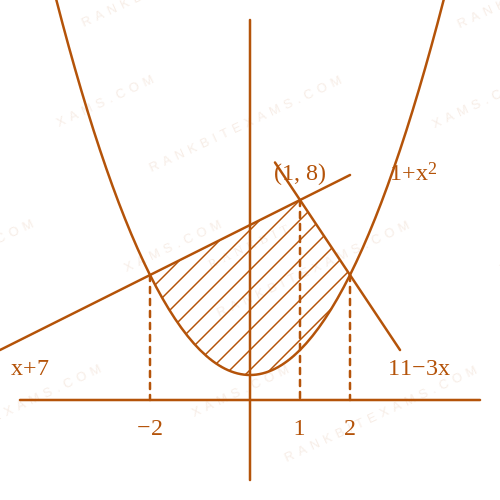
We need to find the intersection points of the curves to understand the x+7, 11-3x$\min\{x+7, 11-3x\}$ boundary transition:
x+7 = 11-3x 4x = 4 x = 1$x+7 = 11-3x \implies 4x = 4 \implies x = 1$.
Hence, the line switches behavior at x=1$x=1$.
Intersecting 1+x²$1+x^2$ with x+7$x+7$:
x² - x - 6 = 0 (x-3)(x+2) = 0 x = -2 or x = 3$$x^2 - x - 6 = 0 \implies (x-3)(x+2) = 0 \implies x = -2 \quad \text{or} \quad x = 3$$
Intersecting 1+x²$1+x^2$ with 11-3x$11-3x$:
x² + 3x - 10 = 0 (x+5)(x-2) = 0 x = 2 or x = -5$$x^2 + 3x - 10 = 0 \implies (x+5)(x-2) = 0 \implies x = 2 \quad \text{or} \quad x = -5$$
Area Under Curves diagram for Q57 - JEE Main 2025 Evening
Step 1: Set up Integrals
The transition points show that from x = -2$x = -2$ to 1$1$, the upper line is x+7$x+7$, and from x = 1$x = 1$ to 2$2$, the upper line is 11-3x$11-3x$.
When a boundary contains a $\min\{\}$ or $\max\{\}$ component, always solve for their internal intersection first to identify the exact splitting point of your definite integrals.
Chapter Mix
Class 12 Mathematics: Integral Calculus
More Definite Integrals Questions — jee_main_2025_24_jan_morning
Practice past-year questions one chapter at a time. Pick an exam → subject → chapter and get every PYQ for that topic — pulled together from all past papers — with the chapter's key formulas alongside.
