If I(m,n) = ∫₀¹ xm-1 (1-x)ⁿ⁻¹ dx where m, n > 0, then I(9,14) + I(10,13) is :

Solution & Explanation

Related Formula

The beta function integral format satisfies:

I(m,n) = ∫₀¹ xm-1 (1-x)ⁿ⁻¹ dx
Core Logic

Let's combine the terms of the requested sum directly by inserting their respective definitions:

I(9,14) = ∫₀¹ x⁹⁻¹ (1-x)¹⁴⁻¹ dx = ∫₀¹ x⁸ (1-x)¹³ dx I(10,13) = ∫₀¹ x¹⁰⁻¹ (1-x)¹³⁻¹ dx = ∫₀¹ x⁹ (1-x)¹² dx
Step 1: Factoring out common algebraic terms

Summing the two components:

I(9,14) + I(10,13) = ∫₀¹ [ x⁸ (1-x)¹³ + x⁹ (1-x)¹² ] dx

Factor out the common term x⁸ (1-x)¹² inside the integrand:

= ∫₀¹ x⁸ (1-x)¹² [ (1-x) + x ] dx = ∫₀¹ x⁸ (1-x)¹² (1) dx = ∫₀¹ x⁹⁻¹ (1-x)¹³⁻¹ dx = I(9,13)
Pattern Recognition

When dealing with linear combinations of beta functions with shifting parameter indices, directly writing down the definite integral expression often results in immediate algebraic cancellation or simplification via basic factoring.

Chapter Mix

Class 12 Mathematics: Definite Integrals

Reference Study Guides

More Definite Integrals Previous-Year Questions — Page 2

Q12 jee_main_2026_22_january_evening Area Under Curves
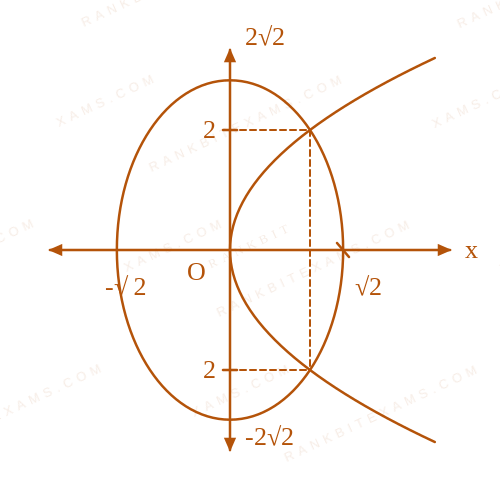
The area of the region A = (x,y) : 4x² + y² ≤ 8 and y² ≤ 4x is:
  • A. (π)/(2) + 2
  • B. π + (2)/(3)
  • C. π + 4
  • D. (π)/(2) + (1)/(3)

Solution

Related Formula

Area enclosed between curves is computed by breaking into integration regions at intersection points.

Core Logic

Area bounded by ellipse and parabola for Q12 - JEE Main 2026 Evening

Find intersection of 4x² + y² = 8 and y² = 4x:

4x² + 4x - 8 = 0 x² + x - 2 = 0 x = 1 (x > 0)

For x in [0, 1], region bounded by parabola y = ± 2√(x). For x in [1, √(2)], region bounded by ellipse y = ± √(8 - 4x²).

Step 1: Definite Integration
Area = 2 ∫₀¹ 2√(x) dx + 2 ∫₁√(2) √(8 - 4x²) dx = 4 [ (2)/(3) x3/2 ]₀¹ + 4 ∫₁√(2) √(2 - x²) dx = (8)/(3) + 4 · (1)/(2) [ x√(2-x²) + 2 ⁻¹( x√(2)) ]₁√(2) = (8)/(3) + 2 [ (0 + 2 · (π)/(2)) - (1 + 2 · (π)/(4)) ] = (8)/(3) + 2π - 2 - π = π + (2)/(3)

Area = π + (2)/(3) sq. units.

Pattern Recognition

Split area integration at intersection x=1 between parabola boundary and ellipse boundary.

Chapter Mix

Class 12 Maths: Integral Calculus

Q22 jee_main_2026_22_january_evening Definite Integral and King's Property
Let [·] be the greatest integer function. If α = ∫₀⁶⁴ (x1/3 - [x1/3]) dx, then (1)/(π) ∫₀απ ( ( ²θ)/( ⁶θ + ⁶θ) ) dθ is equal to ____.
Numerical Answer. Answer: 36 to 36

Solution

Related Formula

King's property of definite integrals: ∫ₐ^b f(x)dx = ∫ₐ^b f(a+b-x)dx.

Core Logic
  • Evaluate α:
∫₀⁶⁴ x1/3 dx = [ (3)/(4) x4/3 ]₀⁶⁴ = (3)/(4) (256) = 192 ∫₀⁶⁴ [x1/3] dx = ∫₀¹ 0 dx + ∫₁⁸ 1 dx + ∫₈²⁷ 2 dx + ∫₂₇⁶⁴ 3 dx = 0 + 7(1) + 19(2) + 37(3) = 7 + 38 + 111 = 156

Thus, α = 192 - 156 = 36.

Step 1: Evaluate Trigonometric Integral

Let E = (1)/(π) ∫₀36π ( ²θ)/( ⁶θ + ⁶θ) dθ = (36)/(π) ∫₀π ( ²θ)/( ⁶θ + ⁶θ) dθ

= (72)/(π) ∫₀π/2 ( ²θ)/( ⁶θ + ⁶θ) dθ

Let

Let $J = \int_{0}^{\pi/2} \frac{\sin^2\theta}{\sin^6\theta + \cos^6\theta} d\theta. By King's property,J = \int_{0}^{\pi/2} \frac{\cos^2\theta}{\sin^6\theta + \cos^6\theta} d\theta.

2J = ∫₀π/2 (1)/( ⁶θ + ⁶θ) dθ = ∫₀∞ (1 + λ²)/(λ⁴ - λ² + 1) dλ = (π)/(2) J = (π)/(4)

Wait, checking addition:

Wait, checking addition: $2J = \frac{\pi}{2} \implies J = \frac{\pi}{2}when evaluating\int_0^{\infty} \frac{1 + 1/\lambda^2}{\lambda^2 - 1 + 1/\lambda^2} d\lambda = \pi. SoJ = \frac{\pi}{2}.

Step 2: Final Calculation
E = (72)/(π) × (π)/(2) = 36$
Pattern Recognition

Break fractional part integral into piecewise constant steps; convert periodic trigonometric integral using symmetry.

Chapter Mix

Class 12 Maths: Integral Calculus

Q2 jee_main_2026_23_january_morning Indefinite Integration
Let f(x) = ∫ (2 - x²)e^x(√(1 + x))(1 - x)(3)/(2) dx. If f(0) = 0, then f((1)/(2)) is equal to:
  • A. √(3e) - 1
  • B. √(2e) + 1
  • C. √(2e) - 1
  • D. √(3e) + 1

Solution

Related Formula
∫ e^x [g(x) + g'(x)] dx = e^x g(x) + C
Core Logic

Rewrite the numerator (2 - x²) as (1 - x²) + 1 to split the integral into two recognizable parts matching the e^x [g(x) + g'(x)] form.

I = ∫ e^x ( (1 - x²) + 1√(1 + x) · (1 - x)3/2 ) dx = ∫ e^x ( 1 - x²√(1 + x) · (1 - x)3/2 + 1√(1 + x) · (1 - x)3/2 ) dx
Step 1: Simplify Terms

Simplify the first term:

1 - x²√(1 + x) · (1 - x)3/2 = (1 - x)(1 + x)√(1 + x) · (1 - x)√(1 - x) = √(1 + x)√(1 - x) = √((1 + x)/(1 - x))

Now verify if the derivative of g(x) = √((1 + x)/(1 - x)) matches the second term.

g'(x) = 12√((1+x)/(1-x)) · ((1-x)(1) - (1+x)(-1))/((1-x)²) = √(1-x)2√(1+x) · (2)/((1-x)²) = 1√(1+x) · (1-x)3/2

This perfectly matches the second term. Thus, the integral evaluates to:

f(x) = e^x √((1 + x)/(1 - x)) + C
Step 2: Apply Boundary Conditions

Given f(0) = 0:

e⁰ √((1 + 0)/(1 - 0)) + C = 0 ⇒ 1 + C = 0 ⇒ C = -1

So, f(x) = e^x √((1 + x)/(1 - x)) - 1.

Step 3: Evaluate at x = 1/2
f((1)/(2)) = e1/2 √((1 + 1/2)/(1 - 1/2)) - 1 = e1/2 √((3/2)/(1/2)) - 1

= √(3e) - 1

Pattern Recognition

Any integral involving e^x multiplied by an algebraic fraction heavily signals the use of ∫ e^x [g(x) + g'(x)] dx. Breaking the numerator into (1-x²) + 1 is the classic key to unlock this.

Chapter Mix

Class 12 Maths: Integrals

Q10 jee_main_2026_23_january_morning Definite Integration Properties
The value of the integral ∫ (π)/(24)(5π)/(24) dx1+3√( 2x) is:
  • A. (π)/(12)
  • B. (π)/(18)
  • C. (π)/(6)
  • D. (π)/(3)

Solution

Related Formula
∫ₐ^b f(x) dx = ∫ₐ^b f(a + b - x) dx (King's Property)
Core Logic

Let I = ∫(π)/(24)(5π)/(24) dx1+3√( 2x) (1) Apply King's property. Here a + b = (π)/(24) + (5π)/(24) = (6π)/(24) = (π)/(4). Replace x with (π)/(4) - x:

I = ∫(π)/(24)(5π)/(24) dx1+3√( 2((π)/(4) - x))
Step 1: Apply Trigonometric Identity

Notice that 2((π)/(4) - x) = ((π)/(2) - 2x) = 2x. So, I = ∫(π)/(24)(5π)/(24) dx1+3√( 2x). Convert 2x to (1)/( 2x):

I = ∫(π)/(24)(5π)/(24) 3√( 2x)3√( 2x)+1 dx (2)
Step 2: Add the Integrals

Add equations (1) and (2):

2I = ∫(π)/(24)(5π)/(24) 1 + 3√( 2x)1 + 3√( 2x) dx = ∫(π)/(24)(5π)/(24) (1) dx 2I = [ x ](π)/(24)(5π)/(24) = (5π)/(24) - (π)/(24) = (4π)/(24) = (π)/(6) I = (1)/(2) ( (π)/(6) ) = (π)/(12)
Pattern Recognition

Limits of π/24 and 5π/24 add up to π/4. When dealing with (2x), multiplying by 2 transforms this upper/lower sum to π/2, establishing the classic / symmetry map triggered by King's Property.

Chapter Mix

Class 12 Maths: Integrals

Q14 jee_main_2026_23_january_evening Integration by Substitution
Let I(x) = ∫ 3dx(4x + 6)( 4x² + 8x + 3) and I(0) = √(3)4 + 20. If I((1)/(2)) = a√(2)b + c, where a, b, c in N, (a,b) = 1, then a + b + c is equal to :
  • A. 29
  • B. 28
  • C. 31
  • D. 30

Solution

Related Formula
∫ xⁿ dx = xⁿ⁺¹n+1 + c

For integrals containing linear terms multiplied by the root of a quadratic, use the standard substitution L = (1)/(t).

Core Logic

Let 4x + 6 = (1)/(t) x = (1/t - 6)/(4). Differentiating, 4 dx = -(1)/(t²) dt dx = -(dt)/(4t²). We also need to map the quadratic part 4x² + 8x + 3 = 4(x² + 2x + 1) - 1 = 4(x+1)² - 1.

Substitute x+1 = (1/t - 6)/(4) + 1 = (1/t - 2)/(4):

4(x+1)² - 1 = 4((1/t - 2)/(4))² - 1 = ((1-2t)²)/(4t²) - 1

The integral becomes:

I(x) = ∫ 3 (-(dt)/(4t²))((1)/(t))√(((1-2t)²)/(4t²) - 1)
Step 1: Simplify Integral
I(x) = -(3)/(4) ∫ dtt √((1 - 4t + 4t² - 4t²)/(4t²)) I(x) = -(3)/(4) ∫ dtt √(1-4t)2t I(x) = -(3)/(2) ∫ dt√(1-4t) I(x) = -(3)/(2) (1-4t)1/2(1/2)(-4) + C = (3)/(4) √(1-4t) + C

Substituting back t = (1)/(4x+6):

I(x) = (3)/(4) √(1 - (4)/(4x+6)) + C = (3)/(4) √((4x+2)/(4x+6)) + C
Step 2: Final Calculation

Given I(0) = √(3)4 + 20:

I(0) = (3)/(4)√((2)/(6)) + C = (3)/(4) 1√(3) + C = √(3)4 + C

Thus, C = 20.

Now, evaluate I(1/2):

I((1)/(2)) = (3)/(4)√((4(1/2)+2)/(4(1/2)+6)) + 20 = (3)/(4)√((4)/(8)) + 20 = (3)/(4) 1√(2) + 20 = 3√(2)8 + 20

Comparing with a√(2)b + c, we get a=3, b=8, c=20. (3,8) = 1, condition is met.

a + b + c = 3 + 8 + 20 = 31
Pattern Recognition

The integral format ∫ dx(ax+b)√(px²+qx+r) classically demands substituting the linear outer piece as ax+b = 1/t.

Chapter Mix

Class 12 Maths: Indefinite Integration
More Definite Integrals Questions — jee_main_2025_24_jan_morning

Practice all Definite Integrals previous-year questions →

Rankbit System
JEE Physics: Waves (+15.5%) | Electrostatics: Concentric Shells (-29.7%) | Modern Physics: Photoelectric Clones (+34.2%) | Mathematics: Definite Integrals (+18.1%) | Chemistry: Coordination Splitting (-11.4%) | JEE Physics: Waves (+15.5%) | Electrostatics: Concentric Shells (-29.7%) | Modern Physics: Photoelectric Clones (+34.2%) | Mathematics: Definite Integrals (+18.1%) | Chemistry: Coordination Splitting (-11.4%)
