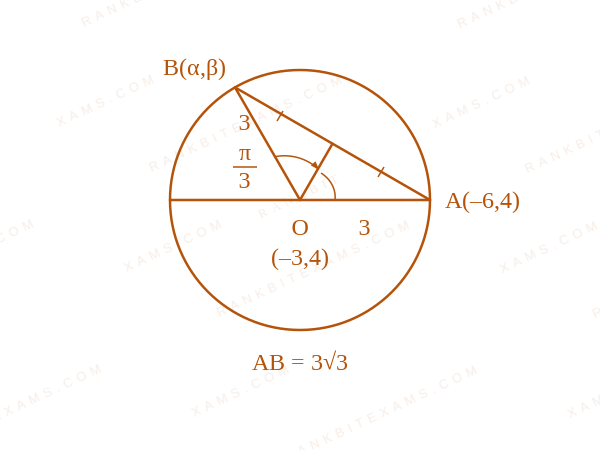
Let circle C$C$ be the image of x² + y² - 2x + 4y - 4 = 0$x^{2} + y^{2} - 2x + 4y - 4 = 0$ in the line 2x - 3y + 5 = 0$2x - 3y + 5 = 0$ and A$A$ be the point on C$C$ such that OA$OA$ is \parallel to the x-axis and A$A$ lies on the \right hand side of the centre O$O$ of C$C$. If B(α,β)$B(\alpha,\beta)$, with β < 4$\beta < 4$, lies on C$C$ such that the length of the arc AB$AB$ is (1/6)th$(1/6)^{\text{th}}$ of the perimeter of C$C$, then β - √(3)α$\beta - \sqrt{3}\alpha$ is equal to :
A.3$3$
B.3 + √(3)$3 + \sqrt{3}$
C.4 - √(3)$4 - \sqrt{3}$
D.4$4$
Solution & Explanation
Related Formula
The coordinates for the reflection image of a point (x₁, y₁)$(x_1, y_1)$ across a standard line ax + by + c = 0$ax + by + c = 0$ are determined using:
Thus, the center O$O$ of the reflected circle C$C$ is (-3, 4)$(-3, 4)$, and its radius is preserved at r = 3$r = 3$.
Step 1: Locate Point A
We are given that OA$OA$ is ∥$\parallel$ to the x-axis, meaning its y-coordinate matches the center. Since A$A$ lies to the right of the center O(-3, 4)$O(-3, 4)$:
Since β < 4$\beta < 4$, the angle θ$\theta$ must point downwards into the negative quadrant relative to A$A$, meaning θ = -60^° = -(π)/(3)$\theta = -60^\circ = -\frac{\pi}{3}$:
Whenever parametric configurations on a circle involve radical coordinate multipliers like β - √(3)α$\beta - \sqrt{3}\alpha$, using angular vectors centered at the origin of the circle avoids setting up and solving long distance equations.
Chapter Mix
Class 11 Mathematics: Circles
More Circles Previous-Year Questions — Page 10
Q64jee_main_2025_29_jan_eveningEquation of a Circle
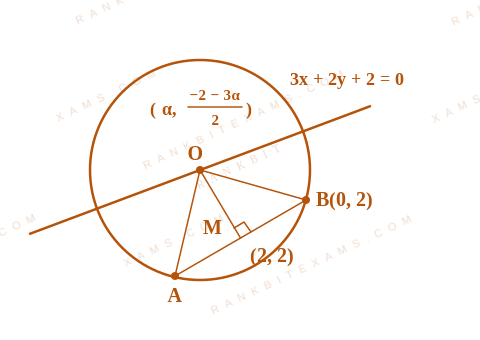
Let a circle C$C$ pass through the points (4,2)$(4,2)$ and (0,2)$(0,2)$, and its centre lie on 3x + 2y + 2 = 0$3x + 2y + 2 = 0$. Then the length of the chord, of the circle C$C$, whose mid-point is (1,2)$(1,2)$, is:
A.√(3)$\sqrt{3}$
B.2√(3)$2\sqrt{3}$
C.4√(2)$4\sqrt{2}$
D.2√(2)$2\sqrt{2}$
Solution
Related Formula
Length of a chord with perpendicular distance d$d$ from the center of a circle of radius r$r$ is:
Points A(4,2)$A(4,2)$ and B(0,2)$B(0,2)$ have the same y-coordinate, meaning chord AB$AB$ is horizontal. The perpendicular bisector of a horizontal chord is vertical.
Equation of a Circle diagram for Q64 - JEE Main 2025 Evening
Midpoint of AB$AB$ is M(2,2)$M(2,2)$. Thus, the vertical line passing through the center is x = 2$x = 2$.
Step 1: Identify Center and Radius
Since the center lies on the line 3x + 2y + 2 = 0$3x + 2y + 2 = 0$, substitute x = 2$x = 2$ to find the y-coordinate:
Points sharing a coordinate define standard vertical or horizontal perpendicular configurations immediately. Always exploit geometrical configurations before jumping into standard circle equations.
Chapter Mix
Class 11 Mathematics: Circles
Q75jee_main_2025_29_jan_eveningProperties of Focal Chords
Let y² = 12x$y^2 = 12x$ the parabola and S$S$ be its focus. Let PQ$PQ$ be a focal chord of the parabola such that (SP) (SQ) = (147)/(4)$(SQ) = \frac{147}{4}$. Let C$C$ be the circle described taking PQ$PQ$ as a diameter. If the equation of a circle C$C$ is 64x² + 64y² - α x - 64√(3)y = β$64x^2 + 64y^2 - \alpha x - 64\sqrt{3}y = \beta$, then \beta - \alpha is equal to
Numerical Answer.Answer: 1328 to 1328
Solution
Related Formula
Properties of focal chord parameter metrics in parabolas y² = 4ax$y^2 = 4ax$:
The distance from focal chord endpoints to the focus equals their perpendicular distance to the directrix. This property connects parameter metrics to geometric lengths cleanly.
Chapter Mix
Class 11 Mathematics: Conic Sections
Class 11 Mathematics: Circles
Qjee_main_2025_28_jan_morningParabola and Trapezium Properties
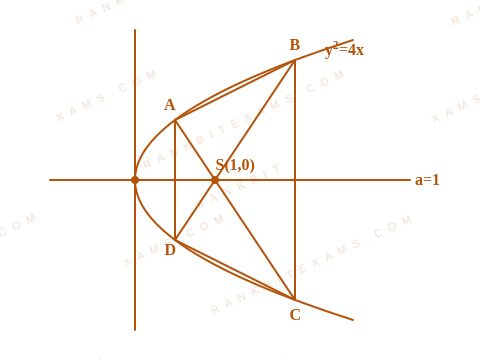
Let ABCD be a trapezium whose vertices lie on the parabola y² = 4x$y^2 = 4x$. Let the sides AD and BC of the trapezium be parallel to y-axis. If the diagonal AC is of length (25)/(4)$\frac{25}{4}$ and it passes through the point (1,0)$(1,0)$, then the area of ABCD is:
A.(75)/(4)$\frac{75}{4}$
B.(25)/(2)$\frac{25}{2}$
C.(125)/(8)$\frac{125}{8}$
D.(75)/(8)$\frac{75}{8}$
Solution
Related Formula
Area of a trapezium is given by:
Area = (1)/(2) × (sum of parallel sides) × (distance between them)$$\text{Area} = \frac{1}{2} \times (\text{sum of parallel sides}) \times (\text{distance between them})$$
Core Logic
Let the coordinates of the vertices be parameterized on the parabola y² = 4x$y^2 = 4x$. Since AD$AD$ and BC$BC$ are parallel to the y-axis, the coordinates take the form:
A(at₁², 2at₁)$A(at_1^2, 2at_1)$ and D(at₁², -2at₁)$D(at_1^2, -2at_1)$B(at₂², 2at₂)$B(at_2^2, 2at_2)$ and C(at₂², -2at₂)$C(at_2^2, -2at_2)$
Given a=1$a=1$, the points simplify accordingly. Parabola and Trapezium Properties diagram for Q52 - JEE Main 2025 Morning
Step 1: Using Diagonal Properties
The length of diagonal AC$AC$ passing through focal point (1,0)$(1,0)$ implies focal chord properties:
Focal chords of parabolas always satisfy t₁ t₂ = -1$t_1 t_2 = -1$. Recognizing the passage through (1,0)$(1,0)$ unlocks quick parametric simplifications.
Chapter Mix
Class 11 Maths: Conic Sections
Qjee_main_2025_28_jan_morningCircles Touching Axes and Intercepts
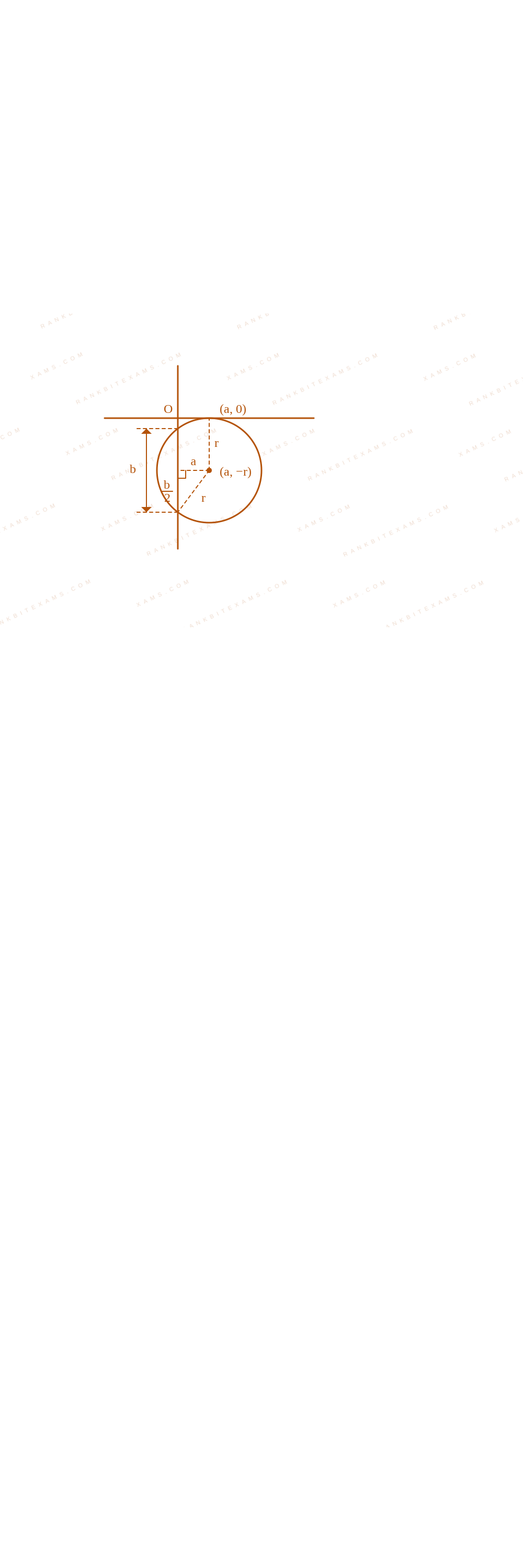
Let the equation of the circle, which touches x-axis at the point (a, 0), a > 0$a > 0$ and cuts off an intercept of length b on y-axis be x² + y² - α x + β y + γ = 0$x^2 + y^2 - \alpha x + \beta y + \gamma = 0$. If the circle lies below x-axis, then the ordered pair (2a, b²)$(2a, b^2)$ is equal to:
Since the circle touches the x-axis at (a,0)$(a,0)$ and lies entirely below it, its center is located at (a, -p)$(a, -p)$ where p$p$ matches its radius r$r$.
By Pythagoras' theorem: Circles Touching Axes and Intercepts diagram for Q58 - JEE Main 2025 Morning
Thus, the mapped ordered pair (2a, b²)$(2a, b^2)$ evaluates directly to (α, β² - 4γ)$(\alpha, \beta^2 - 4\gamma)$.
Pattern Recognition
Tangency conditions fix center parameters to match radius scale sizes instantly, reducing variable overhead in coordinate transformations.
Chapter Mix
Class 11 Maths: Circles
Q75jee_main_2025_28_jan_morningInfinite Series of Ellipses
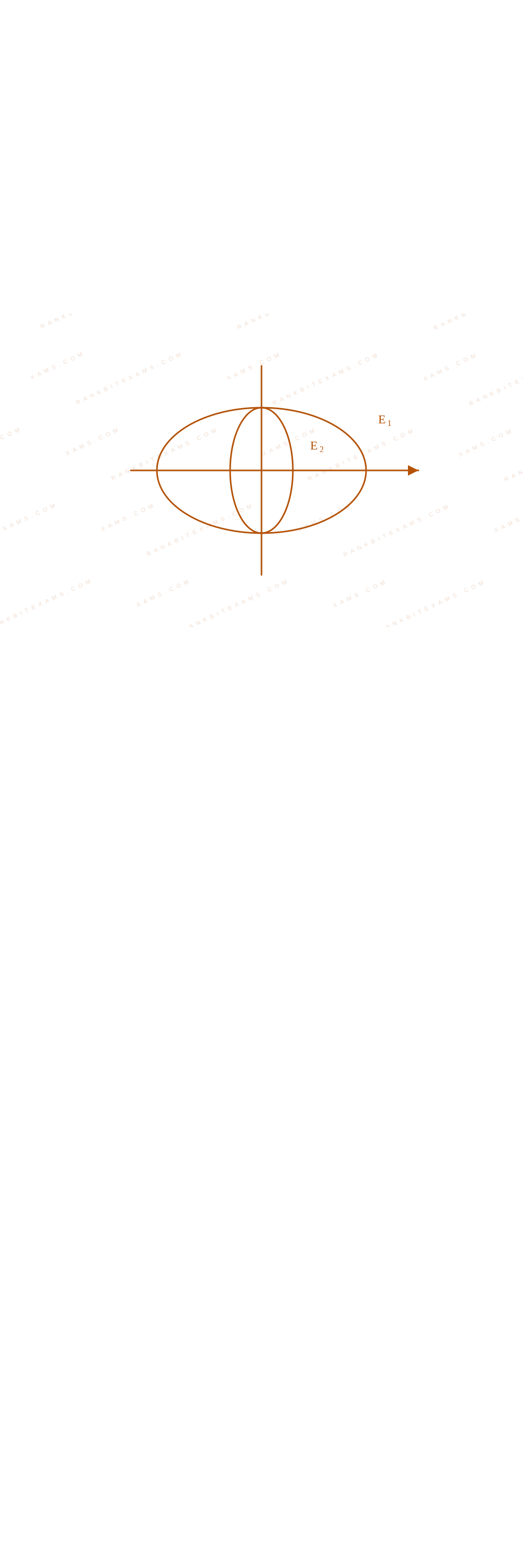
Let E₁: (x²)/(9) + (y²)/(4) = 1$E_1: \frac{x^2}{9} + \frac{y^2}{4} = 1$ be an ellipse. Ellipses Eᵢ$E_i$ 's are constructed such that their centres and eccentricities are same as that of E₁$E_1$ , and the length of minor axis of Eᵢ$E_i$ is the length of major axis of Eᵢ₊₁$E_{i+1}$ ( i ≥ 1$i \ge 1$ ). If Aᵢ$A_i$ is the area of the ellipse Eᵢ$E_i$ , then (5)/(pi) ( Σi=1∞ Aᵢ )$\frac{5}{pi} \left( \sum_{i=1}^{\infty} A_i \right)$ , is equal to ....
Numerical Answer.Answer: 54 to 54
Solution
Related Formula
Area of an ellipse with semi-axes a$a$ and b$b$:
Area = π a b$$\text{Area} = \pi a b$$
Core Logic
Calculate the constant eccentricity e$e$ from the initial ellipse E₁$E_1$: Infinite Series of Ellipses diagram for Q75 - JEE Main 2025 Morning
For any subsequent ellipse E₂$E_2$, its major axis equals the minor axis of E₁$E_1$ (2b₁ = 4 a₂ = 2$2b_1 = 4 \implies a_2 = 2$). Since eccentricity remains constant:
Practice past-year questions one chapter at a time. Pick an exam → subject → chapter and get every PYQ for that topic — pulled together from all past papers — with the chapter's key formulas alongside.