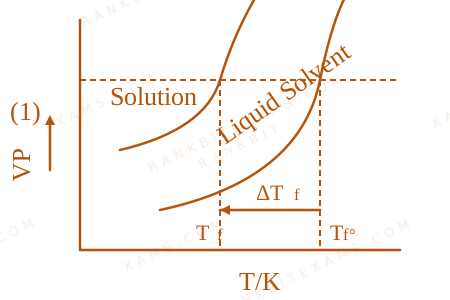
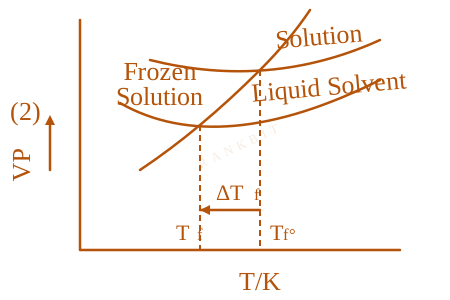
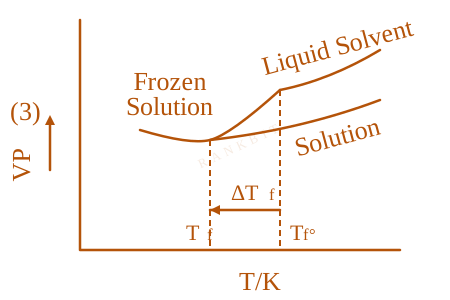
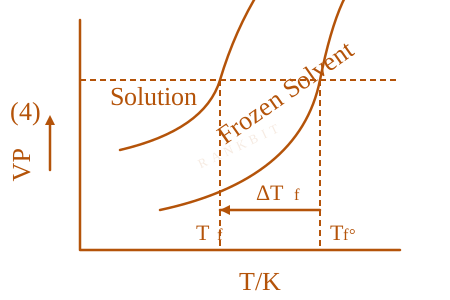
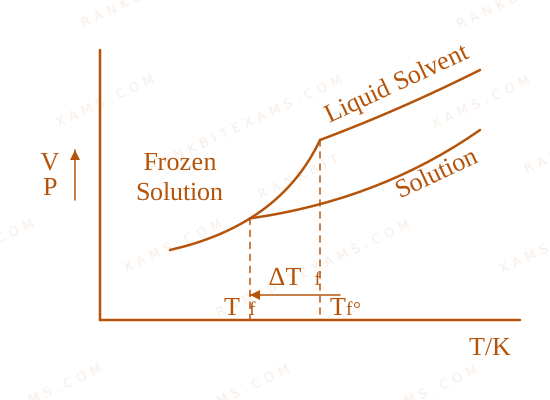
Consider the given plots of vapour pressure (VP) vs temperature (T/K) Which amongst the following options is correct graphical representation showing Delta T_mathrmf , depression in the freezing point of solvent in a solution?

Solution & Explanation

### Related Formula Delta T_f = T_f^0 - T_f ### Core Logic Dissolving a non-volatile solute lower the vapor pressure of the solution relative to the pure solvent across all temperature thresholds. The freezing point is defined as the temperature at which the vapor pressure of the liquid phase matches that of its solid phase. Because the solution's vapor pressure curve lies below that of the pure liquid solvent, its intersection with the frozen solvent curve occurs at a lower temperature (T_f < T_f^0). This shift creates the characteristic freezing point depression step: Delta T_f = T_f^0 - T_f. Plot (3) correctly displays this thermodynamic behavior.
Depression in Freezing Point solution plot for Q42 - JEE Main 2025 Morning
### Pattern Recognition The vapor pressure curve for the solution always runs lower than that of the pure solvent, shifting the freezing intersection to the left. ### Evaluation Rubric / Model Answer null ### Chapter Mix Class 12 Chemistry: Solutions

Reference Study Guides

More Solutions Previous-Year Questions — Page 2

Q49 jee_main_2025_07_april_morning Van't Hoff Factor
The percentage dissociation of a salt (mathrmMX_3) solution at given temperature (van't Hoff factor texti = 2) is ______ %. (Nearest integer)
Numerical Answer. Answer: 33 to 33

Solution

### Related Formula i = 1 + (n - 1)alpha ### Core Logic For the salt mathrmMX_3: mathrmMX_3 rightarrow mathrmM^3+ + 3mathrmX^- - Number of ions formed per formula unit, n = 1 + 3 = 4. Given i = 2, let's find the degree of dissociation (alpha): i = 1 + (4 - 1)alpha 2 = 1 + 3alpha implies 3alpha = 1 implies alpha = frac13 approx 0.3333 Percentage dissociation: \% text dissociation = alpha times 100 = 33.33 \% approx 33 \% ### Pattern Recognition Shortcut: For MX_3 dissociating into 4 ions, alpha = (i - 1) / 3. Since i = 2, alpha = 1/3 = 33\% directly. ### Evaluation Rubric / Model Answer Simple formula application verifying the degree of dissociation to obtain a precise 33 percent. ### Chapter Mix Class 12 Chemistry: Solutions
Q33 jee_main_2025_08_april_evening Azeotropic Mixtures
Which of the following binary mixtures does not show the behaviour of minimum boiling azeotropes?
  • A. textH_2textO + textCH_3textCOC_2textH_5
  • B. textC_6textH_5textOH + textC_6textH_5textNH_2
  • C. textCS_2 + textCH_3textCOCH_3
  • D. textCH_3textOH + textCHCl_3

Solution

### Core Logic Let's connect deviation behaviors to azeotropic styles: * **Minimum Boiling Azeotropes**: Formed by liquid binary solutions that display a strong **positive deviation** from Raoult's Law. In these mixtures, inter-molecular forces between components (A-B) are weaker than pure self-interactions (A-A or B-B). * **Maximum Boiling Azeotropes**: Formed by liquid binary mixtures showing a notable **negative deviation** from Raoult's Law. Here, new inter-molecular interactions (A-B) become significantly stronger. Analyzing **Phenol (C_6H_5OH) + Aniline (C_6H_5NH_2)**: The phenolic -textOH proton forms strong intermolecular hydrogen bonds with the lone pair of the -textNH_2 group of aniline. These new forces exceed the initial individual fluid bonds, lowering vapor pressure below ideal expectations (negative deviation) and creating a **maximum boiling azeotrope**. ### Pattern Recognition Phenol + Aniline, and Chloroform + Acetone are classic textbook models of strong negative deviation from Raoult's Law. Negative deviation explicitly pairs with maximum boiling azeotropes, standing out instantly against minimum boiling selections. ### Evaluation Rubric / Model Answer null ### Chapter Mix Class 12 Chemistry: Solutions
Q34 jee_main_2025_08_april_evening Colligative Properties
For the weak acid dissociation equation: textHA(aq) rightleftharpoons textH^+text(aq) + textA^-text(aq) The freezing point depression of a 0.1 text m aqueous solution of this monobasic weak acid HA is found to be 0.20^circ textC. The dissociation constant (K_a) for the acid is: Given: K_f(textH_2textO) = 1.8 text K kg mol^-1, and assume molality approx molarity.
  • A. 1.38 times 10^-3
  • B. 1.1 times 10^-2
  • C. 1.90 times 10^-3
  • D. 1.89 times 10^-1

Solution

### Related Formula Depression in freezing point colligative relation: Delta T_f = i cdot K_f cdot m Van 't Hoff factor for a weak acid dissociation: i = 1 + alpha Dissociation constant formula: K_a = fracCalpha^21-alpha ### Execution Step 1: Calculate the Van 't Hoff factor i using experimental freezing data: 0.20 = i times 1.8 times 0.1 i = frac0.200.18 = frac2018 = frac109 Step 2: Solve for degree of dissociation alpha: i = 1 + alpha implies frac109 = 1 + alpha alpha = frac109 - 1 = frac19 Step 3: Compute K_a substituting concentration C = 0.1 text M and alpha = frac19: K_a = frac0.1 times left(frac19right)^21 - frac19 = frac0.1 times frac181frac89 = frac0.181 times frac98 = frac0.172 = frac1720 K_a approx 1.388 times 10^-3 ### Pattern Recognition When dealing with weak acids, always determine i first via colligative data, isolate alpha, and map directly to K_a = fracCalpha^21-alpha. Speed up computation by converting decimals into fractional fractions (0.2/0.18 = 10/9) to maintain clean, mistake-free algebra. ### Evaluation Rubric / Model Answer null ### Chapter Mix Class 12 Chemistry: Solutions Class 11 Chemistry: Ionic Equilibrium
Q32 jee_main_2025_29_jan_evening Depression of Freezing Point
Given below are two statements: Statement (I): NaCl is added to the ice at 0^circC, present in the ice cream box to prevent the melting of ice cream. Statement (II): On addition of NaCl to ice at 0^circC, there is a depression in freezing point. In the light of the above statements, choose the correct answer from the options given below:
  • A. Statement I is false but Statement II is true
  • B. Both Statement I and Statement II are true
  • C. Both Statement I and Statement II are false
  • D. Statement I is true but Statement II is false

Solution

### Related Formula Delta T_f = i cdot K_f cdot m ### Core Logic Statement I is true: Adding NaCl to ice creates a freezing mixture with temperatures below 0^circC, preventing the ice cream from melting rapidly. Statement II is true: The addition of a non-volatile solute like NaCl causes a depression in the freezing point of water, enabling ice to remain in the solid state at lower surrounding temperatures. ### Pattern Recognition This is a classic real-world application of colligative properties. Freezing point lowering keeps commercial refrigeration setups colder for a longer duration. ### Evaluation Rubric / Model Answer null ### Chapter Mix Class 12 Chemistry: Solutions
Q40 jee_main_2025_28_jan_morning Colligative Properties - Freezing Point Depression
What is the freezing point depression constant of a solvent, 50mathrmg of which contain 1mathrmg non-volatile solute (molar mass 256mathrmg\,mol^-1 ) and the decrease in freezing point is 0.40mathrmK ?
  • A. 5.12mathrm\,K\,kg\,mol^-1
  • B. 4.43mathrm\,K\,kg\,mol^-1
  • C. 1.86mathrm~K~kg~mol^-1
  • D. 3.72mathrm\,K\,kg\,mol^-1

Solution

### Related Formula Freezing point depression relationship: Delta T_f = K_f cdot m where m is the molality defined as: m = fractextmoles of solutetextmass of solvent in kg ### Step 1: Compute Molality Moles of non-volatile solute: textmoles = frac1\,mathrmg256\,mathrmg\,mol^-1 Mass of solvent in kg: textmass = 50\,mathrmg = 50 times 10^-3\,mathrmkg Therefore, molality values map to: m = frac1256 times 50 times 10^-3 = frac100012800 = frac564\,mathrmmol\,kg^-1 ### Step 2: Calculate K_f Substituting values into the core formula: 0.40 = K_f cdot left(frac564right) K_f = frac0.40 times 645 = 0.08 times 64 = 5.12\,mathrmK\,kg\,mol^-1 ### Pattern Recognition Sees: Direct calculation of cryogenic context constant (K_f). Shortcut: Isolate K_f = fracDelta T_f cdot M cdot W_textsolvent1000 cdot w_textsolute. Substituting instantly returns 5.12. ### Evaluation Rubric / Model Answer null ### Chapter Mix Class 12 Chemistry: Solutions

More Solutions Questions — jee_main_2025_24_jan_morning

Practice all Solutions previous-year questions →

Rankbit System
JEE Physics: Waves (+15.5%) | Electrostatics: Concentric Shells (-29.7%) | Modern Physics: Photoelectric Clones (+34.2%) | Mathematics: Definite Integrals (+18.1%) | Chemistry: Coordination Splitting (-11.4%) | JEE Physics: Waves (+15.5%) | Electrostatics: Concentric Shells (-29.7%) | Modern Physics: Photoelectric Clones (+34.2%) | Mathematics: Definite Integrals (+18.1%) | Chemistry: Coordination Splitting (-11.4%)
