JEE Main · Chemistry → Steady

Aldehydes, Ketones and Carboxylic Acids appeared 46 times across 3 years — 5.3% of Chemistry. This question is from Reactions of Carboxylic Acids.

Year 2026 2025 2024 Total
Questions 14 21 11 46

Xg of benzoic acid on reaction with aq. NaHCO₃ release CO₂ that occupied 11.2 L volume at STP. X is ______ g.

Numerical Answer Type:
Enter a numerical value Answer: 61 to 61 +4 marks

Solution & Explanation

Related Formula
Moles of gas at STP = V in Liters22.4 L/mol
Core Logic

The balanced acid-base reaction equation is:

C₆H₅COOH + NaHCO₃ arrow C₆H₅COO⁻Na⁺ + H₂O + CO₂

This stoichiometry shows a 1:1 molar ratio between benzoic acid and the released carbon dioxide gas.

Calculate the total moles of evolved CO₂ gas at standard conditions:

moles of CO₂ = 11.2 L22.4 L mol⁻¹ = 0.5 moles

Thus, the reaction consumed exactly 0.5 moles of benzoic acid (C₆H₅COOH, molecular weight = 122 g/mol):

mass consumed (X) = 0.5 × 122 = 61 grams
Pattern Recognition

Carboxylic acids react with sodium bicarbonate in a straightforward 1:1 molar ratio, releasing exactly 1 mole of carbon dioxide gas per mole of acid group.

Chapter Mix

Class 12 Chemistry: Aldehydes, Ketones and Carboxylic Acids

Reference Study Guides

More Aldehydes, Ketones and Carboxylic Acids Previous-Year Questions — Page 10

Q jee_main_2024_31_jan_morning Reactions with Grignard Reagent
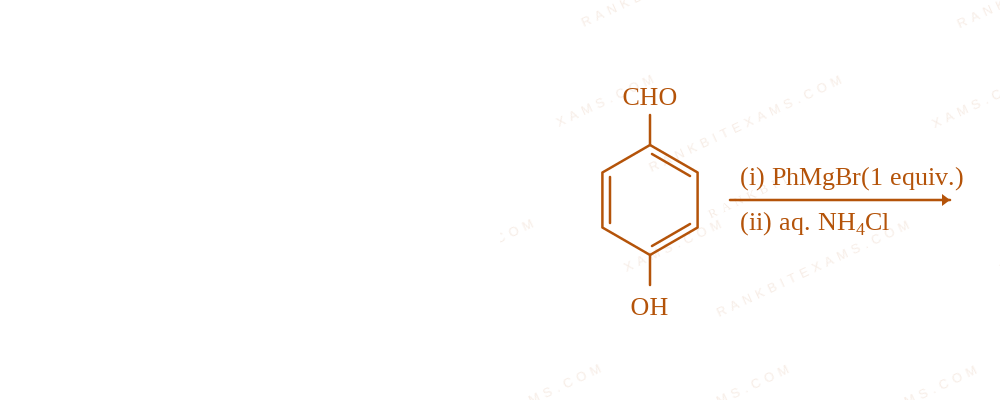
The product of the following reaction is P.
Reactions with Grignard Reagent diagram for Q84 - JEE Main 2024 Morning
The image shows p-hydroxybenzaldehyde reacting with one equivalent of PhMgBr followed by aqueous ammonium chloride.
The number of hydroxyl groups present in the product P is
Numerical Answer. Answer: 0 to 0

Solution

Core Logic

The given reactant is p-hydroxybenzaldehyde, which contains both a phenolic -OH group (acidic) and an aldehyde group (electrophilic).

When one equivalent of Grignard reagent (PhMgBr) is added, it behaves primarily as a strong base due to the presence of an acidic proton. Acid-base reactions are extremely fast compared to nucleophilic additions.

The acidic phenolic -OH reacts with PhMgBr:

PhMgBr + HO-C₆H₄-CHO arrow Ph-H (Benzene) + BrMg-O-C₆H₄-CHO

Upon workup with aq. NH₄Cl, the phenoxide ion simply regenerates the starting p-hydroxybenzaldehyde. However, the question asks for the number of hydroxyl groups present in the formed product (Benzene).
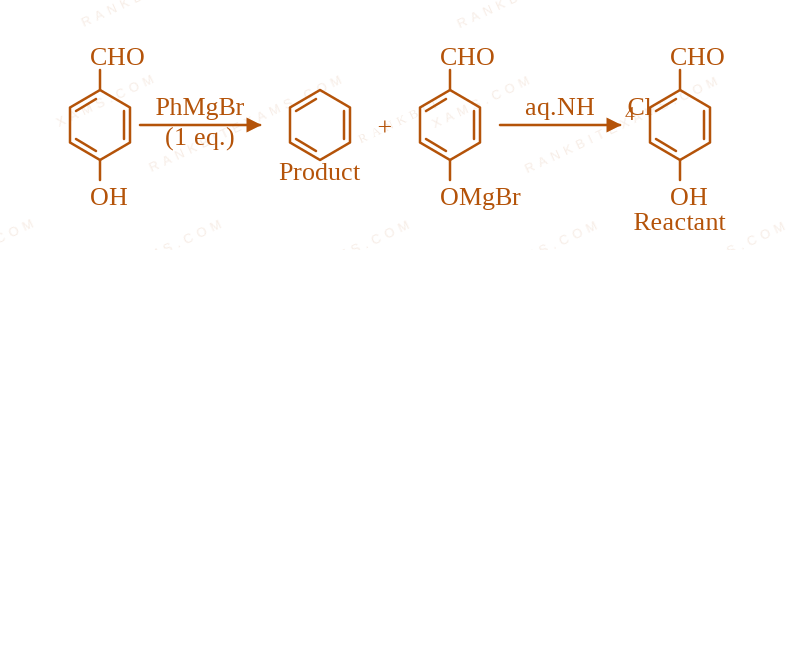
Reactions with Grignard Reagent diagram for Q84 - JEE Main 2024 Morning
The image shows p-hydroxybenzaldehyde reacting with one equivalent of PhMgBr followed by aqueous ammonium chloride.

The distinct product formed in the reaction is Benzene. Benzene has 0 hydroxyl groups.

Pattern Recognition

Whenever a Grignard reagent encounters a molecule with an acidic hydrogen (alcohol, phenol, amine, alkyne), it will invariably act as a base first. If only 1 equivalent is used, nucleophilic addition to carbonyls will NOT happen.

Chapter Mix

Class 12 Chemistry: Aldehydes, Ketones and Carboxylic Acids Class 12 Chemistry: Alcohols, Phenols and Ethers

More Aldehydes, Ketones and Carboxylic Acids Questions — jee_main_2025_24_jan_morning

Practice all Aldehydes, Ketones and Carboxylic Acids previous-year questions →

Rankbit System
JEE Physics: Waves (+15.5%) | Electrostatics: Concentric Shells (-29.7%) | Modern Physics: Photoelectric Clones (+34.2%) | Mathematics: Definite Integrals (+18.1%) | Chemistry: Coordination Splitting (-11.4%) | JEE Physics: Waves (+15.5%) | Electrostatics: Concentric Shells (-29.7%) | Modern Physics: Photoelectric Clones (+34.2%) | Mathematics: Definite Integrals (+18.1%) | Chemistry: Coordination Splitting (-11.4%)