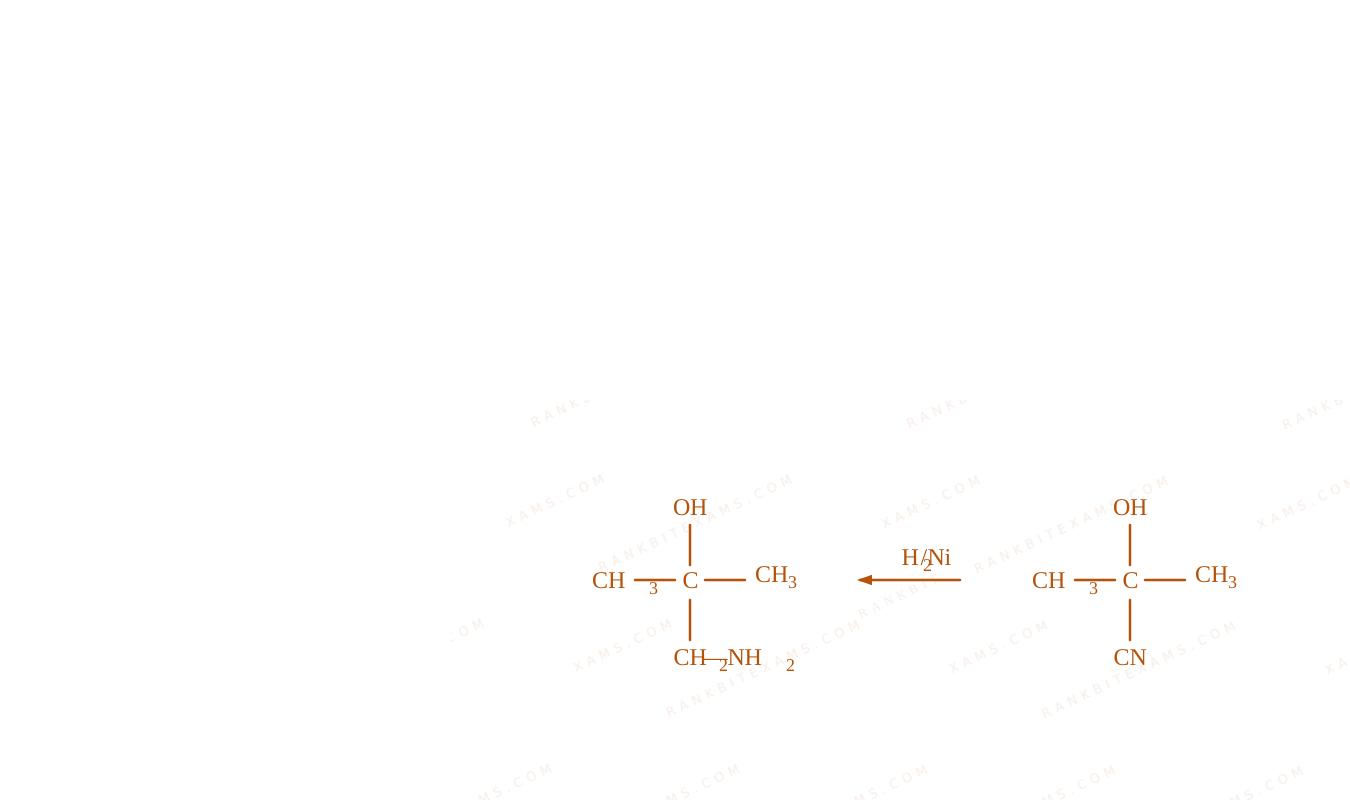
The product (A) formed in the following reaction sequence is : mathrm C H _ 3 - mathrm C equiv mathrm C H xrightarrow [ (mathrm i i) mathrm H _ 2 / mathrm N i ](mathrm i) mathrm H g ^ 2 +, mathrm H _ 2 mathrm S O _ 4 (A)

Solution & Explanation

### Core Logic Breaking down the multi-step reaction path sequence: 1. Hydration of propyne using Kucherov's trigger condition (Hg^2+, H_2SO_4) adds water across the triple bond via Markovnikov's rule. The intermediate enol undergoes tautomerization to yield **acetone** (CH_3-CO-CH_3). 2. Reacting acetone with HCN drives nucleophilic addition at the carbonyl carbon, forming a **cyanohydrin** intermediate: CH_3-C(OH)(CH_3)-CN. 3. Introducing a reducing agent (H_2/Ni) selectively converts the nitrile group (-CN) into a primary amine side chain (-CH_2-NH_2). The final synthesized structure is: mathrmCH_3-mathrmC(mathrmOH)(mathrmCH_3)-mathrmCH_2-mathrmNH_2.
Chemical Reactions of Ketones step sequence product chart for Q45
### Pattern Recognition Alkyne hydration produces a ketone carbonyl system. Cyanohydrin synthesis introduces a carbon coordinate, which subsequently reduces to a primary aliphatic amine functional group. ### Evaluation Rubric / Model Answer null ### Chapter Mix Class 12 Chemistry: Aldehydes, Ketones and Carboxylic Acids

Reference Study Guides

More Aldehydes, Ketones and Carboxylic Acids Previous-Year Questions — Page 6

Q89 jee_main_2024_29_jan_morning Chemical Reactions of Aldehydes and Ketones
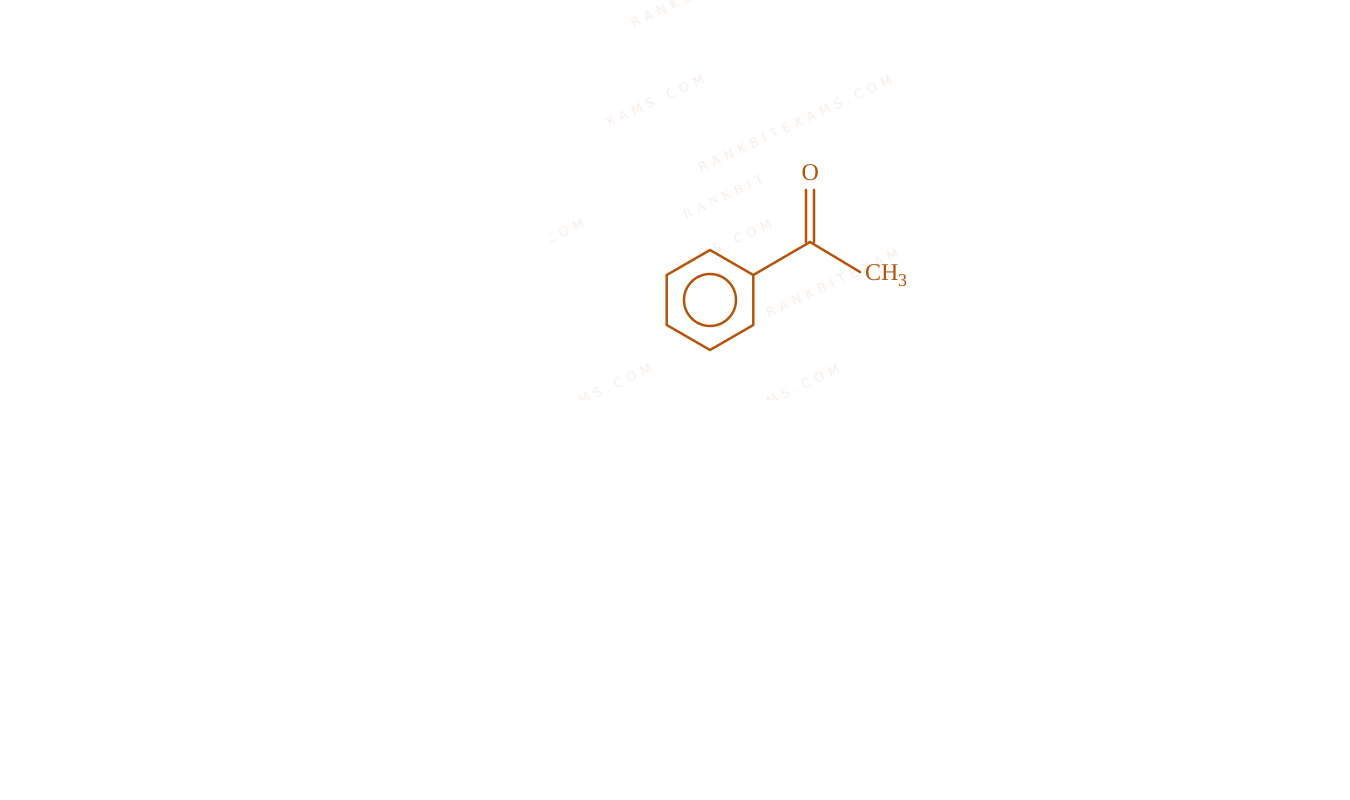
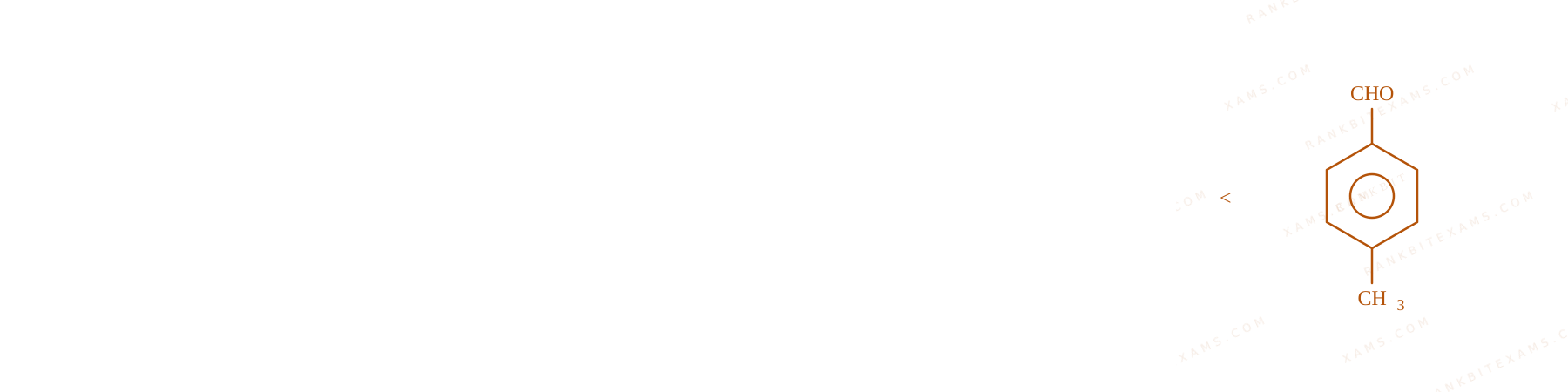
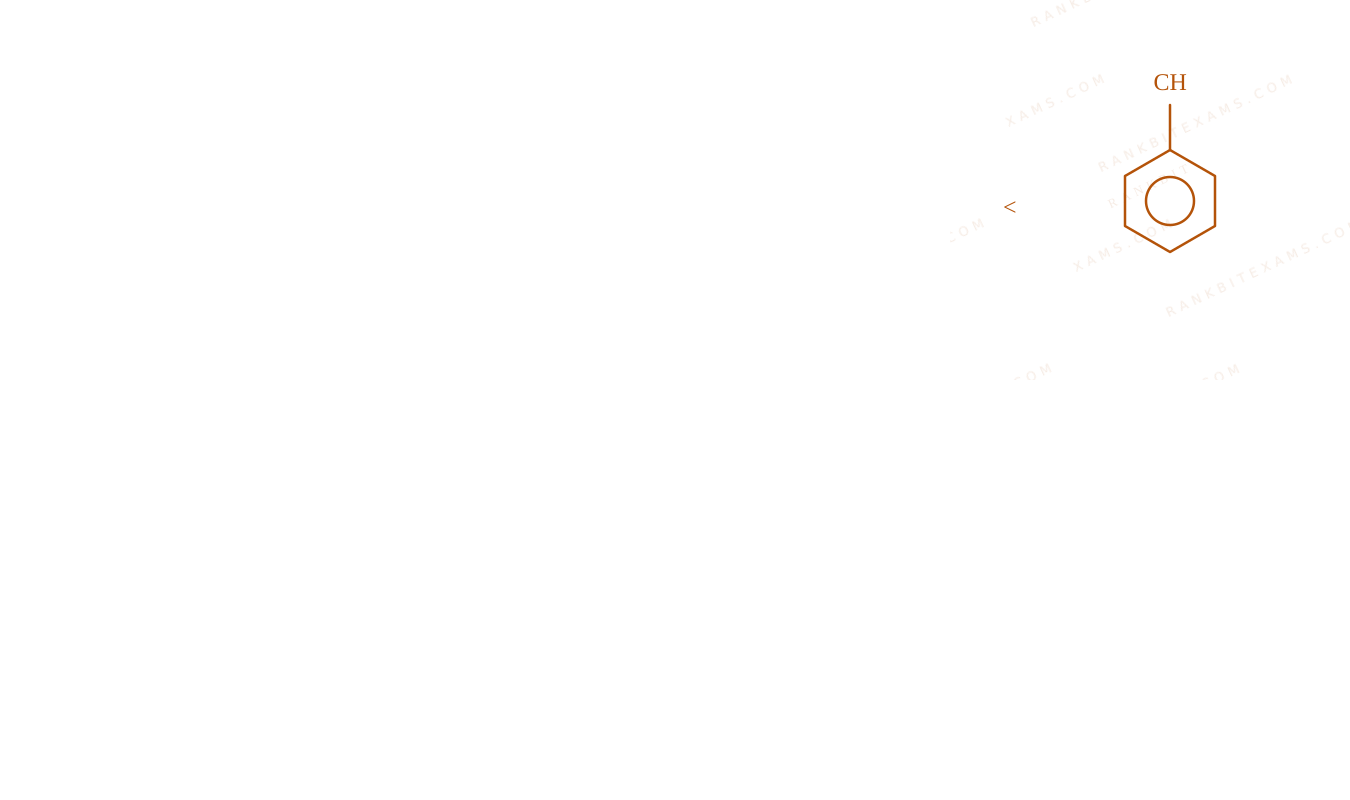
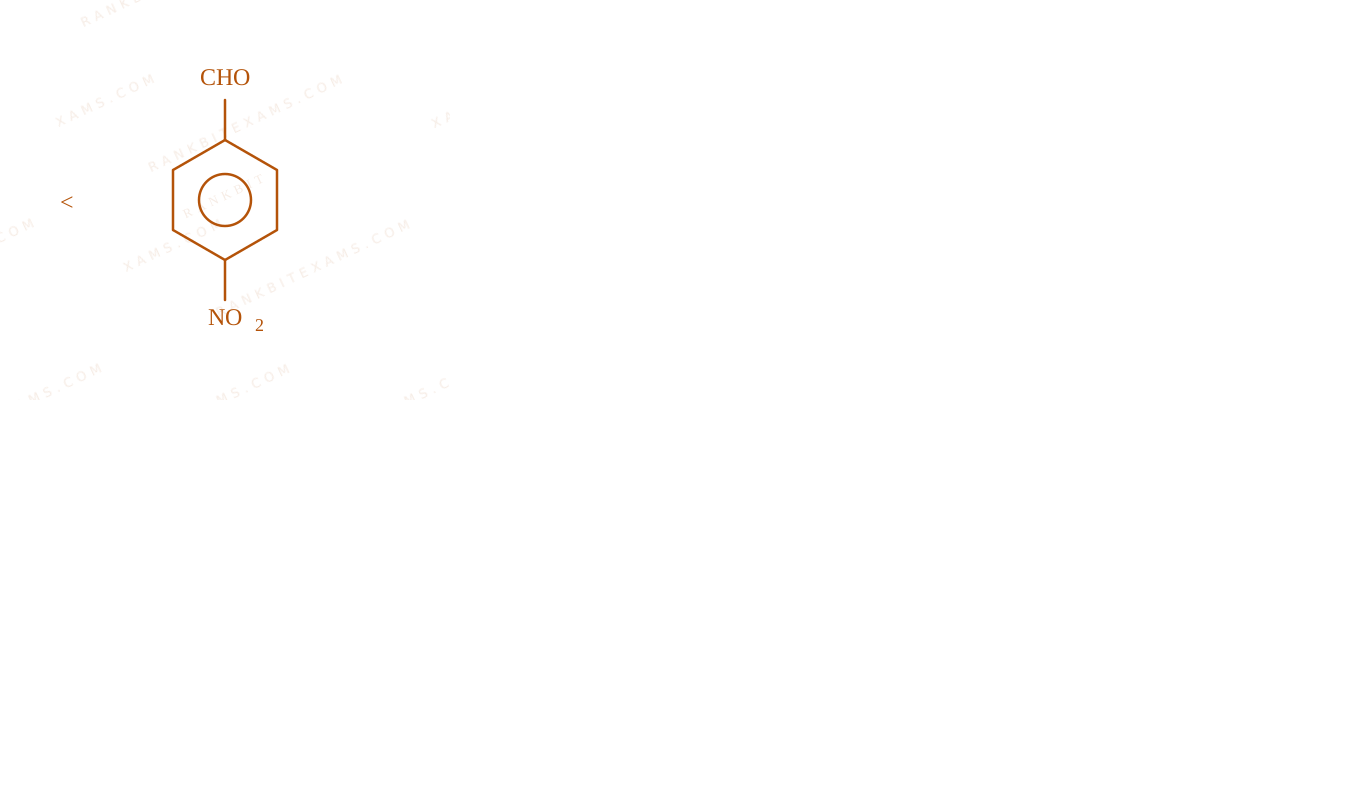
From the compounds given below, number of compounds which give positive Fehling's test is \_\_\_\_\_. Benzaldehyde, Acetaldehyde, Acetone, Acetophenone, Methanal, 4-nitrobenzaldehyde, cyclohexane carbaldehyde.
Numerical Answer. Answer: 3 to 3

Solution

### Core Logic Fehling's test is a mild oxidizing test used primarily to distinguish aliphatic aldehydes from ketones and aromatic aldehydes. - **Aliphatic aldehydes** (like methanal, acetaldehyde, cyclohexane carbaldehyde) give a positive Fehling's test (formation of red-brown precipitate of Cu_2O). - **Aromatic aldehydes** (like benzaldehyde, 4-nitrobenzaldehyde) lack alpha-hydrogens in a purely aliphatic environment and are not sufficiently easily oxidized to give a positive Fehling's test. - **Ketones** (like acetone, acetophenone) generally do not give a positive Fehling's test (except alpha-hydroxy ketones). ### Step 1: Evaluation of Given Compounds 1. Benzaldehyde: Aromatic aldehyde rightarrow Negative 2. Acetaldehyde (CH_3CHO): Aliphatic aldehyde rightarrow Positive 3. Acetone: Ketone rightarrow Negative 4. Acetophenone: Ketone rightarrow Negative 5. Methanal (HCHO): Aliphatic aldehyde rightarrow Positive 6. 4-nitrobenzaldehyde: Aromatic aldehyde rightarrow Negative 7. Cyclohexane carbaldehyde: Aliphatic aldehyde rightarrow Positive The compounds giving a positive test are Acetaldehyde, Methanal, and Cyclohexane carbaldehyde. ### Pattern Recognition Tollens' reagent oxidizes ALL aldehydes (aliphatic + aromatic). Fehling's reagent is weaker and only oxidizes ALIPHATIC aldehydes. ### Evaluation Rubric / Model Answer null ### Chapter Mix Class 12 Chemistry: Aldehydes Ketones and Carboxylic Acids
Q64 jee_main_2024_30_january_evening Cannizzaro Reaction
m-chlorobenzaldehyde on treatment with 50\% KOH solution yields
  • A.
  • B.
  • C.
  • D.

Solution

### Core Logic m-chlorobenzaldehyde lacks alpha-hydrogen atoms. Therefore, when treated with concentrated base like 50\% KOH, it undergoes a disproportionation redox reaction known as the Cannizzaro reaction. Two molecules of the aldehyde react: one gets oxidized to the corresponding carboxylate ion (m-chlorobenzoate ion), and the other gets reduced to the corresponding alcohol (m-chlorobenzyl alcohol). ### Step 1: Reaction The reaction proceeds as:
Cannizzaro reaction of m-chlorobenzaldehyde diagram for Q64 - JEE Main 2024 Evening
### Pattern Recognition No alpha-hydrogen + Conc. Alkali (50\% KOH/NaOH) = Cannizzaro (Oxidation to salt of carboxylic acid + Reduction to primary alcohol). ### Evaluation Rubric / Model Answer null ### Chapter Mix Class 12 Chemistry: Aldehydes Ketones and Carboxylic Acids
Q62 jee_main_2024_30_jan_morning Preparation of Aldehydes
This reduction reaction is known as:
Preparation of Aldehydes diagram for Q62 - JEE Main 2024 Morning
The image shows the catalytic hydrogenation of benzoyl chloride to benzaldehyde in the presence of Pd-BaSO4.
  • A. textRosenmund reduction
  • B. textWolff-Kishner reduction
  • C. textStephen reduction
  • D. textEtard reduction

Solution

### Related Formula R-COCl + H_2 xrightarrowPd/BaSO_4 R-CHO + HCl ### Core Logic The reaction depicts the partial reduction of an acid chloride (benzoyl chloride) to an aldehyde (benzaldehyde) using hydrogen gas in the presence of a poisoned palladium catalyst (Pd supported on BaSO_4).
Preparation of Aldehydes solution diagram for Q62 - JEE Main 2024 Morning
The image shows the catalytic hydrogenation of benzoyl chloride to benzaldehyde in the presence of Pd-BaSO4.
This specific reaction is known as the Rosenmund reduction. ### Pattern Recognition Acid Chloride + H_2, Pd/BaSO_4 rightarrow Aldehyde is strictly the Rosenmund reduction. The BaSO_4 poisons the catalyst to prevent over-reduction to an alcohol. ### Evaluation Rubric / Model Answer null ### Chapter Mix Class 12 Chemistry: Aldehydes, Ketones and Carboxylic Acids
Q70 jee_main_2024_30_jan_morning Nomenclature
Structure of 4-Methylpent-2-enal is
  • A. H_2C=C(CH_3)-CH_2-C(=O)H
  • B. CH_3-CH_2-C(CH_3)=CH-C(=O)H
  • C. CH_3-CH_2-CH=C(CH_3)-C(=O)H
  • D. CH_3-CH(CH_3)-CH=CH-C(=O)H

Solution

### Core Logic Decode the IUPAC name: 4-Methylpent-2-enal 1. Word root: 'pent' rightarrow 5 carbon principal chain. 2. Primary suffix: '2-en' rightarrow Double bond starting at carbon 2. 3. Secondary suffix: 'al' rightarrow Aldehyde group (-CHO) at carbon 1. 4. Substituent: '4-Methyl' rightarrow A methyl group (-CH3) at carbon 4. ### Step 1: Drafting the structure Numbering starts from the aldehyde carbon. C^5 - C^4 - C^3 = C^2 - C^1(=O)H Attach the methyl at C^4: CH_3 - CH(CH_3) - CH = CH - CHO This matches Option 4. ### Evaluation Rubric / Model Answer null ### Chapter Mix Class 12 Chemistry: Aldehydes, Ketones and Carboxylic Acids Class 11 Chemistry: Organic Chemistry - Some Basic Principles and Techniques
Q73 jee_main_2024_30_jan_morning Preparation of Aldehydes
In the given reactions identify the reagent A and reagent B.
Preparation of Aldehydes diagram for Q73 - JEE Main 2024 Morning
The image shows the oxidation of toluene to benzaldehyde via two different pathways requiring reagents A and B.
  • A. textA-CrO_3, textB-CrO_3
  • B. textA-CrO_3, textB-CrO_2Cl_2
  • C. textA-CrO_2Cl_2, textB-CrO_2Cl_2
  • D. textA-CrO_2Cl_2, textB-CrO_3

Solution

### Core Logic Pathway 1 (Upper): Toluene is treated with Reagent 'A' and acetic anhydride (CH_3CO)_2O to form an intermediate (benzylidene diacetate), which on hydrolysis gives benzaldehyde. The reagent used here is Chromic oxide (CrO_3). Thus, A is CrO_3. Pathway 2 (Lower): Toluene is treated with Reagent 'B' in CS_2 to form a chromium complex intermediate, which on hydrolysis yields benzaldehyde. This is the Etard reaction, and the reagent used is Chromyl chloride (CrO_2Cl_2). Thus, B is CrO_2Cl_2.
Preparation of Aldehydes solution diagram for Q73 - JEE Main 2024 Morning
The image shows the oxidation of toluene to benzaldehyde via two different pathways requiring reagents A and B.
### Step 1: Selection Therefore, A = CrO_3 and B = CrO_2Cl_2. ### Pattern Recognition Etard reaction always uses Chromyl chloride (CrO_2Cl_2). Oxidation of toluene with acetic anhydride uses Chromic acid (CrO_3). Both stop the oxidation at the aldehyde stage via intermediate formation. ### Evaluation Rubric / Model Answer null ### Chapter Mix Class 12 Chemistry: Aldehydes, Ketones and Carboxylic Acids

More Aldehydes, Ketones and Carboxylic Acids Questions — jee_main_2025_24_jan_morning

Practice all Aldehydes, Ketones and Carboxylic Acids previous-year questions →

Rankbit System
JEE Physics: Waves (+15.5%) | Electrostatics: Concentric Shells (-29.7%) | Modern Physics: Photoelectric Clones (+34.2%) | Mathematics: Definite Integrals (+18.1%) | Chemistry: Coordination Splitting (-11.4%) | JEE Physics: Waves (+15.5%) | Electrostatics: Concentric Shells (-29.7%) | Modern Physics: Photoelectric Clones (+34.2%) | Mathematics: Definite Integrals (+18.1%) | Chemistry: Coordination Splitting (-11.4%)