The product (A) formed in the following reaction sequence is :
C H _ 3 - C ≡ C H [ (i i) H _ 2 / N i ](i) H g ^ 2 +, H _ 2 S O _ 4 (A)$$\mathrm {C H} _ {3} - \mathrm {C} \equiv \mathrm {C H} \xrightarrow [ (\mathrm {i i}) \mathrm {H} _ {2} / \mathrm {N i} ]{(\mathrm {i}) \mathrm {H} g ^ {2 +}, \mathrm {H} _ {2} \mathrm {S O} _ {4}} (A)$$
Breaking down the multi-step reaction path sequence:
Hydration of propyne using Kucherov's trigger condition (Hg²⁺, H₂SO₄$Hg^{2+}, H_2SO_4$) adds water across the triple bond via Markovnikov's rule. The intermediate enol undergoes tautomerization to yield acetone (CH₃-CO-CH₃$CH_3-CO-CH_3$).
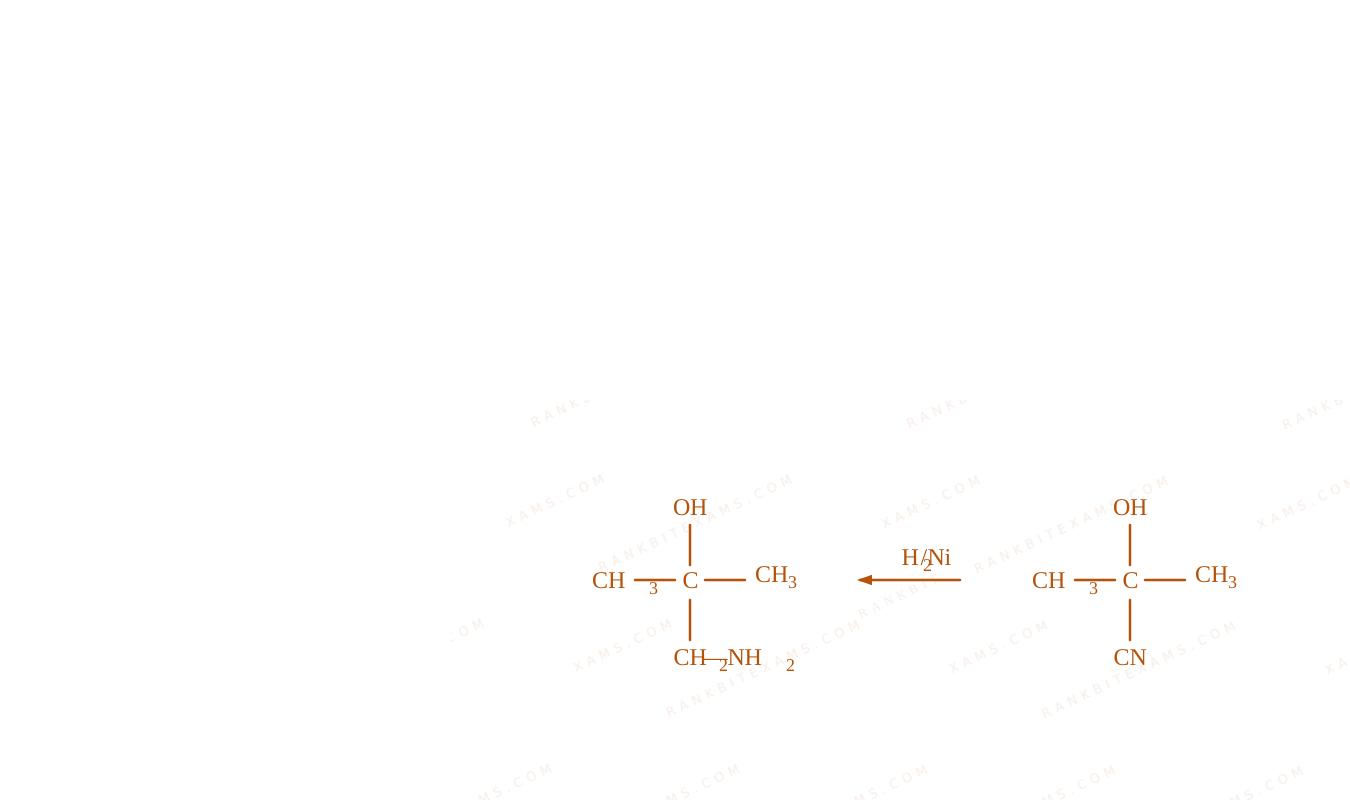
Reacting acetone with HCN$HCN$ drives nucleophilic addition at the carbonyl carbon, forming a cyanohydrin intermediate: CH₃-C(OH)(CH₃)-CN$CH_3-C(OH)(CH_3)-CN$.
Introducing a reducing agent (H₂/Ni$H_2/Ni$) selectively converts the nitrile group (-CN$-CN$) into a primary amine side chain (-CH₂-NH₂$-CH_2-NH_2$).
The final synthesized structure is: CH₃-C(OH)(CH₃)-CH₂-NH₂$\mathrm{CH}_3-\mathrm{C}(\mathrm{OH})(\mathrm{CH}_3)-\mathrm{CH}_2-\mathrm{NH}_2$. Chemical Reactions of Ketones step sequence product chart for Q45
Pattern Recognition
Alkyne hydration produces a ketone carbonyl system. Cyanohydrin synthesis introduces a carbon coordinate, which subsequently reduces to a primary aliphatic amine functional group.
Chapter Mix
Class 12 Chemistry: Aldehydes, Ketones and Carboxylic Acids
Keywords:#product A formed in the following reaction sequence#JEE Main 2025 Morning Q45#Organic Chemistry JEE Main 2025#Chemical Reactions of Ketones
More Aldehydes, Ketones and Carboxylic Acids Previous-Year Questions — Page 4
Qjee_main_2025_02_april_morningReactions of Phenolic Benzaldehydes
Given below are two statements :
Statement (I): Vanillin
Reactions of Phenolic Benzaldehydes will react with NaOH and also with Tollen's reagent.
Statement (II) : Vanillin
Reactions of Phenolic Benzaldehydes will undergo self aldol condensation very easily.
In the light of the above statements, choose the most appropriate answer from the options given below:
A.(1) Statement I is incorrect but Statement II is correct$(1)\ \text{Statement I is incorrect but Statement II is correct}$
B.(2) Statement I is correct but Statement II is incorrect$(2)\ \text{Statement I is correct but Statement II is incorrect}$
C.(3) Both Statement I and Statement II are incorrect$(3)\ \text{Both Statement I and Statement II are incorrect}$
D.(4) Both Statement I and Statement II are correct$(4)\ \text{Both Statement I and Statement II are correct}$
Solution
Related Formula
Phenolic protons react with standard strong bases:
Aldol condensation structural requirement: Requires presence of acidic α$\alpha$-hydrogen atoms connected to carbonyl centers.
Core Logic
Let's analyze functional groups within the Vanillin molecular framework:
Vanillin contains a phenolic hydroxyl group, an aromatic ether, and a formyl functional group (benzaldehyde derivative).
Statement I: The presence of the phenolic -OH$-\mathrm{OH}$ group allows acid-base reaction with NaOH$\mathrm{NaOH}$ directly Vanillin structural functional group verification for Q36. The aldehyde center readily reduces Tollen's reagent to produce a silver mirror. (Statement I is accurate).
Statement II: Vanillin lacks any alpha-hydrogens adjacent to its carbonyl carbon, preventing it from undergoing self-aldol condensation. (Statement II is false).
Pattern Recognition
Benzaldehyde and its substituted derivatives (like vanillin or benzaldehyde itself) never undergo self-aldol condensation because they lack α$\alpha$-carbons with abstractable protons. Instead, they typically perform Cannizzaro transformations when exposed to highly concentrated alkaline media.
Chapter Mix
Class 12 Chemistry: Aldehydes, Ketones and Carboxylic Acids
The major product (P) in the following reaction is :
Benzil-Benzilic Acid Rearrangement
A.
B.
C.
D.
Solution
Related Formula
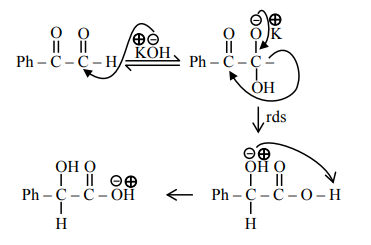
Intramolecular Cannizzaro-type reaction or Benzil-Benzilic acid rearrangement involves nucleophilic attack of hydroxide at a carbonyl group, followed by hydride transfer to the adjacent carbonyl carbon.
Core Logic
Let's analyze the starting compound, phenylglyoxal:
Ph-CO-CHO$$\mathrm{Ph-CO-CHO}$$
The aldehyde carbon (-CHO$-CHO$) is much more electrophilic than the ketone carbon (-CO-$-CO-$) due to less steric hindrance and absence of phenyl group electron donation.
Hydroxide ion (OH^-$\mathrm{OH}^-$) selectively attacks the aldehyde carbonyl carbon, forming a tetrahedral intermediate.
Benzil-Benzilic Acid Rearrangement
Step 1: Hydride Transfer Mechanism
The tetrahedral intermediate collapses, prompting an intramolecular hydride (H^-$H^-$) transfer to the adjacent ketone carbonyl carbon:
In asymmetrical 1,2-dicarbonyl systems with an aldehyde and a ketone, nucleophilic addition occurs preferentially at the more reactive aldehyde carbon. The hydrogen is then transferred as a hydride to the ketone carbon, yielding an α$\alpha$-hydroxy carboxylate salt.
Chapter Mix
Class 12 Chemistry: Aldehydes, Ketones and Carboxylic Acids
Qjee_main_2025_08_april_eveningAldol Condensation
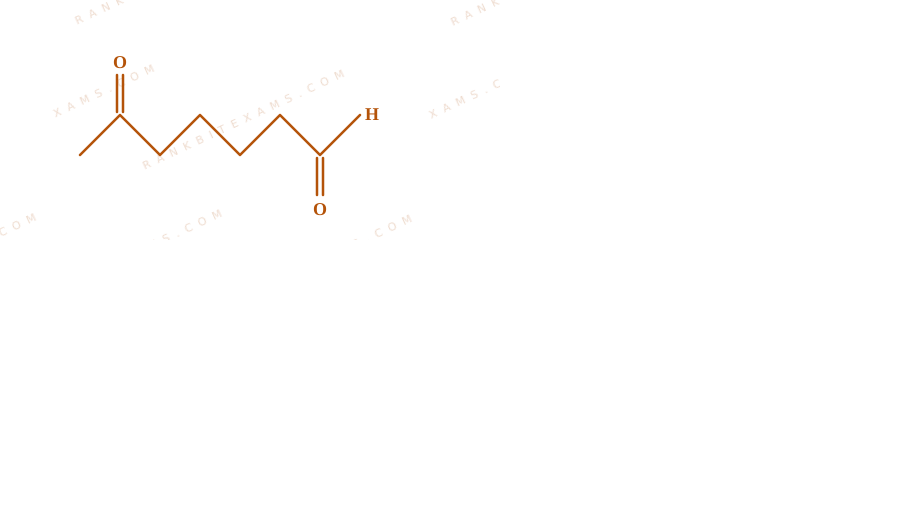
When the dicarbonyl compound shown below undergoes an base-catalyzed intramolecular aldol condensation reaction, the major structural product formed is:
{{Q_IMG1}}
The image features a symmetrical open-chain diketone containing branching elements, poised for intramolecular cyclization.
A.
B.
C.
D.
Solution
Core Logic
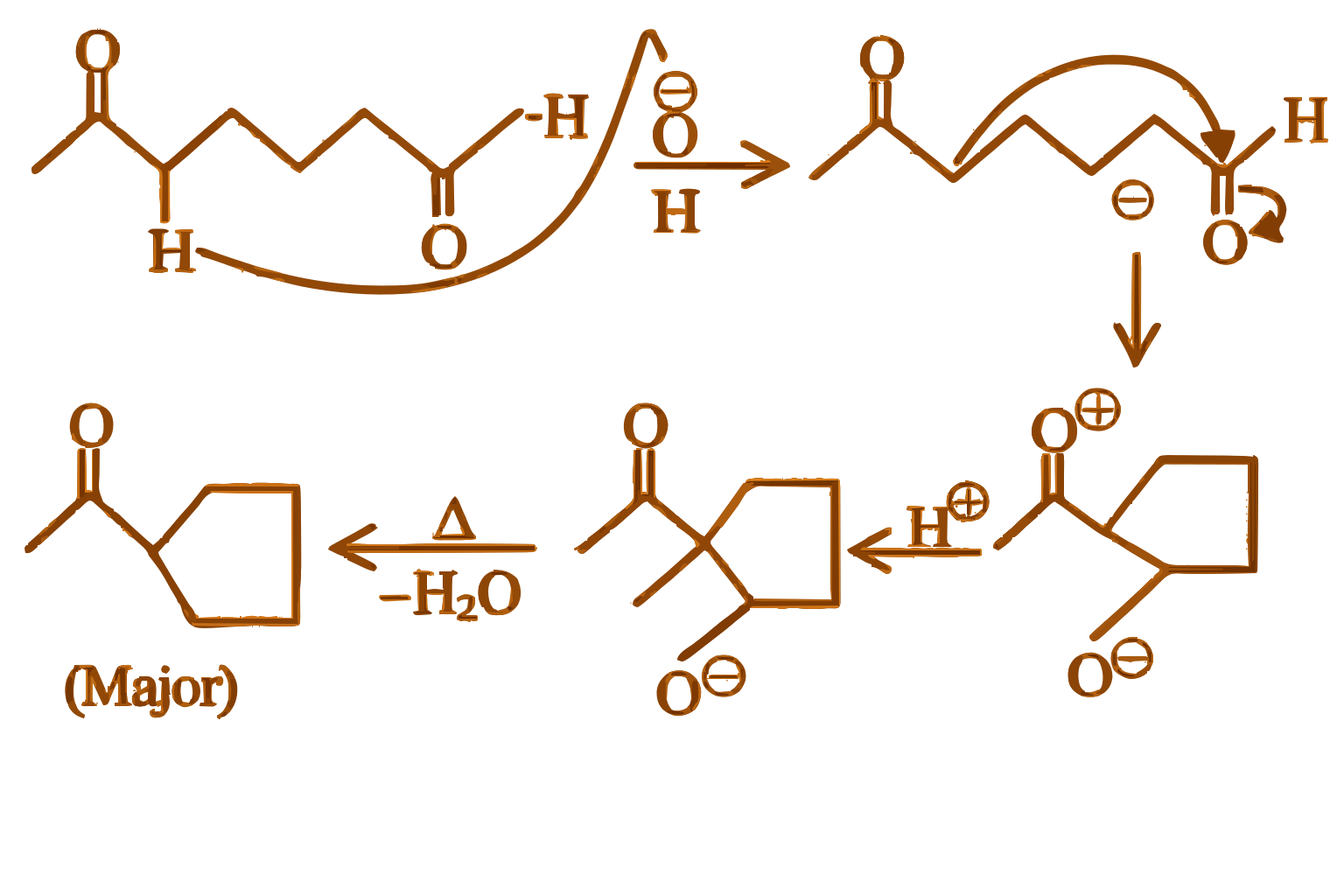
Intramolecular aldol condensations are governed heavily by thermodynamic stability, favoring the formation of 5-membered or 6-membered rings over strained 3-, 4-, or large 7-membered options.
Enolate Generation: Base abstracts an α$\alpha$-proton to form a nucleophilic carbanion enolate.
Attack Vector Selection: Deprotonation at the outer methyl site enables a ring-closing attack on the distant carbonyl carbon, perfectly designing a highly stable cyclopentene ring skeleton.
Dehydration: Heating drives the loss of a water molecule (-H₂O$-\text{H}_2\text{O}$), introducing an α,β$\alpha,\beta$-unsaturated carbonyl arrangement that provides stabilization via conjugated resonance. The image features a symmetrical open-chain diketone containing branching elements, poised for intramolecular cyclization.
Pattern Recognition
Count the intervening carbon chain carefully. Intramolecular aldol pathways will always selectively build 5- or 6-membered rings due to favorable ring strain kinetics. Eliminating choices based on incorrect ring sizes isolates Option (1) instantly.
Chapter Mix
Class 12 Chemistry: Aldehydes, Ketones and Carboxylic Acids
Q30jee_main_2025_08_april_eveningReactions of Cycloalkenes and Alkynes
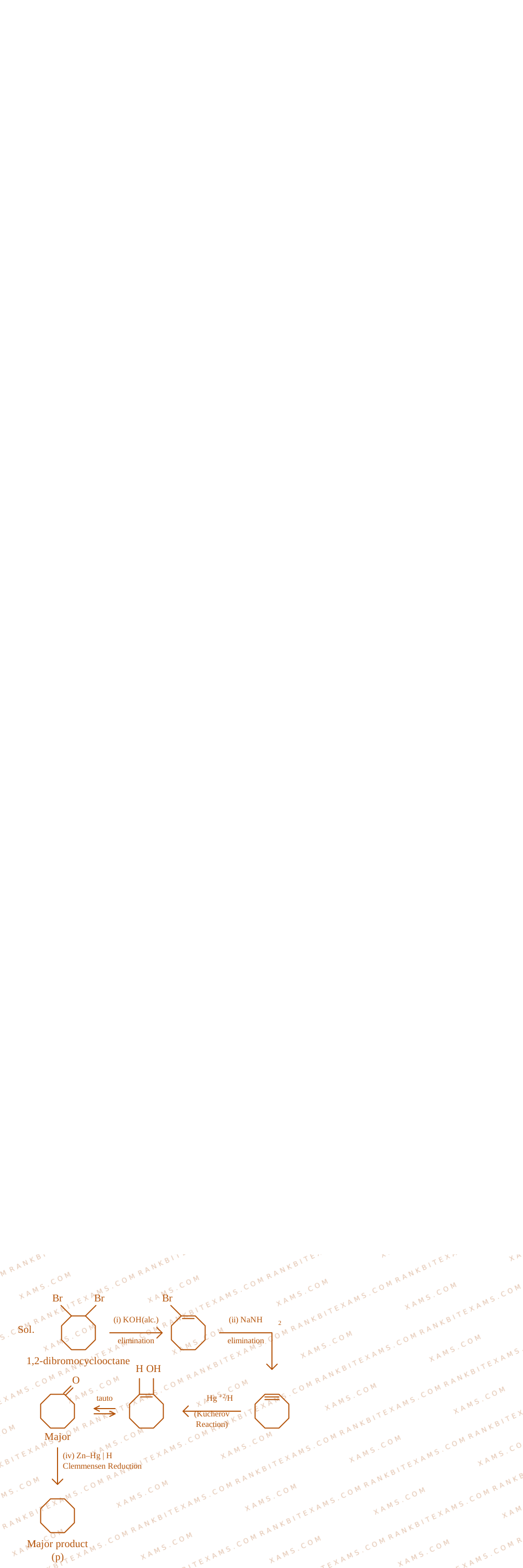
Identify the major product 'P' in the given reaction sequence starting from 1,2-dibromocyclooctane:
1,2-dibromocyclooctane (i) KOH (alc.) (ii) NaNH₂ (iii) Hg²⁺/H^+ (iv) Zn-Hg/HCl 'P (Major product)'$$\text{1,2-dibromocyclooctane} \xrightarrow{\text{(i) KOH (alc.)}} \xrightarrow{\text{(ii) NaNH}_2} \xrightarrow{\text{(iii) Hg}^{2+}/H^+} \xrightarrow{\text{(iv) Zn-Hg/HCl}} \text{'P (Major product)'}$$
Let us systematically follow the transformation steps:
First Elimination: 1,2-dibromocyclooctane reacts with alcoholic KOH$\text{KOH}$ to remove one molecule of HBr$\text{HBr}$, resulting in a bromocyclooctene intermediate.
Second Elimination: Treatment with the stronger base NaNH₂$\text{NaNH}_2$ removes the second molecule of HBr$\text{HBr}$, forming an alkyne inside the 8-membered ring: cyclooctyne.
Kucherov Reaction: Hydration of cyclooctyne using Hg²⁺/H^+$\text{Hg}^{2+}/H^+$ creates an enol intermediate that undergoes tautomerization to form a stable ketone: cyclooctanone.
Clemmensen Reduction: Subjecting cyclooctanone to zinc amalgam and hydrochloric acid (Zn-Hg/HCl$\text{Zn-Hg/HCl}$) completely reduces the carbonyl group (>C=O$>C=O$) to a methylene group (-CH₂-$-\text{CH}_2-$), finishing with cyclooctane. Complete mechanistic sequence mapping for cyclooctane product formation
Pattern Recognition
A vicinal dihalide treated with sequential strong bases creates an alkyne path. Alkyne hydration creates a ketone body. Finally, Clemmensen reduction takes the ketone down to a simple hydrocarbon skeleton. Recognizing this terminal reduction loop establishes cyclooctane as the undisputed answer.
Chapter Mix
Class 12 Chemistry: Aldehydes, Ketones and Carboxylic Acids
Class 11 Chemistry: Hydrocarbons
In the Claisen-Schmidt reaction to prepare dibenzalacetone from 5.3 g$5.3\text{ g}$ of benzaldehyde, a total of 3.51 g$3.51\text{ g}$ of product was obtained.
The percentage yield in this reaction was __%.
Numerical Answer.Answer: 60 to 60
Solution
Core Logic
The balanced chemical equation for the synthesis of dibenzalacetone is:
Molar mass of benzaldehyde (PhCHO) = 106 g/mol$$\text{Molar mass of benzaldehyde } (PhCHO) = 106\text{ g/mol}$$Moles of benzaldehyde used = (5.3)/(106) = 0.05 mol = (1)/(20) mol$$\text{Moles of benzaldehyde used} = \frac{5.3}{106} = 0.05\text{ mol} = \frac{1}{20}\text{ mol}$$
Claisen-Schmidt Condensation diagram for Q48 - JEE Main 2025 Evening
According to the reaction stoichiometry, 2 moles of PhCHO$2\text{ moles of } PhCHO$ yield 1 mole of dibenzalacetone$1\text{ mole of dibenzalacetone}$.
Theoretical moles of product = (0.05)/(2) = 0.025 mol$$\text{Theoretical moles of product} = \frac{0.05}{2} = 0.025\text{ mol}$$
Step 1: Yield Evaluation
$Molar mass of dibenzalacetone (C17H14O) = 234 g/mol$$$\text{Molar mass of dibenzalacetone } (C{17}H{14}O) = 234\text{ g/mol}$$Theoretical mass = 0.025 × 234 = 5.85 g$$\text{Theoretical mass} = 0.025 \times 234 = 5.85\text{ g}$$Percentage yield = Actual massTheoretical mass × 100 = (3.51)/(5.85) × 100 = 60%$$\text{Percentage yield} = \frac{\text{Actual mass}}{\text{Theoretical mass}} \times 100 = \frac{3.51}{5.85} \times 100 = 60%$$
Pattern Recognition
Always remember the stoichiometric ratio: It takes 2 moles of benzaldehyde to condense with 1 mole of acetone to form the symmetrical dibenzalacetone product.
Chapter Mix
Class 12 Chemistry: Aldehydes, Ketones and Carboxylic Acids
More Aldehydes, Ketones and Carboxylic Acids Questions — jee_main_2025_24_jan_morning
Practice past-year questions one chapter at a time. Pick an exam → subject → chapter and get every PYQ for that topic — pulled together from all past papers — with the chapter's key formulas alongside.
.svg)
.svg)
.svg)
)
