Rankbit System
JEE Physics: Waves (+15.5%) | Electrostatics: Concentric Shells (-29.7%) | Modern Physics: Photoelectric Clones (+34.2%) | Mathematics: Definite Integrals (+18.1%) | Chemistry: Coordination Splitting (-11.4%) | JEE Physics: Waves (+15.5%) | Electrostatics: Concentric Shells (-29.7%) | Modern Physics: Photoelectric Clones (+34.2%) | Mathematics: Definite Integrals (+18.1%) | Chemistry: Coordination Splitting (-11.4%)

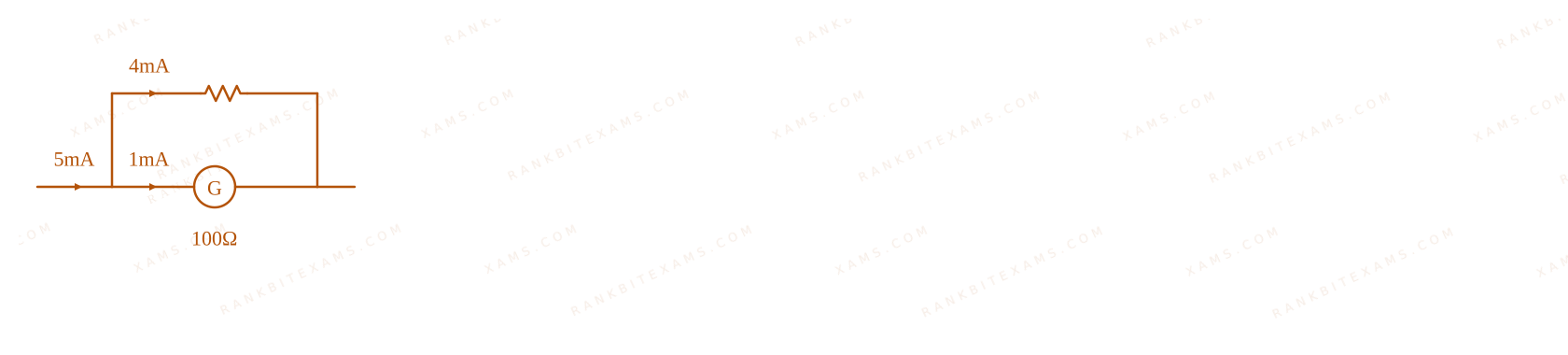
Given below are two statements. One is labelled as Assertion (A) and the other is labelled as Reason (R). Assertion (A): An electron in a certain region of uniform magnetic field is moving with constant velocity in a straight line path. Reason (R): The magnetic field in that region is along the direction of velocity of the electron. In the light of the above statements, choose the correct answer from the options given below:

Solution & Explanation

### Related Formula vecF = q(vecv times vecB) ### Core Logic For a particle to move with a constant velocity in a straight line inside a magnetic field alone, the net magnetic force must be zero: vecF = 0 implies vecv parallel vecB This means the angle theta between the velocity vector and the magnetic field vector is either 0^circ or 180^circ. Thus, if the magnetic field is along the direction of velocity, the force is zero, allowing unaccelerated straight-line motion. Both Assertion and Reason are true, and the Reason correctly explains the Assertion. ### Pattern Recognition Magnetic field cannot change the speed of a charged particle, but it changes direction unless vecv is parallel or anti-parallel to vecB, in which case the magnetic force vanishes entirely. ### Evaluation Rubric / Model Answer null ### Chapter Mix Class 12 Physics: Moving Charges and Magnetism
Reference Study Guides

More Moving Charges and Magnetism Previous-Year Questions — Page 2

Q6 2025 Magnetic Force on a Charged Particle
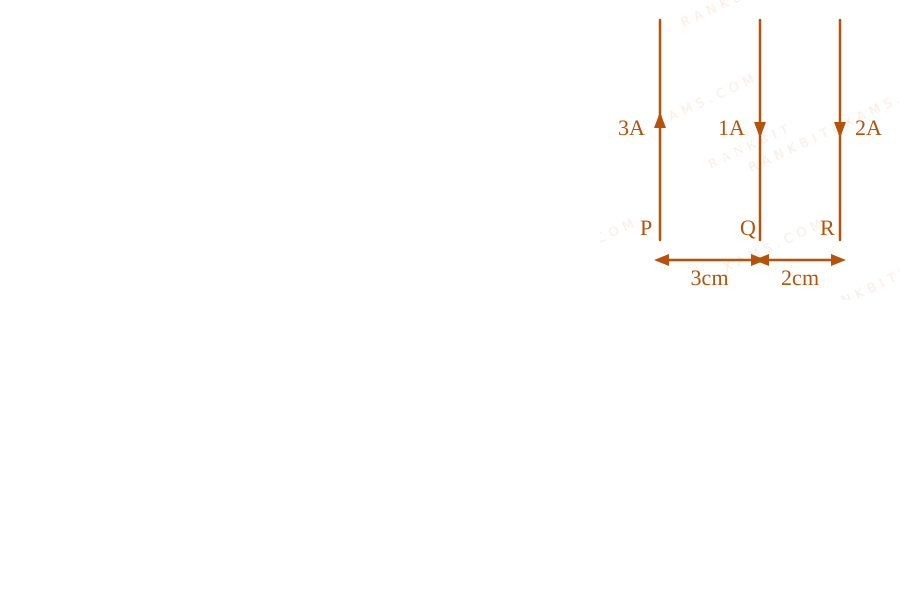
Consider a long thin conducting wire carrying a uniform current I. A particle having mass "M" and charge "q" is released at a distance "a" from the wire with a speed mathbfv_0 along the direction of current in the wire. The particle gets attracted to the wire due to magnetic force. The particle turns round when it is at distance mathbfx from the wire. The value of mathbfx is [mu_0 is vacuum permeability]
  • A. aleft[1 - fracmv_o2qmu_oIright]
  • B. fraca2
  • C. mathrmaleftlbrack 1 - fracmathrmmv_mathrmomathrmqmu _mathrmomathrmIrightrbrack
  • D. mathrmae^frac-4pi mnu_oqmu_oI

Solution

### Core Logic Analyzing motion from path phases mathrmA rightarrow mathrmB and mathrmB rightarrow mathrmC inside the coordinate field:
Coordinate trajectory analysis path diagram for Q6
vecmathrmB = fracmu_0 mathrmI2pi mathrmr(-hatmathrmk) The lorentz magnetic field acceleration rules dictate differential trajectory steps: int_v_0^0 fracv_x dv_xsqrtv_0^2 - v_x^2 = -fracmu_0 mathrmI q2pi mathrmm int_a^x_1 fracdrr Solving this integration step gives the position node parameter: x_1 = a e^-frac2pi m v_0mu_0 I q Compounding this loop interaction for the turning path phase mathrmB rightarrow mathrmC gives: ### Step 1: Final Solution Integration x = x_1 e^-frac2pi m v_0mu_0 I q = a e^-frac4pi m v_0mu_0 I q Matches criteria for option (4). ### Pattern Recognition Variable magnetic field cross-products result in dual exponential scaling metrics. Remember the total velocity magnitude stays fixed under zero work magnetic operations. ### Evaluation Rubric / Model Answer null ### Chapter Mix Class 12 Physics: Moving Charges and Magnetism
Q21 2025 Motion in a Magnetic Field
A particle of charge 1.6 µC and mass 16 µg is present in a strong magnetic field of 6.28 T. The particle is then fired perpendicular to magnetic field. The time required for the particle to return to original location for the first time is ________ s. (Take pi=3.14)
Numerical Answer. Answer: 0 to 0

Solution

### Related Formula Time Period of circular motion in a magnetic field: T = frac2pi mqB ### Core Logic Convert given parameter values into SI baseline metrics: q = 1.6\ mutextC = 1.6 times 10^-6text C m = 16\ mutextg = 16 times 10^-9text kg B = 6.28text T = 2pitext T ### Step 1: Solve for Time Period T = frac2pi times 16 times 10^-91.6 times 10^-6 times 6.28 = frac6.28 times 16 times 10^-91.6 times 10^-6 times 6.28 T = frac16 times 10^-91.6 times 10^-6 = 10 times 10^-3 = 0.01text seconds Rounding to the nearest integer as required for standard integer formatting gives **0**.
Circular trajectory of a charged particle in a magnetic field
### Pattern Recognition Check your prefixes. Micrograms (mutextg) conversion introduces a factor of 10^-9text kg, not 10^-6. If nearest integer is requested, 0.01text s rounds down cleanly to 0. ### Evaluation Rubric / Model Answer null ### Chapter Mix Class 12 Physics: Moving Charges and Magnetism
Q5 2025 Ampere's Circuital Law
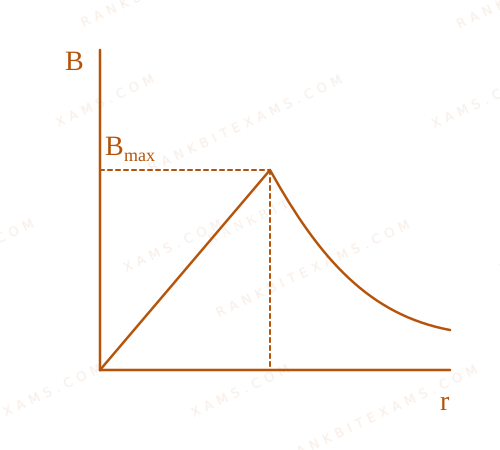
A long straight wire of a circular cross-section with radius 'a' carries a steady current I. The current I is uniformly distributed across this cross-section. The plot of magnitude of magnetic field B with distance r from the centre of the wire is given by:
  • A. Graph (1)
  • B. Graph (2)
  • C. Graph (3)
  • D. Graph (4)

Solution

### Related Formula B_textin = fracmu_0 I r2pi a^2 implies B_textin propto r B_textout = fracmu_0 I2pi r implies B_textout propto frac1r ### Core Logic Inside the wire (r < a), the magnetic field grows linearly with distance r from the axis. At the surface (r = a), it reaches its maximum value B_textmax = fracmu_0 I2pi a. Outside the wire (r > a), it decays inversely with r. This combination matches the curve shown in Graph (1).
Ampere law plot variation for thick wire Q5
magnetic field variation, ampere law plot, current carrying wire
### Pattern Recognition Solid cylinder current profile: linear inside (B propto r), hyperbolic outside (B propto 1/r). ### Evaluation Rubric / Model Answer null ### Chapter Mix Class 12 Physics: Moving Charges and Magnetism

Q11 2025 Ampere's Circuital Law
N equally spaced charges each of value q, are placed on a circle of radius R. The circle rotates about its axis with an angular velocity omega as shown in the figure
Rotating charge ring with Amperian loops Q11
The figure illustrates a rotating ring of charges with two distinct Amperian paths A and B intersecting the ring path.
. A bigger Amperian loop B encloses the whole circle where as a smaller Amperian loop A encloses a small segment. The difference between enclosed currents, I_A - I_B, for the given Amperian loops is
  • A. fracN^22piqomega
  • B. frac2piNqomega
  • C. fracN2piqomega
  • D. fracNpiqomega

Solution

### Related Formula I = fracqT = fracqomega2pi ### Core Logic The loop A encloses one of the moving point charges as it moves past, giving a current contribution localized to that cross-sectional segment intersection: I_A = fracNqleft(frac2piomega ight) = fracNqomega2pi Loop B encloses the entire loop surface coplanar or enclosing the ring structure fully without clipping individual passing current tracks perpendicularly in the same directional fashion, resulting in zero net cross-surface passing enclosed current: I_B = 0 Therefore, the difference is: I_A - I_B = fracNqomega2pi
Enclosed current lines interpretation schematic Q11
The figure illustrates a rotating ring of charges with two distinct Amperian paths A and B intersecting the ring path.
### Pattern Recognition A current loop has net passing current across a large overarching bounding box equal to zero if it doesn't cross the boundary surfaces symmetrically. ### Evaluation Rubric / Model Answer null ### Chapter Mix Class 12 Physics: Moving Charges and Magnetism

More Moving Charges and Magnetism Questions — jee_main_2025_24_jan_evening

Practice all Moving Charges and Magnetism previous-year questions →

YOUR FIRST PREP STEP STARTS HERE

We Map Every Repeating Question in Competitive Exams.

Say goodbye to generic mock test fatigue. RankBit uses smart analysis to group past exam questions into their foundational Repeating Question Types. Find chapter weightage, track repeating questions, and score higher with targeted practice.

Select Your Target Exam

Choose an exam track below to find formulas per chapter and patterns.

Syncing Exam Intelligence

Mapping formulas and patterns across all tracks…

PATH A — FULL LENGTH PRACTICE

Full Mock Test Hub

Simulate real NTA exam conditions with fully tracked mocks. Time yourself against past papers.

Under Development
PATH B — TARGETED PRACTICE

Topic-wise Practice Hub

Practice past-year questions one chapter at a time. Pick an exam → subject → chapter and get every PYQ for that topic — pulled together from all past papers — with the chapter's key formulas alongside.

Loading Questions... Browse Topics
Latest from the Blog
View all →

Loading articles...