A small uncharged conducting sphere is placed in contact with an identical sphere but having 4 times 10^-8$4 \times 10^{-8}$ C charge and then removed to a distance such that the force of repulsion between them is 9 times 10^-3$9 \times 10^{-3}$ N. The distance between them is (Take frac14pivarepsilon_0$\frac{1}{4\pi\varepsilon_{0}}$ as 9 times 10^9$9 \times 10^{9}$ in SI units)
A.2 cm
B.3 cm
C.4 cm
D.1 cm
Solution & Explanation
### Related Formula
F = frack q_1 q_2r^2$$F = \frac{k q_1 q_2}{r^2}$$
### Core Logic
When two identical conducting spheres are brought into contact, the total initial charge splits equally between them:
q_1 = q_2 = frac4 times 10^-8\ mathrmC + 02 = 2 times 10^-8\ mathrmC$$q_1 = q_2 = \frac{4 \times 10^{-8}\ \mathrm{C} + 0}{2} = 2 \times 10^{-8}\ \mathrm{C}$$
Given repulsion force, F = 9 times 10^-3\ mathrmN$F = 9 \times 10^{-3}\ \mathrm{N}$:
9 times 10^-3 = frac9 times 10^9 times (2 times 10^-8) times (2 times 10^-8)r^2$$9 \times 10^{-3} = \frac{9 \times 10^{9} \times (2 \times 10^{-8}) \times (2 \times 10^{-8})}{r^2}$$9 times 10^-3 = frac36 times 10^-7r^2 implies r^2 = frac36 times 10^-79 times 10^-3 = 4 times 10^-4$$9 \times 10^{-3} = \frac{36 \times 10^{-7}}{r^2} \implies r^2 = \frac{36 \times 10^{-7}}{9 \times 10^{-3}} = 4 \times 10^{-4}$$r = 2 times 10^-2\ mathrmm = 2\ mathrmcm$$r = 2 \times 10^{-2}\ \mathrm{m} = 2\ \mathrm{cm}$$Charge redistribution schematic for two spheres Q18
### Pattern Recognition
Identical spheres in contact distribute net charge equally due to symmetric capacitance sharing: q' = Q_texttotal / 2$q' = Q_{\text{total}} / 2$.
### Evaluation Rubric / Model Answer
null
### Chapter Mix
Class 12 Physics: Electrostatics
Charge redistribution schematic for two spheres Q18Charge redistribution schematic for two spheres Q18
Keywords:#Conduction charge sharing identical spheres#JEE Main 2025 Evening Q18#Coulomb force calculation distance#Electrostatic charge splitting
More Electrostatics Previous-Year Questions — Page 3
Q23jee_main_2025_08_april_eveningCapacitance
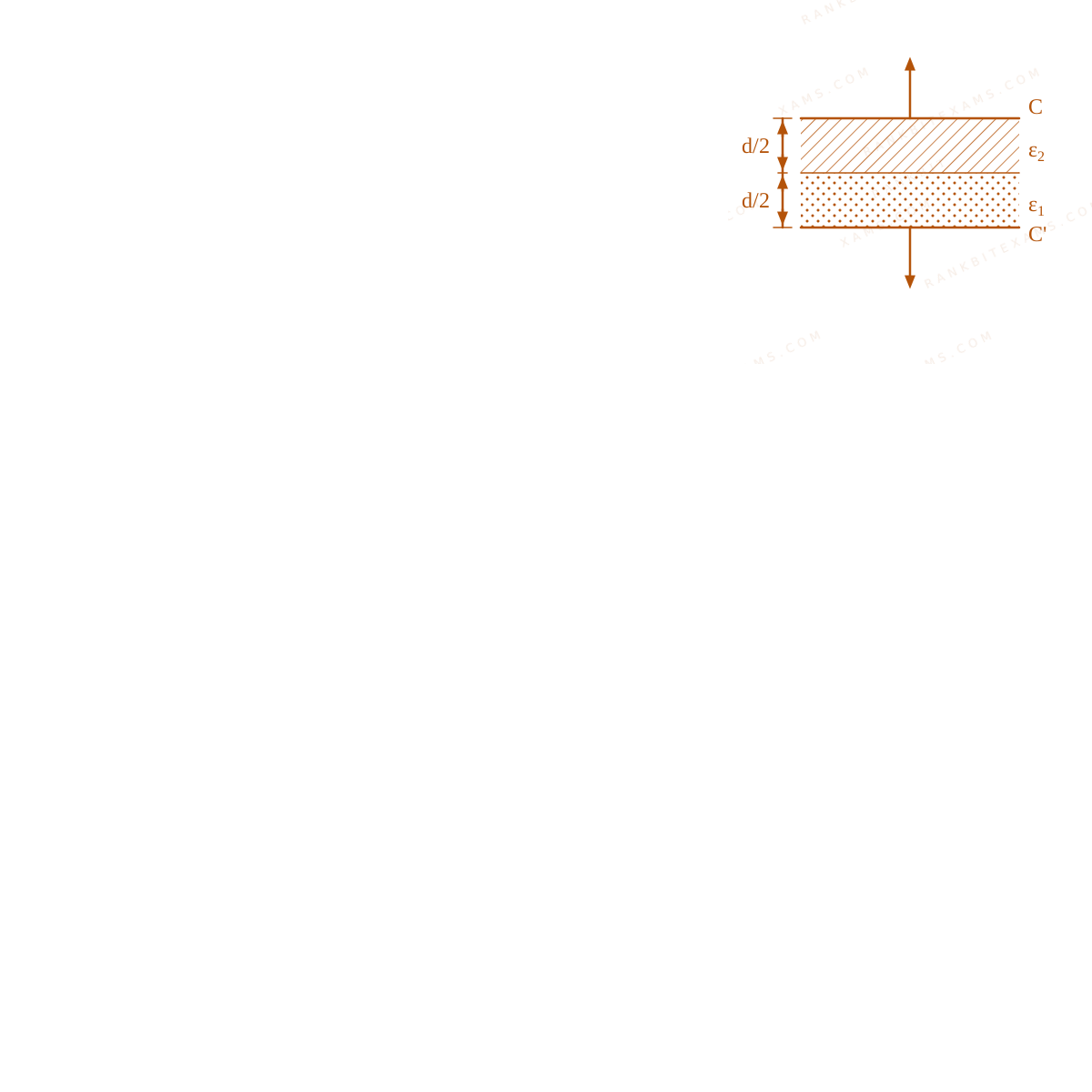
Space between the plates of a parallel plate capacitor of plate area 4mathrm~cm^2$4\mathrm{~cm}^{2}$ and separation of (d) 1.77mathrm~mm$1.77\mathrm{~mm}$, is filled with uniform dielectric materials with dielectric constants (3$3$ and 5$5$) as shown in figure. Another capacitor of capacitance 7.5mathrm~pF$7.5\mathrm{~pF}$ is connected in parallel with it. The effective capacitance of this combination is ________ mathrm~pF$\mathrm{~pF}$.
This diagram shows a parallel plate capacitor filled with two layers of dielectric constant k=5 and k=3, each having thickness d/2.
(Given varepsilon_0 = 8.85times 10^-12mathrm~F/m$\varepsilon_0 = 8.85\times 10^{-12}\mathrm{~F/m}$)
Numerical Answer.Answer: 15 to 15
Solution
### Related Formula
C = k fracvarepsilon_0 At$$C = k \frac{\varepsilon_0 A}{t}$$frac1C_textseries = frac1C_1 + frac1C_2$$\frac{1}{C_{\text{series}}} = \frac{1}{C_1} + \frac{1}{C_2}$$C_textparallel = C_texteq + C_p$$C_{\text{parallel}} = C_{\text{eq}} + C_p$$
### Core Logic
The dielectrics k_1 = 5$k_1 = 5$ and k_2 = 3$k_2 = 3$ split the capacitor separation horizontally into two layers, each of thickness fracd2$\frac{d}{2}$. Thus, they act as two capacitors connected in **series**:
- Capacitor 1: C_1 = k_1 fracvarepsilon_0 Ad/2 = 5 times frac2 varepsilon_0 Ad = 10 fracvarepsilon_0 Ad$C_1 = k_1 \frac{\varepsilon_0 A}{d/2} = 5 \times \frac{2 \varepsilon_0 A}{d} = 10 \frac{\varepsilon_0 A}{d}$
- Capacitor 2: C_2 = k_2 fracvarepsilon_0 Ad/2 = 3 times frac2 varepsilon_0 Ad = 6 fracvarepsilon_0 Ad$C_2 = k_2 \frac{\varepsilon_0 A}{d/2} = 3 \times \frac{2 \varepsilon_0 A}{d} = 6 \frac{\varepsilon_0 A}{d}$
### Step 1: Compute Base Capacitance Factor
First, find the term fracvarepsilon_0 Ad$\frac{\varepsilon_0 A}{d}$ in SI units:
- A = 4mathrm~cm^2 = 4 times 10^-4mathrm~m^2$A = 4\mathrm{~cm}^2 = 4 \times 10^{-4}\mathrm{~m}^2$
- d = 1.77mathrm~mm = 1.77 times 10^-3mathrm~m$d = 1.77\mathrm{~mm} = 1.77 \times 10^{-3}\mathrm{~m}$
- varepsilon_0 = 8.85 times 10^-12mathrm~F/m$\varepsilon_0 = 8.85 \times 10^{-12}\mathrm{~F/m}$fracvarepsilon_0 Ad = frac8.85 times 10^-12 times 4 times 10^-41.77 times 10^-3 = frac35.4 times 10^-161.77 times 10^-3 = 20 times 10^-13mathrm~F = 2mathrm~pF$$\frac{\varepsilon_0 A}{d} = \frac{8.85 \times 10^{-12} \times 4 \times 10^{-4}}{1.77 \times 10^{-3}} = \frac{35.4 \times 10^{-16}}{1.77 \times 10^{-3}} = 20 \times 10^{-13}\mathrm{~F} = 2\mathrm{~pF}$$
Now find C_1$C_1$ and C_2$C_2$:
- C_1 = 10 times 2mathrm~pF = 20mathrm~pF$C_1 = 10 \times 2\mathrm{~pF} = 20\mathrm{~pF}$
- C_2 = 6 times 2mathrm~pF = 12mathrm~pF$C_2 = 6 \times 2\mathrm{~pF} = 12\mathrm{~pF}$
Calculate their series equivalent C_texteq$C_{\text{eq}}$:
C_texteq = fracC_1 C_2C_1 + C_2 = frac20 times 1220 + 12 = frac24032 = 7.5mathrm~pF$$C_{\text{eq}} = \frac{C_1 C_2}{C_1 + C_2} = \frac{20 \times 12}{20 + 12} = \frac{240}{32} = 7.5\mathrm{~pF}$$
### Step 2: Add Parallel Capacitor
Another capacitor of C_p = 7.5mathrm~pF$C_p = 7.5\mathrm{~pF}$ is connected in parallel with the combination:
C_textfinal = C_texteq + C_p = 7.5mathrm~pF + 7.5mathrm~pF = 15mathrm~pF$$C_{\text{final}} = C_{\text{eq}} + C_p = 7.5\mathrm{~pF} + 7.5\mathrm{~pF} = 15\mathrm{~pF}$$
### Pattern Recognition
Sees: Dielectric boundary parallel to the plates → Series capacitors.
Trap: Don't treat horizontally split layers as parallel; split in distance d$d$ means series, while split in area A$A$ means parallel.
Shortcut: Notice frac35.41.77$\frac{35.4}{1.77}$ is exactly 20$20$. This makes the numerical calculations incredibly clean! ✓
### Evaluation Rubric / Model Answer
null
### Chapter Mix
Class 12 Physics: Electrostatics
Q3jee_main_2025_29_jan_eveningElectric Dipole in Uniform Electric Field
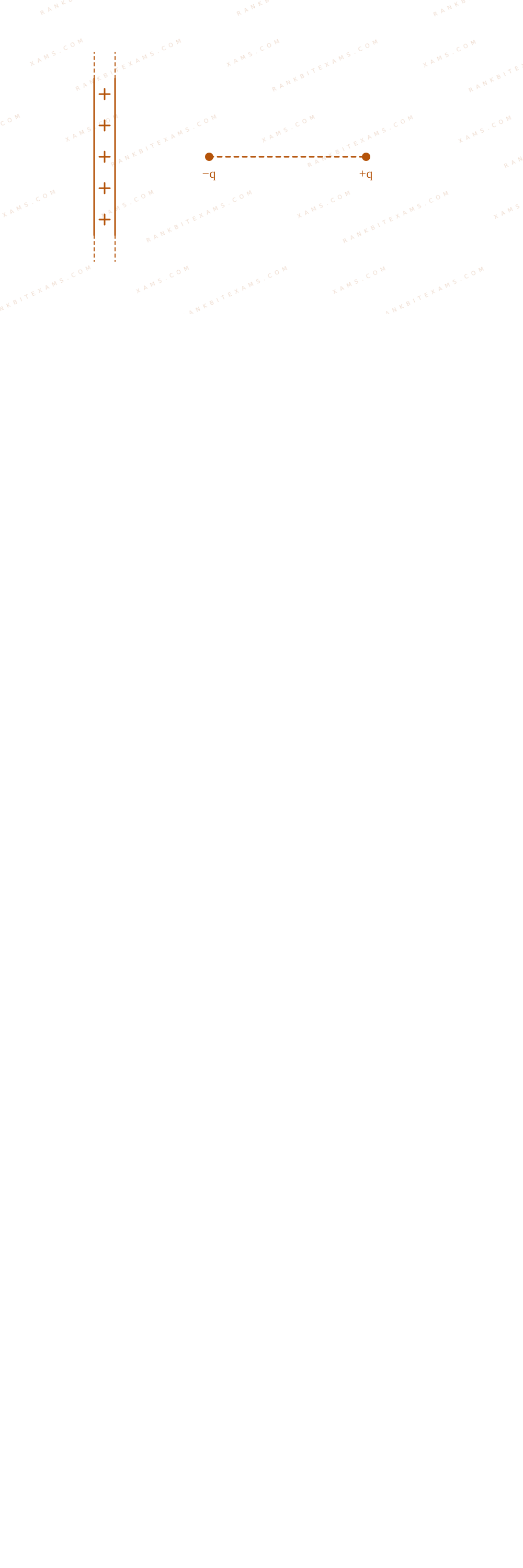
An electric dipole is placed at a distance of 2mathrm~cm$2\mathrm{~cm}$ from an infinite plane sheet having positive charge density sigma_0$\sigma_0$. Choose the correct option from the following.
The diagram illustrates an electric dipole with charges -q and +q aligned parallel to an infinite plane sheet of positive charge density.
A.textTorque on dipole is zero and net force is directed away from the sheet.$\text{Torque on dipole is zero and net force is directed away from the sheet.}$
B.textTorque on dipole is zero and net force acts towards the sheet.$\text{Torque on dipole is zero and net force acts towards the sheet.}$
C.textPotential energy of dipole is minimum and torque is zero.$\text{Potential energy of dipole is minimum and torque is zero.}$
D.textPotential energy and torque both are maximum$\text{Potential energy and torque both are maximum}$
Solution
### Related Formula
E = fracsigma_02epsilon_0$$E = \frac{\sigma_0}{2\epsilon_0}$$vectau = vecp times vecE$$\vec{\tau} = \vec{p} \times \vec{E}$$U = -vecp cdot vecE$$U = -\vec{p} \cdot \vec{E}$$
### Core Logic
An infinite plane sheet produces a uniform electric field vecE$\vec{E}$ directed normally away from the sheet.
As shown in the image layout, the dipole moment vector vecp$\vec{p}$ (pointing from -q$-q$ to +q$+q$) is oriented parallel to the electric field vectors vecE$\vec{E}$:
theta = 0^circ$$\theta = 0^{\circ}$$
1. **Torque evaluation**:
tau = pE sin(0^circ) = 0$$\tau = pE \sin(0^{\circ}) = 0$$
2. **Potential Energy evaluation**:
U = -pE cos(0^circ) = -pE quad (textMinimum)$$U = -pE \cos(0^{\circ}) = -pE \quad (\text{Minimum})$$
3. **Net Force evaluation**:
Since the electric field is uniform, the force on +q$+q$ balances the force on -q$-q$, meaning F_textnet = 0$F_{\text{net}} = 0$.
### Pattern Recognition
When a dipole aligns perfectly with a uniform electric field (vecp parallel vecE$\vec{p} \parallel \vec{E}$), it reaches stable equilibrium. Stable equilibrium fundamentally means minimum potential energy (U = -pE$U = -pE$) and zero torque.
### Evaluation Rubric / Model Answer
null
### Chapter Mix
Class 12 Physics: Electrostatics
Q5jee_main_2025_29_jan_eveningGauss's Law and Flux
A point charge causes an electric flux of -2 times 10^4 mathrm~Nm^2mathrmC^-1$-2 \times 10^{4} \mathrm{~Nm}^{2}\mathrm{C}^{-1}$ to pass through a spherical Gaussian surface of 8.0mathrm~cm$8.0\mathrm{~cm}$ radius, centred on the charge. The value of the point charge is :
(mathrmGiven epsilon_0 = 8.85 times 10^-12 mathrm~C^2mathrmN^-1mathrmm^-2)$(\mathrm{Given } \epsilon_{0} = 8.85 \times 10^{-12} \mathrm{~C}^{2}\mathrm{N}^{-1}\mathrm{m}^{-2})$
A.-17.7 times 10^-8 mathrm~C$-17.7 \times 10^{-8} \mathrm{~C}$
B.-15.7 times 10^-8 mathrm~C$-15.7 \times 10^{-8} \mathrm{~C}$
C.17.7 times 10^-8 mathrm~C$17.7 \times 10^{-8} \mathrm{~C}$
D.15.7 times 10^-8 mathrm~C$15.7 \times 10^{-8} \mathrm{~C}$
Solution
### Related Formula
phi = fracq_textenclosedepsilon_0$$\phi = \frac{q_{\text{enclosed}}}{\epsilon_0}$$
where,
phi$\phi$ = net electric flux through the closed surface
q_textenclosed$q_{\text{enclosed}}$ = net charge enclosed by the surface
epsilon_0$\epsilon_0$ = permittivity of free space
### Core Logic
According to Gauss's Law, the total electric flux through a closed surface depends only on the charge enclosed inside it, completely independent of the radius of the surface.
Rearranging the formula to solve for q$q$:
q = phi cdot epsilon_0$$q = \phi \cdot \epsilon_0$$
Substitute the given values:
q = (-2 times 10^4 mathrm~Nm^2mathrmC^-1) times (8.85 times 10^-12 mathrm~C^2mathrmN^-1mathrmm^-2)$$q = (-2 \times 10^{4} \mathrm{~Nm}^2\mathrm{C}^{-1}) \times (8.85 \times 10^{-12} \mathrm{~C}^2\mathrm{N}^{-1}\mathrm{m}^{-2})$$q = -17.7 times 10^-8 mathrm~C$$q = -17.7 \times 10^{-8} \mathrm{~C}$$
### Pattern Recognition
Distractor alert: The radius (8.0mathrm~cm$8.0\mathrm{~cm}$) is extra data meant to mislead. Gauss's flux depends entirely on the magnitude of the enclosed charge, not the physical surface area configuration.
### Evaluation Rubric / Model Answer
null
### Chapter Mix
Class 12 Physics: Electrostatics
Q8jee_main_2025_03_april_morningCapacitor with Multiple Dielectrics
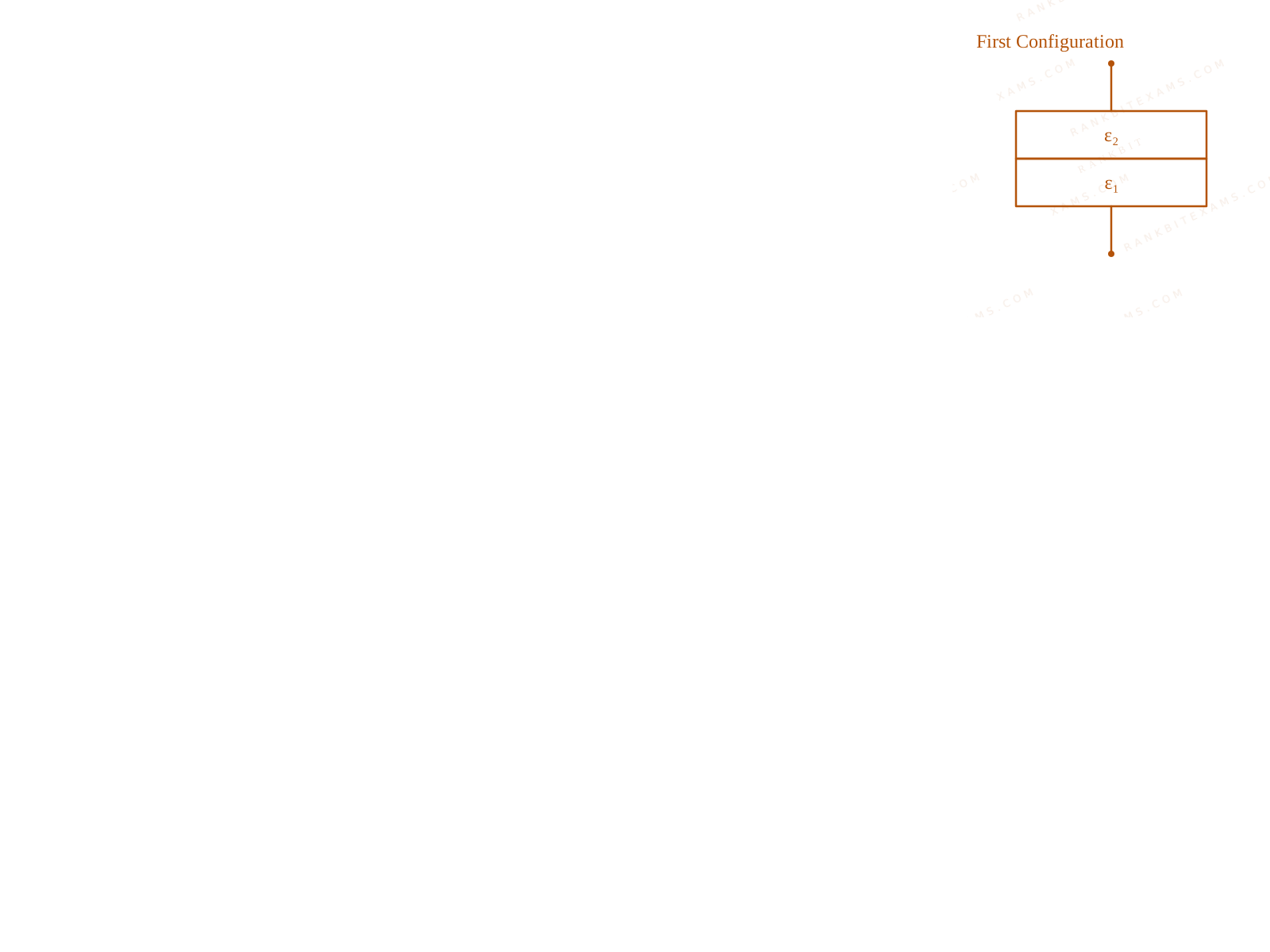
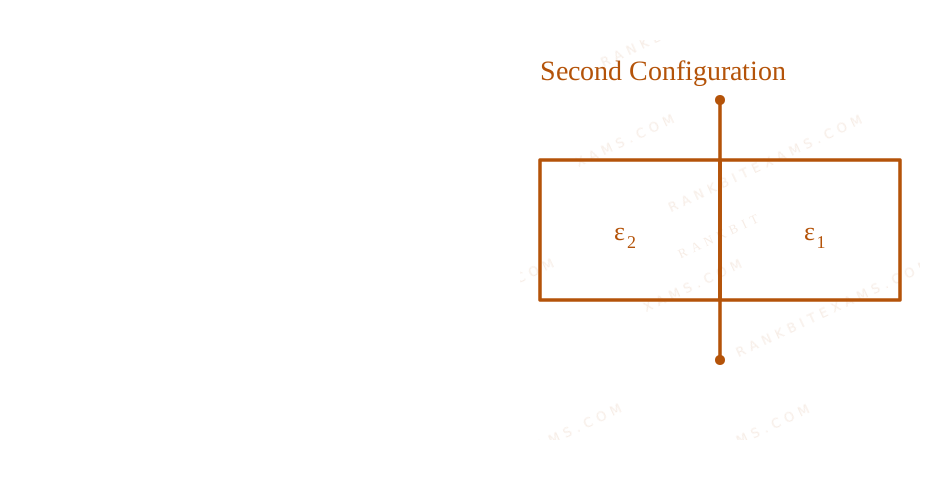
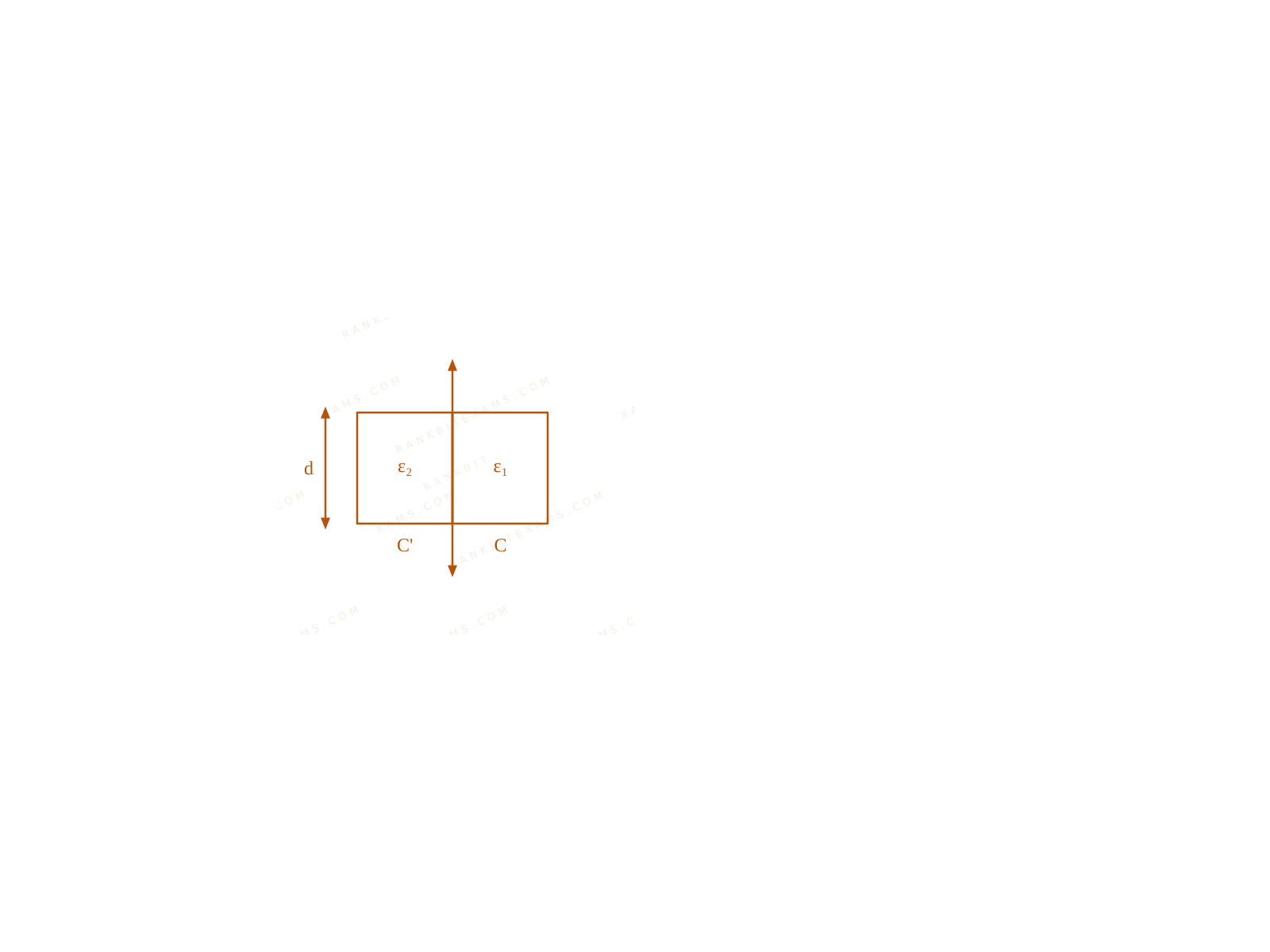
A parallel plate capacitor is filled equally (half) with two dielectrics of dielectric constant varepsilon_1$\varepsilon_1$ and varepsilon_2$\varepsilon_2$, as shown in figures. The distance between the plates is d$d$ and area of each plate is A$A$. If capacitance in first configuration and second configuration are C_1$C_1$ and C_2$C_2$ respectively, then fracC_1C_2$\frac{C_1}{C_2}$ is:
Illustrates two parallel plate configurations: stacked horizontally (series) and stacked vertically (parallel).Illustrates two parallel plate configurations: stacked horizontally (series) and stacked vertically (parallel).
### Related Formula
Capacitance with dielectric:
C = fracvarepsilon_r varepsilon_0 Ad$$C = \frac{\varepsilon_r \varepsilon_0 A}{d}$$
Series Capacitors:
C_texteq = fracC_a C_bC_a + C_b$$C_{\text{eq}} = \frac{C_a C_b}{C_a + C_b}$$
Parallel Capacitors:
C_texteq = C_a + C_b$$C_{\text{eq}} = C_a + C_b$$
### Core Logic
Let C_0 = fracvarepsilon_0 Ad$C_0 = \frac{\varepsilon_0 A}{d}$ be the capacitance without any dielectric.
- **First Configuration (Series connection)**:
The dielectrics split the gap vertically, so the effective thickness of each slab is d/2$d/2$, and the area remains A$A$.
C_a = fracvarepsilon_1 varepsilon_0 Ad/2 = 2varepsilon_1 C_0$$C_a = \frac{\varepsilon_1 \varepsilon_0 A}{d/2} = 2\varepsilon_1 C_0$$C_b = fracvarepsilon_2 varepsilon_0 Ad/2 = 2varepsilon_2 C_0$$C_b = \frac{\varepsilon_2 \varepsilon_0 A}{d/2} = 2\varepsilon_2 C_0$$
Since they are in series:
C_1 = fracC_a C_bC_a + C_b = frac(2varepsilon_1 C_0)(2varepsilon_2 C_0)2varepsilon_1 C_0 + 2varepsilon_2 C_0 = frac4varepsilon_1varepsilon_2 C_0^22C_0(varepsilon_1 + varepsilon_2) = frac2varepsilon_1varepsilon_2varepsilon_1 + varepsilon_2 C_0$$C_1 = \frac{C_a C_b}{C_a + C_b} = \frac{(2\varepsilon_1 C_0)(2\varepsilon_2 C_0)}{2\varepsilon_1 C_0 + 2\varepsilon_2 C_0} = \frac{4\varepsilon_1\varepsilon_2 C_0^2}{2C_0(\varepsilon_1 + \varepsilon_2)} = \frac{2\varepsilon_1\varepsilon_2}{\varepsilon_1 + \varepsilon_2} C_0$$
- **Second Configuration (Parallel connection)**:
The dielectrics split the area horizontally, so the effective area of each slab is A/2$A/2$, and the distance remains d$d$.
C_c = fracvarepsilon_1 varepsilon_0 (A/2)d = fracvarepsilon_1 C_02$$C_c = \frac{\varepsilon_1 \varepsilon_0 (A/2)}{d} = \frac{\varepsilon_1 C_0}{2}$$C_d = fracvarepsilon_2 varepsilon_0 (A/2)d = fracvarepsilon_2 C_02$$C_d = \frac{\varepsilon_2 \varepsilon_0 (A/2)}{d} = \frac{\varepsilon_2 C_0}{2}$$
Since they are in parallel:
C_2 = C_c + C_d = (varepsilon_1 + varepsilon_2) fracC_02$$C_2 = C_c + C_d = (\varepsilon_1 + \varepsilon_2) \frac{C_0}{2}$$Illustrates two parallel plate configurations: stacked horizontally (series) and stacked vertically (parallel).Illustrates two parallel plate configurations: stacked horizontally (series) and stacked vertically (parallel).
### Step 1: Calculating the Ratio
Now, compute fracC_1C_2$\frac{C_1}{C_2}$:
fracC_1C_2 = fracleft(frac2varepsilon_1varepsilon_2varepsilon_1 + varepsilon_2right) C_0left(fracvarepsilon_1 + varepsilon_22right) C_0 = frac4varepsilon_1varepsilon_2(varepsilon_1 + varepsilon_2)^2$$\frac{C_1}{C_2} = \frac{\left(\frac{2\varepsilon_1\varepsilon_2}{\varepsilon_1 + \varepsilon_2}\right) C_0}{\left(\frac{\varepsilon_1 + \varepsilon_2}{2}\right) C_0} = \frac{4\varepsilon_1\varepsilon_2}{(\varepsilon_1 + \varepsilon_2)^2}$$
### Pattern Recognition
For dielectric-filled capacitors: splitting the gap (d/2$d/2$) leads to a series combination, while splitting the plate area (A/2$A/2$) leads to a parallel combination.
Shortcut: C_textseries = textharmonic mean$C_{\text{series}} = \text{harmonic mean}$, C_textparallel = textarithmetic mean$C_{\text{parallel}} = \text{arithmetic mean}$. The ratio fracC_1C_2$\frac{C_1}{C_2}$ is always the ratio of the harmonic mean of the dielectric constants to their arithmetic mean!
### Evaluation Rubric / Model Answer
null
### Chapter Mix
Class 12 Physics: Electrostatic Potential and Capacitance
Q14jee_main_2025_03_april_morningPotential of a Charged Spherical Shell
The electrostatic potential on the surface of uniformly charged spherical shell of radius R = 10mathrm~cm$R = 10\mathrm{~cm}$ is 120mathrm~V$120\mathrm{~V}$. The potential at the centre of shell, at a distance r = 5mathrm~cm$r = 5\mathrm{~cm}$ from centre, and at a distance r = 15mathrm~cm$r = 15\mathrm{~cm}$ from the centre of the shell respectively, are:
### Related Formula
For a uniformly charged spherical shell of radius R$R$ and charge Q$Q$:
- Inside and on the surface of the shell (r le R$r \le R$):
V_textin = V_textsurface = frackQR$$V_{\text{in}} = V_{\text{surface}} = \frac{kQ}{R}$$
- Outside the shell (r > R$r > R$):
V_textout = frackQr = V_textsurface left(fracRrright)$$V_{\text{out}} = \frac{kQ}{r} = V_{\text{surface}} \left(\frac{R}{r}\right)$$
### Core Logic
Let's calculate the potentials at the specified positions:
- Given surface potential at R = 10mathrm~cm$R = 10\mathrm{~cm}$ is 120mathrm~V$120\mathrm{~V}$.
1. **At the center (r = 0$r = 0$)**:
Since the center lies inside the shell (0 < 10mathrm~cm$0 < 10\mathrm{~cm}$), the potential equals the surface potential:
V_textcentre = 120mathrm~V$$V_{\text{centre}} = 120\mathrm{~V}$$
2. **At r = 5mathrm~cm$r = 5\mathrm{~cm}$**:
Since 5mathrm~cm$5\mathrm{~cm}$ is also inside the shell (5 < 10mathrm~cm$5 < 10\mathrm{~cm}$), the potential remains constant at the surface value:
V_r=5 = 120mathrm~V$$V_{r=5} = 120\mathrm{~V}$$
3. **At r = 15mathrm~cm$r = 15\mathrm{~cm}$**:
Since 15mathrm~cm$15\mathrm{~cm}$ is outside the shell (15 > 10mathrm~cm$15 > 10\mathrm{~cm}$), the potential decreases inversely with distance:
V_r=15 = V_textsurface left(fracRrright) = 120 times frac1015 = 80mathrm~V$$V_{r=15} = V_{\text{surface}} \left(\frac{R}{r}\right) = 120 \times \frac{10}{15} = 80\mathrm{~V}$$
Therefore, the potentials are 120mathrm~V$120\mathrm{~V}$, 120mathrm~V$120\mathrm{~V}$, and 80mathrm~V$80\mathrm{~V}$ respectively.
### Pattern Recognition
The electric field inside a uniformly charged conducting spherical shell is zero, meaning that no work is done moving a charge inside it. Consequently, the potential remains absolutely uniform/constant from the surface all the way to the center!
### Evaluation Rubric / Model Answer
null
### Chapter Mix
Class 12 Physics: Electrostatic Potential and Capacitance
More Electrostatics Questions — jee_main_2025_24_jan_evening
We Map Every Repeating Question in Competitive Exams.
Say goodbye to generic mock test fatigue. RankBit uses smart analysis to group past exam questions into their foundational Repeating Question Types. Find chapter weightage, track repeating questions, and score higher with targeted practice.
Select Your Target Exam
Choose an exam track below to find formulas per chapter and patterns.
Syncing Exam Intelligence
Mapping formulas and patterns across all tracks…
PATH A — FULL LENGTH PRACTICE
Full Mock Test Hub
Simulate real NTA exam conditions with fully tracked mocks. Time yourself against past papers.
Practice past-year questions one chapter at a time. Pick an exam → subject → chapter and get every PYQ for that topic — pulled together from all past papers — with the chapter's key formulas alongside.