Rankbit System
JEE Physics: Waves (+15.5%) | Electrostatics: Concentric Shells (-29.7%) | Modern Physics: Photoelectric Clones (+34.2%) | Mathematics: Definite Integrals (+18.1%) | Chemistry: Coordination Splitting (-11.4%) | JEE Physics: Waves (+15.5%) | Electrostatics: Concentric Shells (-29.7%) | Modern Physics: Photoelectric Clones (+34.2%) | Mathematics: Definite Integrals (+18.1%) | Chemistry: Coordination Splitting (-11.4%)

In the first configuration (1) as shown in the figure
Electrostatic potential energy configuration 1 square charges Q7
The diagram displays configuration 1 with 4 charges on corners and configuration 2 with charges on the midpoints of the square sides.
, four identical charges (q_0) are kept at the corners A, B, C and D of square of side length 'a'. In the second configuration (2)
Electrostatic potential energy configuration 1 square charges Q7
The diagram displays configuration 1 with 4 charges on corners and configuration 2 with charges on the midpoints of the square sides.
, the same charges are shifted to mid points G, E, H and F, of the square. If K=frac14pivarepsilon_0, the difference between the potential energies of configuration (2) and (1) is given by:

Solution & Explanation

### Related Formula U = sum_i < j fracK q_i q_jr_ij ### Core Logic For configuration (1) with side length a: - 4 pairs of adjacent side-charges with distance a. - 2 pairs of diagonal charges with distance sqrt2a. U_1 = 4 cdot fracKq_0^2a + 2 cdot fracKq_0^2sqrt2a = fracKq_0^2a(4 + sqrt2) For configuration (2), charges lie on midpoints forming an inner square of side length a' = fracasqrt2: - 4 pairs at distance fracasqrt2. - 2 pairs at diagonal distance a. U_2 = 4 cdot fracKq_0^2fracasqrt2 + 2 cdot fracKq_0^2a = fracKq_0^2a(4sqrt2 + 2) ### Step 1: Finding the difference U_2 - U_1 = fracKq_0^2aleft[(4sqrt2 + 2) - (4 + sqrt2) ight] = fracKq_0^2a(3sqrt2 - 2) ### Pattern Recognition The side of the new square formed by midpoints is scaled down by 1/sqrt2. Therefore, interaction terms scale accordingly based on system geometric dimensions. ### Evaluation Rubric / Model Answer null ### Chapter Mix Class 12 Physics: Electrostatic Potential and Capacitance
More Electrostatic Potential and Capacitance Previous-Year Questions — Page 2

Q4 2025 Equipotential Surfaces
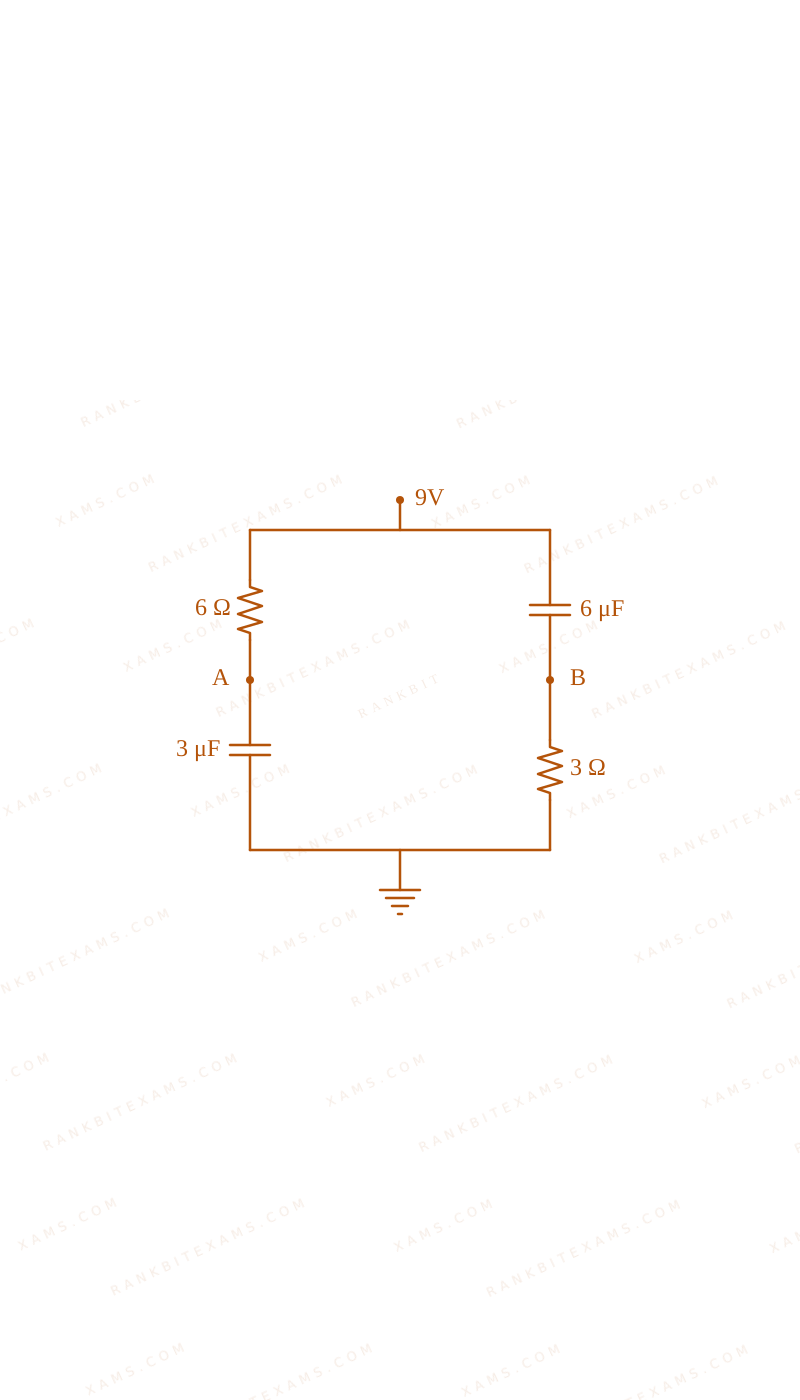
Three infinitely long wires with linear charge density lambda are placed along the x-axis, y-axis and z-axis respectively. Which of the following denotes an equipotential surface?
  • A. mathrmxy + mathrmyz + mathrmzx = textconstant
  • B. (mathrmx + y)(mathrmy + z)(mathrmz + x) = textconstant
  • C. (mathrmx^2 +mathrmy^2)(mathrmy^2 +mathrmz^2)(mathrmz^2 +mathrmx^2) = textconstant
  • D. mathrmxyz = textconstant

Solution

### Related Formula mathrmV = -int vecmathrmEcdotmathrmdvecmathrmr = 2mathrmklambda ln mathrmr + mathrmc ### Core Logic The potential at a point due to a line charge on an axis is proportional to the logarithm of its perpendicular distance. For the wire along the z-axis: mathrmV_z = -mathrmklambda ln(x^2 + y^2) For the wire along the x-axis: mathrmV_x = -mathrmklambda ln(y^2 + z^2) For the wire along the y-axis: mathrmV_y = -mathrmklambda ln(z^2 + x^2) Summing the individual potentials to find the net configuration potential: mathrmV_textnet = -mathrmklambda left[ ln(x^2+y^2) + ln(y^2+z^2) + ln(z^2+x^2) right] + mathrmC' mathrmV_textnet = -mathrmklambda ln left[ (x^2+y^2)(y^2+z^2)(z^2+x^2) right] + mathrmC' For an equipotential surface, set mathrmV_textnet = textconstant: ### Step 1: Final Expression (x^2 + y^2)(y^2 + z^2)(z^2 + x^2) = textconstant This maps perfectly to option (3). ### Pattern Recognition Logarithmic combination rules transform scalar potential additions into products inside the functional argument: sum ln(mathrmr_i^2) = ln(prod mathrmr_i^2). ### Evaluation Rubric / Model Answer null ### Chapter Mix Class 12 Physics: Electrostatic Potential and Capacitance
More Electrostatic Potential and Capacitance Questions — jee_main_2025_24_jan_evening

Practice all Electrostatic Potential and Capacitance previous-year questions →

YOUR FIRST PREP STEP STARTS HERE

We Map Every Repeating Question in Competitive Exams.

Say goodbye to generic mock test fatigue. RankBit uses smart analysis to group past exam questions into their foundational Repeating Question Types. Find chapter weightage, track repeating questions, and score higher with targeted practice.

Select Your Target Exam

Choose an exam track below to find formulas per chapter and patterns.

Syncing Exam Intelligence

Mapping formulas and patterns across all tracks…

PATH A — FULL LENGTH PRACTICE

Full Mock Test Hub

Simulate real NTA exam conditions with fully tracked mocks. Time yourself against past papers.

Under Development
PATH B — TARGETED PRACTICE

Topic-wise Practice Hub

Practice past-year questions one chapter at a time. Pick an exam → subject → chapter and get every PYQ for that topic — pulled together from all past papers — with the chapter's key formulas alongside.

Loading Questions... Browse Topics
Latest from the Blog
View all →

Loading articles...