JEE Main · Mathematics ↓ Falling

Limits, Continuity and Differentiability appeared 52 times across 3 years — 6% of Mathematics. This question is from Number of Real Solutions of Equations.

Year 2026 2025 2024 Total
Questions 12 24 16 52

The number of real solution(s) of the equation x²+3x+2= |x-3|, |x+2| is:

Solution & Explanation

Related Formula

The function f(x), g(x) chooses the lower vertical path between the two curves at any coordinate x.

Core Logic

Analyze the conditions for the right-hand function |x-3|, |x+2|:

  • The intersection of |x-3| = |x+2| happens at x - 3 = -(x + 2) ⇒ 2x = 1 ⇒ x = 0.5.
  • For x ≤ 0.5, |x+2| ≤ |x-3| ⇒ = |x+2|.
  • For x > 0.5, |x-3| ≤ |x+2| ⇒ = |x-3|.
  • Min function intersection graph for Q68 - JEE Main 2025 Evening
    Min function intersection graph for Q68 - JEE Main 2025 Evening

Step 1: Check Interval x ≤ -2

Here, |x+2| = -(x+2) = -x-2:

x² + 3x + 2 = -x - 2 ⇒ x² + 4x + 4 = 0 (x+2)² = 0 ⇒ x = -2

This is a valid solution as it lies precisely within the interval condition boundary.

Step 2: Check Interval -2 < x ≤ 0.5

Here, |x+2| = x+2:

x² + 3x + 2 = x + 2 ⇒ x² + 2x = 0 x(x+2) = 0 ⇒ x = 0 or x = -2

Only x = 0 fits inside this interval.

Step 3: Check Interval x > 0.5

Here, = |x-3| = 3-x:

x² + 3x + 2 = 3 - x ⇒ x² + 4x - 1 = 0 x = -4 ± √(16 - 4(1)(-1))2 = -2 ± √(5)

Evaluating values: -2 + √(5) ≈ 0.236, which does not satisfy x > 0.5. Thus, no real roots occur in this span.

Combining valid points, we find exactly 2 distinct real solutions (x = -2, 0).

Pattern Recognition

Sketching a rough visualization showing the parabola crossing below the sharp wedge of the combined absolute values makes it visually clear that there are exactly two crossing points, confirming the algebraic count.

Chapter Mix

Class 11 Mathematics: Quadratic Equations Class 12 Mathematics: Limits, Continuity and Differentiability

Reference Study Guides

More Limits, Continuity and Differentiability Previous-Year Questions — Page 4

Q51 jee_main_2025_03_april_evening Differentiability and Extrema
Let f: R → R be a function defined by f(x) = | |x + 2| - 2|x| |. If m is the number of points of local minima and n is the number of points of local maxima of f, then m + n is
  • A. 5
  • B. 3
  • C. 2
  • D. 4

Solution

Related Formula

For a continuous function f(x):

  • A point x = c is a local minimum if f(x) changes from decreasing to increasing as x passes through c (i.e., a trough in the graph).
  • A point x = c is a local maximum if f(x) changes from increasing to decreasing as x passes through c (i.e., a peak in the graph).
Core Logic

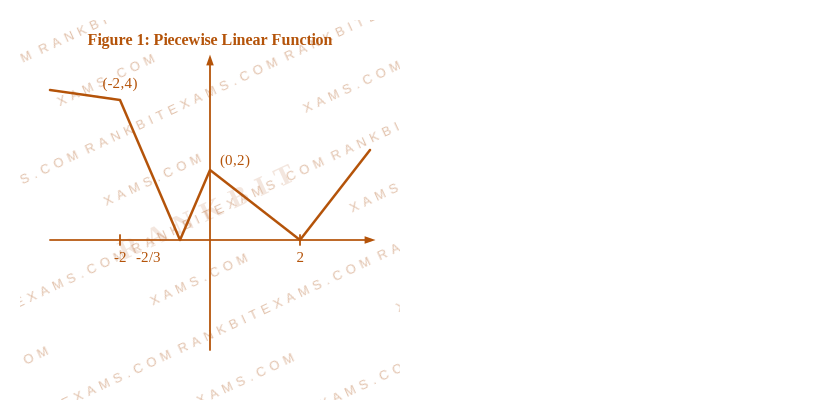
Let's analyze g(x) = |x+2| - 2|x| first to construct f(x) = |g(x)|.

  • If x ≤ -2:
g(x) = -(x+2) - 2(-x) = x - 2
  • If -2 < x ≤ 0:
g(x) = (x+2) - 2(-x) = 3x + 2
  • If x > 0:
g(x) = (x+2) - 2x = -x + 2

Now, we find the critical transition points where g(x) = 0:

  • x - 2 = 0 x = 2 (not in x ≤ -2)
  • 3x + 2 = 0 x = -2/3 (lies in -2 < x ≤ 0)
  • -x + 2 = 0 x = 2 (lies in x > 0)
  • Thus, the absolute value function f(x) = |g(x)| transitions at x = -2, x = -2/3, x = 0, and x = 2.

Step 1: Graph Reconstruction and Critical Points Analysis

Evaluating values at these boundaries:

  • f(-2) = | |-2+2| - 2|-2| | = |0 - 4| = 4
  • f(-2/3) = 0 (trough, local minimum)
  • f(0) = | |2| - 0 | = 2 (peak, local maximum)
  • f(2) = 0 (trough, local minimum)
  • Let's trace the graph:

  • For x < -2, f(x) = |x-2| = 2-x, which decreases towards 4 as x → -2.
  • At x = -2, there is a corner point (-2,4), but it is not an extremum because the function continues to decrease to 0 on the right.
  • At x = -2/3, it reaches 0 and turns upwards (local minimum).
  • At x = 0, it reaches a local peak of 2 and turns downwards (local maximum).
  • At x = 2, it reaches 0 and turns upwards (local minimum).
  • Extrema diagram for Q51 - JEE Main 2025 Evening Shift
    Extrema diagram for Q51 - JEE Main 2025 Evening Shift

Step 2: Calculating m + n

From the verified graph and transition behaviors:

  • Local minima points (m): x = -2/3 and x = 2 m = 2
  • Local maxima points (n): x = 0 n = 1
Sum m + n = 2 + 1 = 3
Pattern Recognition

Whenever you have f(x) = |g(x)| where g(x) is continuous:

  • Any point where g(x) = 0 becomes a local minimum with value 0 (unless it was a tangent point already, which still remains a minimum).
  • Corners of the original absolute segments like x=0, -2 must be checked sequentially for slope changes.
Chapter Mix

Class 12 Mathematics: Limits, Continuity and Differentiability Class 11 Mathematics: Relations and Functions

Q73 jee_main_2025_03_april_evening Evaluation of Limits
If x → 0 ( ( x)/(x) )(1)/(x²) = p, then 96 ₑ p is equal to
Numerical Answer. Answer: 32 to 32

Solution

Related Formula

For a limit of 1∞ form, where f(x) = 1 and g(x) = ∞:

[f(x)]g(x) = eg(x)(f(x) - 1)

Taylor expansion of x:

x = x + (x³)/(3) + (2x⁵)/(15) +
Core Logic

Here, x → 0 ( x)/(x) = 1 and x → 0 (1)/(x²) = ∞.

p = e^ x → 0 (1)/(x²)(( x)/(x) - 1) = e^ x → 0 ( x - x)/(x³)
Step 1: Finding limit exponent

Using expansion of x:

x → 0 ((x + (x³)/(3) + ) - x)/(x³) = x → 0 ((x³)/(3) + O(x⁵))/(x³) = (1)/(3)

Thus: p = e1/3

96 ₑ p = 96((1)/(3)) = 32
Pattern Recognition

Limits of forms like 1∞ always boil down to evaluating standard polynomials in the exponent. Using Taylor series expansion rather than L'Hopital's rule directly avoids taking multiple heavy derivatives.

Chapter Mix

Class 12 Mathematics: Limits, Continuity and Differentiability

Q jee_main_2025_07_april_morning Evaluation of Limits
x→ 0⁺ (5(x)(1)/(3)) ₑ(1 + 3x²)( ⁻¹3√(x))²(e^5(x)(4)/(3) - 1) is equal to
  • A. (1)/(15)
  • B. 1
  • C. (1)/(3)
  • D. (5)/(3)

Solution

Related Formula

Standard limits commands:

f(x)→ 0 ( (f(x)))/(f(x)) = 1 f(x)→ 0 (ln(1+f(x)))/(f(x)) = 1 f(x)→ 0 ⁻¹(f(x))f(x) = 1 f(x)→ 0 ef(x)-1f(x) = 1
Core Logic

We can rewrite the limit by grouping each term with its standard balancing factor:

x→ 0⁺ ( (5x1/3)5x1/3) · ( 3√(x) ⁻¹3√(x))² · ( ₑ(1 + 3x²)3x²) · ( 5x4/3e^5x4/3 - 1) × 5x1/3 · 3x²(3√(x))² · 5x4/3
Step 1: Simplify the Compensating Factor

Evaluate the remaining algebraic factor:

5x1/3 · 3x²9x · 5x4/3 = 15x7/345x7/3 = (15)/(45) = (1)/(3)

Since all individual standard limit terms approach 1, the value of the limit is exactly:

1 · 1² · 1 · 1 · (1)/(3) = (1)/(3)
Pattern Recognition

Shortcut: For standard limits involving (u), ln(1+u), ⁻¹(u), and e^u-1 as u → 0, replace each function directly with its argument:

(5x1/3)(3x²)(3√(x))²(5x4/3) = 15x7/345x7/3 = (1)/(3)
Chapter Mix

Class 11 Mathematics: Limits and Derivatives Class 12 Mathematics: Limits, Continuity and Differentiability

Q71 jee_main_2025_07_april_morning Points of Discontinuity
The number of points of discontinuity of the function f(x) = [(x²)/(2)] - [√(x)], x in [0,4] , where [·] denotes the greatest integer function is
Numerical Answer. Answer: 8 to 8

Solution

Related Formula

The greatest integer function [u] changes value and experiences a step discontinuity at any point where its inner argument u takes on an integer value.

Core Logic

Analyze the potential points where either component function argument changes into an integer within the interval x in [0, 4].

  • For [(x²)/(2)]:
  • (x²)/(2) can range from (0)/(2) = 0 up to (16)/(2) = 8. Integer values are reached at (x²)/(2) = 0, 1, 2, 3, 4, 5, 6, 7, 8, which means critical test locations are:

x = 0, √(2), 2, √(6), √(8), √(10), √(12), √(14), 4
  • For [√(x)]:
  • √(x) can range from √(0) = 0 to √(4) = 2. Integer values are reached at √(x) = 0, 1, 2, which means critical test locations are:

x = 0, 1, 4
Step 1: Audit Each Critical Point

Combine the set of test points within domain boundaries (0, 4):

x in 1, √(2), 2, √(6), √(8), √(10), √(12), √(14)

Let's evaluate the left and right hand limits at these specific values:

  • At x = 1: [√(x)] steps up while [(x²)/(2)] is constant Discontinuous.
  • At x = √(2): [(x²)/(2)] steps up while [√(x)] is constant Discontinuous.
  • At x = 2: Both functions experience an simultaneous integer step. Let's inspect:
  • f(2) = [2] - [√(2)] = 2 - 1 = 1
  • f(2^-) = [1.99] - [1.41] = 1 - 1 = 0
  • Since LHL ≠ value at point, it is Discontinuous. Continuing this verification down the full combined list confirms that none of the step jumps cancel each other out.

Step 2: Sum the Discontinuity Points

Counting all isolated inner points within (0, 4) yields exactly 8 locations:

Total Points = 8
Pattern Recognition

When two greatest integer functions drop steps simultaneously at the same point (like at x=2), always write out the explicit left and right limits manually, as simultaneous steps occasionally step in matching directions and maintain unexpected continuity.

Chapter Mix

Class 12 Mathematics: Limits, Continuity and Differentiability

Q70 jee_main_2025_08_april_evening Standard Limits and Expansion
Given below are two statements : Statement I : _ x arrow 0 ( ^ - 1 x + _ e 1 + x1 - x - 2 xx ^ 5) = (2)/(5) Statement II: x→ 1(x(2)/(1 - x)) = 1e² In the light of the above statements, choose the correct answer from the options given below:
  • A. Statement I is false but Statement II is true
  • B. Statement I is true but Statement II is false
  • C. Both Statement I and Statement II are false.
  • D. Both Statement I and Statement II are true.

Solution

Related Formula
(1+x) = x - (x²)/(2) + (x³)/(3) - x → a u^v = e(u-1)v
Core Logic

Verify Statement I via high-order Taylor polynomial series tracking, and determine Statement II values by resolving standard exponential limit properties.

Step 1: Expand Statement I Sequence Polynomials
⁻¹x = x - (x³)/(3) + (x⁵)/(5) - (1)/(2)[ln(1+x) - ln(1-x)] = x + (x³)/(3) + (x⁵)/(5) +

Summing terms together and subtracting 2x leaves:

x → 0 (2x⁵/5 + )/(x⁵) = (2)/(5) (Statement I is true)
Step 2: Verify Statement II Limit Power Structure

Evaluating the 1^∞ form configuration style:

e^ x → 1 ((2)/(1-x))(x-1) = e⁻² = (1)/(e²) (Statement II is true)
Step 3: State Conclusion

Both statements are correct.

Pattern Recognition

When a limit features a power factor of 5 in the denominator, you must track expansion variables through the 5th degree term to guarantee accuracy.

Chapter Mix

Class 11 Mathematics: Limits

More Limits, Continuity and Differentiability Questions — jee_main_2025_24_jan_evening

Practice all Limits, Continuity and Differentiability previous-year questions →

Rankbit System
JEE Physics: Waves (+15.5%) | Electrostatics: Concentric Shells (-29.7%) | Modern Physics: Photoelectric Clones (+34.2%) | Mathematics: Definite Integrals (+18.1%) | Chemistry: Coordination Splitting (-11.4%) | JEE Physics: Waves (+15.5%) | Electrostatics: Concentric Shells (-29.7%) | Modern Physics: Photoelectric Clones (+34.2%) | Mathematics: Definite Integrals (+18.1%) | Chemistry: Coordination Splitting (-11.4%)