JEE Main · Mathematics ↓ Falling

Limits, Continuity and Differentiability appeared 52 times across 3 years — 6% of Mathematics. This question is from Number of Real Solutions of Equations.

Year 2026 2025 2024 Total
Questions 12 24 16 52

The number of real solution(s) of the equation x²+3x+2= |x-3|, |x+2| is:

Solution & Explanation

Related Formula

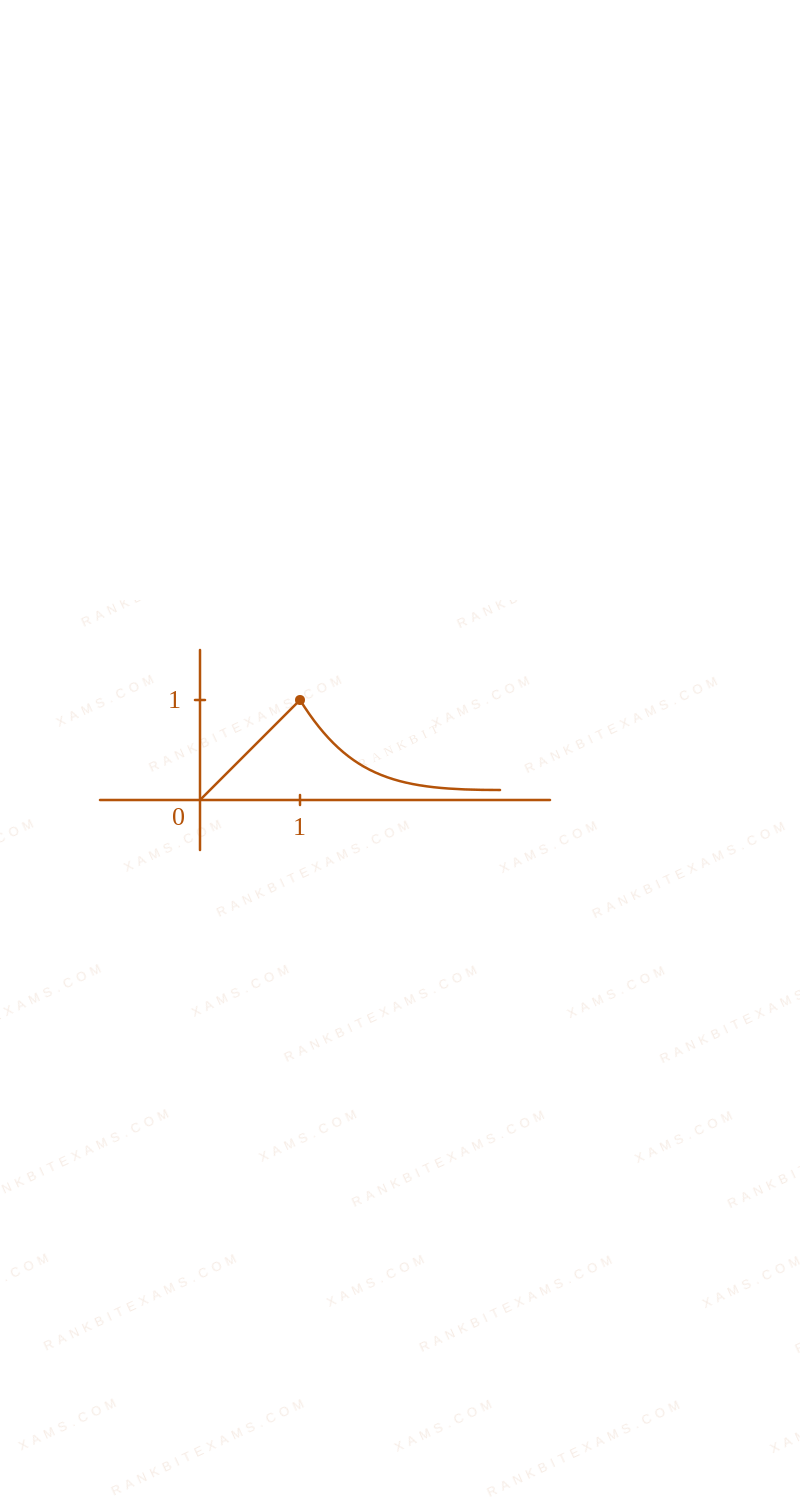
The function f(x), g(x) chooses the lower vertical path between the two curves at any coordinate x.

Core Logic

Analyze the conditions for the right-hand function |x-3|, |x+2|:

  • The intersection of |x-3| = |x+2| happens at x - 3 = -(x + 2) ⇒ 2x = 1 ⇒ x = 0.5.
  • For x ≤ 0.5, |x+2| ≤ |x-3| ⇒ = |x+2|.
  • For x > 0.5, |x-3| ≤ |x+2| ⇒ = |x-3|.
  • Min function intersection graph for Q68 - JEE Main 2025 Evening
    Min function intersection graph for Q68 - JEE Main 2025 Evening

Step 1: Check Interval x ≤ -2

Here, |x+2| = -(x+2) = -x-2:

x² + 3x + 2 = -x - 2 ⇒ x² + 4x + 4 = 0 (x+2)² = 0 ⇒ x = -2

This is a valid solution as it lies precisely within the interval condition boundary.

Step 2: Check Interval -2 < x ≤ 0.5

Here, |x+2| = x+2:

x² + 3x + 2 = x + 2 ⇒ x² + 2x = 0 x(x+2) = 0 ⇒ x = 0 or x = -2

Only x = 0 fits inside this interval.

Step 3: Check Interval x > 0.5

Here, = |x-3| = 3-x:

x² + 3x + 2 = 3 - x ⇒ x² + 4x - 1 = 0 x = -4 ± √(16 - 4(1)(-1))2 = -2 ± √(5)

Evaluating values: -2 + √(5) ≈ 0.236, which does not satisfy x > 0.5. Thus, no real roots occur in this span.

Combining valid points, we find exactly 2 distinct real solutions (x = -2, 0).

Pattern Recognition

Sketching a rough visualization showing the parabola crossing below the sharp wedge of the combined absolute values makes it visually clear that there are exactly two crossing points, confirming the algebraic count.

Chapter Mix

Class 11 Mathematics: Quadratic Equations Class 12 Mathematics: Limits, Continuity and Differentiability

Reference Study Guides

More Limits, Continuity and Differentiability Previous-Year Questions — Page 10

Q20 jee_main_2024_30_jan_morning Limits
Let f:[-(π)/(2),(π)/(2)] → R be a differentiable function such that f(0) = (1)/(2). If the x → 0 x ∫₀x f(t) dtex² - 1 = α, then 8α² is equal to:
  • A. 16
  • B. 2
  • C. 1
  • D. 4

Solution

Related Formula
y → 0 (e^y - 1)/(y) = 1

Leibniz Integral Rule:

(d)/(dx) ∫₀^x f(t) dt = f(x)
Core Logic

Given limit is:

α = x → 0 x ∫₀x f(t) dtex² - 1

Multiply and divide the denominator by x² to use standard exponential limit:

α = x → 0 x ∫₀x f(t) dt( ex² - 1x²) · x²

Since x→ 0 ex² - 1x² = 1, the expression simplifies to:

α = x → 0 x ∫₀x f(t) dt1 · x² = x → 0 ∫₀x f(t) dtx
Step 1: Applying L'Hôpital's Rule

This is a 0/0 form. Apply L'Hôpital's Rule by differentiating numerator and denominator w.r.t x:

α = x → 0 (d)/(dx) ∫₀x f(t) dt(d)/(dx)(x) = x → 0 (f(x))/(1)

By continuity of differentiable function f at 0: α = f(0)

Step 2: Final Calculation

We are given f(0) = (1)/(2), so α = (1)/(2). We need to find 8α²:

8α² = 8 ((1)/(2))² = 8 ((1)/(4)) = 2
Pattern Recognition

Standard expansion/limits on isolated terms in denominators immediately reduce the power of x, setting up a trivial Leibniz derivative application.

Chapter Mix

Class 11 Maths: Limits and Derivatives Class 12 Maths: Integrals
Q29 jee_main_2024_30_jan_morning Differentiability
If the function f(x) = cases (1)/(|x|) & ,|x| ≥ 2 ax² + 2b & ,|x| < 2 cases is differentiable on R, then 48 (a + b) is equal to
Numerical Answer. Answer: 15 to 15

Solution

Related Formula
Continuity at x=c: x → c^- f(x) = x → c^+ f(x) Differentiability at x=c: x → c^- f'(x) = x → c^+ f'(x)
Core Logic

Rewrite the piecewise function without absolute values:

f(x) = cases (1)/(x) & , x ≥ 2 ax² + 2b & , -2 < x < 2 -(1)/(x) & , x ≤ -2 cases
Step 1: Applying Continuity

For f(x) to be continuous at x = 2:

x → 2^- (ax² + 2b) = x → 2^+ (1)/(x) a(2)² + 2b = (1)/(2) ⇒ 4a + 2b = (1)/(2) (1)

Because the function is even, continuity at x = -2 yields the exact same equation: 4a + 2b = 1/2.

Step 2: Applying Differentiability

Find the derivative f'(x) for piecewise sections:

f'(x) = cases -(1)/(x²) & , x > 2 2ax & , -2 < x < 2 (1)/(x²) & , x < -2 cases

For f(x) to be differentiable at x = 2:

x → 2^- (2ax) = x → 2^+ (-(1)/(x²)) 4a = -(1)/(4) ⇒ a = -(1)/(16)
Step 3: Finding variables and final target

Substitute a back into equation (1):

4(-(1)/(16)) + 2b = (1)/(2) -(1)/(4) + 2b = (1)/(2) ⇒ 2b = (3)/(4) ⇒ b = (3)/(8)

We need to evaluate 48(a + b):

48(-(1)/(16) + (3)/(8)) = 48((-1 + 6)/(16)) = 48((5)/(16)) = 3 × 5 = 15
Pattern Recognition

Piecewise differentiability forces simultaneous linear equations matching function values and their first derivatives at boundary limits.

Chapter Mix

Class 12 Maths: Continuity and Differentiability

Q10 jee_main_2024_31_jan_evening Limits of Functions
Let f: R → (0, ∞) be strictly increasing function such that x → ∞ (f(7x))/(f(x)) = 1. Then, the value of x arrow ∞ [ (f(5x))/(f(x)) - 1 ] is equal to
  • A. 4
  • B. 0
  • C. 7/5
  • D. 1

Solution

Related Formula
Sandwich / Squeeze Theorem: If g(x) ≤ h(x) ≤ k(x) and g(x) = k(x) = L, then h(x) = L
Core Logic

Since f is a strictly increasing function mapping to (0,∞): For x > 0, we have x < 5x < 7x. Thus, f(x) < f(5x) < f(7x). Divide everything by f(x) (which is strictly positive):

1 < (f(5x))/(f(x)) < (f(7x))/(f(x))

Take the limit as x → ∞:

x→∞ 1 ≤ x→∞ (f(5x))/(f(x)) ≤ x→∞ (f(7x))/(f(x)) 1 ≤ x→∞ (f(5x))/(f(x)) ≤ 1

Therefore, x→∞ (f(5x))/(f(x)) = 1. The required value is:

x arrow ∞ [ (f(5x))/(f(x)) - 1 ] = 1 - 1 = 0
Chapter Mix

Class 11 Maths: Limits and Derivatives Class 12 Maths: Continuity and Differentiability

Q14 jee_main_2024_31_jan_evening Differentiability
Consider the function f:(0,∞)→ R defined by f(x) = e^-| ₑx|. If m and n be respectively the number of points at which f is not continuous and f is not differentiable, then m + n is
  • A. 0
  • B. 3
  • C. 1
  • D. 2

Solution

Core Logic

Differentiability diagram for Q14 - JEE Main 2024 Evening

The function is f(x) = e-|ln x|. Rewrite piecewise for (0, ∞):

f(x) = cases e-(-ln x) & if 0 < x < 1 e-ln x & if x ≥ 1 cases f(x) = cases eln x = x & if 0 < x < 1 1eln x = (1)/(x) & if x ≥ 1 cases

Check continuity at x = 1:

x → 1^- f(x) = x → 1^- x = 1 x → 1^+ f(x) = x → 1^+ (1)/(x) = 1

f(1) = 1. The function is continuous everywhere on (0, ∞). Thus, m = 0.

Check differentiability at x = 1:

LHD = x → 1^- f'(x) = 1 RHD = x → 1^+ f'(x) = -(1)/(x²)|x=1 = -1

Since LHD ≠ RHD, the function is not differentiable at x = 1. Thus, n = 1.

Finally, m + n = 0 + 1 = 1.

Chapter Mix

Class 12 Maths: Continuity and Differentiability

Q27 jee_main_2024_31_jan_evening Maclaurin Series / L'Hopital
If x → 0 ax²e^x - b ₑ(1 + x) + cxe-xx² x = 1, then 16(a² + b² + c²) is equal to
Numerical Answer. Answer: 81 to 81

Solution

Related Formula
e^x = 1 + x + (x²)/(2!) + ln(1+x) = x - (x²)/(2) + (x³)/(3) - x ≈ x x² x ≈ x³
Core Logic

Expand the numerator terms using Maclaurin series around x=0:

ax² (1 + x + (x²)/(2) + ) - b (x - (x²)/(2) + (x³)/(3) - ) + cx (1 - x + (x²)/(2) - (x³)/(6) + )

Denominator behavior is x³. Group by powers of x: Coefficient of x: -b + c = 0 c = b Coefficient of x²: a + (b)/(2) - c = 0 a = c - (b)/(2) = (b)/(2) Coefficient of x³: a - (b)/(3) + (c)/(2) = 1

Substitute a = b/2 and c = b into the x³ equation:

(b)/(2) - (b)/(3) + (b)/(2) = 1 b - (b)/(3) = 1 (2b)/(3) = 1 b = (3)/(2)

This gives c = (3)/(2) and a = (3)/(4).

Calculate the required value:

16(a² + b² + c²) = 16((9)/(16) + (9)/(4) + (9)/(4)) = 9 + 36 + 36 = 81
Chapter Mix

Class 11 Maths: Limits and Derivatives

More Limits, Continuity and Differentiability Questions — jee_main_2025_24_jan_evening

Practice all Limits, Continuity and Differentiability previous-year questions →

Rankbit System
JEE Physics: Waves (+15.5%) | Electrostatics: Concentric Shells (-29.7%) | Modern Physics: Photoelectric Clones (+34.2%) | Mathematics: Definite Integrals (+18.1%) | Chemistry: Coordination Splitting (-11.4%) | JEE Physics: Waves (+15.5%) | Electrostatics: Concentric Shells (-29.7%) | Modern Physics: Photoelectric Clones (+34.2%) | Mathematics: Definite Integrals (+18.1%) | Chemistry: Coordination Splitting (-11.4%)
