Match List-I with List-II tracking nitrogenous bases structures:
List-I (Base)
List-II (Chemical Structure Diagram)
(A) Adenine
(I) The Match List contains nitrogenous bases aligned with their corresponding biochemical molecular ring structures.
(B) Cytosine
(II) The Match List contains nitrogenous bases aligned with their corresponding biochemical molecular ring structures.
(C) Thymine
(III) The Match List contains nitrogenous bases aligned with their corresponding biochemical molecular ring structures.
(D) Uracil
(IV) The Match List contains nitrogenous bases aligned with their corresponding biochemical molecular ring structures.
Choose the correct answer from the options given below :
A.\text{(A)-(III), (B)-(IV), (C)-(II), (D)-(I)}
B.\text{(A)-(III), (B)-(I), (C)-(IV), (D)-(II)}
C.\text{(A)-(IV), (B)-(III), (C)-(II), (D)-(I)}
D.\text{(A)-(III), (B)-(IV), (C)-(I), (D)-(II)}
Solution & Explanation
### Core Logic
Let's identify the chemical structures of the nitrogenous bases used in nucleic acids:
* **(A) Adenine:** A purine derivative featuring a characteristic fused bicyclic ring system with an amino substituent at position 6 (6-aminopurine)
ightarrow$
ightarrow$ **(III)**.
* **(B) Cytosine:** A pyrimidine monocyclic derivative with an amino group at position 4 and a carbonyl group at position 2 (4-amino-2-oxo-pyrimidine)
ightarrow$
ightarrow$ **(IV)**.
* **(C) Thymine:** Found in DNA, this pyrimidine derivative features a methyl substituent at position 5 along with carbonyl groups at positions 2 and 4 (5-methyl-2,4-dioxo-pyrimidine)
ightarrow$
ightarrow$ **(II)**.
* **(D) Uracil:** Found in RNA, this pyrimidine derivative lacks the methyl group found in thymine, featuring just carbonyl groups at positions 2 and 4 (2,4-dioxo-pyrimidine)
ightarrow$
ightarrow$ **(I)**.
Matching these structures gives the sequence: (A)-(III), (B)-(IV), (C)-(II), (D)-(I).
### Step-by-Step Structural Validation
The biochemical structures correspond to the following configurations:
The Match List contains nitrogenous bases aligned with their corresponding biochemical molecular ring structures.The Match List contains nitrogenous bases aligned with their corresponding biochemical molecular ring structures.The Match List contains nitrogenous bases aligned with their corresponding biochemical molecular ring structures.The Match List contains nitrogenous bases aligned with their corresponding biochemical molecular ring structures.
### Pattern Recognition
Quick identification keys:
- Bicyclic ring = Adenine
- Monocyclic ring with a -mathrmCH_3$-\mathrm{CH}_3$ group = Thymine
- Monocyclic ring without a -mathrmCH_3$-\mathrm{CH}_3$ group = Uracil
- Monocyclic ring with an amino group (-mathrmNH_2$-\mathrm{NH}_2$) = Cytosine
### Evaluation Rubric / Model Answer
null
### Chapter Mix
Class 12 Chemistry: Biomolecules
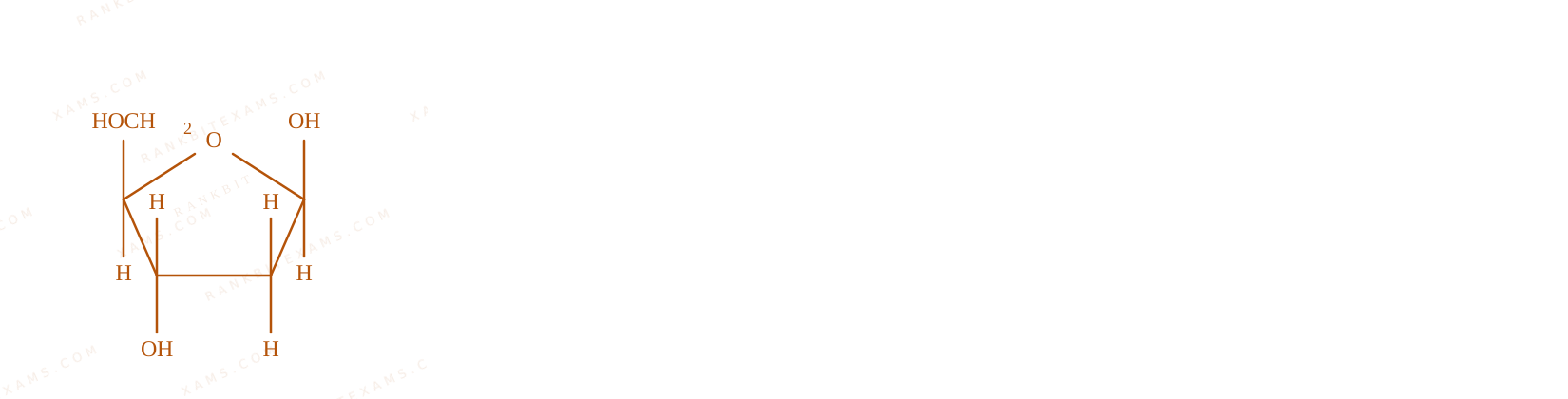
The carbohydrates "Ribose" present in DNA, is
A. A pentose sugar
B. present in pyranose from
C. in "D" configuration
D. a reducing sugar, when free
E. in alpha$\alpha$ -anomeric form
Choose the correct answer from the options given below:
A. A, C and D Only
B. A, B and E Only
C. B, D and E Only
D. A, D and E Only
Solution
### Core Logic
The specific carbohydrate residue present across backbone units in DNA molecules is beta$\beta$-2-deoxy-D-ribose.
Its spatial parameters satisfy the following conditions:
- It is a 5-carbon pentose sugars skeleton structure (A).
- It maintains a canonical D configuration pathway sequence (C).
- When localized in free, open unlinked molecular solutions, it standardly functions as a reducing carbohydrate assembly agent (D).
- It exists predominantly in a furanose cycle form inside DNA, rather than a pyranose ring. Carbohydrates - Nucleic Acids component diagram for Q36 - JEE Main 2025 Morning
### Pattern Recognition
Ribose in nucleic acids occurs primarily as a five-membered furanose ring configuration system.
### Evaluation Rubric / Model Answer
null
### Chapter Mix
Class 12 Chemistry: Biomolecules
Q28jee_main_2025_28_jan_eveningCarbohydrates and Glycosidic Linkages
Match List-I with List-II
List-I (Saccharides)
List-II (Glycosidic-linkages found)
(A) Sucrose
(I) alphatext 1-4$\alpha\text{ 1-4}$
(B) Maltose
(II) alphatext 1-4 and alphatext 1-6$\alpha\text{ 1-4 and }\alpha\text{ 1-6}$
### Related Formula
Glycosidic linkages define the connectivity between monosaccharide units in disaccharides and polysaccharides.
### Core Logic
Analyzing each saccharide configuration:
- **Sucrose**: Formed by alpha$\alpha$-D-glucose and beta$\beta$-D-fructose via a alpha 1 - beta 2$\alpha 1 - \beta 2$ glycosidic linkage.
- **Maltose**: Composed of two alpha$\alpha$-D-glucose units connected by a alpha 1-4$\alpha 1-4$ glycosidic linkage.
- **Lactose**: Composed of beta$\beta$-D-galactose and beta$\beta$-D-glucose via a beta 1-4$\beta 1-4$ glycosidic linkage.
- **Amylopectin**: A branched polymer of glucose with linear alpha 1-4$\alpha 1-4$ linkages and branching at alpha 1-6$\alpha 1-6$ positions.
### Step 1: Final Mapping
Matching pairs lead to:
(A)-(III), (B)-(I), (C)-(IV), (D)-(II).
### Pattern Recognition
Remember shortcuts for common linkages:
- Sucrose is a non-reducing sugar involving the anomeric carbons of both units (alpha 1 - beta 2$\alpha 1 - \beta 2$).
- Lactose has a beta$\beta$-linkage (beta 1-4$\beta 1-4$).
- Amylopectin represents branched starch (alpha 1-4$\alpha 1-4$ and alpha 1-6$\alpha 1-6$).
### Evaluation Rubric / Model Answer
null
### Chapter Mix
Class 12 Chemistry: Biomolecules
Q32jee_main_2025_28_jan_eveningHydrolysis of Carbohydrates
Identify correct conversion during acidic hydrolysis from the following:
(A) starch gives galactose.
(B) cane sugar gives equal amount of glucose and fructose.
(C) milk sugar gives glucose and galactose.
(D) amylopectin gives glucose and fructose.
(E) amylose gives only glucose.
Choose the correct answer from the options given below :
A. (C), (D) and (E) only
B. (A), (B) and (C) only
C. (B), (C) and (E) only
D. (B), (C) and (D) only
Solution
### Related Formula
Acidic or enzymatic hydrolysis cleaves the glycosidic linkages to yield constituent monosaccharides:
textPolysaccharide/Disaccharide xrightarrowH^+ / H_2O textMonosaccharides$$\text{Polysaccharide/Disaccharide} \xrightarrow{H^+ / H_2O} \text{Monosaccharides}$$
### Core Logic
Evaluating each conversion statement:
- (A) Starch xrightarrowH^+$\xrightarrow{H^+}$ only Glucose (not galactose) rightarrow$\rightarrow$ **Incorrect**
- (B) Cane sugar (Sucrose) xrightarrowH^+$\xrightarrow{H^+}$50\%$50\%$ Glucose + 50\%$50\%$ Fructose rightarrow$\rightarrow$ **Correct**
- (C) Milk sugar (Lactose) xrightarrowH^+$\xrightarrow{H^+}$ Glucose + Galactose rightarrow$\rightarrow$ **Correct**
- (D) Amylopectin xrightarrowH^+$\xrightarrow{H^+}$ only Glucose (not fructose) rightarrow$\rightarrow$ **Incorrect**
- (E) Amylose xrightarrowH^+$\xrightarrow{H^+}$ only Glucose rightarrow$\rightarrow$ **Correct**
### Step 1: Finding the Matching Options
Statements (B), (C), and (E) are strictly correct according to carbohydrate biochemistry properties.
### Pattern Recognition
Amylose and amylopectin are both structural components of starch, meaning their hydrolysis yields *only* D-glucose units. Fructose is obtained from sucrose, while galactose comes exclusively from lactose.
### Evaluation Rubric / Model Answer
null
### Chapter Mix
Class 12 Chemistry: Biomolecules
The structural visual index links common natural polysaccharides to glycosidic configurations.The structural visual index links common natural polysaccharides to glycosidic configurations.
A. (A)-(III), (B)-(II), (C)-(I), (D)-(IV)
B. (A)-(IV), (B)-(I), (C)-(II), (D)-(III)
C. (A)-(II), (B)-(III), (C)-(I), (D)-(IV)
D. (A)-(IV), (B)-(I), (C)-(III), (D)-(II)
Solution
### Related Formula
Polysaccharides are defined by specific monomer units bound through distinct alpha$\alpha$ or beta$\beta$ glycosidic linkages.
### Core Logic
Reviewing biological carbohydrate structural configurations based on standard biochemical definitions:
* **(A) Amylose:** Linear unbranched chain polymer of glucose connected via alpha-mathrmC_1-mathrmC_4$\alpha-\mathrm{C}_1-\mathrm{C}_4$ paths in plants rightarrow$\rightarrow$ **(IV)**.
* **(B) Cellulose:** Linear polymer containing glucose linkages connected exclusively via beta-mathrmC_1-mathrmC_4$\beta-\mathrm{C}_1-\mathrm{C}_4$ paths in plants rightarrow$\rightarrow$ **(I)**.
* **(C) Glycogen:** Animal storage polysaccharide with highly branched links alpha-mathrmC_1-mathrmC_4$\alpha-\mathrm{C}_1-\mathrm{C}_4$ and alpha-mathrmC_1-mathrmC_6$\alpha-\mathrm{C}_1-\mathrm{C}_6$ pathways rightarrow$\rightarrow$ **(II)**.
* **(D) Amylopectin:** Branched plant starch components showing mixed linear alpha-mathrmC_1-mathrmC_4$\alpha-\mathrm{C}_1-\mathrm{C}_4$ and branched alpha-mathrmC_1-mathrmC_6$\alpha-\mathrm{C}_1-\mathrm{C}_6$ lines rightarrow$\rightarrow$ **(III)**.
This maps precisely to option (2).
### Pattern Recognition
Cellulose represents the primary standard framework containing beta$\beta$-linkages exclusively; standard starch components like amylose utilize alpha$\alpha$-configurations.
### Chapter Mix
Class 12 Chemistry: Biomolecules
More Biomolecules Questions — jee_main_2025_24_jan_evening
We Map Every Repeating Question in Competitive Exams.
Say goodbye to generic mock test fatigue. RankBit uses smart analysis to group past exam questions into their foundational Repeating Question Types. Find chapter weightage, track repeating questions, and score higher with targeted practice.
Select Your Target Exam
Choose an exam track below to find formulas per chapter and patterns.
Syncing Exam Intelligence
Mapping formulas and patterns across all tracks…
PATH A — FULL LENGTH PRACTICE
Full Mock Test Hub
Simulate real NTA exam conditions with fully tracked mocks. Time yourself against past papers.
Practice past-year questions one chapter at a time. Pick an exam → subject → chapter and get every PYQ for that topic — pulled together from all past papers — with the chapter's key formulas alongside.
 "purine pyrimidine structures, adenine cytosine skeletal core, thymine uracil classification")
 "purine pyrimidine structures, adenine cytosine skeletal core, thymine uracil classification")
 "purine pyrimidine structures, adenine cytosine skeletal core, thymine uracil classification")
 "purine pyrimidine structures, adenine cytosine skeletal core, thymine uracil classification")
 "purine pyrimidine structures, adenine cytosine skeletal core, thymine uracil classification")
 "purine pyrimidine structures, adenine cytosine skeletal core, thymine uracil classification")
 "purine pyrimidine structures, adenine cytosine skeletal core, thymine uracil classification")
 "purine pyrimidine structures, adenine cytosine skeletal core, thymine uracil classification")