Related Formula
Bwire = (μ₀ I)/(4π d) ( θ₁ + θ₂)$$B_{\text{wire}} = \frac{\mu_0 I}{4\pi d} \left(\sin\theta_1 + \sin\theta_2\right)$$
where,
Bwire$B_{\text{wire}}$ = magnetic field due to a straight wire segment
d$d$ = perpendicular distance from center to wire segment (d = a/2$d = a/2$)
θ₁, θ₂$\theta_1, \theta_2$ = subtended angles at the center
Core Logic
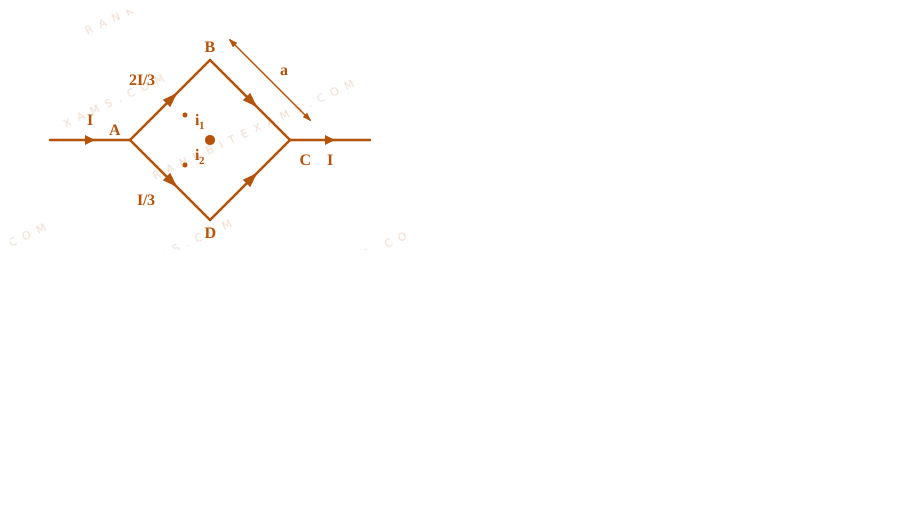
The loop parts ABC and ADC are in parallel. Let total current entering corner A and leaving corner C be I$I$.
- Resistance of path ABC = r$r$
- Resistance of path ADC = 2r$2r$
Using current divider rule:
- Current in path ABC, I₁ = (2r)/(r + 2r) I = (2)/(3) I$I_1 = \frac{2r}{r + 2r} I = \frac{2}{3} I$
- Current in path ADC, I₂ = (r)/(r + 2r) I = (1)/(3) I$I_2 = \frac{r}{r + 2r} I = \frac{1}{3} I$
Now, calculate the magnetic field contribution at center O$O$:
- Distance of center from each of the 4 wire segments is d = (a)/(2)$d = \frac{a}{2}$.
- For each segment, the angles are θ₁ = θ₂ = 45^°$\theta_1 = \theta_2 = 45^\circ$:
Bsegment = (μ₀ i)/(4π (a/2)) ( 45^° + 45^°) = (μ₀ i)/(2π a) √(2)$$B_{\text{segment}} = \frac{\mu_0 i}{4\pi (a/2)} \left(\sin 45^\circ + \sin 45^\circ\right) = \frac{\mu_0 i}{2\pi a} \sqrt{2}$$
Step 1: Summing the Fields at the Center
Using right-hand rule to find the direction of magnetic fields:
- Paths AB and BC (carrying I₁$I_1$ clockwise) create fields pointing into the page (- k$-\hat{k}$).
- Paths AD and DC (carrying I₂$I_2$ counter-clockwise) create fields pointing out of the page (+ k$+\hat{k}$).
Bₙₑₜ = 2 Bsegment(I₂) - 2 Bsegment(I₁)$$B_{\text{net}} = 2 B_{\text{segment}}(I_2) - 2 B_{\text{segment}}(I_1)$$
Bₙₑₜ = 2 [ (μ₀ (I/3))/(2π a) √(2) ] - 2 [ (μ₀ (2I/3))/(2π a) √(2) ]$$B_{\text{net}} = 2 \left[ \frac{\mu_0 (I/3)}{2\pi a} \sqrt{2} \right] - 2 \left[ \frac{\mu_0 (2I/3)}{2\pi a} \sqrt{2} \right]$$
Bₙₑₜ = √(2)μ₀ Iπ a ( (1)/(3) - (2)/(3) ) = - √(2)μ₀ I3π a k$$B_{\text{net}} = \frac{\sqrt{2}\mu_0 I}{\pi a} \left( \frac{1}{3} - \frac{2}{3} \right) = -\frac{\sqrt{2}\mu_0 I}{3\pi a}\hat{k}$$
Taking the magnitude of the field:
|Bₙₑₜ| = √(2)μₒ I3π a$$|B_{\text{net}}| = \frac{\sqrt{2}\mu_{\mathrm{o}} I}{3\pi a}$$
Pattern Recognition
Sees: Current divides into parallel paths of a symmetric loop.
Trap: In a completely symmetric square loop (equal resistances), the net magnetic field at the center is exactly 0$0$. However, here the paths have unequal resistances (r$r$ and 2r$2r$), which prevents total cancellation.
Shortcut: Find the net effective current imbalance Δ I = I₁ - I₂ = (2)/(3)I - (1)/(3)I = (1)/(3)I$\Delta I = I_1 - I_2 = \frac{2}{3}I - \frac{1}{3}I = \frac{1}{3}I$. The magnitude is simply the magnetic field contribution of two sides carrying this net imbalance. ✓
Chapter Mix
Class 12 Physics: Magnetic Effects of Current