JEE Main · Chemistry ↓ Falling

Haloalkanes and Haloarenes appeared 38 times across 3 years — 4.4% of Chemistry. This question is from Preparation and Reactions of Styrene derivatives.

Year 2026 2025 2024 Total
Questions 11 15 12 38

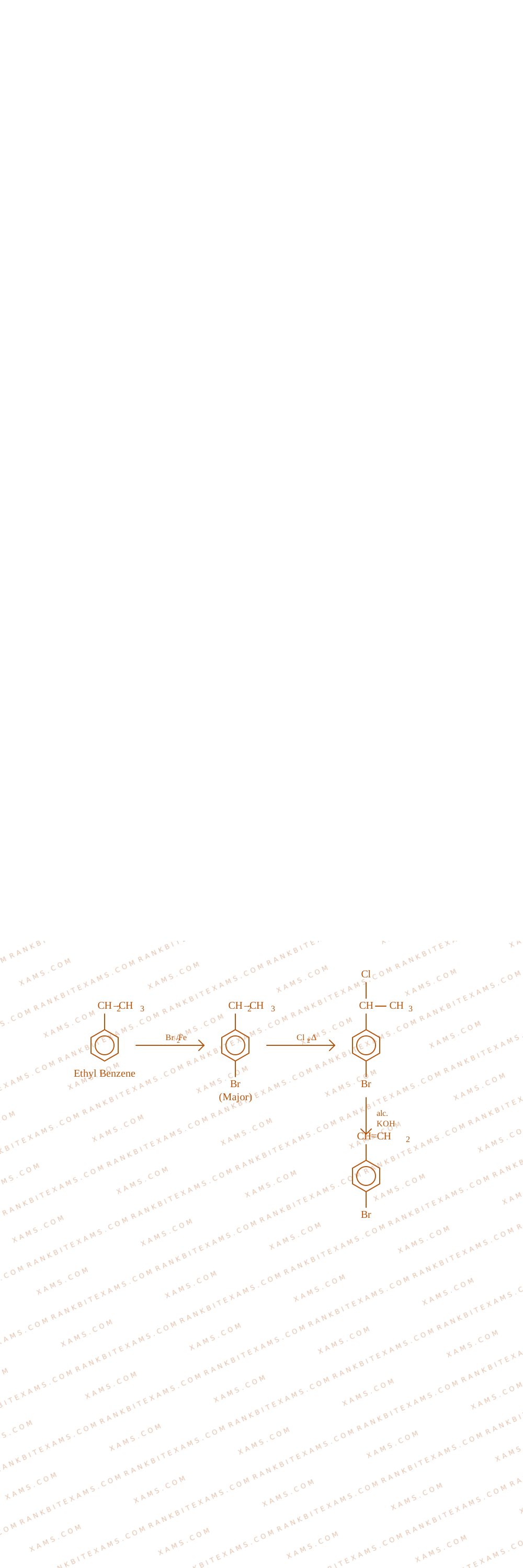
Choose the correct set of reagents for the following conversion: Ethyl benzene 4-bromostyrene {{Q_IMG1}}

Conversion scheme of ethylbenzene to 4-bromostyrene for Q29
The figure illustrates the multi-step conversion starting from ethylbenzene to yield a brominated styrene derivative.
Conversion scheme of ethylbenzene to 4-bromostyrene for Q29
The figure illustrates the multi-step conversion starting from ethylbenzene to yield a brominated styrene derivative.

Solution & Explanation

Core Logic

To synthesize 4-bromostyrene starting from ethyl benzene, we must carry out ring functionalization prior to developing the side-chain double bond:

  • Ring Bromination: Treatment of ethylbenzene with Br₂ in the presence of Fe (or FeBr₃) acts via electrophilic aromatic substitution. The ethyl group is an ortho/para director, yielding 1-bromo-4-ethylbenzene as the major product owing to steric mitigation.
  • Side-Chain Halogenation: Free radical substitution with Cl₂ under thermal conditions (Δ) or UV light specifically chlorinates the benzylic position because the benzylic radical is exceptionally stable via resonance.
  • Elimination: Heating with alcoholic KOH drives an E2 elimination of the benzylic chloride, cleanly synthesizing the terminal alkene linkage of the styrene system.
    Detailed mechanism of 4-bromostyrene synthesis from ethylbenzene
    The figure illustrates the multi-step conversion starting from ethylbenzene to yield a brominated styrene derivative.
Pattern Recognition

If you perform side-chain halogenation/alkene generation first, the ring substitution later would lack para-selectivity control and risk reacting across the alkene path. Hence, ring substitution MUST precede double bond creation.

Chapter Mix

Class 12 Chemistry: Haloalkanes and Haloarenes Class 11 Chemistry: Hydrocarbons

More Haloalkanes and Haloarenes Previous-Year Questions — Page 3

Q58 jee_main_2026_28_january_evening Halogenation Reactions
Which of the following reaction is NOT correctly represented ?
  • A. (1)
  • B. (2)
  • C. (3)
  • D. (4) C₆H₅CH₃ [Br₂, Fe]Dark Ortho and para Bromotoluenes

Solution

Core Logic

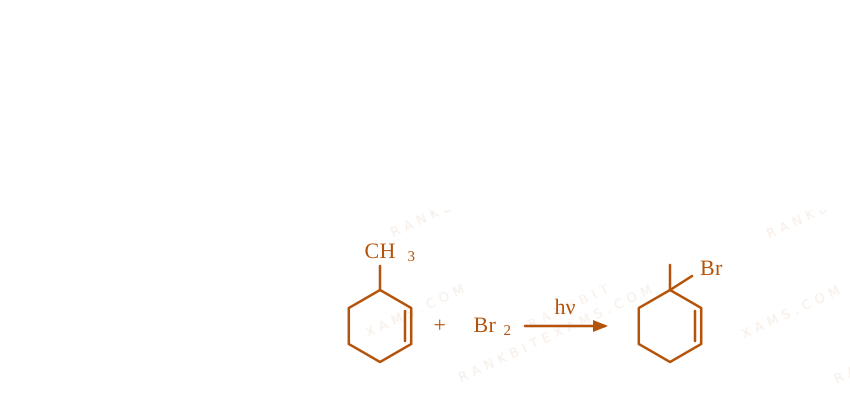
Analyzing each option: (1) Alkyl substitution reaction with Br₂, hν (free radical substitution) targets the most stable free radical. The allylic or benzylic position is preferred. In the given structure
Halogenation Reactions
, the most stable radical is 3° allylic radical, leading to the major product
Halogenation Reactions
. The option portrays substitution at the terminal carbon, which is incorrect.

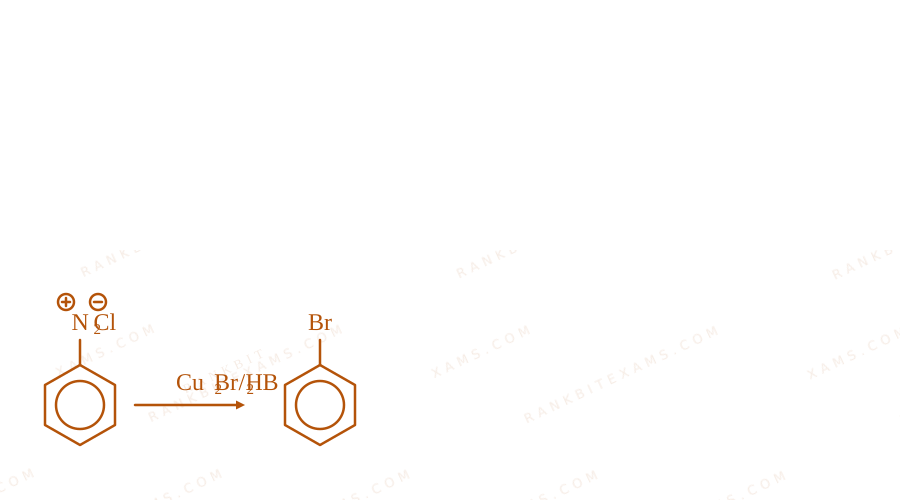
(2) Reaction involves diazotization followed by Sandmeyer reaction with Cu₂Br₂/HBr
Halogenation Reactions
, converting aromatic amine to aryl bromide correctly.

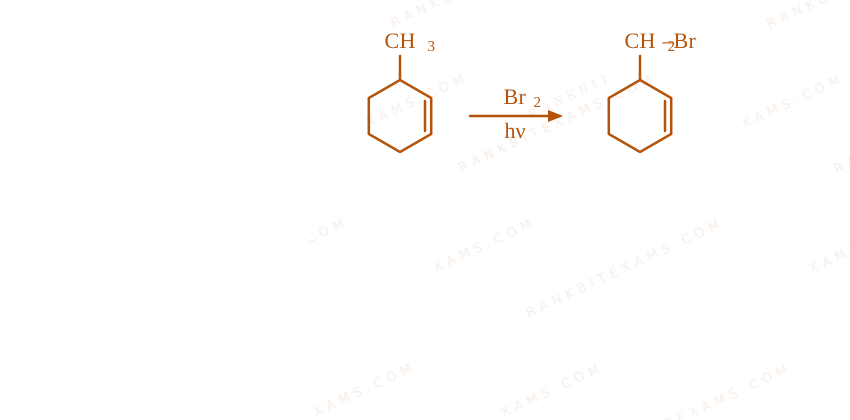
(3) Free radical halogenation on toluene side-chain
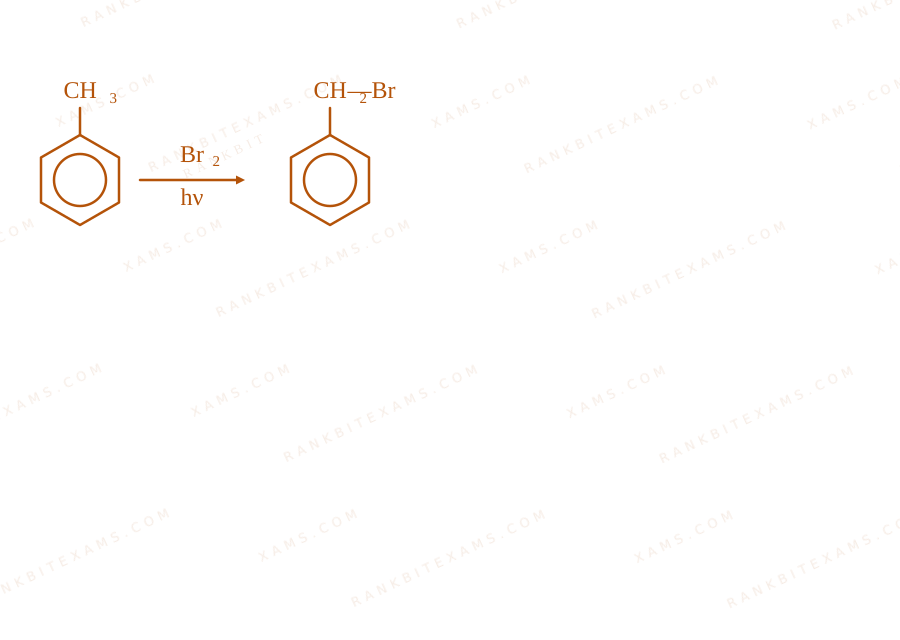
Halogenation Reactions
selectively forms benzyl bromide. Correct.

(4) Electrophilic aromatic substitution of toluene with Br₂/Fe in the dark correctly
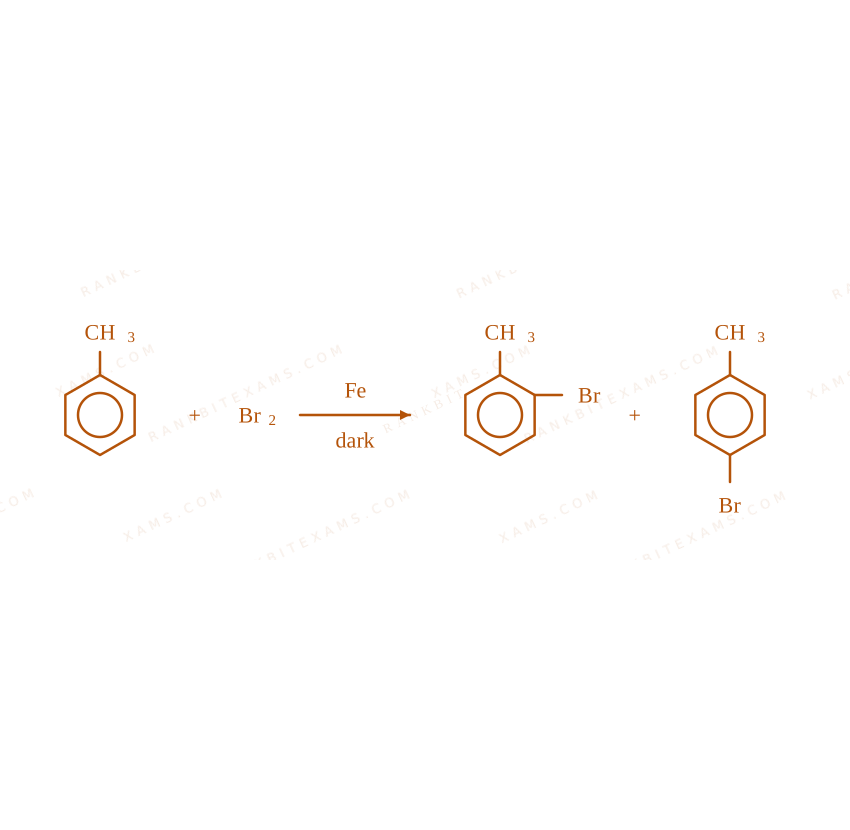
Halogenation Reactions
produces ortho and para isomers. Correct.

Step 1: Final Conclusion

Reaction (1) is incorrectly represented as it gives a 1° radical product rather than the more stable 3° substituted major product.

Pattern Recognition

Free radical halogenation favors 3° > 2° > 1° substitution due to intermediate stability. Allylic and benzylic are even more favored. Always check if the halogen landed on the most substituted available carbon.

Chapter Mix

Class 12 Chemistry: Haloalkanes and Haloarenes
Q jee_main_2025_02_april_evening Chemical Reactions and Named Rules
Match List-I with List-II: array|l|l| arrayc List-I (Reaction) array & arrayc List-II (Name of reaction) array (A) 2Ar-X + 2Na Dry Ether Ar-Ar + 2NaX & (I) Lucas reaction (B) ArN₂^+X^- Cu / HCl ArCl + N₂ + CuX & (II) Finkelstein reaction (C) C₂H₅Br + NaI Dry Acetone C₂H₅I + NaBr & (III) Fittig reaction (D) CH₃C(OH)(CH₃)CH₃ HCl / ZnCl₂ CH₃C(Cl)(CH₃)CH₃ & (IV) Gatterman reaction array Choose the correct answer from the options given below:
  • A. (A)-(III), (B)-(II), (C)-(IV), (D)-(I)
  • B. (A)-(III), (B)-(IV), (C)-(II), (D)-(I)
  • C. (A)-(IV), (B)-(III), (C)-(I), (D)-(II)
  • D. (A)-(IV), (B)-(I), (C)-(II), (D)-(III)

Solution

Related Formula
Named Organic Transformations
Core Logic

Let us systematically match each reaction in List-I to its standardized organic reaction name in List-II:

  • Reaction (A): Coupling of two aryl halides with sodium metal in dry ether to form biaryl is the classic Fittig reaction arrow (III).
  • Reaction (B): Conversion of benzene diazonium chloride to aryl halide using copper powder (Cu) in halogen acids like HCl is the Gatterman reaction arrow (IV).
  • Reaction (C): Substitution of halogen in an alkyl halide with sodium iodide (NaI) in dry acetone solvent is the classic halogen exchange method called the Finkelstein reaction arrow (II).
  • Reaction (D): Replacement of the hydroxyl group in tertiary butyl alcohol with chlorine using conc. HCl in the presence of anhydrous ZnCl₂ catalyst is the Lucas reaction arrow (I).
Step 1: Selection

Combining the selections, the correct sequence is: (A)-(III), (B)-(IV), (C)-(II), (D)-(I)

This maps directly to option (2).

Pattern Recognition

Named reaction matching questions are very straightforward. Keep a clear distinction between the Sandmeyer reaction (which uses cuprous halide, e.g. Cu₂Cl₂) and the Gatterman reaction (which uses copper powder, Cu).

Chapter Mix

Class 12 Chemistry: Haloalkanes and Haloarenes
Q48 jee_main_2025_02_april_evening Elimination and Addition Reaction Sequences
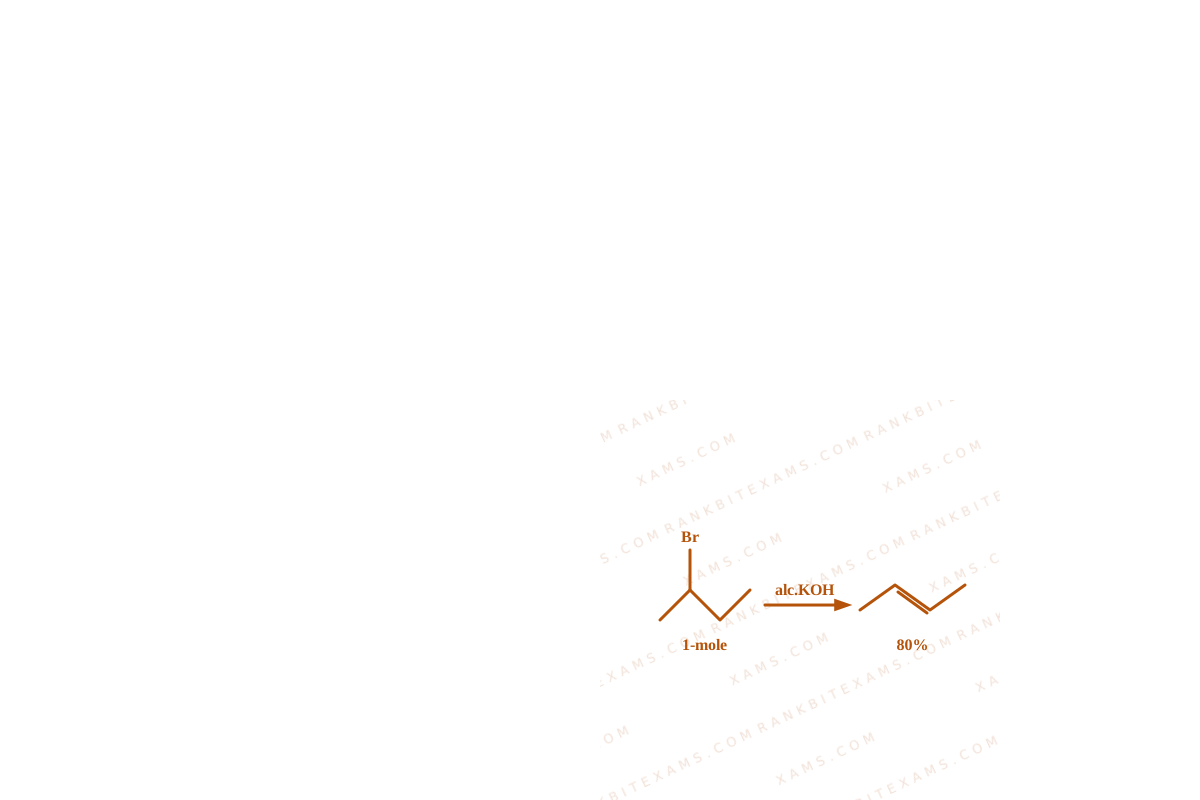
Consider the following sequence of reactions: CH₃-CH₂-CH₂-CH(Br)-CH₃ alcoholic KOH P (Major Product) Br₂ Q Consider the above sequence of reactions. 151~g of 2-bromopentane is made to react. Yield of major product P is 80% whereas Q is 100%. Mass of product Q obtained is _______ g. Given molar mass in g~mol⁻¹ H: 1, C: 12, O: 16, Br: 80
Numerical Answer. Answer: 184 to 184

Solution

Related Formula
Actual Yield = Theoretical Yield × % Yield
Core Logic

Let us break down each chemical reaction step:

  • Step 1: 2-bromopentane undergoes dehydrohalogenation via an E2 mechanism using alcoholic KOH. According to Saytzeff's rule, the more substituted alkene is the major product. Thus, pent-2-ene is the major product P.
  • Chemical reaction showing elimination of 2-bromopentane to form pent-2-ene
    Chemical reaction showing elimination of 2-bromopentane to form pent-2-ene

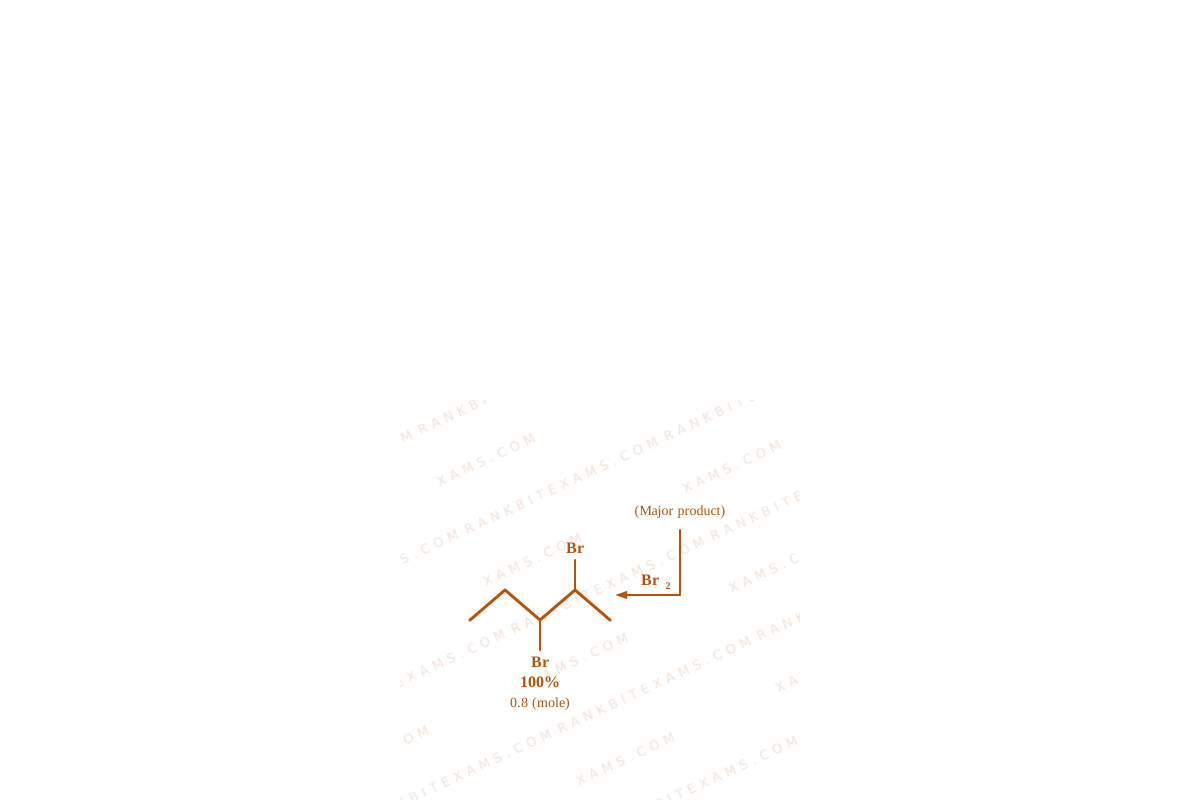
  • Step 2: Pent-2-ene undergoes electrophilic bromination with liquid bromine (Br₂) to give 2,3-dibromopentane (product Q):
  • Chemical reaction showing elimination of 2-bromopentane to form pent-2-ene
    Chemical reaction showing elimination of 2-bromopentane to form pent-2-ene

Step 1: Calculate Initial Moles of Reactant

Calculate the molar mass of 2-bromopentane (C₅H₁₁Br):

Molar mass = 5(12) + 11(1) + 80 = 60 + 11 + 80 = 151~ g~mol⁻¹ Initial moles = 151~g151~ g~mol⁻¹ = 1~mol
Step 2: Calculate Moles of Intermediate P and Q

Since the yield of P is 80%:

Moles of P formed = 1 × 0.80 = 0.8~mol

Since the conversion of P arrow Q has a yield of 100%, the mole count remains stoichiometric:

Moles of Q formed = 0.8 × 1.00 = 0.8~mol
Step 3: Calculate Mass of Q

Product Q is 2,3-dibromopentane (C₅H₁₀Br₂). Calculate its molar mass:

Molar mass of Q = 5(12) + 10(1) + 2(80) = 60 + 10 + 160 = 230~ g~mol⁻¹ Mass of Q = 0.8 × 230 = 184~g
Pattern Recognition

Saytzeff vs Hofmann: Alcoholic KOH is a small, non-bulky base, which selectively targets the internal secondary proton to yield the thermodynamic trans-alkene (pent-2-ene) as the major product rather than the terminal 1-alkene.

Chapter Mix

Class 12 Chemistry: Haloalkanes and Haloarenes
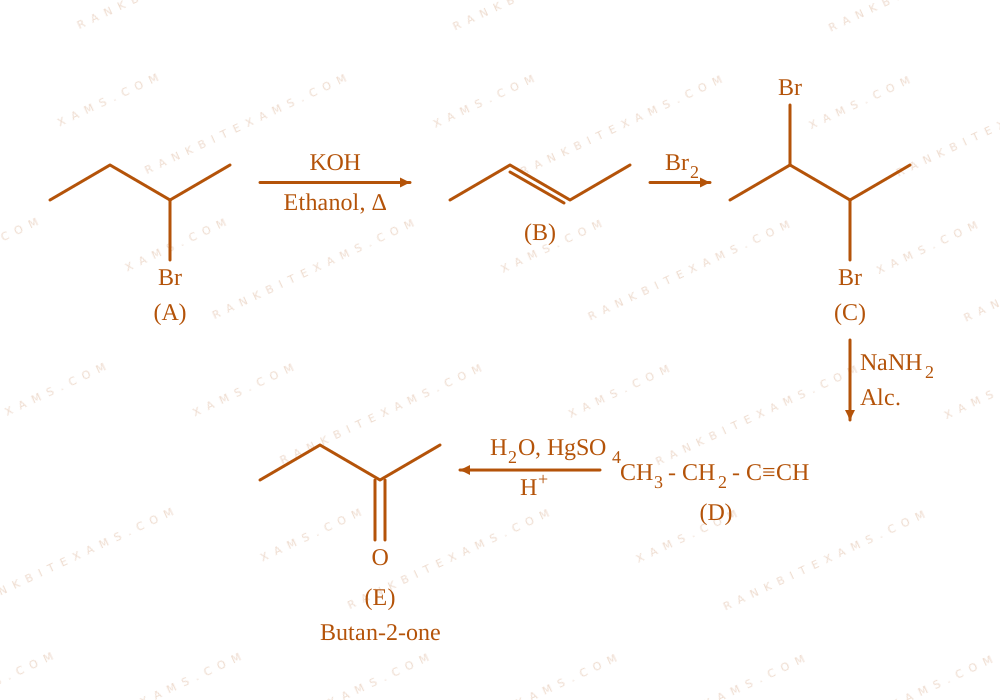
Q jee_main_2025_02_april_morning Reactions of Alkyl Halides and Alkyne Hydration
An optically active alkyl halide C₄H₉Br [A] reacts with hot KOH dissolved in ethanol and forms alkene [B] as major product which reacts with bromine to give dibromide [C]. The compound [C] is converted into a gas [D] upon reacting with alcoholic NaNH₂. During hydration 18 gram of water is added to 1 mole of gas [D] on warming with mercuric sulphate and dilute acid at 333K to form compound [E]. The IUPAC name of compound [E] is :
  • A. (1) But-2-yne
  • B. (2) Butan-2-ol
  • C. (3) Butan-2-one
  • D. (4) Butan-1-al

Solution

Related Formula

Dehydrohalogenation via alcoholic KOH follows E2 elimination mechanism:

R-CH₂-CH(Br)-R' alc. KOH R-CH=CH-R'

Hydration of alkynes using HgSO₄/H₂SO₄ yields ketones via keto-enol tautomerism.

Core Logic

Let's trace the full sequence line-by-row:

  • [A] is an optically active halide with formula C₄H₉Br arrow CH₃-CH(Br)-CH₂-CH₃ (2-Bromobutane).
  • Reaction of [A] with hot ethanolic KOH produces [B] as the major product: CH₃-CH=CH-CH₃ (But-2-ene).
  • Treatment of [B] with Br₂ yields a vicinal dibromide [C]: CH₃-CH(Br)-CH(Br)-CH₃ (2,3-Dibromobutane).
  • Reaction of [C] with alcoholic NaNH₂ converts it via double dehydrohalogenation into gas [D]: CH₃-C≡ C-CH₃ (But-2-yne).
  • Hydration of 1 mole of [D] with H₂O in the presence of Hg²⁺/H^+ forms an enol intermediate that rapidly tautomerizes to compound [E]: CH₃-CO-CH₂-CH₃ (Butan-2-one).
Step 1: Visualization

Reaction roadmap step verification for Q27

Pattern Recognition

Whenever you see a 4-carbon chain undergoing terminal/internal dehydrohalogenation followed by hydration of the resulting alkyne, look closely at the configuration: symmetric or unsymmetric alkyne hydration both systematically lead to Butan-2-one because a stable ketone cannot form on position 1 via standard Kucherov hydration of an internal chain.

Chapter Mix

Class 12 Physics: Haloalkanes and Haloarenes Class 11 Chemistry: Hydrocarbons Class 12 Chemistry: Aldehydes, Ketones and Carboxylic Acids

Rankbit System
JEE Physics: Waves (+15.5%) | Electrostatics: Concentric Shells (-29.7%) | Modern Physics: Photoelectric Clones (+34.2%) | Mathematics: Definite Integrals (+18.1%) | Chemistry: Coordination Splitting (-11.4%) | JEE Physics: Waves (+15.5%) | Electrostatics: Concentric Shells (-29.7%) | Modern Physics: Photoelectric Clones (+34.2%) | Mathematics: Definite Integrals (+18.1%) | Chemistry: Coordination Splitting (-11.4%)