Resonance in an X₂Y molecule is represented as follows: X = X = Y X ≡ X^+ - Y^- The experimental enthalpy of formation for gaseous X₂Y is given by the reaction: X ≡ X(g) + (1)/(2)Y = Y(g) X₂Y(g) Δ Hf(exp) = 80 kJ mol⁻¹ Calculate the magnitude of the resonance energy of X₂Y in kJ mol⁻¹ (as the nearest integer value). **Given bond energies:** * X ≡ X = 940 kJ mol⁻¹ * X = X = 410 kJ mol⁻¹ * Y = Y = 500 kJ mol⁻¹ * X = Y = 602 kJ mol⁻¹ Valence settings: X : 3, Y : 2

Numerical Answer Type:
Enter a numerical value Answer: 98 to 98 +4 marks

Solution & Explanation

Related Formula

Resonance energy equation related to experimental and theoretical formation enthalpies:

Δ HR.E. = Δ Hf(exp) - Δ Hf(Theo)

Theoretical enthalpy calculation using bond energies:

Δ Hf(Theo) = Σ B.E.reactants - Σ B.E.products
Execution

Step 1: Write the chemical equation to calculate the theoretical enthalpy of formation based on the localized structure X=X=Y:

X ≡ X(g) + (1)/(2)Y=Y(g) X=X=Y(g)

Step 2: Substitute the localized bond energies into the reactant-minus-product relation:

Δ Hf(Theo) = [ B.E.X ≡ X + (1)/(2)B.E.Y=Y ] - [ B.E.X=X + B.E.X=Y ] Δ Hf(Theo) = [ 940 + (1)/(2)(500) ] - [410 + 602] Δ Hf(Theo) = [940 + 250] - 1012 = 1190 - 1012 = 178 kJ mol⁻¹

Step 3: Calculate the resonance energy:

Δ HR.E. = Δ Hf(exp) - Δ Hf(Theo) = 80 - 178 = -98 kJ mol⁻¹

Taking the magnitude as requested: |Δ HR.E.| = 98.

Pattern Recognition

Resonance energy is always a stabilizing factor, meaning Δ Hf(exp) is more exothermic (or less endothermic) than the theoretical localized state. The magnitude is simply the absolute value of this difference (|80 - 178| = 98).

Chapter Mix

Class 11 Chemistry: Chemical Thermodynamics Class 11 Chemistry: Chemical Bonding and Molecular Structure

More Chemical Thermodynamics Previous-Year Questions — Page 9

Q83 jee_main_2024_30_january_evening Hess's Law of Constant Heat Summation
Two reactions are given below: 2Fe(s) + (3)/(2)O2(g) arrow Fe₂O3(s), Δ H° = -822 kJ/mol C(s) + (1)/(2)O2(g) arrow CO(g), Δ H° = -110 kJ/mol Then enthalpy change for following reaction 3C(s) + Fe₂O3(s) arrow 2Fe(s) + 3CO(g)
Numerical Answer. Answer: 492 to 492

Solution

Related Formula

According to Hess's Law, the net enthalpy change of a reaction is the sum of the enthalpy changes of the individual steps into which it can be divided.

Core Logic

Let the given reactions be: (1) 2Fe(s) + (3)/(2)O2(g) arrow Fe₂O3(s), Δ H₁ = -822 kJ/mol (2) C(s) + (1)/(2)O2(g) arrow CO(g), Δ H₂ = -110 kJ/mol

Target Reaction (3):

3C(s) + Fe₂O3(s) arrow 2Fe(s) + 3CO(g), Δ H₃ = ?

To construct the target reaction:

  • We need 3 CO(g) on the product side, so we multiply reaction (2) by 3.
  • We need Fe₂O3(s) on the reactant side and 2 Fe(s) on the product side, so we reverse reaction (1).
Step 1: Calculate Net Enthalpy

Target Reaction (3) = 3 × (2) - (1)

Δ H₃ = 3 × Δ H₂ - Δ H₁ Δ H₃ = 3(-110) - (-822) Δ H₃ = -330 + 822 = 492 kJ/mol
Chapter Mix

Class 11 Chemistry: Thermodynamics
Q jee_main_2024_30_jan_morning Work Done in Cyclic Process
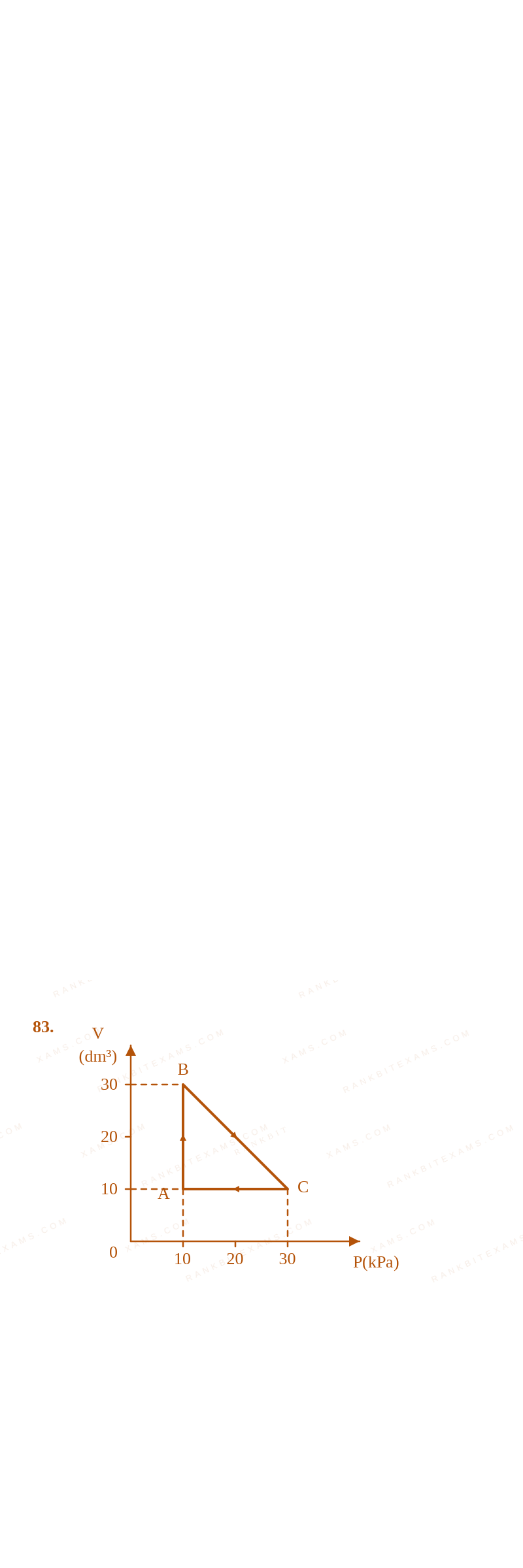
An ideal gas undergoes a cyclic transformation starting from the point A and coming back to the same point by tracing the path Aarrow Barrow Carrow A as shown in the diagram. The total work done in the process is ________ J.
Work Done in Cyclic Process diagram for Q83 - JEE Main 2024 Morning
The image is a graph of Volume (dm3) vs Pressure (kPa) showing a triangular cyclic process starting from A(10,10) to B(10,30) to C(30,10) and back to A.
Numerical Answer. Answer: 200 to 200

Solution

Related Formula
Wcyclic = Area enclosed in P-V graph
Core Logic

The work done in a cyclic process is equal to the magnitude of the area enclosed by the cycle on a Pressure-Volume graph. Note that the provided graph is Volume (V) on the y-axis versus Pressure (P) on the x-axis. The path A arrow B arrow C arrow A is traced in a clockwise direction on the V-P graph. Clockwise on a V-P graph corresponds to anti-clockwise on a standard P-V graph, meaning net expansion work is done by the gas, making it positive conventionally (or negative depending on chemistry sign convention, but magnitude is asked for).

Step 1: Calculating Area

The enclosed region is a right-angled triangle. Base of triangle on P-axis = 30 - 10 = 20 kPa Height of triangle on V-axis = 30 - 10 = 20 dm³

Area = (1)/(2) × base × height Area = (1)/(2) × 20 × 20 = 200 kPa ³
Step 2: Unit conversion

1 kPa = 10³ Pa 1 dm³ = 1 Litre = 10⁻³ m³

W = 200 × 10³ Pa × 10⁻³ m³ W = 200 J
Pattern Recognition

1 kPa · 1 L = 1 Joule. This direct conversion saves time without converting explicitly to standard SI units (Pa and m³).

Chapter Mix

Class 11 Chemistry: Thermodynamics

Q90 jee_main_2024_31_jan_evening Work Done in Isothermal Reversible Expansion
If 5 moles of an ideal gas expands from 10 L to a volume of 100 L at 300 K under isothermal and reversible condition then work w, is -x J. The value of x is ________ (Given R = 8.314 J K⁻¹mol⁻¹)
Numerical Answer. Answer: 28720 to 28721

Solution

Related Formula
W = -2.303 nRT ( (V₂)/(V₁) )
Core Logic

For an isothermal and reversible expansion of an ideal gas, work is done by the system on the surroundings, hence it is negative by IUPAC convention. Given: n = 5 moles R = 8.314 J K⁻¹mol⁻¹ T = 300 K V₁ = 10 L V₂ = 100 L

Step 1: Calculating Work Done
W = -2.303 × 5 × 8.314 × 300 × ( (100)/(10) ) W = -2.303 × 5 × 8.314 × 300 × (10) W = -2.303 × 12471 × 1 W = -28720.713 J
Step 2: Final Formatting

The question asks for work w = -x J. So x = 28720.713, which rounds to 28721.

Chapter Mix

Class 11 Chemistry: Thermodynamics

Q88 jee_main_2024_31_jan_morning Gibbs Free Energy and Equilibrium
Consider the following reaction at 298 K. (3)/(2)O2(g) leftharpoons O3(g). Kₚ = 2.47 × 10⁻²⁹ ΔᵣG for the reaction is ________ kJ. (Given R = 8.314 J K⁻¹ mol⁻¹)
Numerical Answer. Answer: 163 to 164

Solution

Related Formula
ΔᵣG = -RT ln Kₚ
Step 1: Calculation
ΔᵣG = -8.314 × 10⁻³ kJ K⁻¹ mol⁻¹ × 298 K × ln(2.47 × 10⁻²⁹) = -8.314 × 10⁻³ × 298 × (-65.87) = 163.19 kJ
Step 2: Nearest Integer

Rounding 163.19 to the nearest integer gives 163.

Chapter Mix

Class 11 Chemistry: Thermodynamics

Rankbit System
JEE Physics: Waves (+15.5%) | Electrostatics: Concentric Shells (-29.7%) | Modern Physics: Photoelectric Clones (+34.2%) | Mathematics: Definite Integrals (+18.1%) | Chemistry: Coordination Splitting (-11.4%) | JEE Physics: Waves (+15.5%) | Electrostatics: Concentric Shells (-29.7%) | Modern Physics: Photoelectric Clones (+34.2%) | Mathematics: Definite Integrals (+18.1%) | Chemistry: Coordination Splitting (-11.4%)