JEE Main · Chemistry ↓ Falling

Biomolecules appeared 36 times across 3 years — 4.2% of Chemistry. This question is from Amino Acids.

Year 2026 2025 2024 Total
Questions 9 19 8 36

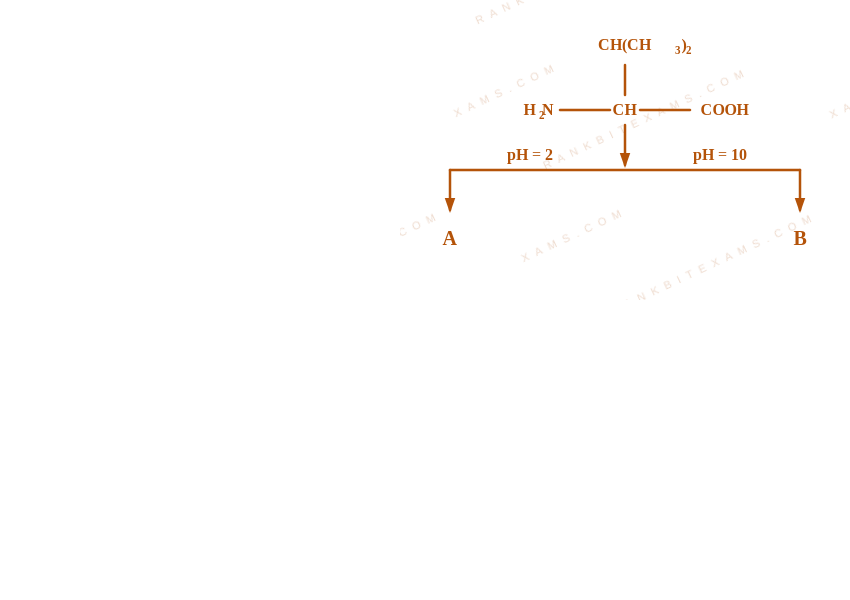
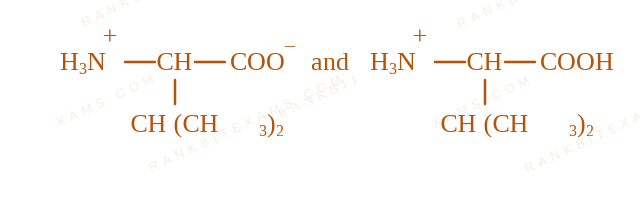
The chemical structure of the amino acid Valine is monitored across different environments: Choose the correct option depicting the structures of products A and B under pH = 2 and pH = 10 conditions respectively.

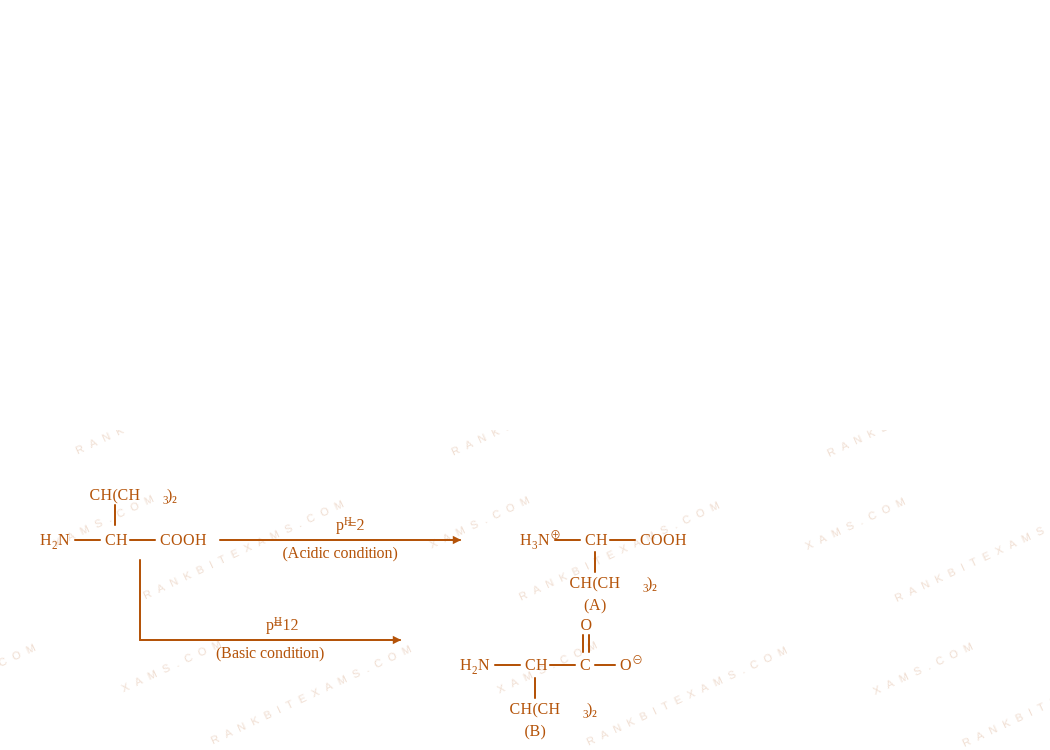
Valine pH equilibrium conversion layout for Q39
The flowchart maps the structural modifications of Valine when treated at strongly acidic (pH = 2) versus basic (pH = 10) conditions.

Solution & Explanation

Core Logic

Amino acids exhibit amphoteric behavior due to the simultaneously present basic amino (-NH₂) and acidic carboxyl (-COOH) functional groups:

  • At pH = 2 (Highly Acidic Medium):
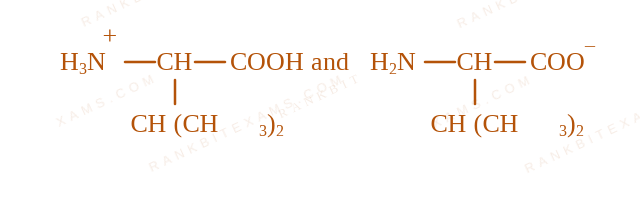
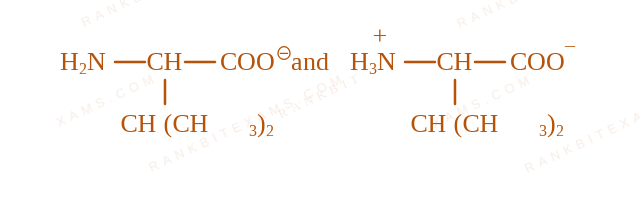
  • The abundant concentration of hydronium ions (H^+) protonates the carboxylate ion back into its non-ionized acid state (-COO^- arrow -COOH), while the amine group remains securely protonated as an ammonium ion (-NH₃^+). Hence, product A exists purely as a cation.

  • At pH = 10 (Highly Basic Medium):
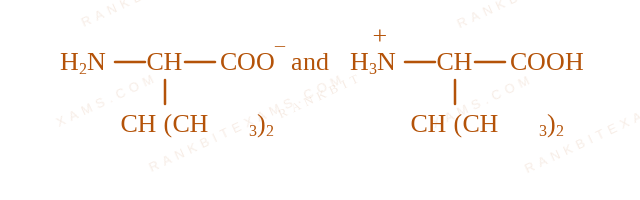
  • The high concentration of hydroxide ions (OH^-) abstracts protons from the system, deprotonating the carboxyl group into a carboxylate anion (-COO^-) and neutralizing the ammonium group back into a free amine fraction (-NH₂). Hence, product B exists purely as an anion.

    Protonation state structures of Valine across the pH spectrum
    The flowchart maps the structural modifications of Valine when treated at strongly acidic (pH = 2) versus basic (pH = 10) conditions.

Pattern Recognition

Acidic environments (low pH) force positive overall charges onto amino structures (cation form). Basic environments (high pH) drive a net negative structure (anion form). This simple rule makes picking Option (1) immediate.

Chapter Mix

Class 12 Chemistry: Biomolecules

More Biomolecules Previous-Year Questions — Page 8

Q78 jee_main_2024_31_jan_morning Reactions of Glucose
Match List I with List II
LIST-ILIST-II
A. Glucose/NaHCO₃/ΔI. Gluconic acid
B. Glucose/HNO₃II. No reaction
C. Glucose/HI/ΔIII. n-hexane
D. Glucose/Bromine waterIV. Saccharic acid
Choose the correct answer from the options given below:
  • A. A-IV, B-I, C-III, D-II
  • B. A-II, B-IV, C-III, D-I
  • C. A-III, B-II, C-I, D-IV
  • D. A-I, B-IV, C-III, D-II

Solution

Core Logic

Matching the reactions of glucose: (A) Glucose does not react with NaHCO₃, so there is no reaction. (A arrow II) (B) Oxidation of glucose with strong oxidizing agents like HNO₃ yields a dicarboxylic acid called saccharic acid. (B arrow IV) (C) Prolonged heating of glucose with HI forms n-hexane, indicating a straight chain of six carbon atoms. (C arrow III) (D) Oxidation with mild agents like bromine water converts glucose to gluconic acid. (D arrow I)

Chapter Mix

Class 12 Chemistry: Biomolecules

Rankbit System
JEE Physics: Waves (+15.5%) | Electrostatics: Concentric Shells (-29.7%) | Modern Physics: Photoelectric Clones (+34.2%) | Mathematics: Definite Integrals (+18.1%) | Chemistry: Coordination Splitting (-11.4%) | JEE Physics: Waves (+15.5%) | Electrostatics: Concentric Shells (-29.7%) | Modern Physics: Photoelectric Clones (+34.2%) | Mathematics: Definite Integrals (+18.1%) | Chemistry: Coordination Splitting (-11.4%)