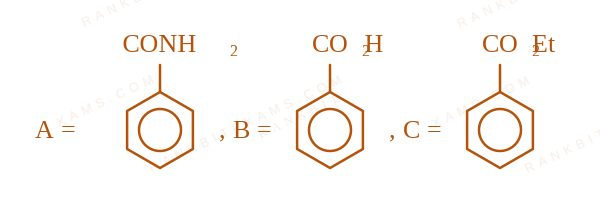
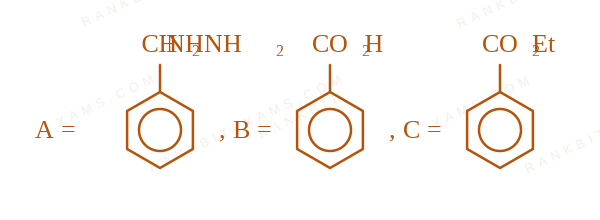
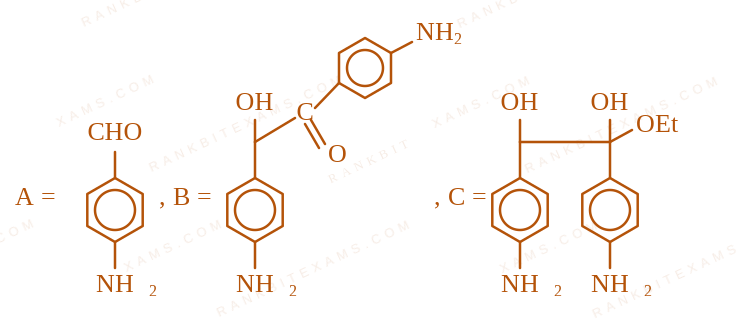
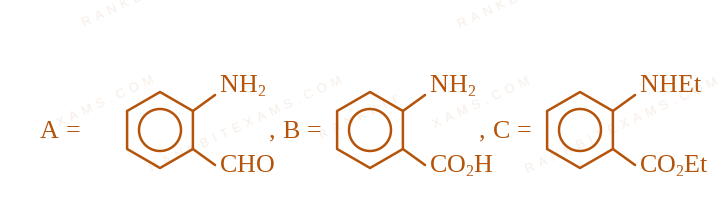
An organic compound 'A' undergoes the following sequence of transformations:
'A' [(ii) H₃O^+](i) NaOH 'B' [(ii) H₂SO₄, Δ](i) EtOH 'C'$$\text{'A'} \xrightarrow[\text{(ii) } H_3O^+]{\text{(i) } NaOH} \text{'B'} \xrightarrow[\text{(ii) } H_2SO_4, \Delta]{\text{(i) } EtOH} \text{'C'}$$
* 'A' shows a positive Lassaigne's test for nitrogen and its molar mass is 121 g mol⁻¹$121 \text{ g mol}^{-1}$.
* 'B' gives effervescence with aqueous NaHCO₃$\text{NaHCO}_3$.
* 'C' gives a characteristic fruity smell.
Identify A, B, and C from the options below:
A.
Functional Group Analysis and Identification
B.
Functional Group Analysis and Identification
C.
Functional Group Analysis and Identification
D.
Functional Group Analysis and Identification
Solution & Explanation
Core Logic
Let's perform a step-by-step diagnostic analysis:
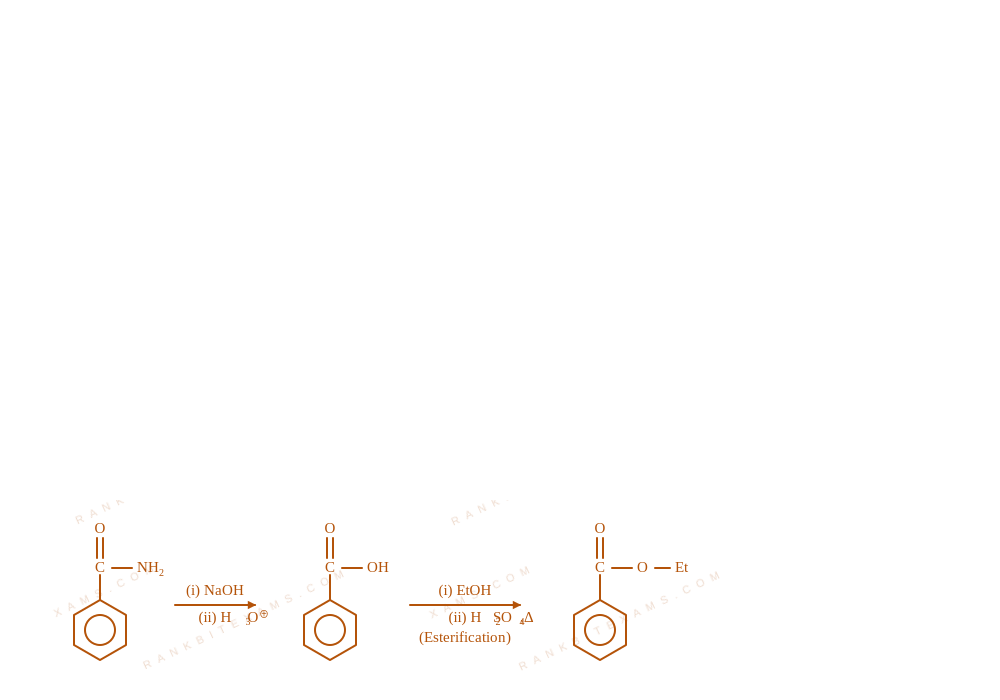
Molar Mass & Nitrogen Test: Compound 'A' has a nitrogen atom and a molar mass of 121 g mol⁻¹$121 \text{ g mol}^{-1}$. Let's verify Benzamide (C₆H₅CONH₂$\text{C}_6\text{H}_5\text{CONH}_2$):
Benzoic acid reactively gives effervescence with NaHCO₃$\text{NaHCO}_3$ due to the liberation of CO₂$\text{CO}_2$ gas.
Esterification: Reaction of benzoic acid with ethanol in the presence of acid catalyst results in the creation of ethyl benzoate, an ester with a pleasant fruity smell:
"Fruity smell" is an absolute indicator for an ester product. "Effervescence with NaHCO₃$\text{NaHCO}_3$" dictates a carboxylic acid intermediate. Basic hydrolysis converting an organo-nitrogen compound into an acid points directly to an amide or a nitrile—molar mass calculation establishes benzamide over benzonitrile (M = 103$M = 103$).
Chapter Mix
Class 12 Chemistry: Amines
Class 12 Chemistry: Aldehydes, Ketones and Carboxylic Acids
More Amines Previous-Year Questions — Page 5
Q41jee_main_2025_29_jan_eveningDiazotization and Coupling Reactions
Which one of the following reaction sequences will give an azo dye?
(1) Nitrobenzene treated with (i) Sn/HCl$Sn/HCl$, (ii) NaNO₂/HCl$NaNO_{2}/HCl$, (iii) β$\beta$-naphthol, NaOH$NaOH$
(2) Benzenesulfonic acid treated with (i) SOCl₂$SOCl_2$, (ii) NH₃$NH_3$, (iii) Benzyl chloride
(3) Benzonitrile treated with (i) 70% H₂SO₄$70\% H_2SO_4$, (ii) PCl₅$PCl_5$, (iii) Aniline
(4) Aniline treated with (i) HCl/NaNO₂$HCl/NaNO_2$, (ii) Toluene
A. Reaction sequence (1)
B. Reaction sequence (2)
C. Reaction sequence (3)
D. Reaction sequence (4)
Solution
Core Logic
Let's track sequence (1):
Nitrobenzene (Ph-NO₂$Ph-NO_2$) is reduced using Sn/HCl$Sn/HCl$ to form Aniline (Ph-NH₂$Ph-NH_2$).
Aniline undergoing diazotization with NaNO₂/HCl$NaNO_{2}/HCl$ at cold temperatures (0-5circC$0-5^{circ}C$) creates Benzene diazonium chloride (Ph-N₂⁺Cl⁻$Ph-N_{2}^{+}Cl^{-}$).
The diazonium salt undergoes a coupling reaction with β$\beta$-naphthol in alkaline conditions (NaOH$NaOH$) to synthesize a highly vibrant red-orange azo dye.
Diazotization and Coupling Reactions diagram for Q41 - JEE Main 2025 Evening
Pattern Recognition
The standard sequence for azo dye preparation is: Aromatic Nitro arrow$\rightarrow$ Primary Amine arrow$\rightarrow$ Diazonium Salt arrow$\rightarrow$ Phenol/Naphthol Coupling.
Chapter Mix
Class 12 Chemistry: Amines
Q49jee_main_2025_28_jan_morningYield and Stoichiometric Calculations
Consider the following sequence of reactions :
The flowchart tracks a chemical conversion starting from chlorobenzene down to final compound B.
11.25 mg of chlorobenzene will produce x × 10⁻¹$\mathrm{x} \times 10^{-1}$ mg of product B.
(Consider the reactions result in complete conversion.)
[Given molar mass of C, H, O, N and Cl as 12, 1, 16, 14 and 35.5g mol⁻¹$35.5\mathrm{g\,mol}^{-1}$ respectively]
Numerical Answer.Answer: 93 to 93
Solution
Core Logic
The reaction sequence details the functional conversion of chlorobenzene down to product B (aniline, with a molar mass of 93 g mol⁻¹$93\,\mathrm{g\,mol}^{-1}$).
Following stoichiometric preservation:
moles of chlorobenzene = moles of Aniline (B)$$\text{moles of chlorobenzene} = \text{moles of Aniline (B)}$$
Molar mass of chlorobenzene (C₆H₅Cl$\mathrm{C}_6\mathrm{H}_5\mathrm{Cl}$) = 112.5 g mol⁻¹$112.5\,\mathrm{g\,mol}^{-1}$.
The flowchart tracks a chemical conversion starting from chlorobenzene down to final compound B.
Mass = 10⁻⁴ mol × 93 g mol⁻¹ = 9.3 × 10⁻³ g = 9.3 mg$$\text{Mass} = 10^{-4}\,\mathrm{mol} \times 93\,\mathrm{g\,mol}^{-1} = 9.3 \times 10^{-3}\,\mathrm{g} = 9.3\,\mathrm{mg}$$
Expressing in the specified format:
9.3 mg = 93 × 10⁻¹ mg ⇒ x = 93$$9.3\,\mathrm{mg} = 93 \times 10^{-1}\,\mathrm{mg} \Rightarrow x = 93$$
Pattern Recognition
Sees: Conversion sequence preserving a 1:1 mole ratio layout.
Shortcut: Directly compute target weight via WB = WA · (MB)/(MA) = 11.25 · (93)/(112.5) = 9.3$W_B = W_A \cdot \frac{M_B}{M_A} = 11.25 \cdot \frac{93}{112.5} = 9.3$.
Chapter Mix
Class 12 Chemistry: Amines
Q37jee_main_2025_03_april_morningDiazonium Salts and Reactions
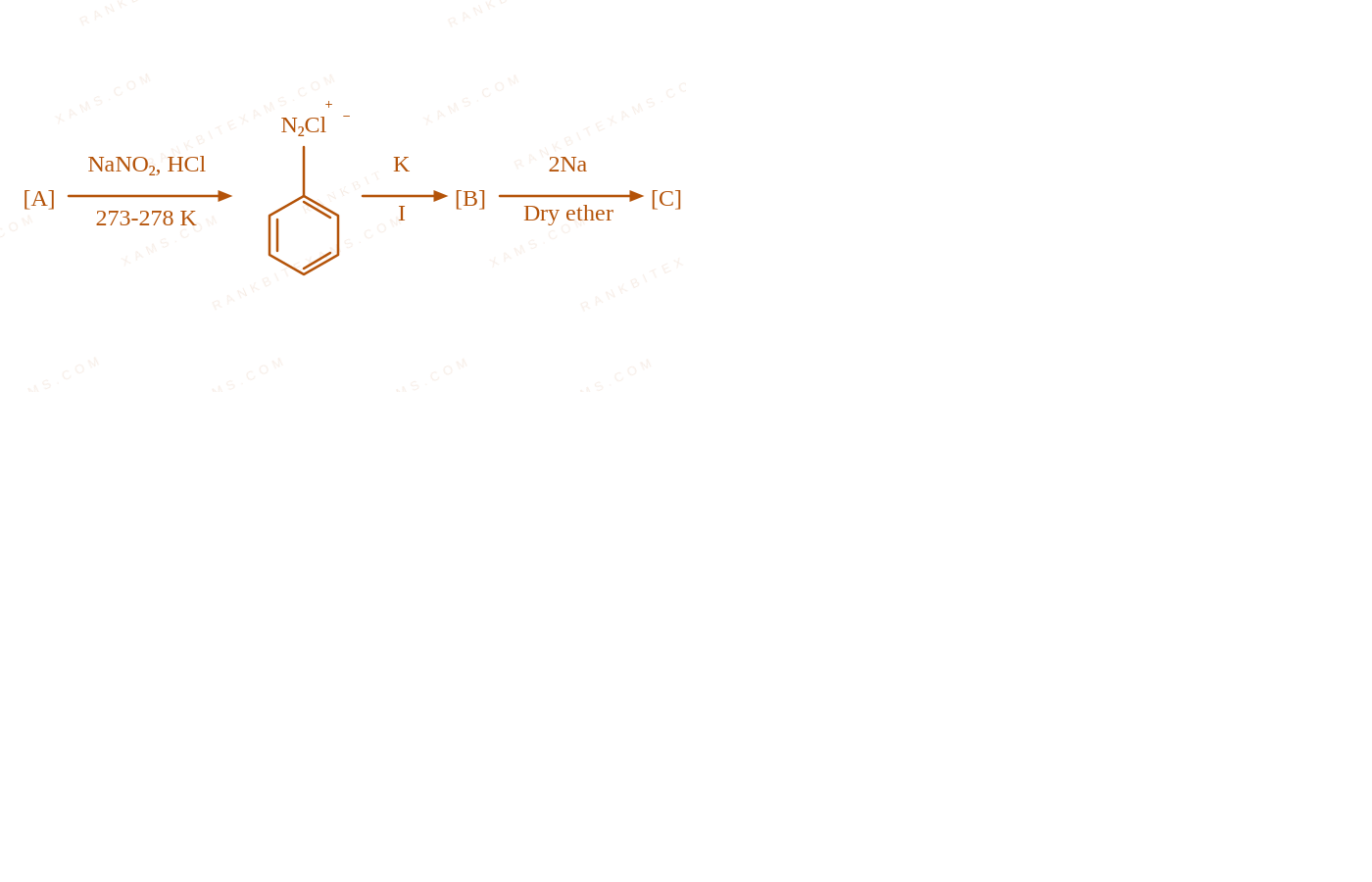
Identify [A], [B], and [C], respectively in the following reaction sequence: Reaction sequence starting from aniline reacting with NaNO2/HCl to give [A], which reacts with KI to give [B], and with 2Na/Dry ether to give [C].
Aniline with NaNO₂/HCl$\mathrm{NaNO_2/HCl}$ at 273--278~K$273\text{--}278\mathrm{~K}$ undergoes diazotization to yield benzenediazonium chloride [A] = C₆H₅N₂^+Cl^-$[\mathrm{A}] = \mathrm{C_6H_5N_2^+Cl^-}$.
Reaction of [A]$[\mathrm{A}]$ with KI$\mathrm{KI}$ replaces the diazonium group with iodine to form iodobenzene [B] = C₆H₅I$[\mathrm{B}] = \mathrm{C_6H_5I}$.
Treating iodobenzene [B]$[\mathrm{B}]$ with 2Na/dry ether$\mathrm{2Na/dry\ ether}$ yields biphenyl [C] = C₆H₅-C₆H₅$[\mathrm{C}] = \mathrm{C_6H_5-C_6H_5}$ via the Fittig reaction.
Reaction of benzenediazonium chloride with ethanol (EtOH$\mathrm{EtOH}$) is a reduction/deamination reaction that converts the diazonium salt to benzene, while ethanol gets oxidized to ethanal (CH₃CHO$\mathrm{CH_3CHO}$).
It does NOT yield phenetole (ethoxybenzene, Ar-OEt$\mathrm{Ar-OEt}$). Therefore, Reaction (1) is incorrect.
Step 1: Verification of Other Reactions
Reaction with H₃PO₂/H₂O$\mathrm{H_3PO_2/H_2O}$ gives benzene. (Correct)
Reaction with KI$\mathrm{KI}$ gives iodobenzene. (Correct)
Reaction with CuCN/KCN$\mathrm{CuCN/KCN}$ gives benzonitrile. (Correct)
Pattern Recognition
Diazonium salt + Ethanol arrow$\rightarrow$ Benzene (reduction), NOT Ethoxybenzene.
Practice past-year questions one chapter at a time. Pick an exam → subject → chapter and get every PYQ for that topic — pulled together from all past papers — with the chapter's key formulas alongside.