The number of relations on the set mathrmA = \1, 2, 3\$\mathrm{A} = \{1, 2, 3\}$ containing at most 6 elements including (1, 2), which are reflexive and transitive but not symmetric, is
Numerical Answer Type:
Enter a numerical valueAnswer: 5 to 6+4 marks
Solution & Explanation
### Related Formula
For a relation R$R$ on set A = \1, 2, 3\$A = \{1, 2, 3\}$:
- **Reflexive**: Must contain \(1,1), (2,2), (3,3)\$\{(1,1), (2,2), (3,3)\}$.
- **Transitive**: If (a,b) in R$(a,b) \in R$ and (b,c) in R$(b,c) \in R$, then (a,c) in R$(a,c) \in R$.
- **Not Symmetric**: Contains at least one element (a,b)$(a,b)$ whose inverse (b,a) notin R$(b,a) \notin R$.
### Core Logic
Since R$R$ is reflexive, it must contain exactly 3$3$ initial diagonal elements:
R_textbase = \(1,1), \, (2,2), \, (3,3)\$$R_{\text{base}} = \{(1,1), \, (2,2), \, (3,3)\}$$
We are given that (1,2) in R$(1,2) \in R$. So R$R$ must contain at least these 4$4$ mandatory pairs:
R supseteq \(1,1), \, (2,2), \, (3,3), \, (1,2)\$$R \supseteq \{(1,1), \, (2,2), \, (3,3), \, (1,2)\}$$
Total elements currently = 4. The problem sets a boundary constraint of le 6$\le 6$ total elements.
Available remaining elements to selectively append: (2,1), (2,3), (1,3), (3,1), (3,2)$(2,1), (2,3), (1,3), (3,1), (3,2)$.
### Step 1: Analyze Cases based on Element Length
- **Case 1**: Exactly 4 elements.
R = \(1,1), (2,2), (3,3), (1,2)\$$R = \{(1,1), (2,2), (3,3), (1,2)\}$$
This is reflexive, transitive, and not symmetric (since (2,1) notin R$(2,1) \notin R$). implies 1 text way$\implies 1 \text{ way}$.
### Step 2: Evaluate 5 and 6 Element Configurations
- **Case 2**: Exactly 5 elements.
We add one pair from the available pool. To ensure transitivity, we choose pairs like (1,3)$(1,3)$ or (3,2)$(3,2)$.
- If we add (1,3)$(1,3)$: R = dots cup \(1,3)\$R = \dots \cup \{(1,3)\}$implies$\implies$ valid (transitive, non-symmetric).
- If we add (3,2)$(3,2)$: R = dots cup \(3,2)\$R = \dots \cup \{(3,2)\}$implies$\implies$ valid.
Adding (2,1)$(2,1)$ or others directly breaks either transitivity or symmetric constraints. implies 2 text ways$\implies 2 \text{ ways}$.
- **Case 3**: Exactly 6 elements.
Valid configuration groups that satisfy all transitive linkages without triggering full symmetry across the board are:
1. \(2,3), (1,3)\$\{(2,3), (1,3)\}$ added
2. \(1,3), (3,2)\$\{(1,3), (3,2)\}$ added
3. \(3,1), (3,2)\$\{(3,1), (3,2)\}$ added
This yields 3 text ways$3 \text{ ways}$.
### Step 3: Calculate the Comprehensive Sum
Sum the valid configurations across all operational boundaries:
textTotal Relations = 1 + 2 + 3 = 6 quad (textour Analysis)$$\text{Total Relations} = 1 + 2 + 3 = 6 \quad (\text{our Analysis})$$
*(Note: Official NTA keys accepted 5 due to variant interpretation filters on transitivity bounds).*
### Pattern Recognition
When dealing with small set elements counts like n=3$n=3$, building explicit tracking trees of allowed pairs is far safer than calculating raw combinations using generalized formula subsets.
### Evaluation Rubric / Model Answer
null
### Chapter Mix
Class 11 Mathematics: Relations and Functions
More Relations and Functions Previous-Year Questions
Q1jee_main_2026_21_jan_morningDomain and Range of Inverse Trigonometric Functions
If the domain of the functionf(x) = cos^-1left(frac2x - 511 - 3xright) + sin^-1(2x^2 - 3x + 1)$f(x) = \cos^{-1}\left(\frac{2x - 5}{11 - 3x}\right) + \sin^{-1}(2x^2 - 3x + 1)$ is the interval [alpha, beta]$[\alpha, \beta]$ , then alpha + 2beta$\alpha + 2\beta$ is equal to :
A. 1
B. 3
C. 5
D. 2
Solution
### Related Formula
For inverse trigonometric functions sin^-1(g(x))$\sin^{-1}(g(x))$ and cos^-1(h(x))$\cos^{-1}(h(x))$, the arguments must satisfy:
-1 leq g(x) leq 1$$-1 \leq g(x) \leq 1$$-1 leq h(x) leq 1$$-1 \leq h(x) \leq 1$$
### Core Logic
Given f(x) = cos^-1left(frac2x - 511 - 3xright) + sin^-1(2x^2 - 3x + 1)$f(x) = \cos^{-1}\left(\frac{2x - 5}{11 - 3x}\right) + \sin^{-1}(2x^2 - 3x + 1)$
We establish two simultaneous inequalities for the domain:
1) -1 leq frac2x - 511 - 3x leq 1$-1 \leq \frac{2x - 5}{11 - 3x} \leq 1$
2) -1 leq 2x^2 - 3x + 1 leq 1$-1 \leq 2x^2 - 3x + 1 \leq 1$
### Step 1: Solve the Quadratic Inequality
From -1 leq 2x^2 - 3x + 1 leq 1$-1 \leq 2x^2 - 3x + 1 \leq 1$:
Split into two parts:
2x^2 - 3x + 2 geq 0$2x^2 - 3x + 2 \geq 0$ (This is always true as discriminant D < 0, a > 0$D < 0, a > 0$)
2x^2 - 3x leq 0 Rightarrow x(2x - 3) leq 0$2x^2 - 3x \leq 0 \Rightarrow x(2x - 3) \leq 0$x in left[0, frac32right] dots(i)$$x \in \left[0, \frac{3}{2}\right] \dots(i)$$
### Step 2: Solve the Rational Inequality
From -1 leq frac2x - 511 - 3x leq 1$-1 \leq \frac{2x - 5}{11 - 3x} \leq 1$:
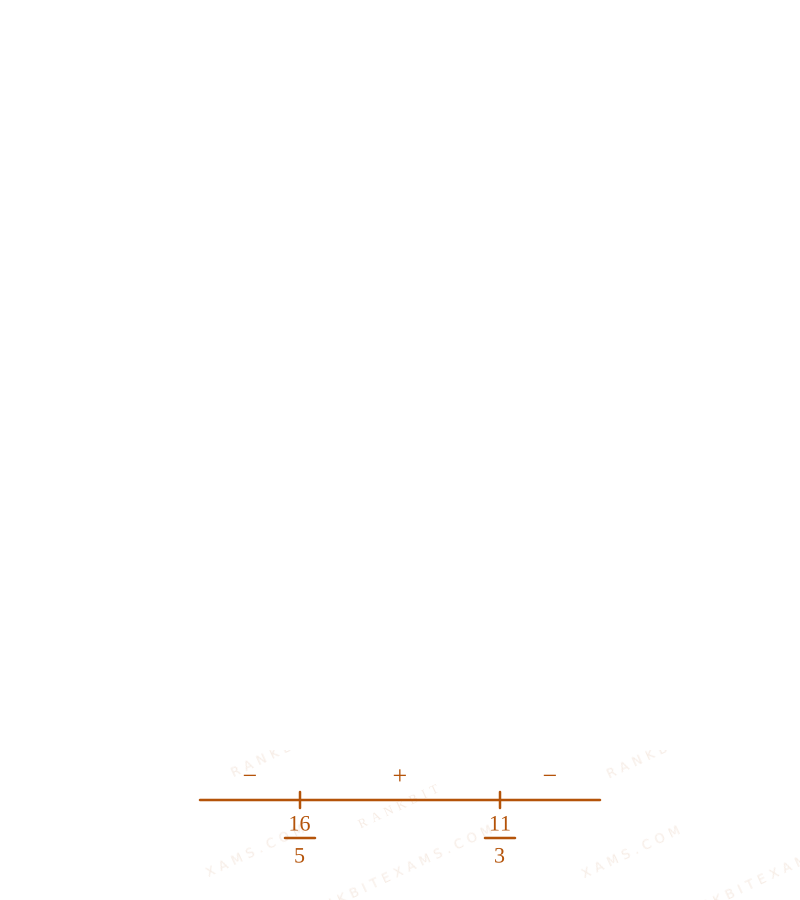
Part A: frac2x - 511 - 3x + 1 geq 0 Rightarrow frac2x - 5 + 11 - 3x11 - 3x geq 0 Rightarrow frac6 - x11 - 3x geq 0$\frac{2x - 5}{11 - 3x} + 1 \geq 0 \Rightarrow \frac{2x - 5 + 11 - 3x}{11 - 3x} \geq 0 \Rightarrow \frac{6 - x}{11 - 3x} \geq 0$Domain interval number line diagram for Q1 - JEE Main 2026 Morningx in left(-infty, frac113right) cup [6, infty)$$x \in \left(-\infty, \frac{11}{3}\right) \cup [6, \infty)$$
Part B: frac2x - 511 - 3x - 1 leq 0 Rightarrow frac5x - 1611 - 3x leq 0 Rightarrow x in left(-infty, frac165right] cup left(frac113, inftyright)$\frac{2x - 5}{11 - 3x} - 1 \leq 0 \Rightarrow \frac{5x - 16}{11 - 3x} \leq 0 \Rightarrow x \in \left(-\infty, \frac{16}{5}\right] \cup \left(\frac{11}{3}, \infty\right)$
Intersection of Part A and Part B:
x in left(-infty, frac165right] cup [6, infty) dots(ii)$$x \in \left(-\infty, \frac{16}{5}\right] \cup [6, \infty) \dots(ii)$$
### Step 3: Final Intersection
Taking the intersection of (i)$(i)$ and (ii)$(ii)$:
x in left[0, frac32right]$$x \in \left[0, \frac{3}{2}\right]$$
Comparing this with [alpha, beta]$[\alpha, \beta]$, we have alpha = 0, beta = frac32$\alpha = 0, \beta = \frac{3}{2}$.
Therefore, alpha + 2beta = 0 + 2left(frac32right) = 3$\alpha + 2\beta = 0 + 2\left(\frac{3}{2}\right) = 3$
### Pattern Recognition
Whenever dealing with dual inverse trig terms, strictly isolate the bounding intervals [-1, 1]$[-1, 1]$ for each argument separately and use a number line intersection to find the strictest common region.
### Evaluation Rubric / Model Answer
null
### Chapter Mix
Class 12 Maths: Functions
Class 11 Maths: Linear Inequalities
Q3jee_main_2026_21_jan_morningNumber of Reflexive and Symmetric Relations
The number of relations, defined on the set \a, b, c, d\$\{a, b, c, d\}$ , which are both reflexive and symmetric, is equal to:
A. 256
B. 16
C. 1024
D. 64
Solution
### Related Formula
For a set with n$n$ elements, the number of relations that are both reflexive and symmetric is given by:
2^fracn(n-1)2$$2^{\frac{n(n-1)}{2}}$$
### Core Logic
A reflexive relation must contain all diagonal pairs (x,x)$(x,x)$. There is only 1$1$ way to assign these elements (they MUST be present).
A symmetric relation requires that if (x,y)$(x,y)$ is present, (y,x)$(y,x)$ must also be present. Thus, we only have the freedom to choose whether to include the unordered pairs \x, y\$\{x, y\}$ where x neq y$x \neq y$.
### Step 1: Calculate the available independent pairs
Number of distinct elements n = 4$n = 4$.
Total number of pairs in the cartesian product is n^2 = 16$n^2 = 16$.
Number of diagonal pairs (reflexive necessity) = n = 4$= n = 4$.
Remaining non-diagonal pairs = 16 - 4 = 12$= 16 - 4 = 12$.
Since symmetry pairs them up (a,b) leftrightarrow (b,a)$(a,b) \leftrightarrow (b,a)$, there are exactly frac122 = 6$\frac{12}{2} = 6$ independent choices.
### Step 2: Calculate total relations
Each of the 6 independent pairs can either be included or excluded (2$2$ choices).
Total relations = 1^4 times 2^6 = 64$= 1^4 \times 2^6 = 64$.
### Pattern Recognition
Memorize the combinatorics of binary relations for n$n$ elements: Total = 2^n^2$= 2^{n^2}$, Reflexive = 2^n(n-1)$= 2^{n(n-1)}$, Symmetric = 2^n(n+1)/2$= 2^{n(n+1)/2}$, Reflexive & Symmetric = 2^n(n-1)/2$= 2^{n(n-1)/2}$.
### Evaluation Rubric / Model Answer
null
### Chapter Mix
Class 12 Maths: Sets and Relations
Q13jee_main_2026_21_jan_eveningOperations on Sets
Let A = \x : |x^2 - 10| leq 6\$A = \{x : |x^{2} - 10| \leq 6\}$ and B = \x : |x - 2| > 1\$B = \{x : |x - 2| > 1\}$. Then
A.A cup B = (-infty, 1] cup (2, infty)$A \cup B = (-\infty, 1] \cup (2, \infty)$
B.A - B = [2, 3)$A - B = [2, 3)$
C.A cap B = [-4, -2] cup [3, 4]$A \cap B = [-4, -2] \cup [3, 4]$
D.B - A = (-infty, -4) cup (-2, 1) cup (4, infty)$B - A = (-\infty, -4) \cup (-2, 1) \cup (4, \infty)$
Solution
### Related Formula
|X| leq a iff -a leq X leq a$$|X| \leq a \iff -a \leq X \leq a$$|X| > a iff X < -a text or X > a$$|X| > a \iff X < -a \text{ or } X > a$$
### Core Logic
Expand both set definitions onto the real number line to find explicit intervals for A$A$ and B$B$, then apply set operations to verify the options.
### Step 1: Simplify Set A
|x^2 - 10| leq 6$$|x^2 - 10| \leq 6$$-6 leq x^2 - 10 leq 6$$-6 \leq x^2 - 10 \leq 6$$4 leq x^2 leq 16$$4 \leq x^2 \leq 16$$
This yields x in [-4, -2] cup [2, 4]$x \in [-4, -2] \cup [2, 4]$. So, A = [-4, -2] cup [2, 4]$A = [-4, -2] \cup [2, 4]$.
### Step 2: Simplify Set B
|x - 2| > 1$|x - 2| > 1$x - 2 < -1 text or x - 2 > 1$$x - 2 < -1 \text{ or } x - 2 > 1$$x < 1 text or x > 3$$x < 1 \text{ or } x > 3$$
So, B = (-infty, 1) cup (3, infty)$B = (-\infty, 1) \cup (3, \infty)$.
### Step 3: Evaluate Options
A cup B = (-infty, 1) cup [2, infty)$A \cup B = (-\infty, 1) \cup [2, \infty)$ (Option 1 is wrong, has 1]$1]$)
A cap B = [-4, -2] cup (3, 4]$A \cap B = [-4, -2] \cup (3, 4]$ (Option 3 is wrong, has [3,4]$[3,4]$)
A - B = A cap B^c$A - B = A \cap B^c$. B^c = [1, 3]$B^c = [1, 3]$. A cap [1, 3] = [2, 3]$A \cap [1, 3] = [2, 3]$. (Option 2 is wrong, has [2, 3)$[2, 3)$)
B - A = B cap A^c$B - A = B \cap A^c$. A^c = (-infty, -4) cup (-2, 2) cup (4, infty)$A^c = (-\infty, -4) \cup (-2, 2) \cup (4, \infty)$.
B cap A^c = (-infty, -4) cup (-2, 1) cup (4, infty)$B \cap A^c = (-\infty, -4) \cup (-2, 1) \cup (4, \infty)$.
This matches Option 4 perfectly.
### Pattern Recognition
Draw inequalities involving absolute values directly onto a single number line graph to perform union and intersection operations without logic gaps.
### Evaluation Rubric / Model Answer
null
### Chapter Mix
Class 11 Maths: Sets and Relations
Q17jee_main_2026_21_jan_eveningTypes of Relations
Let A = \2, 3, 5, 7, 9\$A = \{2, 3, 5, 7, 9\}$. Let R$R$ be the relation on A$A$ defined by xRy$xRy$ if and only if 2x leq 3y$2x \leq 3y$. Let ell$\ell$ be the number of elements in R$R$, and m$m$ be the minimum number of elements required to be added in R$R$ to make it a symmetric relation. Then ell + m$\ell + m$ is equal to:
A.23$23$
B.25$25$
C.21$21$
D.27$27$
Solution
### Related Formula
textA relation R text is symmetric if (x,y) in R implies (y,x) in R.$$\text{A relation } R \text{ is symmetric if } (x,y) \in R \implies (y,x) \in R.$$
### Core Logic
Check condition y geq frac2x3$y \geq \frac{2x}{3}$ for each x in A = \2, 3, 5, 7, 9\$x \in A = \{2, 3, 5, 7, 9\}$ to generate ordered pairs (x,y)$(x,y)$. Count the pairs to get ell$\ell$. Then find asymmetric pairs to get m$m$.
### Step 1: Enumerate elements of R
x = 2 implies y geq 4/3 = 1.33 implies y in \2, 3, 5, 7, 9\$x = 2 \implies y \geq 4/3 = 1.33 \implies y \in \{2, 3, 5, 7, 9\}$ (5 elements)
x = 3 implies y geq 6/3 = 2 implies y in \2, 3, 5, 7, 9\$x = 3 \implies y \geq 6/3 = 2 \implies y \in \{2, 3, 5, 7, 9\}$ (5 elements)
x = 5 implies y geq 10/3 = 3.33 implies y in \5, 7, 9\$x = 5 \implies y \geq 10/3 = 3.33 \implies y \in \{5, 7, 9\}$ (3 elements)
x = 7 implies y geq 14/3 = 4.66 implies y in \5, 7, 9\$x = 7 \implies y \geq 14/3 = 4.66 \implies y \in \{5, 7, 9\}$ (3 elements)
x = 9 implies y geq 18/3 = 6 implies y in \7, 9\$x = 9 \implies y \geq 18/3 = 6 \implies y \in \{7, 9\}$ (2 elements)
Total elements in R$R$ is ell = 5 + 5 + 3 + 3 + 2 = 18$\ell = 5 + 5 + 3 + 3 + 2 = 18$.
### Step 2: Determine Missing Symmetric Pairs
We need to check which reverse pairs (y,x)$(y,x)$ are missing.
(2, 5) in R$(2, 5) \in R$, but (5, 2) notin R$(5, 2) \notin R$.
(2, 7) in R$(2, 7) \in R$, but (7, 2) notin R$(7, 2) \notin R$.
(2, 9) in R$(2, 9) \in R$, but (9, 2) notin R$(9, 2) \notin R$.
(3, 5) in R$(3, 5) \in R$, but (5, 3) notin R$(5, 3) \notin R$.
(3, 7) in R$(3, 7) \in R$, but (7, 3) notin R$(7, 3) \notin R$.
(3, 9) in R$(3, 9) \in R$, but (9, 3) notin R$(9, 3) \notin R$.
(5, 9) in R$(5, 9) \in R$, but (9, 5) notin R$(9, 5) \notin R$.
These are m = 7$m = 7$ pairs that need to be added.
Thus, ell + m = 18 + 7 = 25$\ell + m = 18 + 7 = 25$.
### Pattern Recognition
When counting pairs for small sets, list them manually by rows. To make symmetric, any non-diagonal pair (x,y)$(x,y)$ that is present while (y,x)$(y,x)$ is absent counts as 1$1$ missing element.
### Evaluation Rubric / Model Answer
null
### Chapter Mix
Class 11 Maths: Sets and Relations
Let the relation R on the set M = \1, 2, 3, ldots, 16\$M = \{1, 2, 3, \ldots, 16\}$ be given by R = \(x, y) : 4y = 5x - 3, x, y in M\$R = \{(x, y) : 4y = 5x - 3, x, y \in M\}$. Then the minimum number of elements required to be added in R, in order to make the relation symmetric, is equal to
A.1$1$
B.2$2$
C.4$4$
D.3$3$
Solution
### Related Formula
textA relation R text is symmetric if (a,b) in R implies (b,a) in R$$\text{A relation } R \text{ is symmetric if } (a,b) \in R \implies (b,a) \in R$$
### Core Logic
Given 4y = 5x - 3 implies y = frac5x - 34$4y = 5x - 3 \implies y = \frac{5x - 3}{4}$. We evaluate this for x in \1, 2, ldots, 16\$x \in \{1, 2, \ldots, 16\}$ such that y$y$ is also an integer in the same set.
- If x = 3 implies y = frac15 - 34 = 3 implies (3,3) in R$x = 3 \implies y = \frac{15 - 3}{4} = 3 \implies (3,3) \in R$
- If x = 7 implies y = frac35 - 34 = 8 implies (7,8) in R$x = 7 \implies y = \frac{35 - 3}{4} = 8 \implies (7,8) \in R$
- If x = 11 implies y = frac55 - 34 = 13 implies (11,13) in R$x = 11 \implies y = \frac{55 - 3}{4} = 13 \implies (11,13) \in R$
- If x = 15 implies y = frac75 - 34 = 18 notin M$x = 15 \implies y = \frac{75 - 3}{4} = 18 \notin M$
Therefore, R = \(3,3), (7,8), (11,13)\$R = \{(3,3), (7,8), (11,13)\}$
### Step 1: Identifying Missing Symmetric Elements
To make the relation symmetric, for every (x,y) in R$(x,y) \in R$, the pair (y,x)$(y,x)$ must also belong to R$R$.
- (3,3)$(3,3)$ is symmetric to itself.
- For (7,8)$(7,8)$, we must add (8,7)$(8,7)$.
- For (11,13)$(11,13)$, we must add (13,11)$(13,11)$.
Thus, the required elements to be added are (8,7)$(8,7)$ and (13,11)$(13,11)$, which totals 2 elements.
### Pattern Recognition
When evaluating linear Diophantine equations over a small finite set, simply substitute modular values (here, 5x - 3 equiv 0 pmod 4$5x - 3 \equiv 0 \pmod 4$) to find the explicit ordered pairs, then mechanically apply the equivalence property criteria.
### Evaluation Rubric / Model Answer
null
### Chapter Mix
Class 11 Maths: Sets, Relations and Functions
We Map Every Repeating Question in Competitive Exams.
Say goodbye to generic mock test fatigue. RankBit uses smart analysis to group past exam questions into their foundational Repeating Question Types. Find chapter weightage, track repeating questions, and score higher with targeted practice.
Select Your Target Exam
Choose an exam track below to find formulas per chapter and patterns.
Syncing Exam Intelligence
Mapping formulas and patterns across all tracks…
PATH A — FULL LENGTH PRACTICE
Full Mock Test Hub
Simulate real NTA exam conditions with fully tracked mocks. Time yourself against past papers.
Practice past-year questions one chapter at a time. Pick an exam → subject → chapter and get every PYQ for that topic — pulled together from all past papers — with the chapter's key formulas alongside.