The number of points of discontinuity of the function f(x) = left[fracx^22right] - left[sqrtxright], x in [0,4]$f(x) = \left[\frac{x^2}{2}\right] - \left[\sqrt{x}\right], x \in [0,4]$ , where [cdot]$[\cdot]$ denotes the greatest integer function is
Numerical Answer Type:
Enter a numerical valueAnswer: 8 to 8+4 marks
Solution & Explanation
### Related Formula
The greatest integer function [u]$[u]$ changes value and experiences a step discontinuity at any point where its inner argument u$u$ takes on an integer value.
### Core Logic
Analyze the potential points where either component function argument changes into an integer within the interval x in [0, 4]$x \in [0, 4]$.
1. For left[fracx^22right]$\left[\frac{x^2}{2}\right]$:
fracx^22$\frac{x^2}{2}$ can range from frac02 = 0$\frac{0}{2} = 0$ up to frac162 = 8$\frac{16}{2} = 8$.
Integer values are reached at fracx^22 = 0, 1, 2, 3, 4, 5, 6, 7, 8$\frac{x^2}{2} = 0, 1, 2, 3, 4, 5, 6, 7, 8$, which means critical test locations are:
x = 0, \, sqrt2, \, 2, \, sqrt6, \, sqrt8, \, sqrt10, \, sqrt12, \, sqrt14, \, 4$$x = 0, \, \sqrt{2}, \, 2, \, \sqrt{6}, \, \sqrt{8}, \, \sqrt{10}, \, \sqrt{12}, \, \sqrt{14}, \, 4$$
2. For [sqrtx]$[\sqrt{x}]$:
sqrtx$\sqrt{x}$ can range from sqrt0 = 0$\sqrt{0} = 0$ to sqrt4 = 2$\sqrt{4} = 2$.
Integer values are reached at sqrtx = 0, 1, 2$\sqrt{x} = 0, 1, 2$, which means critical test locations are:
x = 0, \, 1, \, 4$$x = 0, \, 1, \, 4$$
### Step 1: Audit Each Critical Point
Combine the set of test points within domain boundaries (0, 4)$(0, 4)$:
x in \1, \, sqrt2, \, 2, \, sqrt6, \, sqrt8, \, sqrt10, \, sqrt12, \, sqrt14\$$x \in \{1, \, \sqrt{2}, \, 2, \, \sqrt{6}, \, \sqrt{8}, \, \sqrt{10}, \, \sqrt{12}, \, \sqrt{14}\}$$
Let's evaluate the left and right hand limits at these specific values:
- At x = 1$x = 1$: [sqrtx]$[\sqrt{x}]$ steps up while left[fracx^22right]$\left[\frac{x^2}{2}\right]$ is constant implies$\implies$ Discontinuous.
- At x = sqrt2$x = \sqrt{2}$: left[fracx^22right]$\left[\frac{x^2}{2}\right]$ steps up while [sqrtx]$[\sqrt{x}]$ is constant implies$\implies$ Discontinuous.
- At x = 2$x = 2$: Both functions experience an simultaneous integer step. Let's inspect:
- f(2) = [2] - [sqrt2] = 2 - 1 = 1$f(2) = [2] - [\sqrt{2}] = 2 - 1 = 1$
- f(2^-) = [1.99] - [1.41] = 1 - 1 = 0$f(2^-) = [1.99] - [1.41] = 1 - 1 = 0$
Since LHL neq$\neq$ value at point, it is Discontinuous.
Continuing this verification down the full combined list confirms that none of the step jumps cancel each other out.
### Step 2: Sum the Discontinuity Points
Counting all isolated inner points within (0, 4)$(0, 4)$ yields exactly 8$8$ locations:
textTotal Points = 8$$\text{Total Points} = 8$$
### Pattern Recognition
When two greatest integer functions drop steps simultaneously at the same point (like at x=2$x=2$), always write out the explicit left and right limits manually, as simultaneous steps occasionally step in matching directions and maintain unexpected continuity.
### Evaluation Rubric / Model Answer
null
### Chapter Mix
Class 12 Mathematics: Limits, Continuity and Differentiability
Keywords:#greatest integer function step discontinuity#continuity analysis step boundary#JEE Main 2025 Morning Q71#Limits Continuity and Differentiability questions
More Limits, Continuity and Differentiability Previous-Year Questions — Page 3
Q72jee_main_2025_29_jan_eveningLimits of Definite Integrals
If lim_tto 0left(int_0^1 (3x + 5)^t dxright)^frac1t = fracalpha5eleft(frac85right)^frac23$\lim_{t\to 0}\left(\int_0^1 (3x + 5)^t dx\right)^{\frac{1}{t}} = \frac{\alpha}{5e}\left(\frac{8}{5}\right)^{\frac{2}{3}}$, then alpha$\alpha$ is equal to
Numerical Answer.Answer: 64 to 64
Solution
### Related Formula
Standard indeterminacy layout resolution rules for limits matching form 1^infty$1^\infty$:
lim_t to 0 [g(t)]^frac1t = e^lim_t to 0 fracg(t) - 1t$$\lim_{t \to 0} [g(t)]^{\frac{1}{t}} = e^{\lim_{t \to 0} \frac{g(t) - 1}{t}}$$
### Core Logic
Evaluate structural integration base at boundary limit initialization state t to 0$t \to 0$:
int_0^1 1 \, dx = 1$$\int_{0}^{1} 1 \, dx = 1$$
This confirms it matches an indeterminate form of type 1^infty$1^\infty$.
### Step 1: Apply Taylor Series or L'Hopital's Theorem
Compute limits of logarithmic integration properties inside exponential power indices:
textExponent Expression = lim_t to 0 fracint_0^1 (3x+5)^t \, dx - 1t$$\text{Exponent Expression} = \lim_{t \to 0} \frac{\int_{0}^{1} (3x+5)^t \, dx - 1}{t}$$
Applying L'Hopital's theorem to differentiate the numerator with respect to t$t$ yields:
int_0^1 (3x+5)^t ln(3x+5) \, dx$$\int_{0}^{1} (3x+5)^t \ln(3x+5) \, dx$$
Evaluating this at t = 0$t = 0$ gives:
int_0^1 ln(3x+5) \, dx$$\int_{0}^{1} \ln(3x+5) \, dx$$
### Step 2: Complete the Final Form Match
Integrating via parts results in logarithmic value updates:
left[ frac(3x+5)ln(3x+5) - (3x+5)3 right]_0^1 = frac8ln 8 - 5ln 5 - 33$$\left[ \frac{(3x+5)\ln(3x+5) - (3x+5)}{3} \right]_{0}^{1} = \frac{8\ln 8 - 5\ln 5 - 3}{3}$$
Passing components back through exponential foundations transforms terms to:
e^frac8ln 8 - 5ln 5 - 33 = left(frac85right)^frac23 cdot left(frac645eright)$$e^{\frac{8\ln 8 - 5\ln 5 - 3}{3}} = \left(\frac{8}{5}\right)^{\frac{2}{3}} \cdot \left(\frac{64}{5e}\right)$$
Comparing with the target expression fracalpha5eleft(frac85
ight)^frac23$\frac{\alpha}{5e}\left(\frac{8}{5}
ight)^{\frac{2}{3}}$ isolates the numerical solution directly:
alpha = 64$\alpha = 64$
### Pattern Recognition
Treating 1^infty$1^\infty$ structural transformations using logarithmic derivatives allows managing complex functions containing multiple integral boundaries effectively.
### Evaluation Rubric / Model Answer
null
### Chapter Mix
Class 11 Mathematics: Limits
Class 12 Mathematics: Definite Integration
Q74jee_main_2025_28_jan_morningContinuity and Differentiability of Piecewise Functions
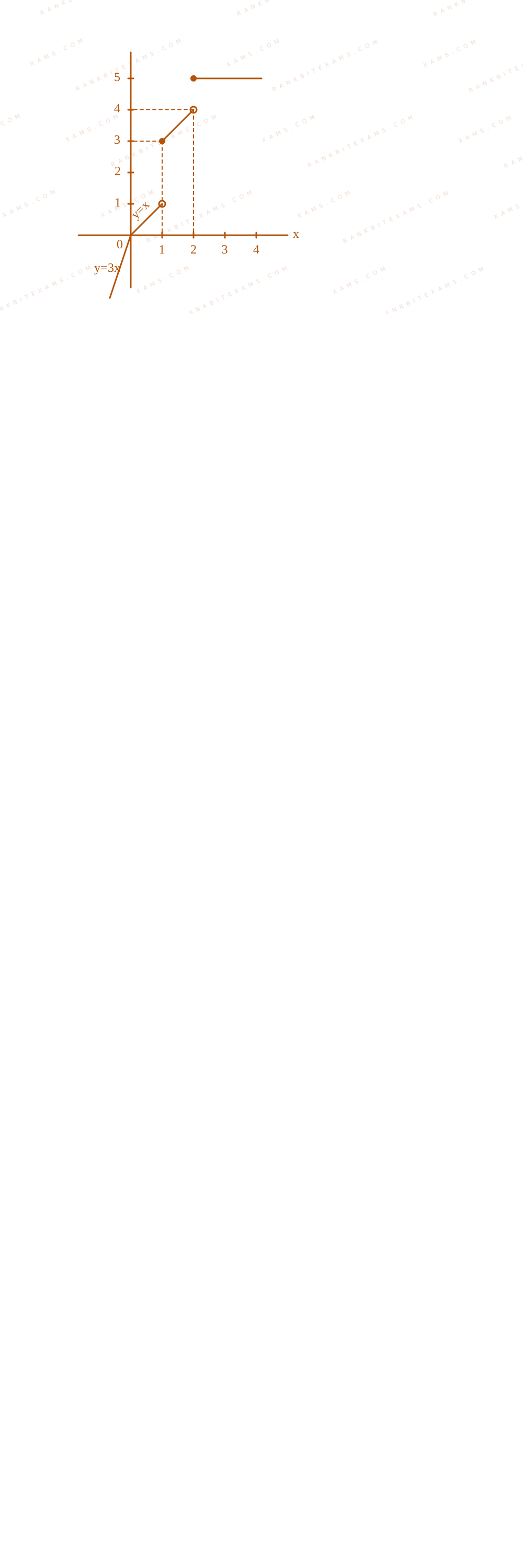
Let
f(x) = begincases 3x, & x < 0 \\ min left\1 + x + [ x ], x + 2 [ x ] right\, & 0 le x le 2 \\ 5, & x > 2 endcases$$f(x) = \begin{cases} 3x, & x < 0 \\ \min \left\{1 + x + [ x ], x + 2 [ x ] \right\}, & 0 \le x \le 2 \\ 5, & x > 2 \end{cases}$$
where [.]$[.]$ denotes greatest integer function. If alpha$\alpha$ and beta$\beta$ are the number of points, where f$f$ is not continuous and is not differentiable, respectively, then alpha + beta$\alpha + \beta$ equals....
Numerical Answer.Answer: 5 to 5
Solution
### Related Formula
A function is discontinuous if left-hand and right-hand limits mismatch at boundary transitions. Non-differentiability occurs at discontinuities or sharp turns.
### Core Logic
Simplify the greatest integer component [x]$[x]$ by expanding over integer intervals: Continuity and Differentiability of Piecewise Functions diagram for Q74 - JEE Main 2025 Morningf(x) = begincases 3x, & x < 0 \\ x, & 0 le x < 1 \\ x + 2, & 1 le x < 2 \\ 5, & x > 2 endcases$$f(x) = \begin{cases} 3x, & x < 0 \\ x, & 0 \le x < 1 \\ x + 2, & 1 \le x < 2 \\ 5, & x > 2 \end{cases}$$
### Step 1: Testing Continuity Limits
Check continuity at structural boundaries:
At x = 0$x = 0$: textLHM = 0$\text{LHM} = 0$, textRHM = 0$\text{RHM} = 0$implies$\implies$ Continuous.
At x = 1$x = 1$: textLHM = 1$\text{LHM} = 1$, textRHM = 3$\text{RHM} = 3$implies$\implies$ Discontinuous.
At x = 2$x = 2$: textLHM = 4$\text{LHM} = 4$, textRHM = 5$\text{RHM} = 5$implies$\implies$ Discontinuous.
Thus, alpha = 2$\alpha = 2$ points of discontinuity (x in \1, 2\$x \in \{1, 2\}$).
### Step 2: Testing Differentiability Parameters
Discontinuities automatically introduce non-differentiability. Now check smooth corners at the remaining continuous transition x = 0$x = 0$:
f^prime(0^-) = 3, quad f^prime(0^+) = 1 implies textNot differentiable at x=0.$$f^\prime(0^-) = 3, \quad f^\prime(0^+) = 1 \implies \text{Not differentiable at } x=0.$$
Thus, beta = 3$\beta = 3$ points of non-differentiability (x in \0, 1, 2\$x \in \{0, 1, 2\}$).
alpha + beta = 2 + 3 = 5$$\alpha + \beta = 2 + 3 = 5$$
### Pattern Recognition
Discontinuities automatically break differentiability. Always count them first before checking derivatives at smooth corner points.
### Evaluation Rubric / Model Answer
null
### Chapter Mix
Class 12 Maths: Limits, Continuity and Differentiability
Q69jee_main_2025_03_april_morningContinuity of Piecewise Functions
Let f(x) = begincases (1 + ax)^1/x & , x < 0 \\ 1 + b & , x = 0 \\ frac(x + 4)^1/2 - 2(x + c)^1/3 - 2 & , x > 0 endcases$f(x) = \begin{cases} (1 + ax)^{1/x} & , x < 0 \\ 1 + b & , x = 0 \\ \frac{(x + 4)^{1/2} - 2}{(x + c)^{1/3} - 2} & , x > 0 \end{cases}$ [cite: 680] be continuous at x = 0$x = 0$[cite: 681]. Then mathrme^mathrmacdot b cdot c$\mathrm{e}^{\mathrm{a}}\cdot b \cdot c$ is equal to[cite: 681]:
A. 64
B. 72
C. 48
D. 36
Solution
### Related Formula
Continuity definition condition frame:
lim_x rightarrow 0^- f(x) = f(0) = lim_x rightarrow 0^+ f(x)$$\lim_{x \rightarrow 0^-} f(x) = f(0) = \lim_{x \rightarrow 0^+} f(x)$$
### Core Logic
Evaluate Left-Hand Limit (LHL) using standard forms [cite: 1410]:
textLHL = lim_x rightarrow 0^- (1+ax)^1/x = e^a$$\text{LHL} = \lim_{x \rightarrow 0^-} (1+ax)^{1/x} = e^a$$ [cite: 1410]
Given baseline definition states f(0) = 1+b$f(0) = 1+b$ [cite: 1410].
For Right-Hand Limit (RHL) to be finite and valid, the numerator tracking towards 0 means the denominator must also balance towards 0 to avoid divergence [cite: 1411]:
lim_x rightarrow 0^+ left[(x+c)^1/3 - 2right] = 0 implies c^1/3 = 2 implies c = 8$$\lim_{x \rightarrow 0^+} \left[(x+c)^{1/3} - 2\right] = 0 \implies c^{1/3} = 2 \implies c = 8$$ [cite: 1414]
### Step 1: Applying L'Hopital's rule to the RHL
With c=8$c=8$, evaluate RHL limit expressions using derivatives [cite: 1411]:
textRHL = lim_x rightarrow 0^+ fracfrac12sqrtx+4frac13(x+8)^-2/3 = fracfrac12(2)frac13(8)^-2/3 = fracfrac14frac13 cdot 4 = frac14 cdot 12 = 3$$\text{RHL} = \lim_{x \rightarrow 0^+} \frac{\frac{1}{2\sqrt{x+4}}}{\frac{1}{3}(x+8)^{-2/3}} = \frac{\frac{1}{2(2)}}{\frac{1}{3}(8)^{-2/3}} = \frac{\frac{1}{4}}{\frac{1}{3 \cdot 4}} = \frac{1}{4} \cdot 12 = 3$$ [cite: 1411, 1415]
### Step 2: Equating limits for parameter solutions
Equate continuous criteria milestones together [cite: 1416]:
e^a = 1 + b = 3$e^a = 1 + b = 3$ [cite: 1416]
e^a = 3 implies b = 2$$e^a = 3 \implies b = 2$$ [cite: 1416]
Compute the ultimate target combination product configuration [cite: 1416]:
e^a cdot b cdot c = 3 cdot 2 cdot 8 = 48$$e^a \cdot b \cdot c = 3 \cdot 2 \cdot 8 = 48$$ [cite: 1416]
### Pattern Recognition
Determining missing root constants inside indeterminate fraction structures handles calculations swiftly before running formal limits.
### Evaluation Rubric / Model Answer
null
### Chapter Mix
Class 12 Mathematics: Limits, Continuity and Differentiability
Q52jee_main_2025_04_april_eveningEvaluation of Limits
Let f$f$ be a differentiable function on mathbfR$\mathbf{R}$ such that f(2) = 1$f(2) = 1$, f'(2) = 4$f'(2) = 4$. Let lim_x to 0 (f(2 + x))^3/x = e^alpha$\lim_{x \to 0} (f(2 + x))^{3/x} = e^{\alpha}$. Then the number of times the curve y = 4x^3 - 4x^2 - 4(alpha -7)x - alpha$y = 4x^{3} - 4x^{2} - 4(\alpha -7)x - \alpha$ meets x-axis is:-
A.2$2$
B.1$1$
C.0$0$
D.3$3$
Solution
### Related Formula
For a limit of the form lim_x to 0 [g(x)]^h(x)$\lim_{x \to 0} [g(x)]^{h(x)}$ where g(x) to 1$g(x) \to 1$ and h(x) to infty$h(x) \to \infty$, the limit evaluates to:
e^lim_x to 0 h(x)[g(x) - 1]$$e^{\lim_{x \to 0} h(x)[g(x) - 1]}$$
### Core Logic
Given the limit expression:
lim_x to 0 (f(2 + x))^3/x = e^alpha$$\lim_{x \to 0} (f(2 + x))^{3/x} = e^{\alpha}$$
Using the standard form as f(2)=1$f(2)=1$, this transforms to:
e^lim_x to 0 frac3x (f(2 + x) - 1) = e^alpha$$e^{\lim_{x \to 0} \frac{3}{x} (f(2 + x) - 1)} = e^{\alpha}$$
Recognizing the definition of the derivative f'(2) = lim_x to 0 fracf(2+x)-1x$f'(2) = \lim_{x \to 0} \frac{f(2+x)-1}{x}$:
e^3 f'(2) = e^alpha$$e^{3 f'(2)} = e^{\alpha}$$
Given f'(2) = 4$f'(2) = 4$:
e^3(4) = e^12 = e^alpha implies alpha = 12$$e^{3(4)} = e^{12} = e^{\alpha} \implies \alpha = 12$$
### Step 1: Finding Intersection points with x-axis
Substitute alpha = 12$\alpha = 12$ into the equation of the curve:
y = 4x^3 - 4x^2 - 4(12 - 7)x - 12$$y = 4x^3 - 4x^2 - 4(12 - 7)x - 12$$y = 4x^3 - 4x^2 - 20x - 12$$y = 4x^3 - 4x^2 - 20x - 12$$
To find where it meets the x-axis, set y = 0$y = 0$:
4x^3 - 4x^2 - 20x - 12 = 0 implies x^3 - x^2 - 5x - 3 = 0$$4x^3 - 4x^2 - 20x - 12 = 0 \implies x^3 - x^2 - 5x - 3 = 0$$
Testing for rational roots, x = -1$x = -1$ is a root because (-1)^3 - (-1)^2 - 5(-1) - 3 = -1 - 1 + 5 - 3 = 0$(-1)^3 - (-1)^2 - 5(-1) - 3 = -1 - 1 + 5 - 3 = 0$.
### Step 2: Factoring the cubic polynomial
Dividing x^3 - x^2 - 5x - 3$x^3 - x^2 - 5x - 3$ by (x+1)$(x+1)$ gives:
(x + 1)(x^2 - 2x - 3) = 0$$(x + 1)(x^2 - 2x - 3) = 0$$(x + 1)(x + 1)(x - 3) = 0 implies (x + 1)^2(x - 3) = 0$$(x + 1)(x + 1)(x - 3) = 0 \implies (x + 1)^2(x - 3) = 0$$
The roots are x = -1$x = -1$ (repeated root) and x = 3$x = 3$. Therefore, the distinct real values of x$x$ where the curve intersects the x-axis are -1$-1$ and 3$3$, meaning it meets the x-axis exactly 2$2$ times.
### Pattern Recognition
A repeated root like (x+1)^2$(x+1)^2$ means the curve is tangent to the x-axis at that point, but it still counts as a meeting point. Always count distinct real roots when determining the number of meeting points with the coordinate axes.
### Evaluation Rubric / Model Answer
null
### Chapter Mix
Class 12 Mathematics: Limits, Continuity and Differentiability
Class 11 Mathematics: Theory of Equations
Q57jee_main_2025_04_april_morningEvaluation of Limits using Expansion
If lim_x to 1^+frac(x - 1)(6 + lambdacos(x - 1)) + musin(1 - x)(x - 1)^3 = -1$\lim_{x \to 1^{+}}\frac{(x - 1)(6 + \lambda\cos(x - 1)) + \mu\sin(1 - x)}{(x - 1)^3} = -1$, where lambda, mu in mathbbR$\lambda, \mu \in \mathbb{R}$, then \lambda + \mu is equal to
A. 18
B. 20
C. 19
D. 17
Solution
### Related Formula
Standard Taylor expansions near zero:
cos h = 1 - frach^22! + frach^44! - dots$$\cos h = 1 - \frac{h^2}{2!} + \frac{h^4}{4!} - \dots$$sin h = h - frach^33! + frach^55! - dots$$\sin h = h - \frac{h^3}{3!} + \frac{h^5}{5!} - \dots$$
### Core Logic
Let x - 1 = h$x - 1 = h$, where h to 0^+$h \to 0^{+}$. The expression transforms into:
lim_h to 0frach(6 + lambdacos h) - musin hh^3 = -1$$\lim_{h \to 0}\frac{h(6 + \lambda\cos h) - \mu\sin h}{h^3} = -1$$
Substitute the expansions into the numerator:
lim_h to 0frachleft[6 + lambdaleft(1 - frach^22right)right] - muleft(h - frach^36right)h^3 = -1$$\lim_{h \to 0}\frac{h\left[6 + \lambda\left(1 - \frac{h^2}{2}\right)\right] - \mu\left(h - \frac{h^3}{6}\right)}{h^3} = -1$$lim_h to 0frac(6 + lambda - mu)h + left(-fraclambda2 + fracmu6right)h^3h^3 = -1$$\lim_{h \to 0}\frac{(6 + \lambda - \mu)h + \left(-\frac{\lambda}{2} + \frac{\mu}{6}\right)h^3}{h^3} = -1$$
### Step 1: Match Coefficients for Existence
For the limit to be finite, the coefficient of h$h$ must vanish:
6 + lambda - mu = 0 implies mu - lambda = 6 quad dots (1)$$6 + \lambda - \mu = 0 \implies \mu - \lambda = 6 \quad \dots (1)$$
Equating the h^3$h^3$ term to the given limit value:
-fraclambda2 + fracmu6 = -1 implies -3lambda + mu = -6 quad dots (2)$$-\frac{\lambda}{2} + \frac{\mu}{6} = -1 \implies -3\lambda + \mu = -6 \quad \dots (2)$$
### Step 2: Solve System of Equations
Subtract equation (1) from (2):
(-3lambda + mu) - (mu - lambda) = -6 - 6 implies -2lambda = -12 implies lambda = 6$$(-3\lambda + \mu) - (\mu - \lambda) = -6 - 6 \implies -2\lambda = -12 \implies \lambda = 6$$
From (1), mu = 6 + 6 = 12$\mu = 6 + 6 = 12$.
lambda + mu = 6 + 12 = 18$$\lambda + \mu = 6 + 12 = 18$$
### Pattern Recognition
When dealing with indeterminate form limits involving mixed trigonometric expressions with a non-zero denominator power, polynomial substitution using Taylor series is much cleaner and less prone to differentiation tracking mistakes compared to multiple L'Hôpital cycles.
### Evaluation Rubric / Model Answer
null
### Chapter Mix
Class 12 Mathematics: Limits, Continuity and Differentiability
More Limits, Continuity and Differentiability Questions — jee_main_2025_07_april_morning
We Map Every Repeating Question in Competitive Exams.
Say goodbye to generic mock test fatigue. RankBit uses smart analysis to group past exam questions into their foundational Repeating Question Types. Find chapter weightage, track repeating questions, and score higher with targeted practice.
Select Your Target Exam
Choose an exam track below to find formulas per chapter and patterns.
Syncing Exam Intelligence
Mapping formulas and patterns across all tracks…
PATH A — FULL LENGTH PRACTICE
Full Mock Test Hub
Simulate real NTA exam conditions with fully tracked mocks. Time yourself against past papers.
Practice past-year questions one chapter at a time. Pick an exam → subject → chapter and get every PYQ for that topic — pulled together from all past papers — with the chapter's key formulas alongside.