Let C_1$C_1$ be the circle in the third quadrant of radius 3, that touches both coordinate axes. Let C_2$C_2$ be the circle with centre (1, 3) that touches C_1$C_1$ externally at the point (alpha, beta)$(\alpha, \beta)$. If (beta - alpha)^2 = fracmn$(\beta - \alpha)^2 = \frac{m}{n}$, gcd(m, n) = 1$\gcd(m, n) = 1$, then m + n$m + n$ is equal to:
A.9$9$
B.13$13$
C.22$22$
D.31$31$
Solution & Explanation
### Related Formula
For a circle in the third quadrant touching both coordinate axes, the center layout is (-r, -r)$(-r, -r)$ and equation looks like:
(x + r)^2 + (y + r)^2 = r^2$$(x + r)^2 + (y + r)^2 = r^2$$
For external contact between circles C_1$C_1$ and C_2$C_2$, the distance between centers equals the sum of their radii:
C_1C_2 = r_1 + r_2$$C_1C_2 = r_1 + r_2$$
### Core Logic
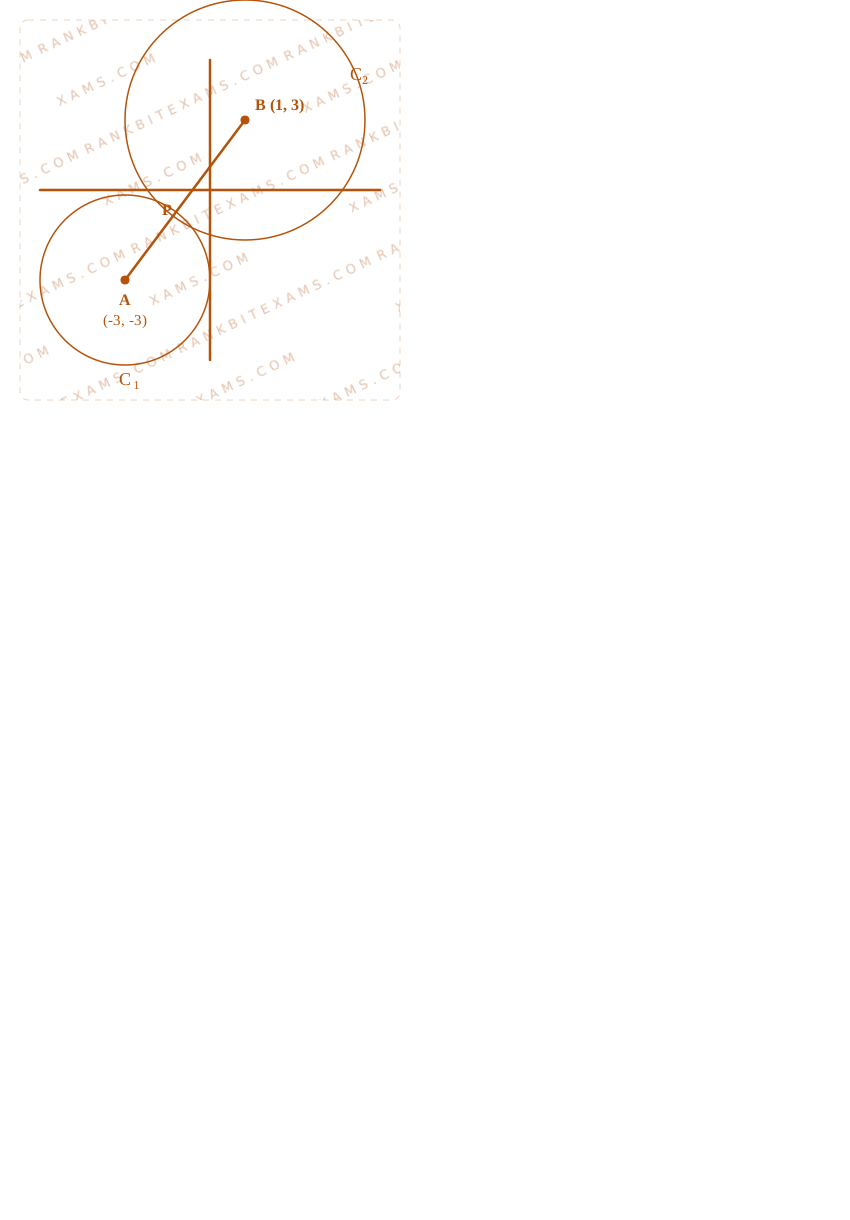
Circle C_1$C_1$ has radius r_1 = 3$r_1 = 3$ and touches both axes in the third quadrant, so its center is A(-3, -3)$A(-3, -3)$.
Circle C_2$C_2$ has center B(1, 3)$B(1, 3)$.
The distance between centers A$A$ and B$B$ is:
AB = sqrt(1 - (-3))^2 + (3 - (-3))^2 = sqrt4^2 + 6^2 = sqrt16 + 36 = sqrt52 = 2sqrt13$$AB = \sqrt{(1 - (-3))^2 + (3 - (-3))^2} = \sqrt{4^2 + 6^2} = \sqrt{16 + 36} = \sqrt{52} = 2\sqrt{13}$$
### Step 1: Determine Radius of Circle 2
Tangent and Normal to a Circle diagram for Q59 - JEE Main 2025 Morning
Since the circles touch externally:
AB = r_1 + r_2 implies 2sqrt13 = 3 + r_2 implies r_2 = 2sqrt13 - 3$$AB = r_1 + r_2 \implies 2\sqrt{13} = 3 + r_2 \implies r_2 = 2\sqrt{13} - 3$$
### Step 2: Locate the Contact Point via Section Formula
The point of contact P(alpha, beta)$P(\alpha, \beta)$ divides the line segment joining centers A(-3, -3)$A(-3, -3)$ and B(1, 3)$B(1, 3)$ internally in the ratio r_1 : r_2 = 3 : (2sqrt13 - 3)$r_1 : r_2 = 3 : (2\sqrt{13} - 3)$.
Using the internal section formula:
alpha = frac3(1) + (2sqrt13 - 3)(-3)3 + (2sqrt13 - 3) = frac3 - 6sqrt13 + 92sqrt13 = frac12 - 6sqrt13 + 02sqrt13 = frac6 - 3sqrt13sqrt13$$\alpha = \frac{3(1) + (2\sqrt{13} - 3)(-3)}{3 + (2\sqrt{13} - 3)} = \frac{3 - 6\sqrt{13} + 9}{2\sqrt{13}} = \frac{12 - 6\sqrt{13} + 0}{2\sqrt{13}} = \frac{6 - 3\sqrt{13}}{\sqrt{13}}$$beta = frac3(3) + (2sqrt13 - 3)(-3)3 + (2sqrt13 - 3) = frac9 - 6sqrt13 + 92sqrt13 = frac18 - 6sqrt132sqrt13 = frac9 - 3sqrt13sqrt13$$\beta = \frac{3(3) + (2\sqrt{13} - 3)(-3)}{3 + (2\sqrt{13} - 3)} = \frac{9 - 6\sqrt{13} + 9}{2\sqrt{13}} = \frac{18 - 6\sqrt{13}}{2\sqrt{13}} = \frac{9 - 3\sqrt{13}}{\sqrt{13}}$$
### Step 3: Calculate the Difference Value
Find (beta - alpha)^2$(\beta - \alpha)^2$:
beta - alpha = frac9 - 3sqrt13sqrt13 - frac6 - 3sqrt13sqrt13 = frac3sqrt13$$\beta - \alpha = \frac{9 - 3\sqrt{13}}{\sqrt{13}} - \frac{6 - 3\sqrt{13}}{\sqrt{13}} = \frac{3}{\sqrt{13}}$$(beta - alpha)^2 = left(frac3sqrt13right)^2 = frac913$$(\beta - \alpha)^2 = \left(\frac{3}{\sqrt{13}}\right)^2 = \frac{9}{13}$$
Comparing with fracmn$\frac{m}{n}$ where gcd(m, n) = 1$\gcd(m, n) = 1$ gives m = 9, n = 13$m = 9, n = 13$.
m + n = 9 + 13 = 22$$m + n = 9 + 13 = 22$$
### Pattern Recognition
Notice that computing (beta - alpha)$(\beta - \alpha)$ directly cancels out the irrational sqrt13$\sqrt{13}$ term from the numerator before squaring, saving a significant amount of tedious arithmetic expansion.
### Evaluation Rubric / Model Answer
null
### Chapter Mix
Class 11 Mathematics: Coordinate Geometry
Class 11 Mathematics: Circles
More Circles Previous-Year Questions — Page 3
Q4jee_main_2024_31_jan_eveningEquation of Tangent and Normal
Let a variable line passing through the centre of the circle x^2 + y^2 - 16x - 4y = 0$x^2 + y^2 - 16x - 4y = 0$, meet the positive co-ordinate axes at the point A$A$ and B$B$. Then the minimum value of OA + OB$OA + OB$, where O$O$ is the origin, is equal to
A.12$12$
B.18$18$
C.20$20$
D.24$24$
Solution
### Related Formula
textIntercept form of line: fracxa + fracyb = 1$$\text{Intercept form of line: } \frac{x}{a} + \frac{y}{b} = 1$$
### Core Logic
Circle x^2 + y^2 - 16x - 4y = 0$x^2 + y^2 - 16x - 4y = 0$ has its centre at (8, 2)$(8, 2)$.
Let the line passing through (8, 2)$(8, 2)$ have slope m$m$. Its equation is:
y - 2 = m(x - 8)$$y - 2 = m(x - 8)$$
x-intercept (A$A$): set y=0 implies -2 = m(x-8) implies x = 8 - frac2m$y=0 \implies -2 = m(x-8) \implies x = 8 - \frac{2}{m}$.
y-intercept (B$B$): set x=0 implies y = 2 - 8m$x=0 \implies y = 2 - 8m$.
Sum of intercepts OA + OB = (8 - frac2m) + (2 - 8m) = 10 - frac2m - 8m$OA + OB = (8 - \frac{2}{m}) + (2 - 8m) = 10 - \frac{2}{m} - 8m$.
To minimize, let f(m) = 10 - frac2m - 8m$f(m) = 10 - \frac{2}{m} - 8m$.
f'(m) = frac2m^2 - 8 = 0 implies m^2 = frac14$$f'(m) = \frac{2}{m^2} - 8 = 0 \implies m^2 = \frac{1}{4}$$
Since the line meets the positive coordinate axes, intercepts must be positive, which requires m < 0$m < 0$. Thus m = -1/2$m = -1/2$.
Substitute m = -1/2$m = -1/2$:
OA + OB = 10 - frac2-1/2 - 8(-1/2) = 10 + 4 + 4 = 18$$OA + OB = 10 - \frac{2}{-1/2} - 8(-1/2) = 10 + 4 + 4 = 18$$
### Pattern Recognition
AM-GM can also be applied: 8a + 2b = ab implies 1 = frac8a + frac2b$8a + 2b = ab \implies 1 = \frac{8}{a} + \frac{2}{b}$. To minimize a+b$a+b$, use Cauchy-Schwarz or standard differentiation. Differentiation directly yields intercept minima.
### Evaluation Rubric / Model Answer
null
### Chapter Mix
Class 11 Maths: Circles
Q4jee_main_2024_31_jan_morningIntersection and Common Chords
If one of the diameters of the circle x^2 + y^2 - 10x + 4y + 13 = 0$x^2 + y^2 - 10x + 4y + 13 = 0$ is a chord of another circle C, whose center is the point of intersection of the lines 2x + 3y = 12$2x + 3y = 12$ and 3x - 2y = 5$3x - 2y = 5$, then the radius of the circle C is
A.sqrt20$\sqrt{20}$
B.4$4$
C.6$6$
D.3sqrt2$3\sqrt{2}$
Solution
### Core Logic
Find the center of circle C by solving 2x + 3y = 12$2x + 3y = 12$ and 3x - 2y = 5$3x - 2y = 5$.
Multiplying and subtracting yields 13x = 39 implies x = 3, y = 2$13x = 39 \implies x = 3, y = 2$.
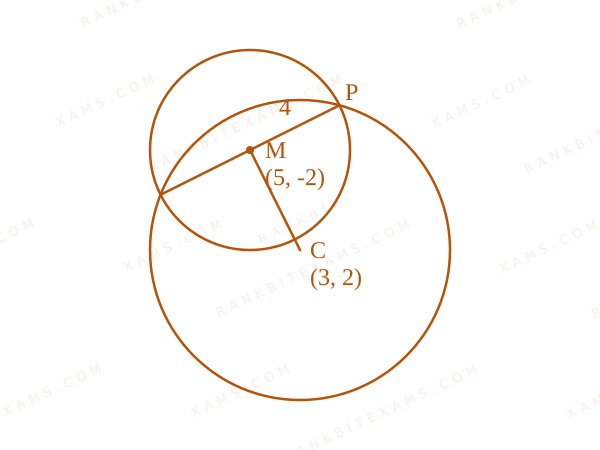
Center of C is (3, 2)$(3, 2)$.
### Step 1: Properties of Given Circle
Given circle: x^2 + y^2 - 10x + 4y + 13 = 0$x^2 + y^2 - 10x + 4y + 13 = 0$.
Center M(5, -2)$M(5, -2)$.
Radius r = sqrt25 + 4 - 13 = 4$r = \sqrt{25 + 4 - 13} = 4$.
Intersection and Common Chords diagram for Q4 - JEE Main 2024 Morning
### Step 2: Radius Calculation
The diameter of the first circle is a chord of circle C. Therefore, the distance between the two centers forms a right-angled triangle with the radius of C (CP$CP$) and the radius of the first circle (r = 4$r = 4$).
Distance CM = sqrt(5-3)^2 + (-2-2)^2 = sqrt4 + 16 = sqrt20$CM = \sqrt{(5-3)^2 + (-2-2)^2} = \sqrt{4 + 16} = \sqrt{20}$.
Radius of circle C is CP = sqrtCM^2 + r^2 = sqrt20 + 16 = sqrt36 = 6$CP = \sqrt{CM^2 + r^2} = \sqrt{20 + 16} = \sqrt{36} = 6$.
### Pattern Recognition
When a diameter of circle 1 is a chord of circle 2, the triangle formed by the centers and the point of intersection is a right-angled triangle at the center of circle 1.
### Evaluation Rubric / Model Answer
null
### Chapter Mix
Class 11 Maths: Circles
Class 11 Maths: Straight Lines
We Map Every Repeating Question in Competitive Exams.
Say goodbye to generic mock test fatigue. RankBit uses smart analysis to group past exam questions into their foundational Repeating Question Types. Find chapter weightage, track repeating questions, and score higher with targeted practice.
Select Your Target Exam
Choose an exam track below to find formulas per chapter and patterns.
Syncing Exam Intelligence
Mapping formulas and patterns across all tracks…
PATH A — FULL LENGTH PRACTICE
Full Mock Test Hub
Simulate real NTA exam conditions with fully tracked mocks. Time yourself against past papers.
Practice past-year questions one chapter at a time. Pick an exam → subject → chapter and get every PYQ for that topic — pulled together from all past papers — with the chapter's key formulas alongside.