JEE Main · Chemistry → Steady

Chemical Kinetics appeared 43 times across 3 years — 5% of Chemistry. This question is from Integrated Rate Equations.

Year 2026 2025 2024 Total
Questions 14 21 8 43

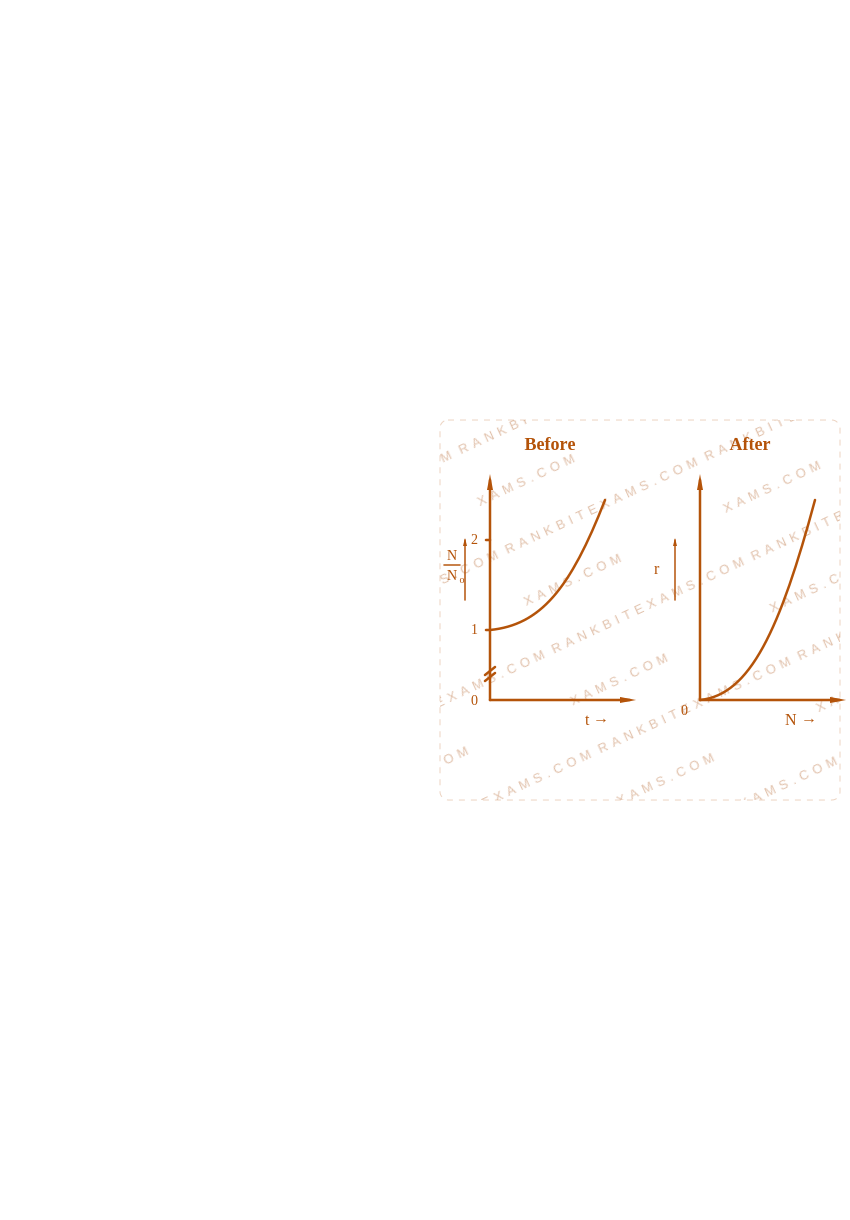
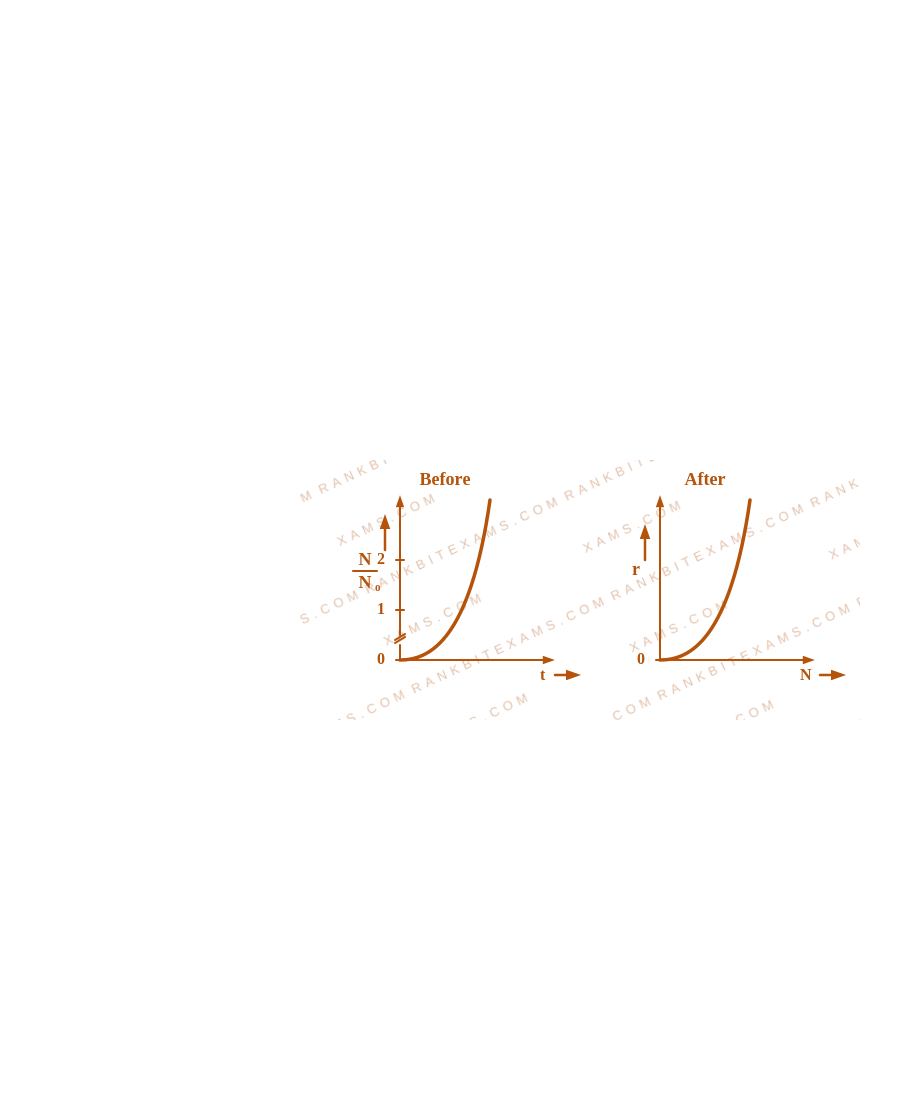
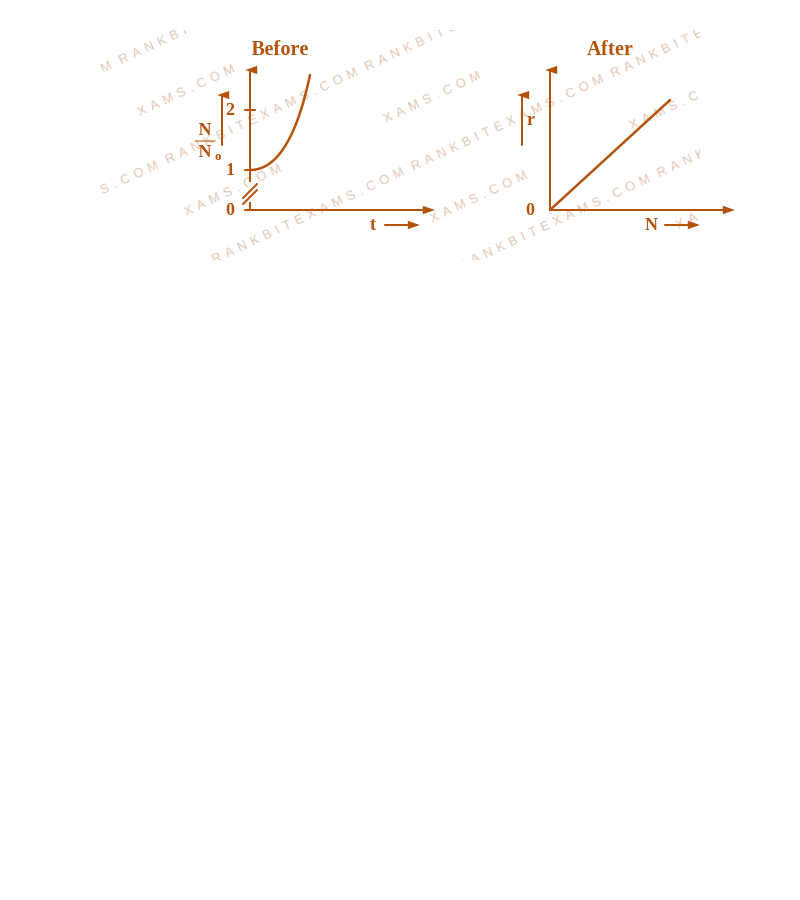
A person's wound was exposed to some bacteria and then bacteria growth started to happen at the same place. The wound was later treated with some antibacterial medicine and the rate of bacterial decay (r) was found to be proportional with the square of the existing number of bacteria at any instance. Which of the following set of graphs correctly represents the 'before' and 'after' situation of the application of the medicine? [Given: N = No. of bacteria, t = time, bacterial growth follows Ist order kinetics.]

Solution & Explanation

Related Formula
Before: (dN)/(dt) = k₁ N N = N₀ ek₁ t After: -(dN)/(dt) = k₂ N² (1)/(N) - (1)/(N₀) = k₂ t
Core Logic

Let's analyze the kinetics for the two stages:

  • Before applying medicine:
  • Bacterial growth follows 1st order kinetics: (dN)/(dt) = k₁ N.
  • Integrating this yields: N(t) = N₀ ek₁ t.
  • The graph of (N)/(N₀) vs t is a rising exponential curve starting from 1 (since at t=0, (N)/(N₀) = 1).
  • After applying medicine:
  • Reductive rate is proportional to the square of existing bacteria (2nd order decay):
-(dN)/(dt) = k₂ N² (dN)/(N²) = -k₂ dt
  • Integrating this yields:
-(1)/(N) = -k₂ t + C (1)/(N) = k₂ t + (1)/(N₀) N(t) = (N₀)/(1 + N₀ k₂ t)
  • A plot of N vs t or (N)/(N₀) vs t for this decay is a hyperbolic curve decreasing gradually.
  • Option B correctly matches the exponential growth before medicine and the hyperbolic decay after medicine.
Pattern Recognition

First-order growth is an exponential curve (N₀ ekt), while second-order decay behaves as a rational hyperbolic relationship (1 / (1 + bt)). Option B shows the exact transition from an exponential rise to a hyperbolic decay curve.

Chapter Mix

Class 12 Chemistry: Chemical Kinetics

More Chemical Kinetics Previous-Year Questions — Page 9

Q81 jee_main_2024_30_jan_morning First Order Reactions
The rate of first order reaction is 0.04 mol L⁻¹s⁻¹ at 10 minutes and 0.03 mol L⁻¹s⁻¹ at 20 minutes after initiation. Half life of the reaction is ________ minutes. (Given 2=0.3010, 3=0.4771)
Numerical Answer. Answer: 24 to 24.1

Solution

Related Formula

Rate = k[A]

[A] = [A]₀ e-kt t1/2 = (ln 2)/(k)
Core Logic

For a first order reaction, rate is directly proportional to concentration.

R₁ = k[A]₁₀ = k[A]₀ e-k(10 × 60) R₂ = k[A]₂₀ = k[A]₀ e-k(20 × 60)
Step 1: Setting up equations
0.04 = k[A]₀ e-600k (1) 0.03 = k[A]₀ e-1200k (2)
Step 2: Solving for k

Dividing equation (1) by (2):

(0.04)/(0.03) = e-600ke-1200k (4)/(3) = e600k

Take natural log on both sides:

ln((4)/(3)) = 600k k = (ln(4/3))/(600) s⁻¹
Step 3: Calculating half life
t1/2 = (ln 2)/(k) = (ln 2)/((ln(4/3))/(600)) = (600 ln 2)/(ln 4 - ln 3) seconds

Convert to minutes by dividing by 60:

t1/2 = (10 ln 2)/(ln 4 - ln 3) minutes

Substitute log values (since ln x = 2.303 x, the 2.303 cancels out):

t1/2 = 10 × ( 2)/( 4 - 3) minutes t1/2 = 10 × (0.3010)/(2(0.3010) - 0.4771) t1/2 = 10 × (0.3010)/(0.6020 - 0.4771) = 10 × (0.3010)/(0.1249) t1/2 = 24.099 ≈ 24 minutes
Chapter Mix

Class 12 Chemistry: Chemical Kinetics

Q82 jee_main_2024_31_jan_evening First Order Kinetics
r = k[A] for a reaction, 50% of A is decomposed in 120 minutes. The time taken for 90% decomposition of A is ________ minutes.
Numerical Answer. Answer: 398.5 to 399.5

Solution

Related Formula
k = 0.693t1/2 t = (2.303)/(k) ( (a)/(a - x) )
Core Logic

Since r = k[A], the reaction follows first-order kinetics. The half-life (50% decomposition) is t1/2 = 120 minutes.

Step 1: Calculating for 90% decomposition

For 90% completion of the reaction, [A]₀ = 100 and [A]ₜ = 100 - 90 = 10.

t = (2.303)/(k) (100)/(10) t = 2.303( 0.693t1/2 ) (10) t = (2.303 × 120)/(0.693) × 1 t = 398.78 minutes

Rounding off to the nearest integer, we get 399 minutes.

Pattern Recognition

For a first order reaction, t90% ≈ 3.32 × t50%. 120 × 3.32 = 398.4, so roughly 399.

Chapter Mix

Class 12 Chemistry: Chemical Kinetics

Q73 jee_main_2024_31_jan_morning First Order Reactions
Integrated rate law equation for a first order gas phase reaction is given by (where Pᵢ is initial pressure and Pₜ is total pressure at time t)
  • A. k = (2.303)/(t) × (Pᵢ)/((2Pᵢ - Pₜ))
  • B. k = (2.303)/(t) × (2Pᵢ)/((2Pᵢ - Pₜ))
  • C. k = (2.303)/(t) × ((2Pᵢ - Pₜ))/(Pᵢ)
  • D. k = (2.303)/(t) × (Pᵢ)/((2Pᵢ - Pₜ))

Solution

Core Logic

Consider a general gas phase reaction: A arrow B + C

Initial (t=0): Pᵢ 0 0 At time t: Pᵢ - x x x

Total pressure at time t:

Pₜ = (Pᵢ - x) + x + x = Pᵢ + x

x = Pₜ - Pᵢ

Partial pressure of A at time t (PA): PA = Pᵢ - x

PA = Pᵢ - (Pₜ - Pᵢ) = 2Pᵢ - Pₜ

For a first-order reaction:

k = (2.303)/(t) (P₀)/(Pₜ)

Here, P₀ = Pᵢ and the pressure of the reactant at time t is PA.

k = (2.303)/(t) (Pᵢ)/(2Pᵢ - Pₜ)
Chapter Mix

Class 12 Chemistry: Chemical Kinetics

Rankbit System
JEE Physics: Waves (+15.5%) | Electrostatics: Concentric Shells (-29.7%) | Modern Physics: Photoelectric Clones (+34.2%) | Mathematics: Definite Integrals (+18.1%) | Chemistry: Coordination Splitting (-11.4%) | JEE Physics: Waves (+15.5%) | Electrostatics: Concentric Shells (-29.7%) | Modern Physics: Photoelectric Clones (+34.2%) | Mathematics: Definite Integrals (+18.1%) | Chemistry: Coordination Splitting (-11.4%)