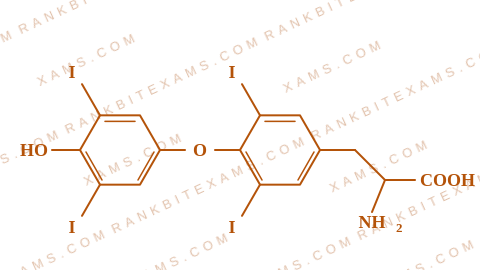
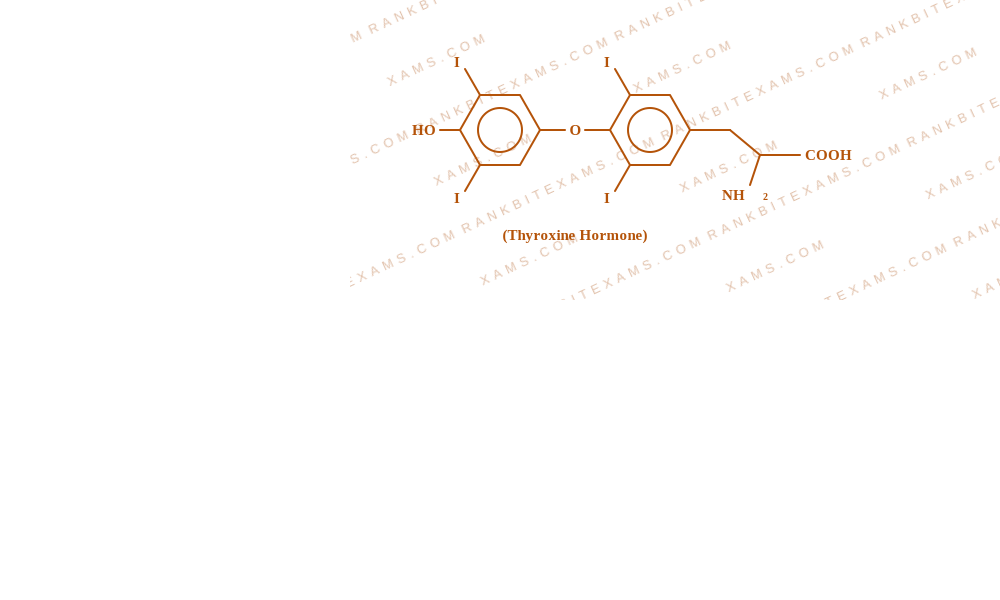
Thyroxine, the hormone has the structure given below:
The structural formula of Thyroxine shows four iodine atoms attached to the aromatic benzene rings.
The percentage of iodine in thyroxine is ______ %. (nearest integer)
(Given molar mass in g mol⁻¹$\mathrm{g\ mol}^{-1}$ of C: 12$\mathrm{C}: 12$, H: 1$\mathrm{H}: 1$, O: 16$\mathrm{O}: 16$, N: 14$\mathrm{N}: 14$, I: 127$\mathrm{I}: 127$)
Hence, the percentage of iodine in thyroxine is 65$65$.
Pattern Recognition
Thyroxine molecular mass (777$777$) is composed mostly of Iodine (508$508$), making up approximately 508/777 ≈ 65%$508/777 \approx 65\%$ of its entire mass. Always carefully account for the four phenyl-bound iodines.
Evaluation Rubric / Model Answer
Accurate molecular weight summation leading to 65%$65\%$ nearest integer Iodine composition.
Chapter Mix
Class 12 Chemistry: Biomolecules

Class 12 Chemistry: Organic Chemistry - Oxygen containing compounds
Keywords:#Thyroxine Structure#Iodine Percentage#Hormones#Molecular Mass Calculation
More Biomolecules Previous-Year Questions — Page 8
Q78jee_main_2024_31_jan_morningReactions of Glucose
Match List I with List II
LIST-I
LIST-II
A. Glucose/NaHCO₃$NaHCO_3$/Δ$\Delta$
I. Gluconic acid
B. Glucose/HNO₃$HNO_3$
II. No reaction
C. Glucose/HI/Δ$\Delta$
III. n-hexane
D. Glucose/Bromine water
IV. Saccharic acid
Choose the correct answer from the options given below:
Matching the reactions of glucose:
(A) Glucose does not react with NaHCO₃$NaHCO_3$, so there is no reaction. (A arrow$\rightarrow$ II)
(B) Oxidation of glucose with strong oxidizing agents like HNO₃$HNO_3$ yields a dicarboxylic acid called saccharic acid. (B arrow$\rightarrow$ IV)
(C) Prolonged heating of glucose with HI$HI$ forms n-hexane, indicating a straight chain of six carbon atoms. (C arrow$\rightarrow$ III)
(D) Oxidation with mild agents like bromine water converts glucose to gluconic acid. (D arrow$\rightarrow$ I)
Practice past-year questions one chapter at a time. Pick an exam → subject → chapter and get every PYQ for that topic — pulled together from all past papers — with the chapter's key formulas alongside.