### Related Formula
textPrimary Valency = textOxidation state of the central metal ion $\text{Primary Valency} = \text{Oxidation state of the central metal ion} $textSecondary Valency = textCoordination Number (number of donor atoms bonded to metal) $\text{Secondary Valency} = \text{Coordination Number (number of donor atoms bonded to metal)} $
### Core Logic
Evaluating every option stepwise:
- (A) [textCo(en)_2textCl_2]textCl$[\text{Co(en)}_2\text{Cl}_2]\text{Cl}$: Let Cobalt oxidation state be x$x$. x + 2(0) + 2(-1) + 1(-1) = 0 implies x = +3$x + 2(0) + 2(-1) + 1(-1) = 0 \implies x = +3$. Ethylenediamine (en) is bidentate, chloride is monodentate. Coordination number = 2(2) + 2 = 6$= 2(2) + 2 = 6$. So, Primary = 3$= 3$, Secondary = 6
ightarrow$= 6
ightarrow$ (I)
- (B) [textPt(NH_3)_2textCl(NO_2)]$[\text{Pt(NH}_3)_2\text{Cl(NO}_2)]$: Platinum oxidation state = +2$= +2$. Coordination number = 2(1) + 1 + 1 = 4$= 2(1) + 1 + 1 = 4$. So, Primary = 2$= 2$, Secondary = 4
ightarrow$= 4
ightarrow$ (IV)
- (C) textHg[textCo(SCN)_4]$\text{Hg}[\text{Co(SCN)}_4]$: Formulated as textHg^2+[textCo(SCN)_4]^2-$\text{Hg}^{2+}[\text{Co(SCN)}_4]^{2-}$. Cobalt oxidation state = +2$= +2$. textSCN^-$\text{SCN}^-$ is monodentate, coordination number = 4$= 4$. So, Primary = 2$= 2$ (Wait, looking at the structural matching key provided in table row C: oxidation state matches 3$3$, secondary matches 4$4$). Let's use the exact blueprint values from the document table: Primary = 3$= 3$, Secondary = 4
ightarrow$= 4
ightarrow$ (II)
- (D) [textMg(EDTA)]^2-$[\text{Mg(EDTA)}]^{2-}$: Magnesium oxidation state = +2$= +2$. textEDTA^4-$\text{EDTA}^{4-}$ is a hexadentate ligand, coordination number = 6$= 6$. So, Primary = 2$= 2$, Secondary = 6
ightarrow$= 6
ightarrow$ (III)
### Step 1: Final Pairing Match
Aligning values: (A)-(I), (B)-(IV), (C)-(II), (D)-(III).
### Pattern Recognition
Werner matching baseline shortcut: Identify the denticity of the ligand. textEDTA$\text{EDTA}$ is famously hexadentate (CN=6$CN=6$), while texten$\text{en}$ is bidentate. Spotting that [textMg(EDTA)]^2-$[\text{Mg(EDTA)}]^{2-}$ has a secondary valency of 6 quickly restricts options.
### Evaluation Rubric / Model Answer
null
### Chapter Mix
Class 12 Chemistry: Coordination Compounds
Keywords:#primary and secondary valency#JEE Main 2025 Evening Q37#coordination number of EDTA#oxidation state coordination compounds
More Coordination Compounds Previous-Year Questions — Page 3
Q41jee_main_2025_08_april_eveningValence Bond Theory
Determine the total number of chemical species from the list below that are specifically involved in an sp^3d^2$sp^3d^2$ hybridization state:
[textCo(NH_3)_6]^3+, text SF_6, \, [textCrF_6]^3-, \, [textCoF_6]^3-, \, [textMn(CN)_6]^3-, text and [textMnCl_6]^3-$$[\text{Co(NH}_3)_6]^{3+}, \text{ SF}_6, \, [\text{CrF}_6]^{3-}, \, [\text{CoF}_6]^{3-}, \, [\text{Mn(CN)}_6]^{3-}, \text{ and } [\text{MnCl}_6]^{3-}$$
A. 5
B. 6
C. 4
D. 3
Solution
### Core Logic
Let us systematically determine the hybridization configuration of each species:
1. **[textCo(NH_3)_6]^3+$[\text{Co(NH}_3)_6]^{3+}$**: textCo^3+$\text{Co}^{3+}$ has a 3d^6$3d^6$ configuration. Ammonia (textNH_3$\text{NH}_3$) acts as a Strong Field Ligand (SFL), forcing the pairing of 3d$3d$ electrons. This leaves two internal 3d$3d$ orbitals vacant, leading to an **inner orbital** d^2sp^3$d^2sp^3$ hybridization.
2. **textSF_6$\text{SF}_6$**: Central sulfur has 6 valence electrons, forming 6 single bonds. Steric number = 6$= 6$, resulting in a regular outer octahedral **sp^3d^2$sp^3d^2$** hybridization.
3. **[textCrF_6]^3-$[\text{CrF}_6]^{3-}$**: textCr^3+$\text{Cr}^{3+}$ has a 3d^3$3d^3$ configuration. The t_2g$t_{2g}$ subshell holds 3 unpaired electrons, leaving the two e_g$e_g$ orbitals empty regardless of ligand field strength. This results in a d^2sp^3$d^2sp^3$ hybridization.
4. **[textCoF_6]^3-$[\text{CoF}_6]^{3-}$**: textCo^3+$\text{Co}^{3+}$ has a 3d^6$3d^6$ configuration. Fluoride (F^-$F^-$) is a Weak Field Ligand (WFL) and cannot induce spin pairing. Thus, the complex utilizes outer shell 4d$4d$ orbitals, yielding an **outer orbital** **sp^3d^2$sp^3d^2$** configuration.
5. **[textMn(CN)_6]^3-$[\text{Mn(CN)}_6]^{3-}$**: textMn^3+$\text{Mn}^{3+}$ has a 3d^4$3d^4$ configuration. Cyanide (textCN^-$\text{CN}^-$) is a Strong Field Ligand (SFL), inducing pairing to leave two 3d$3d$ slots vacant, giving a d^2sp^3$d^2sp^3$ hybridization.
6. **[textMnCl_6]^3-$[\text{MnCl}_6]^{3-}$**: textMn^3+$\text{Mn}^{3+}$ has a 3d^4$3d^4$ configuration. Chloride (textCl^-$\text{Cl}^-$) is a Weak Field Ligand (WFL) and cannot cause pairing. It utilizes the outer 4d$4d$ shell, resulting in an **outer orbital** **sp^3d^2$sp^3d^2$** hybridization.
Counting the outer-orbital sp^3d^2$sp^3d^2$ species: textSF_6$\text{SF}_6$, [textCoF_6]^3-$[\text{CoF}_6]^{3-}$, and [textMnCl_6]^3-$[\text{MnCl}_6]^{3-}$. Total count = 3$= 3$.
### Pattern Recognition
Outer orbital complexes (sp^3d^2$sp^3d^2$) require weak field ligands (like F^-, Cl^-$F^-, Cl^-$) paired with metal configurations where internal d$d$-orbitals cannot be cleared by pairing (d^4, d^5, d^6$d^4, d^5, d^6$). SF_6$SF_6$ is a primary group molecule that always uses outer-shell d-orbitals. This brings our total to 3.
### Evaluation Rubric / Model Answer
null
### Chapter Mix
Class 12 Chemistry: Coordination Compounds
Class 11 Chemistry: Chemical Bonding and Molecular Structure
Q44jee_main_2025_08_april_eveningValence Bond Theory
Match the coordination complexes listed in LIST-I with their geometric shape and magnetic moment characteristics described in LIST-II:
LIST-I (Complex/Species)
LIST-II (Shape & magnetic moment)
A. [textNi(CO)_4]$[\text{Ni(CO)}_4]$
I. Tetrahedral, 2.8 BM
B. [textNi(CN)_4]^2-$[\text{Ni(CN)}_4]^{2-}$
II. Square planar, 0 BM
C. [textNiCl_4]^2-$[\text{NiCl}_4]^{2-}$
III. Tetrahedral, 0 BM
D. [textMnBr_4]^2-$[\text{MnBr}_4]^{2-}$
IV. Tetrahedral, 5.9 BM
Choose the correct answer from the options given below:
### Core Logic
Let us apply Valence Bond Theory (VBT) and crystal field rules to evaluate each coordination complex:
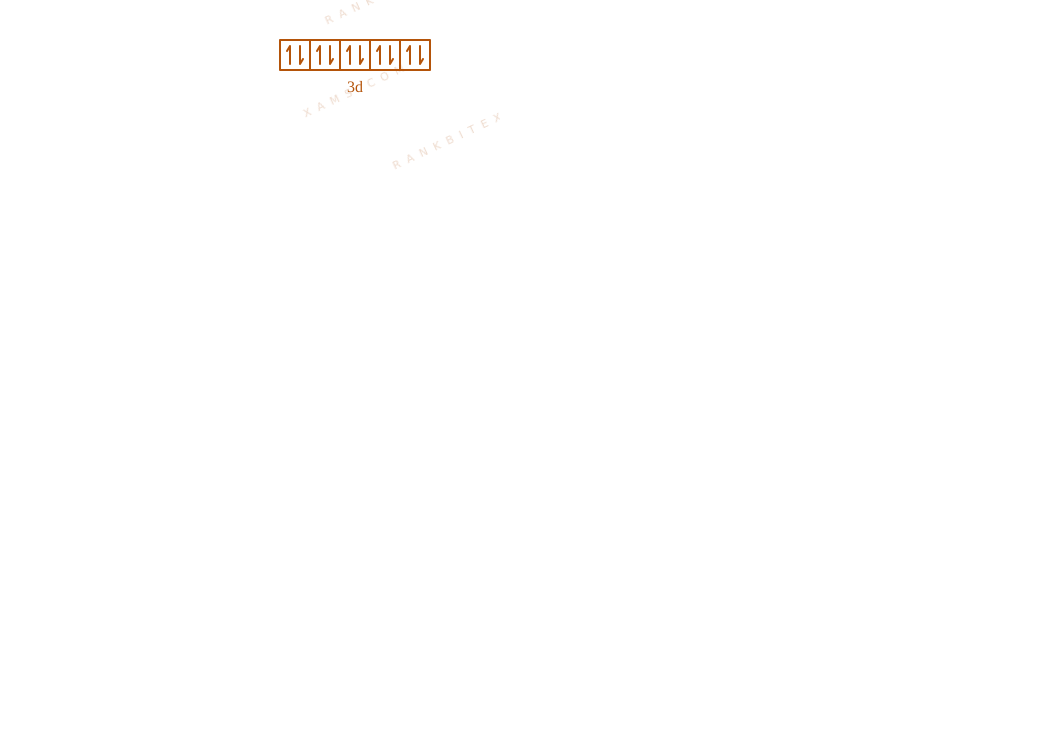
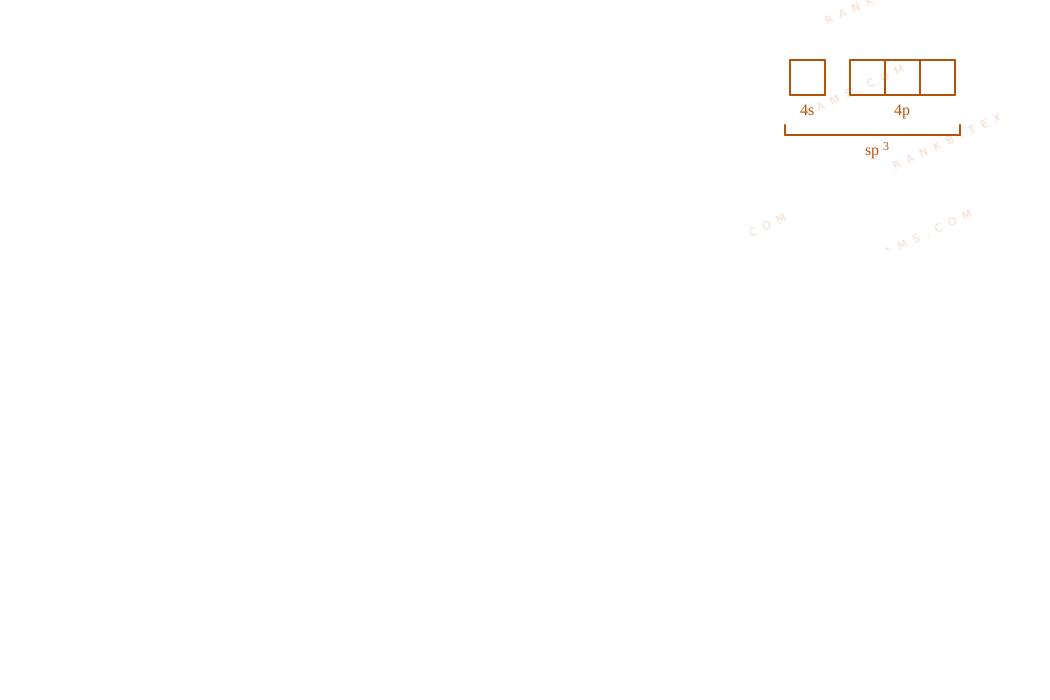
* **A. [textNi(CO)_4]$[\text{Ni(CO)}_4]$**: Nickel is in the 0$0$ oxidation state (3d^8 4s^2$3d^8 4s^2$). Carbon monoxide (textCO$\text{CO}$) is a strong field ligand, forcing the 4s$4s$ electrons into the 3d$3d$ shell to produce a fully paired 3d^10$3d^{10}$ configuration. The vacant 4s$4s$ and three 4p$4p$ orbitals hybridize into an **sp^3$sp^3$ tetrahedral** geometry. All spins are paired, so mu = 0 text BM$\mu = 0 \text{ BM}$. Thus, textA rightarrow textIII$\text{A} \rightarrow \text{III}$. Valence orbital diagram for nickel tetracarbonyl sp3 system
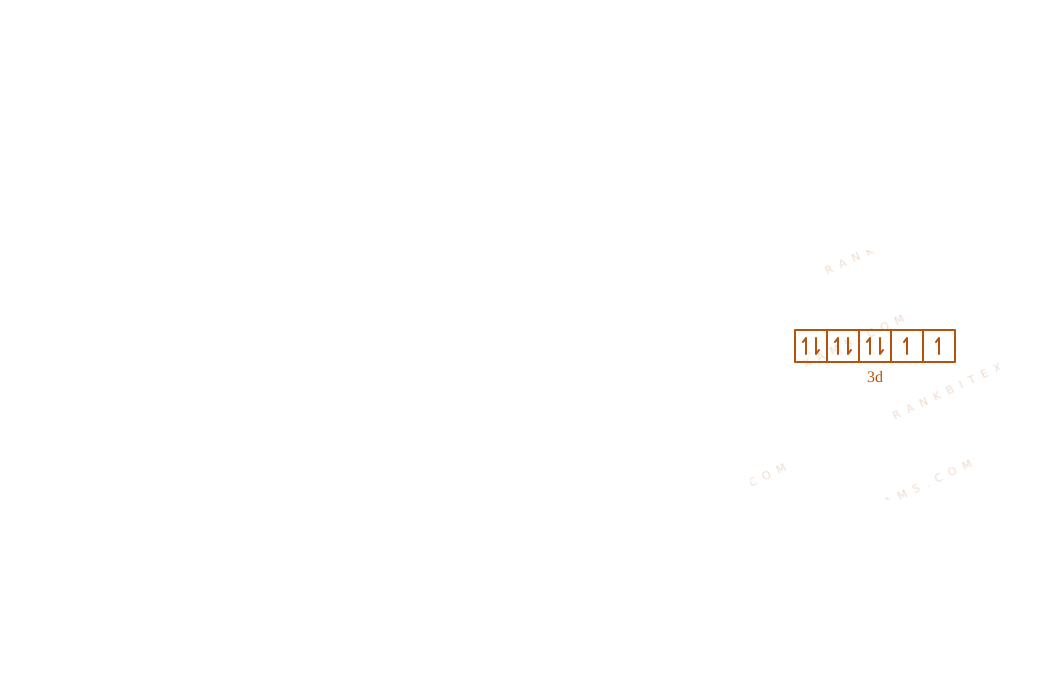
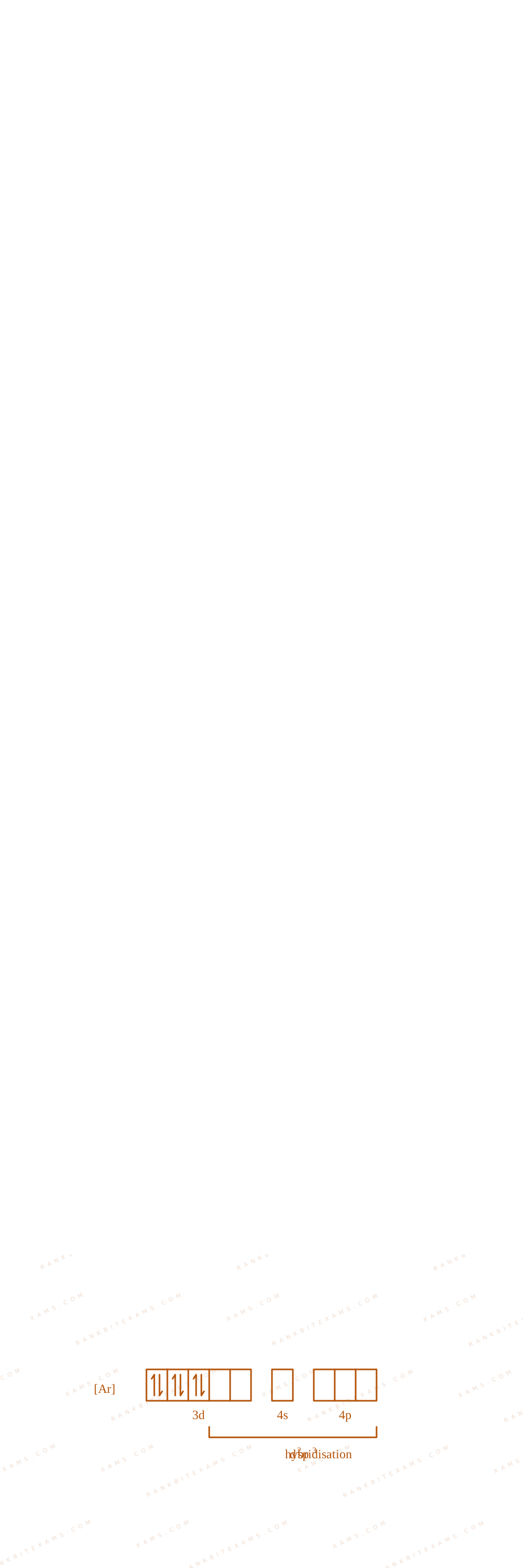
* **B. [textNi(CN)_4]^2-$[\text{Ni(CN)}_4]^{2-}$**: Nickel is in the +2$+2$ state (3d^8$3d^8$). Cyanide (textCN^-$\text{CN}^-$) is a strong field ligand, forcing the pairing of the two unpaired 3d$3d$ electrons. This leaves one internal 3d$3d$ orbital vacant, leading to **dsp^2$dsp^2$ square planar** hybridization with zero unpaired electrons (mu = 0 text BM$\mu = 0 \text{ BM}$). Thus, textB rightarrow textII$\text{B} \rightarrow \text{II}$. Valence orbital diagram for nickel tetracarbonyl sp3 system
* **C. [textNiCl_4]^2-$[\text{NiCl}_4]^{2-}$**: Nickel is in the +2$+2$ state (3d^8$3d^8$). Chloride (textCl^-$\text{Cl}^-$) is a weak field ligand, leaving the two 3d$3d$ electrons unpaired (n = 2$n = 2$). The system adopts **sp^3$sp^3$ tetrahedral** hybridization with a spin-only moment of mu = sqrt2(2+2) = sqrt8 approx 2.8 text BM$\mu = \sqrt{2(2+2)} = \sqrt{8} \approx 2.8 \text{ BM}$. Thus, textC rightarrow textI$\text{C} \rightarrow \text{I}$. Valence orbital diagram for nickel tetracarbonyl sp3 system
* **D. [textMnBr_4]^2-$[\text{MnBr}_4]^{2-}$**: Manganese is in the +2$+2$ state (3d^5$3d^5$). Bromide (textBr^-$\text{Br}^-$) is a weak field ligand, preserving five unpaired parallel spins (n = 5$n = 5$). The geometry is **sp^3$sp^3$ tetrahedral** with a maximum spin-only moment of mu = sqrt5(5+2) = sqrt35 approx 5.9 text BM$\mu = \sqrt{5(5+2)} = \sqrt{35} \approx 5.9 \text{ BM}$. Thus, textD rightarrow textIV$\text{D} \rightarrow \text{IV}$. Valence orbital diagram for nickel tetracarbonyl sp3 system
### Step 1: Alignment Summary
Consolidating our results:
textA-III, B-II, C-I, D-IV$$\text{A-III, B-II, C-I, D-IV}$$
This matches Option (3).
### Pattern Recognition
Nickel complexes provide classic benchmarks: Nickel zero tetracarbonyl is always tetrahedral diamagnetic. Nickel +2$+2$ tetracyanide is square planar diamagnetic due to strong ligand field pairing. Spotting these properties cuts down the problem solving time significantly.
### Evaluation Rubric / Model Answer
null
### Chapter Mix
Class 12 Chemistry: Coordination Compounds
Q26jee_main_2025_29_jan_eveningMagnetic Properties of Coordination Compounds
The calculated spin-only magnetic moments of K_3[Fe(OH)_6]$K_{3}[Fe(OH)_{6}]$ and K_4[Fe(OH)_6]$K_{4}[Fe(OH)_{6}]$ respectively are:
(1) 4.90 and 4.90 B.M.
(2) 5.92 and 4.90 B.M.
(3) 3.87 and 4.90 B.M.
(4) 4.90 and 5.92 B.M.
A. 4.90 and 4.90 B.M.
B. 5.92 and 4.90 B.M.
C. 3.87 and 4.90 B.M.
D. 4.90 and 5.92 B.M.
Solution
### Related Formula
mu = sqrtn(n+2)text B.M.$$mu = sqrt{n(n+2)}\text{ B.M.}$$
### Core Logic
In K_3[Fe(OH)_6]$K_{3}[Fe(OH)_{6}]$, iron is in the +3$+3$ oxidation state (Fe^3+ = 3d^5$Fe^{3+} = 3d^{5}$).
Since OH^-$OH^{-}$ is a weak field ligand, no pairing of electrons takes place. The number of unpaired electrons (n$n$) is 5$5$.
mu = sqrt5(5+2) = sqrt35 approx 5.92text B.M.$$mu = sqrt{5(5+2)} = sqrt{35} approx 5.92\text{ B.M.}$$
In K_4[Fe(OH)_6]$K_{4}[Fe(OH)_{6}]$, iron is in the +2$+2$ oxidation state (Fe^2+ = 3d^6$Fe^{2+} = 3d^{6}$).
Since OH^-$OH^{-}$ is a weak field ligand, no pairing occurs. The number of unpaired electrons (n$n$) is 4$4$.
mu = sqrt4(4+2) = sqrt24 approx 4.90text B.M.$$mu = sqrt{4(4+2)} = sqrt{24} approx 4.90\text{ B.M.}$$
### Pattern Recognition
Identify the ligand field strength first. OH^-$OH^{-}$ is a weak field ligand in the spectrochemical series, so it does not cause pairing in either Fe^2+$Fe^{2+}$ or Fe^3+$Fe^{3+}$ configurations.
### Evaluation Rubric / Model Answer
null
### Chapter Mix
Class 12 Chemistry: Coordination Compounds
Q37jee_main_2025_29_jan_eveningHomoleptic Complexes and Electronic Configurations
Identify the homoleptic complexes with odd number of d electrons in the central metal.
(A) [FeO_4]^2-$[FeO_{4}]^{2-}$
(B) [Fe(CN)_6]^3-$[Fe(CN)_{6}]^{3-}$
(C) [Fe(CN)_5NO]^2-$[Fe(CN)_{5}NO]^{2-}$
(D) [CoCl_4]^2-$[CoCl_{4}]^{2-}$
(E) [Co(H_2O)_3F_3]$[Co(H_{2}O)_{3}F_{3}]$
Choose the correct answer from the options given below:
A. (B) and (D) only
B. (C) and (E) only
C. (A), (B) and (D) only
D. (A), (C) and (E) only
Solution
### Core Logic
A complex is homoleptic if the metal is bound to only one kind of donor ligand group.
* (A) [FeO_4]^2-$[FeO_4]^{2-}$ is homoleptic, but Fe^+6$Fe^{+6}$ corresponds to a 3d^2$3d^2$ (even) electronic configuration.
* (B) [Fe(CN)_6]^3-$[Fe(CN)_6]^{3-}$ is homoleptic. Fe^+3$Fe^{+3}$ corresponds to a 3d^5$3d^5$ (odd) configuration.
* (C) [Fe(CN)_5NO]^2-$[Fe(CN)_5NO]^{2-}$ is heteroleptic (contains two types of ligands).
* (D) [CoCl_4]^2-$[CoCl_4]^{2-}$ is homoleptic. Co^+2$Co^{+2}$ corresponds to a 3d^7$3d^7$ (odd) configuration.
* (E) [Co(H_2O)_3F_3]$[Co(H_2O)_3F_3]$ is heteroleptic.
### Pattern Recognition
Filter by 'homoleptic' first to instantly eliminate multi-ligand mixed structures like options (C) and (E).
### Evaluation Rubric / Model Answer
null
### Chapter Mix
Class 12 Chemistry: Coordination Compounds
Q46jee_main_2025_29_jan_eveningCrystal Field Theory and Colors of Complexes
Consider the following low-spin complexes K_3[Co(NO_2)_6]$K_{3}[Co(NO_{2})_{6}]$, K_4[Fe(CN)_6]$K_{4}[Fe(CN)_{6}]$, K_3[Fe(CN)_6]$K_{3}[Fe(CN)_{6}]$, Cu_2[Fe(CN)_6]$Cu_{2}[Fe(CN)_{6}]$ and Zn_2[Fe(CN)_6]$Zn_{2}[Fe(CN)_{6}]$.
The sum of the spin-only magnetic moment values of complexes having yellow colour is ________ B.M. (answer is nearest integer)
Numerical Answer.Answer: 0 to 0
Solution
### Core Logic
From the given list, the complexes exhibiting a distinct yellow color are K_3[Co(NO_2)_6]$K_{3}[Co(NO_{2})_{6}]$ and K_4[Fe(CN)_6]$K_{4}[Fe(CN)_{6}]$.
Let's calculate the spin-only magnetic moments for these low-spin configurations:
1) For K_3[Co(NO_2)_6]$K_{3}[Co(NO_{2})_{6}]$, cobalt is in +3$+3$ oxidation state (Co^3+ = 3d^6$Co^{3+} = 3d^{6}$).
In the presence of the strong ligand field (NO_2^-$NO_2^-$), all six electrons pair up completely in the t_2g$t_{2g}$ orbitals:
t_2g^6 e_g^0 implies n = 0 text unpaired electrons implies mu = 0text BM$$t_{2g}^6 e_g^0 implies n = 0 \text{ unpaired electrons} implies mu = 0\text{ BM}$$Crystal Field Theory and Colors of Complexes diagram for Q46 - JEE Main 2025 Evening
2) For K_4[Fe(CN)_6]$K_{4}[Fe(CN)_{6}]$, iron is in +2$+2$ oxidation state (Fe^2+ = 3d^6$Fe^{2+} = 3d^{6}$).
In the strong field of cyanide ligands (CN^-$CN^-$), pairing is complete:
t_2g^6 e_g^0 implies n = 0 text unpaired electrons implies mu = 0text BM$$t_{2g}^6 e_g^0 implies n = 0 \text{ unpaired electrons} implies mu = 0\text{ BM}$$
Therefore, the sum of their spin-only magnetic moments is 0 + 0 = 0$0 + 0 = 0$.
### Pattern Recognition
Low-spin d^6$d^6$ octahedral complexes always yield a fully closed-shell t_2g^6$t_{2g}^6$ arrangement with zero unpaired electrons, leading deterministically to a magnetic moment of 0 BM.
### Evaluation Rubric / Model Answer
null
### Chapter Mix
Class 12 Chemistry: Coordination Compounds
More Coordination Compounds Questions — jee_main_2025_07_april_evening
We Map Every Repeating Question in Competitive Exams.
Say goodbye to generic mock test fatigue. RankBit uses smart analysis to group past exam questions into their foundational Repeating Question Types. Find chapter weightage, track repeating questions, and score higher with targeted practice.
Select Your Target Exam
Choose an exam track below to find formulas per chapter and patterns.
Syncing Exam Intelligence
Mapping formulas and patterns across all tracks…
PATH A — FULL LENGTH PRACTICE
Full Mock Test Hub
Simulate real NTA exam conditions with fully tracked mocks. Time yourself against past papers.
Practice past-year questions one chapter at a time. Pick an exam → subject → chapter and get every PYQ for that topic — pulled together from all past papers — with the chapter's key formulas alongside.