JEE Main · Chemistry → Steady

Aldehydes, Ketones and Carboxylic Acids appeared 46 times across 3 years — 5.3% of Chemistry. This question is from Identification of Carbonyl Compounds.

Year 2026 2025 2024 Total
Questions 14 21 11 46

"P" is an optically active compound with molecular formula C₆H₁₂O. When "P" is treated with 2,4-dinitrophenylhydrazine, it gives a positive test. However, in presence of Tollens reagent, "P" gives a negative test. Predict the structure of "P".

Solution & Explanation

Related Formula
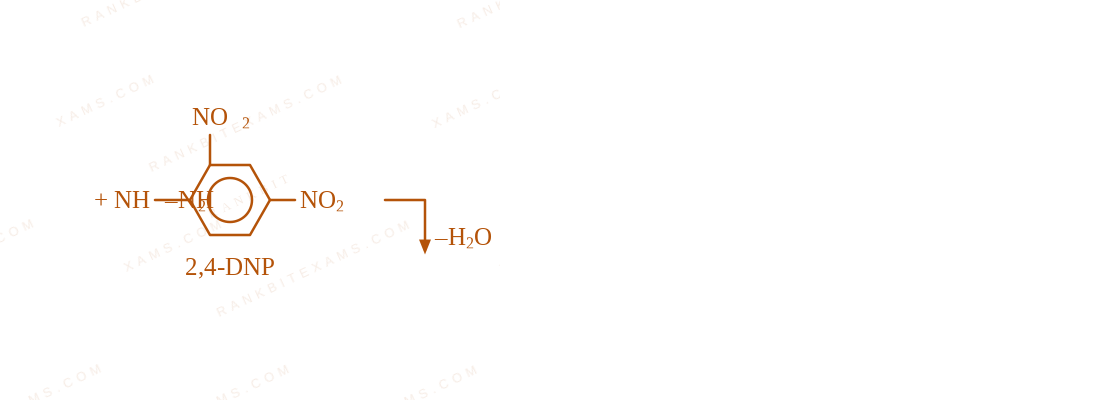
Carbonyl compound + 2,4-DNP arrow Hydrazone derivative (Positive test) Aldehyde + Tollens' Reagent arrow Silver Mirror (Positive test) Ketone + Tollens' Reagent arrow No reaction (Negative test)
Core Logic

Analyzing individual functional constraints:

  • Positive 2,4-DNP test shows compound contains a carbonyl group (aldehyde or ketone).
  • Negative Tollens' test clarifies it is not an aldehyde; hence it must be a ketone.
  • The compound is optically active, meaning it must possess a chiral center (carbon with 4 distinct groups).
  • Let's evaluate the options via structural configurations:

    Identification of Carbonyl Compounds diagram for Q30 - JEE Main 2025 Evening
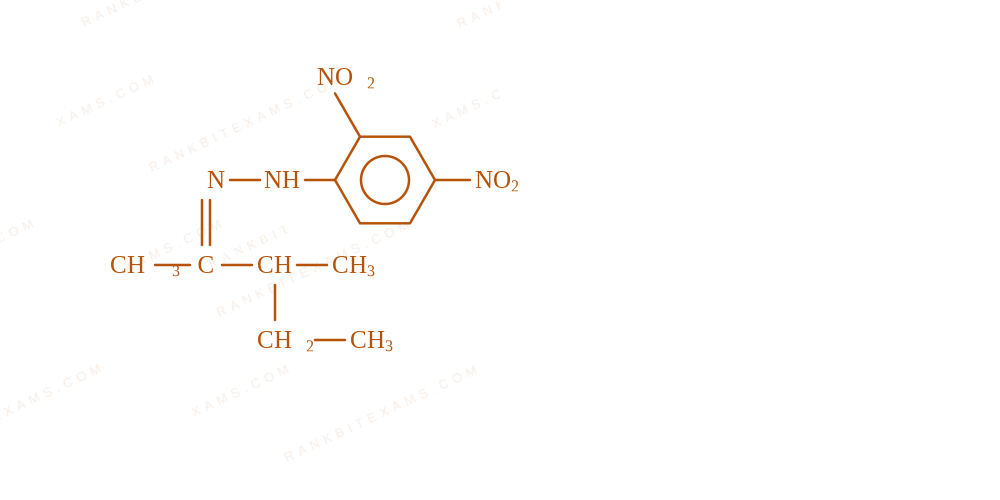
    Identification of Carbonyl Compounds diagram for Q30 - JEE Main 2025 Evening

    Identification of Carbonyl Compounds diagram for Q30 - JEE Main 2025 Evening
    Identification of Carbonyl Compounds diagram for Q30 - JEE Main 2025 Evening

Step 1: Structural Verification

Option (2) represents 3-methylpentan-2-one:

CH3-C(=O)- CH(CH3)(CH2CH3)

The third carbon (C3) is linked to: -H, -CH₃, -CH₂CH₃, and -COCH₃. It has 4 distinct structural fields, making it chiral and optically active.

Pattern Recognition

Tollens' negative + DNP positive = Ketone. Once categorized as a ketone, look directly for the structure holding a carbon with four unique groups to secure the optical activity constraint.

Chapter Mix

Class 12 Chemistry: Aldehydes, Ketones and Carboxylic Acids Class 11 Chemistry: Organic Chemistry - Some Basic Principles and Techniques

Reference Study Guides

More Aldehydes, Ketones and Carboxylic Acids Previous-Year Questions — Page 10

Q jee_main_2024_31_jan_morning Reactions with Grignard Reagent
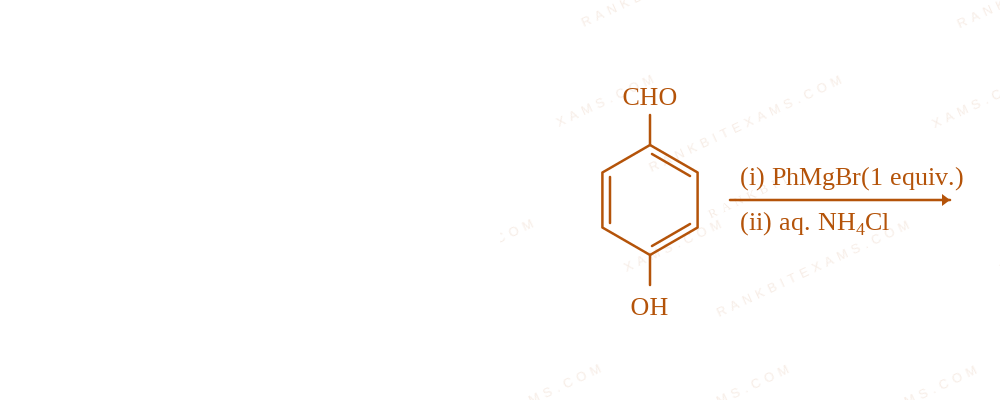
The product of the following reaction is P.
Reactions with Grignard Reagent diagram for Q84 - JEE Main 2024 Morning
The image shows p-hydroxybenzaldehyde reacting with one equivalent of PhMgBr followed by aqueous ammonium chloride.
The number of hydroxyl groups present in the product P is
Numerical Answer. Answer: 0 to 0

Solution

Core Logic

The given reactant is p-hydroxybenzaldehyde, which contains both a phenolic -OH group (acidic) and an aldehyde group (electrophilic).

When one equivalent of Grignard reagent (PhMgBr) is added, it behaves primarily as a strong base due to the presence of an acidic proton. Acid-base reactions are extremely fast compared to nucleophilic additions.

The acidic phenolic -OH reacts with PhMgBr:

PhMgBr + HO-C₆H₄-CHO arrow Ph-H (Benzene) + BrMg-O-C₆H₄-CHO

Upon workup with aq. NH₄Cl, the phenoxide ion simply regenerates the starting p-hydroxybenzaldehyde. However, the question asks for the number of hydroxyl groups present in the formed product (Benzene).
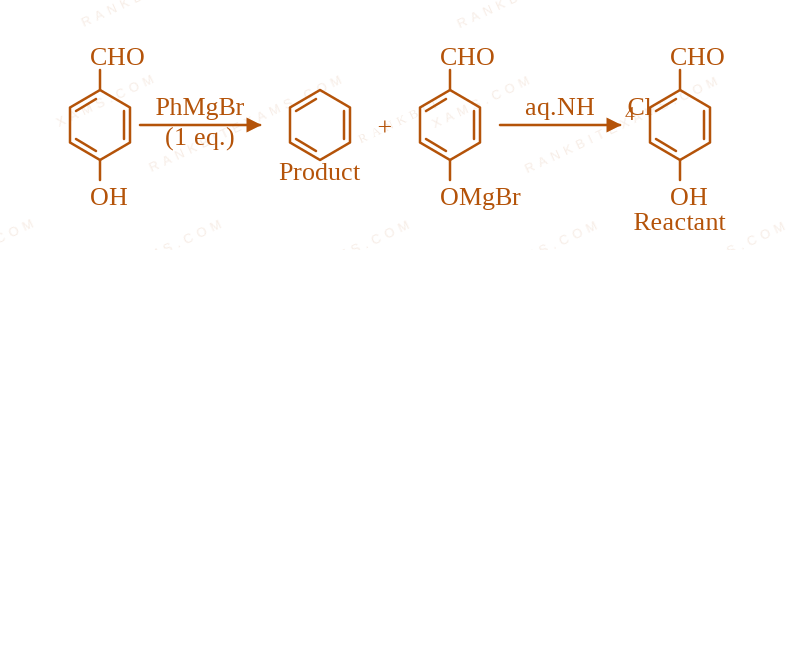
Reactions with Grignard Reagent diagram for Q84 - JEE Main 2024 Morning
The image shows p-hydroxybenzaldehyde reacting with one equivalent of PhMgBr followed by aqueous ammonium chloride.

The distinct product formed in the reaction is Benzene. Benzene has 0 hydroxyl groups.

Pattern Recognition

Whenever a Grignard reagent encounters a molecule with an acidic hydrogen (alcohol, phenol, amine, alkyne), it will invariably act as a base first. If only 1 equivalent is used, nucleophilic addition to carbonyls will NOT happen.

Chapter Mix

Class 12 Chemistry: Aldehydes, Ketones and Carboxylic Acids Class 12 Chemistry: Alcohols, Phenols and Ethers

More Aldehydes, Ketones and Carboxylic Acids Questions — jee_main_2025_07_april_evening

Practice all Aldehydes, Ketones and Carboxylic Acids previous-year questions →

Rankbit System
JEE Physics: Waves (+15.5%) | Electrostatics: Concentric Shells (-29.7%) | Modern Physics: Photoelectric Clones (+34.2%) | Mathematics: Definite Integrals (+18.1%) | Chemistry: Coordination Splitting (-11.4%) | JEE Physics: Waves (+15.5%) | Electrostatics: Concentric Shells (-29.7%) | Modern Physics: Photoelectric Clones (+34.2%) | Mathematics: Definite Integrals (+18.1%) | Chemistry: Coordination Splitting (-11.4%)