Rankbit System
JEE Physics: Waves (+15.5%) | Electrostatics: Concentric Shells (-29.7%) | Modern Physics: Photoelectric Clones (+34.2%) | Mathematics: Definite Integrals (+18.1%) | Chemistry: Coordination Splitting (-11.4%) | JEE Physics: Waves (+15.5%) | Electrostatics: Concentric Shells (-29.7%) | Modern Physics: Photoelectric Clones (+34.2%) | Mathematics: Definite Integrals (+18.1%) | Chemistry: Coordination Splitting (-11.4%)

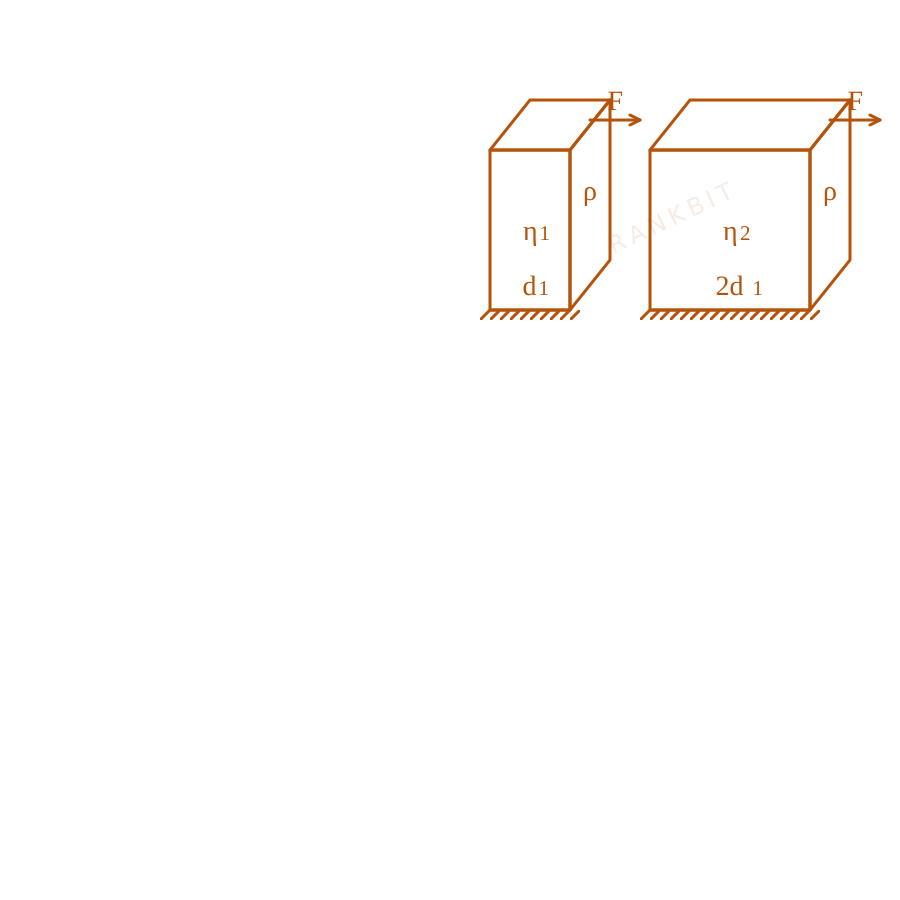
Two slabs with square cross section of different materials (1, 2) with equal sides (l) and thickness d_1 and d_2 such that d_2 = 2d_1 and l > d_2. Considering lower edges of these slabs are fixed to the floor, we apply equal shearing force on the narrow faces. The angle of deformation is theta_2 = 2theta_1. If the shear moduli of material 1 is 4 times 10^9mathrm~N/m^2, then shear moduli of material 2 is x times 10^9mathrm~N/m^2, where value of x is

Numerical Answer Type:
Enter a numerical value Answer: 1 to 1 +4 marks

Solution & Explanation

### Related Formula Shear modulus definition: eta = fracsigmatheta = fracFA cdot theta where A = l cdot d is the shearing face surface cross-area block configuration. ### Core Logic We are given that: * theta_2 = 2theta_1 * Shearing forces are identical (F_1 = F_2 = F). * Cross section area parameter tracking: A_1 = l cdot d_1, A_2 = l cdot d_2 = l cdot (2d_1) = 2A_1.
Shear strain deformation slab configuration layout for Q22 - JEE Main 2025 Morning
### Step 1: Link Modulus Terms Express deformation angles: theta_1 = fracFl cdot d_1 cdot eta_1 theta_2 = fracFl cdot d_2 cdot eta_2 = fracFl cdot (2d_1) cdot eta_2 Substitute these into the relation theta_2 = 2theta_1: fracF2l d_1 eta_2 = 2 cdot left( fracFl d_1 eta_1 ight) frac12eta_2 = frac2eta_1 implies 4eta_2 = eta_1 implies eta_2 = fraceta_14 ### Step 2: Solve for x Given eta_1 = 4 times 10^9mathrm~N/m^2: eta_2 = frac4 times 10^94 = 1 times 10^9mathrm~N/m^2 Thus, x = 1. ### Pattern Recognition Be careful when identifying the dimensions of the shear face area. Doubling the slab width doubles the base support area resisting deformation, reducing stress maps under equivalent lateral loading vectors. ### Evaluation Rubric / Model Answer null ### Chapter Mix Class 11 Physics: Mechanical Properties of Solids

Reference Study Guides

More Mechanical Properties of Solids Previous-Year Questions — Page 2

Q24 2025 Bulk Modulus
The increase in pressure required to decrease the volume of a water sample by 0.2% is P times 10^5 Nm ^-2 . Bulk modulus of water is 2.15 times 10^9 Nm ^-2 . The value of P is ____.
Numerical Answer. Answer: 43 to 43

Solution

### Related Formula Bulk Modulus formula: B = - fracDelta PfracDelta VV implies Delta P = B left( frac-Delta VV ight) ### Core Logic Given specifications: - Fractional volume drop, frac-Delta VV = 0.2\% = frac0.2100 = 2 times 10^-3 - Bulk modulus value, B = 2.15 times 10^9\ mathrmN/m^2 Calculating excess pressure: Delta P = 2.15 times 10^9 times 2 times 10^-3 Delta P = 4.3 times 10^6\ mathrmN/m^2 = 43 times 10^5\ mathrmN/m^2 Comparing with P times 10^5, we get P = 43. ### Pattern Recognition Bulk modulus measures a fluid's resistance to compression. A tiny percentage reduction in volume requires a massive amount of pressure due to water's near-incompressibility. ### Evaluation Rubric / Model Answer null ### Chapter Mix Class 11 Physics: Mechanical Properties of Solids
Q23 2025 Bulk Modulus
The volume contraction of a solid copper cube of edge length 10mathrmcm , when subjected to a hydraulic pressure of 7 times 10^6mathrmPa , would be ____________ mm^3 . (Given bulk modulus of copper = 1.4 times 10^11 mathrmNm^-2 )
Numerical Answer. Answer: 50

Solution

### Related Formula Bulk modulus B measures a material's resistance to uniform compression and is defined as the ratio of hydraulic pressure to volumetric strain: B = fracDelta Pleft(fracDelta VVright) implies Delta V = fracDelta P cdot VB ### Core Logic Given parameters [cite: 192, 193]: * Edge length of the cube, a = 10 text cm = 0.1 text m * Initial volume, V = a^3 = (0.1)^3 = 10^-3 text m^3 = 10^6 text mm^3 * Hydraulic pressure increase, Delta P = 7 times 10^6 text Pa * Bulk Modulus, B = 1.4 times 10^11 text N/m^2 Substitute these values into the volume change equation : Delta V = frac7 times 10^6 times 10^-31.4 times 10^11 Delta V = frac7 times 10^31.4 times 10^11 = 5 times 10^-7 text m^3 quad text Convert the volume contraction into textmm^3: Delta V = 5 times 10^-7 times (10^3)^3 text mm^3 = 5 times 10^-7 times 10^9 text mm^3 = 50 text mm^3 ### Pattern Recognition Always perform unit conversions carefully at the final step to avoid handling complex decimals during calculations. Converting 1 text m^3 = 10^9 text mm^3 ensures a clean, error-free conversion. ### Evaluation Rubric / Model Answer null ### Chapter Mix Class 11 Physics: Mechanical Properties of Solids
Q13 2025 Elasticity
The fractional compression left(fracDeltamathrmVmathrmVright) of water at the depth of 2.5mathrmkm below the sea level is \% Given, the Bulk modulus of water = 2times 10^9mathrmNm^-2 , density of water = 10^3mathrmkgmathrmm^-3 , acceleration due to gravity = mathrmg = 10mathrmms^-2 . [cite: 1, 2]
  • A. 1.75
  • B. 1.0
  • C. 1.5
  • D. 1.25

Solution

### Related Formula B = fracDelta Pleft(fracDelta VVright) = fracrho g hleft(fracDelta VVright) ### Core Logic Calculate the hydrostatic pressure change at depth h = 2.5text km = 2500text m : Delta P = rho g h = 10^3 cdot 10 cdot 2500 = 2.5 times 10^7 mathrm~Ncdot m^-2 [cite: 62, 672] Now compute the percentage fractional compression : fracDelta VV times 100 = fracDelta PB times 100 = frac2.5 times 10^72 times 10^9 times 100\% = 1.25\% [cite: 672, 673] ### Chapter Mix Class 11 Physics: Mechanical Properties of Solids Class 11 Physics: Mechanical Properties of Fluids

More Mechanical Properties of Solids Questions — jee_main_2025_04_april_morning

Practice all Mechanical Properties of Solids previous-year questions →

YOUR FIRST PREP STEP STARTS HERE

We Map Every Repeating Question in Competitive Exams.

Say goodbye to generic mock test fatigue. RankBit uses smart analysis to group past exam questions into their foundational Repeating Question Types. Find chapter weightage, track repeating questions, and score higher with targeted practice.

Select Your Target Exam

Choose an exam track below to find formulas per chapter and patterns.

Syncing Exam Intelligence

Mapping formulas and patterns across all tracks…

PATH A — FULL LENGTH PRACTICE

Full Mock Test Hub

Simulate real NTA exam conditions with fully tracked mocks. Time yourself against past papers.

Under Development
PATH B — TARGETED PRACTICE

Topic-wise Practice Hub

Practice past-year questions one chapter at a time. Pick an exam → subject → chapter and get every PYQ for that topic — pulled together from all past papers — with the chapter's key formulas alongside.

Loading Questions... Browse Topics
Latest from the Blog
View all →

Loading articles...