The fractional compression ( V)$\left(\frac{\Delta\mathrm{V}}{\mathrm{V}}\right)$ of water at the depth of 2.5km$2.5\mathrm{km}$ below the sea level is %$\%$ Given, the Bulk modulus of water = 2× 10⁹Nm⁻²$= 2\times 10^{9}\mathrm{Nm}^{-2}$ , density of water = 10³kgm⁻³$= 10^{3}\mathrm{kg}\mathrm{m}^{-3}$ , acceleration due to gravity = g = 10ms⁻²$= \mathrm{g} = 10\mathrm{ms}^{-2}$ .
A.1.75
B.1.0
C.1.5
D.1.25
Solution & Explanation
Related Formula
B = (Δ P)/(((Δ V)/(V))) = (ρ g h)/(((Δ V)/(V)))$$B = \frac{\Delta P}{\left(\frac{\Delta V}{V}\right)} = \frac{\rho g h}{\left(\frac{\Delta V}{V}\right)}$$
Core Logic
Calculate the hydrostatic pressure change at depth h = 2.5 km = 2500 m$h = 2.5\text{ km} = 2500\text{ m}$ :
Δ P = ρ g h = 10³ · 10 · 2500 = 2.5 × 10⁷ ~N· m⁻²$$\Delta P = \rho g h = 10^3 \cdot 10 \cdot 2500 = 2.5 \times 10^7 \mathrm{~N\cdot m^{-2}}$$
Now compute the percentage fractional compression :
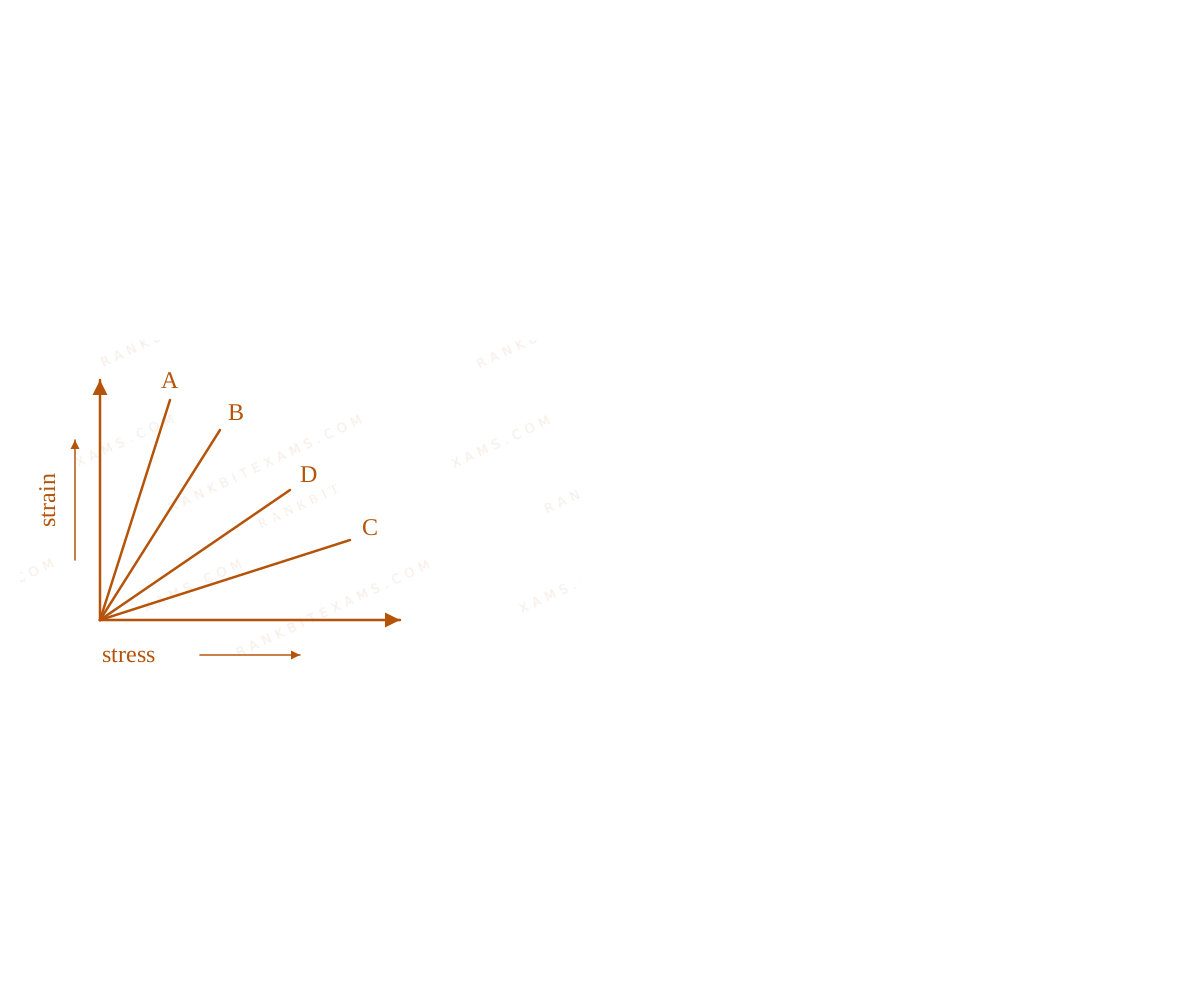
The strain-stress plot for materials A, B, C and D is shown in the figure. Which material has the largest Young's modulus?
A graph plotting Strain on the y-axis vs Stress on the x-axis for four materials.
A. C
B. D
C. A
D. B
Solution
Related Formula
Y = StressStrain$$Y = \frac{\text{Stress}}{\text{Strain}}$$
Core Logic
In a plot where Strain is on the y-axis and Stress is on the x-axis, the slope of the line equals Strain/Stress.
Since Y = (1)/(Slope)$Y = \frac{1}{Slope}$, the material with the largest Young's modulusY$Y$ will correspond to the line with the minimum slope (least steep line).
Step 1: Final Conclusion
From the given graph, curve C is closest to the x-axis, meaning it has the smallest slope. Therefore, material C has the largest Young's modulus.
Pattern Recognition
Sees: "strain-stress plot" instead of standard "stress-strain plot" → The axes are swapped! Always double check axis labels. Strain on Y means Slope = 1/Y.
Chapter Mix
Class 11 Physics: Mechanical Properties of Solids
Q39jee_main_2026_24_january_morningThermal Stress
A brass wire of length 2m and radius 1mm at 27°$27^{\circ}$ C is held taut between two rigid supports. Initially it was cooled to a temperature of -43°$-43^{\circ}$ C creating a tension T in the wire. The temperature to which the wire has to be cooled in order to increase the tension in it to 1.4T, is ____°$^{\circ}$C
A.-86$-86$
B.-71$-71$
C.-65$-65$
D.-80$-80$
Solution
Related Formula
Thermal Tension, T = Y A α Δ θ$$\text{Thermal Tension, } T = Y A \alpha \Delta \theta$$
Core Logic
For the first cooling, the tension T$T$ generated is:
T = Y A α Δ θ₁$$T = Y A \alpha \Delta \theta_1$$T = Y A α (27 - (-43))$$T = Y A \alpha (27 - (-43))$$T = Y A α (70) (i)$$T = Y A \alpha (70) \quad \dots \text{(i)}$$
Let θ$\theta$ be the final temperature required for a tension of 1.4T$1.4T$.
1.4T = Y A α (27 - θ) (ii)$$1.4T = Y A \alpha (27 - \theta) \quad \dots \text{(ii)}$$
Thermal tension strictly scales with the absolute difference in temperature from the unstressed state, Δ θ$\Delta \theta$. Multiplying tension by a factor simply scales Δ θ$\Delta \theta$ by that identical factor.
Chapter Mix
Class 11 Physics: Mechanical Properties of Solids
Class 11 Physics: Thermal Properties of Matter
Two wires A and B made of different materials of length 6.0 cm and 5.4 cm, respectively and area of cross sections 3.0 × 10⁻⁵ ~m²$3.0 \times 10^{-5} \mathrm{~m}^{2}$ and 4.5 × 10⁻⁵ ~m²$4.5 \times 10^{-5} \mathrm{~m}^{2}$ , respectively are stretched by the same magnitude under a given load. The ratio of the Young's modulus of A to that of B is x : 3$x : 3$. The value of x is ____.
Since the wires are stretched by the same magnitude (Δ A = Δ B$\Delta \ell_A = \Delta \ell_B$) under the same load (FA = FB$F_A = F_B$), the Young's Modulus Y$Y$ is proportional to ( )/(A)$\frac{\ell}{A}$.
(x)/(3) = (5)/(3) ⇒ x = 5$$\frac{x}{3} = \frac{5}{3} \Rightarrow x = 5$$
Pattern Recognition
Whenever "stretched by same magnitude under same load" appears, strip out F$F$ and Δ$\Delta \ell$ to leave Y ∝ / A$Y \propto \ell / A$.
Chapter Mix
Class 11 Physics: Mechanical Properties of Solids
Q34jee_main_2026_28_january_eveningSpeed of Longitudinal Wave
The speed of a longitudinal wave in a metallic bar is 400 m/s$400 \text{ m/s}$. If the density and Young's modulus of the bar material are increased by 0.5% and 1% respectively then the speed of the wave is changed approximately to ____ m/s.
Vfinal = V + Δ V = 400 + 1 = 401 m/s$$V_{\text{final}} = V + \Delta V = 400 + 1 = 401 \text{ m/s}$$
Pattern Recognition
For products and quotients of the form A^a / B^b$A^a / B^b$, the small percentage change is ± a(%Δ A) ∓ b(%Δ B)$\pm a(\%\Delta A) \mp b(\%\Delta B)$. Here, velocity scales with Y1/2 ρ-1/2$Y^{1/2} \rho^{-1/2}$, so change is (1)/(2)(%Δ Y) - (1)/(2)(%Δ ρ)$\frac{1}{2}(\%\Delta Y) - \frac{1}{2}(\%\Delta \rho)$.
Chapter Mix
Class 11 Physics: Mechanical Properties of Solids
Class 11 Physics: Waves
Q24jee_main_2025_02_april_eveningHooke's Law and Elongation of String
The length of a light string is 1.4m$1.4\mathrm{m}$ when the tension on it is 5N$5\mathrm{N}$ . If the tension increases to 7N$7\mathrm{N}$ , the length of the string is 1.56m$1.56\mathrm{m}$ . The original length of the string is ______ m$\mathrm{m}$ .
Numerical Answer.Answer: 1 to 1
Solution
Related Formula
By Hooke's Law, the tension (T$T$) in a stretched elastic string is proportional to its change in length:
T = k · Δ L = k(L - L₀)$$T = k \cdot \Delta L = k(L - L_0)$$
where:
k$k$ = spring constant of the string
L$L$ = current stretched length
L₀$L_0$ = natural original length
Core Logic
We can set up two algebraic equations using the given conditions:
Thus, the original length of the string is 1 ~m$1 \mathrm{~m}$.
Pattern Recognition
Sees: Elastic stretching of a string/wire under variable load.
Trap: Attempting to resolve details like Young's modulus or cross-sectional area. Taking ratios allows the spring constant k$k$ to cancel cleanly, saving computational effort.
Shortcut: Use the ratio equation (T₁)/(T₂) = (L₁ - L₀)/(L₂ - L₀)$\frac{T_1}{T_2} = \frac{L_1 - L_0}{L_2 - L_0}$ directly. Solving the linear equation yields L₀ = 1 m$L_0 = 1\text{ m}$.
Chapter Mix
Class 11 Physics: Mechanical Properties of Solids
More Mechanical Properties of Solids Questions — jee_main_2025_29_jan_morning
Practice past-year questions one chapter at a time. Pick an exam → subject → chapter and get every PYQ for that topic — pulled together from all past papers — with the chapter's key formulas alongside.