Rankbit System
JEE Physics: Waves (+15.5%) | Electrostatics: Concentric Shells (-29.7%) | Modern Physics: Photoelectric Clones (+34.2%) | Mathematics: Definite Integrals (+18.1%) | Chemistry: Coordination Splitting (-11.4%) | JEE Physics: Waves (+15.5%) | Electrostatics: Concentric Shells (-29.7%) | Modern Physics: Photoelectric Clones (+34.2%) | Mathematics: Definite Integrals (+18.1%) | Chemistry: Coordination Splitting (-11.4%)

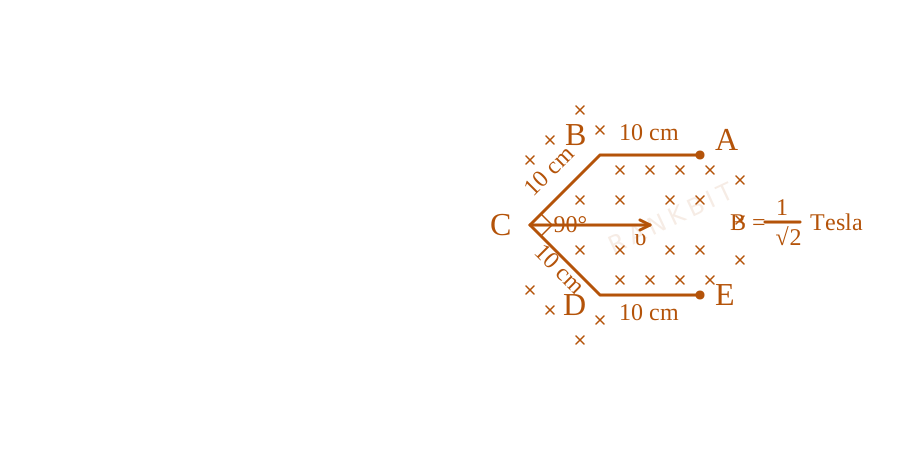
Conductor wire ABCDE with each arm 10mathrm~cm in length is placed in magnetic field of frac1sqrt2mathrm~Tesla, perpendicular to its plane. When conductor is pulled towards right with constant velocity of 10mathrm~cm/s, induced emf between points A and E is ________ mV.
Conductor wire path geometry layout for Q25 - JEE Main 2025 Morning
The figure outlines a segmented conductive wire trail pulled laterally through an orthogonal inward magnetic field matrix region.

Numerical Answer Type:
Enter a numerical value Answer: 10 to 10 +4 marks

Solution & Explanation

### Related Formula Motional electromotive force formula: epsilon = B cdot v cdot l_texteff where l_texteff is the net straight-line displacement distance joining start point A to target endpoint E (l_AE). ### Core Logic Since the external magnetic induction field map remains completely uniform across space, any arbitrary zig-zag wire loop profile can be simplified into a straight line connector vector bridging its raw boundary tips.
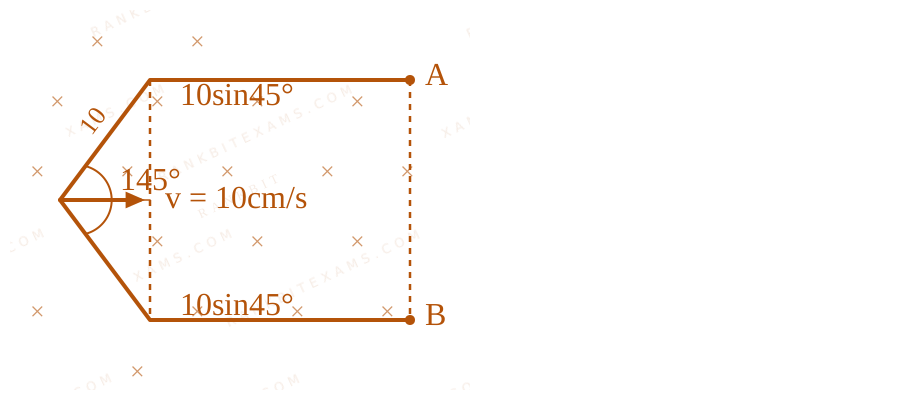
Effective vector length translation resolution mapping for Q25 - JEE Main 2025 Morning
The figure outlines a segmented conductive wire trail pulled laterally through an orthogonal inward magnetic field matrix region.
### Step 1: Compute Effective Length From the geometric angle configurations: l_texteff = 2 cdot (10 cdot sin 45^circ) = 2 cdot 10 cdot frac1sqrt2 = 10sqrt2mathrm~cm = 0.1sqrt2mathrm~m (Alternatively tracking structural vector projections: l_AB = 2 cdot 10sin(45^circ)mathrm~cm). ### Step 2: Calculate Induced EMF Substitute the parameters into the induction formula: epsilon = left( frac1sqrt2 ight) times left( 10 times 10^-2mathrm~m/s ight) times left( 10sqrt2 times 10^-2mathrm~m ight) epsilon = frac1sqrt2 cdot (0.1) cdot (0.1sqrt2) = 0.01mathrm~V = 10mathrm~mV ### Pattern Recognition In uniform magnetic fields, intermediate paths do not affect motional EMF values. The output voltage depends strictly on the straight line distance joining the end tips perpendicular to the velocity direction. ### Evaluation Rubric / Model Answer null ### Chapter Mix Class 12 Physics: Electromagnetic Induction
Reference Study Guides

More Electromagnetic Induction Previous-Year Questions — Page 2

Q12 2025 AC Generator
A coil of area A and N turns is rotating with angular velocity omega in a uniform magnetic field vecB about an axis perpendicular to vecB . Magnetic flux varphi and induced emf varepsilon across it, at an instant when vecB is parallel to the plane of coil, are: [cite: 1, 2]
  • A. varphi = mathrmAB,varepsilon = 0
  • B. varphi = 0, varepsilon = mathrmNABomega
  • C. varphi = 0, varepsilon = 0
  • D. varphi = mathrmAB,varepsilon = mathrmNABomega

Solution

### Related Formula phi = BAN cos(omega t) varepsilon = BANomega sin(omega t) ### Core Logic
AC Generator explanation diagram for Q12
When the magnetic field vector vecB lines up parallel to the plane of the coil, the norm area vector stands perpendicular to vecB, yielding omega t = fracpi2. Thus : phi = BAN cosleft(fracpi2right) = 0 [cite: 692, 693] varepsilon = BANomega sinleft(fracpi2right) = NABomega ### Pattern Recognition Flux is zero when the field lines are parallel to the coil surface, but the rate of change of flux (and thus emf) peaks to its absolute maximum[cite: 691, 693]. ### Chapter Mix Class 12 Physics: Electromagnetic Induction
More Electromagnetic Induction Questions — jee_main_2025_04_april_morning

Practice all Electromagnetic Induction previous-year questions →

YOUR FIRST PREP STEP STARTS HERE

We Map Every Repeating Question in Competitive Exams.

Say goodbye to generic mock test fatigue. RankBit uses smart analysis to group past exam questions into their foundational Repeating Question Types. Find chapter weightage, track repeating questions, and score higher with targeted practice.

Select Your Target Exam

Choose an exam track below to find formulas per chapter and patterns.

Syncing Exam Intelligence

Mapping formulas and patterns across all tracks…

PATH A — FULL LENGTH PRACTICE

Full Mock Test Hub

Simulate real NTA exam conditions with fully tracked mocks. Time yourself against past papers.

Under Development
PATH B — TARGETED PRACTICE

Topic-wise Practice Hub

Practice past-year questions one chapter at a time. Pick an exam → subject → chapter and get every PYQ for that topic — pulled together from all past papers — with the chapter's key formulas alongside.

Loading Questions... Browse Topics
Latest from the Blog
View all →

Loading articles...