JEE Main · Mathematics ↓ Falling

Sets, Relations and Functions appeared 65 times across 3 years — 7.5% of Mathematics. This question is from Composition of Functions.

Year 2026 2025 2024 Total
Questions 19 31 15 65

Let f, g: (1, ∞) → R be defined as f(x) = (2x + 3)/(5x + 2) and g(x) = (2 - 3x)/(1 - x). If the range of the function f(g(x)) on the interval [2, 4] is [α, β], then (1)/(β - α) is equal to

Solution & Explanation

Related Formula

For a composite function f(g(x)):

f(g(x)) = (2g(x) + 3)/(5g(x) + 2)
Core Logic

Substitute g(x) = (2 - 3x)/(1 - x) into f(x):

f(g(x)) = (2((2 - 3x)/(1 - x)) + 3)/(5((2 - 3x)/(1 - x)) + 2) = (4 - 6x + 3 - 3x)/(10 - 15x + 2 - 2x) = (7 - 9x)/(12 - 17x)

For the domain interval [2, 4], calculate the boundary values since the function is monotonic:

f(g(2)) = (7 - 9(2))/(12 - 17(2)) = (-11)/(-22) = (1)/(2) f(g(4)) = (7 - 9(4))/(12 - 17(4)) = (-29)/(-56) = (29)/(56)

Thus, the range [α, β] = [(1)/(2), (29)/(56)].

Step 1: Calculate the Difference
β - α = (29)/(56) - (1)/(2) = (29 - 28)/(56) = (1)/(56) (1)/(β - α) = 56
Pattern Recognition

When dealing with composite functions of linear fractions, simplify algebraically first. If the resulting function has no vertical asymptote in the specified interval, it is monotonic, and the extreme values occur exactly at the endpoints.

Chapter Mix

Class 11 Mathematics: Sets, Relations and Functions Class 12 Mathematics: Relations and Functions

Reference Study Guides

More Sets, Relations and Functions Previous-Year Questions — Page 9

Q54 jee_main_2025_07_april_evening Range of Rational Functions
If the range of the function f(x) = (5 - x)/(x² - 3x + 2), x ≠ 1, 2, is (-∞ , α ] [ β , ∞), then α² +β² is equal to :
  • A. 190
  • B. 192
  • C. 188
  • D. 194

Solution

Related Formula

For a quadratic equation Ax² + Bx + C = 0 to yield real roots, its discriminant must satisfy:

D = B² - 4AC ≥ 0
Core Logic

Set y = (5 - x)/(x² - 3x + 2):

y(x² - 3x + 2) = 5 - x yx² - 3xy + 2y + x - 5 = 0

Rearranging into a standard quadratic equation in terms of x:

yx² + (1 - 3y)x + (2y - 5) = 0
Step 1: Discriminant Method

Case I: If y = 0, the equation simplifies to x - 5 = 0 x = 5, which is a valid part of the domain. Thus, 0 belongs to the range.

Case II: If y ≠ 0, for x to be real, D ≥ 0:

(1 - 3y)² - 4(y)(2y - 5) ≥ 0 9y² + 1 - 6y - 8y² + 20y ≥ 0 y² + 14y + 1 ≥ 0
Step 2: Solving the Inequality

Completing the square for y² + 14y + 1 ≥ 0:

(y + 7)² - 48 ≥ 0 (y + 7)² ≥ (4√(3))²

This gives:

y ≤ -7 - 4√(3) or y ≥ -7 + 4√(3)

Comparing with the interval (-∞ , α ] [ β , ∞):

α = -7 - 4√(3) β = -7 + 4√(3)
Step 3: Finding alpha^2 + beta^2

Using algebraic identities:

α² + β² = (-7 - 4√(3))² + (-7 + 4√(3))² = 2(7² + (4√(3))²) = 2(49 + 48) = 2(97) = 194
Pattern Recognition

For rational expressions of the form LinearQuadratic, converting to a quadratic in x and forcing D ≥ 0 establishes the range boundaries elegantly.

Chapter Mix

Class 11 Mathematics: Sets, Relations and Functions

Q52 jee_main_2025_24_jan_evening One-One and Onto Functions
The function f:(-∞,∞)arrow(-∞,1), defined by f(x)= 2x-2-x2x+2-x is:
  • A. One-one but not onto
  • B. Onto but not one-one
  • C. Both one-one and onto
  • D. Neither one-one nor onto

Solution

Related Formula

A function is one-one if its derivative is strictly monotonic (always positive or always negative) across its domain. It is onto if its range equals its co-domain.

Core Logic

Rewrite the function by multiplying the numerator and denominator by 2^x:

f(x) = 22x - 122x + 1 = 1 - 222x + 1
Step 1: Check One-One property

Differentiating f(x) with respect to x :

f'(x) = 2(22x + 1)² · 2 · 22x · ln 2 = 4 · 22x · ln 2(22x + 1)²

Since 22x > 0 and ln 2 > 0, f'(x) > 0 always. Thus, f(x) is strictly increasing, confirming it is a one-one function.

Step 2: Check Onto property

Analyze the limits at boundaries:

x → -∞ f(x) = 1 - (2)/(0 + 1) = -1 x → ∞ f(x) = 1 - 0 = 1

Thus, the range of the function is (-1, 1). Since the given co-domain is (-∞, 1) and Range ≠ Co-domain , the function is not onto.

Pattern Recognition

The expression given is a shifted form of the hyperbolic tangent function (x ln 2). Hyperbolic tangent always maps to (-1, 1), making its restriction against (-∞, 1) non-surjective (not onto).

Chapter Mix

Class 12 Mathematics: Relations and Functions

Q58 jee_main_2025_24_jan_evening Linear Programming and Inequalities in Two Variables
Let the points ((11)/(2),α) lie on or inside the with sides x+y=11, x+2y=16 and 2x+3y=29 Then the product of the smallest and the largest values of a is equal to:
  • A. 22
  • B. 44
  • C. 33
  • D. 55

Solution

Related Formula

For a vertical line x = x₀ crossing a bounded region, the valid coordinates of y sit between the boundary lines intersecting that specific line vertical plane.

Core Logic

The point given is fixed at x = (11)/(2) = 5.5. We evaluate the values of y along this vertical line segment across each boundary edge.

Linear Programming region graph for Q58 - JEE Main 2025 Evening

Step 1: Evaluate Intersections

Substitute x = (11)/(2) into the three linear constraints:

  • From x + y = 11:
(11)/(2) + y = 11 ⇒ y = 11 - 5.5 = 5.5
  • From x + 2y = 16:
(11)/(2) + 2y = 16 ⇒ 2y = 16 - 5.5 = 10.5 ⇒ y = 5.25
  • From 2x + 3y = 29:
2((11)/(2)) + 3y = 29 ⇒ 11 + 3y = 29 ⇒ 3y = 18 ⇒ y = 6
Step 2: Define Extrema and Multiply

Checking the internal region of the bounded by these lines, the valid range for α along the section line is delimited by y = 5.5 and y = 6:

α = (11)/(2) = 5.5 α = 6

The product of the limits is :

α · α = (11)/(2) × 6 = 33
Pattern Recognition

Instead of drawing full coordinate diagrams or computing all three vertex points, evaluating values directly at the fixed coordinate constraint x = 5.5 saves time during multi-line area problems.

Chapter Mix

Class 11 Mathematics: Linear Inequalities Class 11 Mathematics: Straight Lines

Q71 jee_main_2025_24_jan_evening Number of Functions under Constraints
Number of functions f:1,2, ,100arrow0,1, that assign 1 to exactly one of the positive integers less than or equal to 98, is equal to \_\_\_\_.
Numerical Answer. Answer: 392

Solution

Related Formula

Fundamental Counting Principle: If an operation can be performed in n₁ ways, followed by a second operation in n₂ ways, the total configurations equal n₁ × n₂.

Core Logic

The domain set contains integers from 1 to 100. We divide the mapping requirements across distinct subsets of this domain.

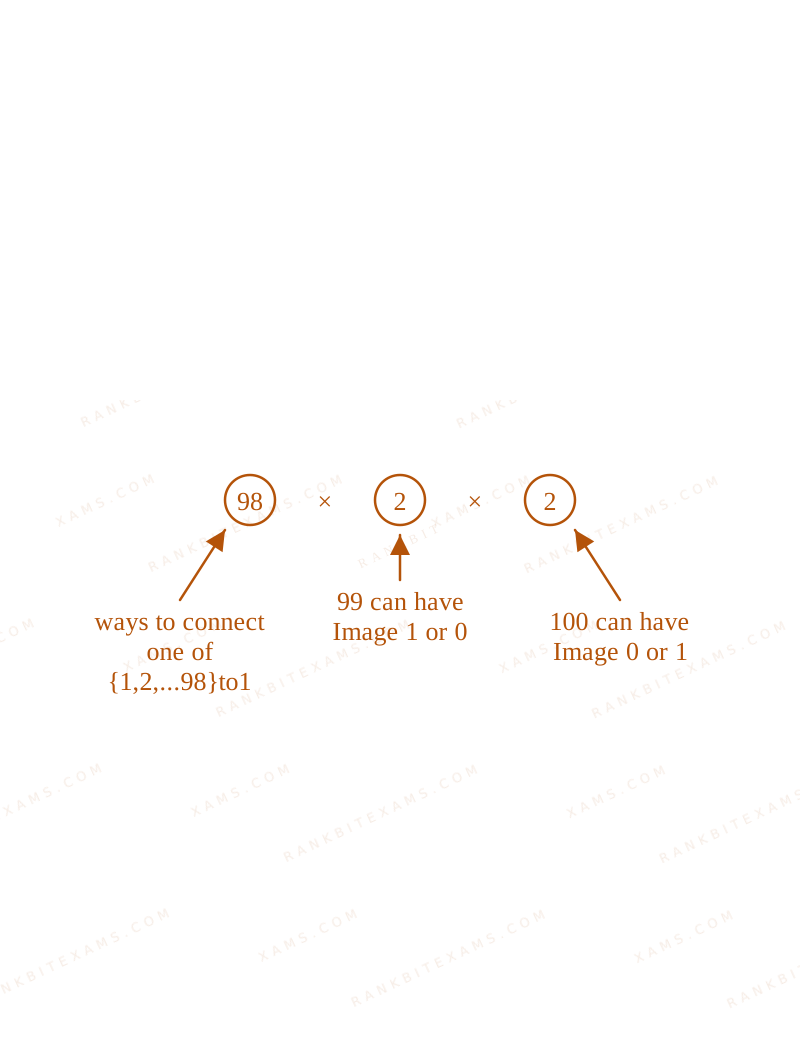
Function mapping grid for Q71 - JEE Main 2025 Evening

Step 1: Choose the single element from 1, 2, , 98

We must assign the image value 1 to exactly one positive integer from the subset 1, 2, , 98. The number of ways to pick this single element is :

981 = 98 ways
Step 2: Mapping remaining elements

The remaining 97 elements in the 1, 2, , 98 subset cannot map to 1, so they must map to 0. This leaves exactly 1 choice per remaining element.

For the final two elements in the domain, 99 and 100, there are no structural constraints:

  • Element 99 can map to either 0 or 1 (2 options) .
  • Element 100 can map to either 0 or 1 (2 options).
Step 3: Total functions combination

Multiply the independent choices together :

Total functions = 98 × 2 × 2 = 392
Pattern Recognition

Separate domains tightly into restricted blocks vs completely free components. Realizing that elements 99 and 100 behave independently with full co-domain targets leaves a clear product formulation.

Chapter Mix

Class 12 Mathematics: Relations and Functions Class 11 Mathematics: Permutations and Combinations

Q jee_main_2025_24_jan_morning Symmetric Property of Functions
Let f(x) = 2x + 2 + 1622x + 1 + 2x + 4 + 32. Then the value of 8(f((1)/(15)) + f((2)/(15)) + … + f((59)/(15))) is equal to:
  • A. 118
  • B. 92
  • C. 102
  • D. 108

Solution

Related Formula

Many finite fractional sum questions involving functional terms rely on identifying an underlying symmetric summation invariant, typically of the form f(x) + f(k-x) = constant.

Core Logic

First simplify the expression for f(x) algebraically:

f(x) = (4 · 2^x + 16)/(2 · (2^x)² + 16 · 2^x + 32)

Factor out 4 from the numerator and 2 from the denominator:

f(x) = (4(2^x + 4))/(2[(2^x)² + 8 · 2^x + 16]) = (2(2^x + 4))/((2^x + 4)²) = (2)/(2^x + 4)
Step 1: Establish Symmetry Pairings

Let's check the value of f(x) + f(4-x):

f(4-x) = 224-x + 4 = (2)/((16)/(2^x) + 4) = (2 · 2^x)/(16 + 4 · 2^x) = (2 · 2^x)/(4(2^x + 4)) = (2^x)/(2(2^x + 4))

Now compute the sum directly:

f(x) + f(4-x) = (2)/(2^x + 4) + (2^x)/(2(2^x + 4)) = (4 + 2^x)/(2(2^x + 4)) = (1)/(2)

Hence, whenever two input arguments sum up to 4, the sum of their functional values is exactly (1)/(2).

Step 2: Group the Finite Series Terms

Consider the terms inside the requested sequence:

(1)/(15) + (59)/(15) = (60)/(15) = 4 f((1)/(15)) + f((59)/(15)) = (1)/(2) (2)/(15) + (58)/(15) = (60)/(15) = 4 f((2)/(15)) + f((58)/(15)) = (1)/(2)

This complementary pairing continues up to:

f((29)/(15)) + f((31)/(15)) = (1)/(2)

This yields exactly 29 distinct pairs. The single middle term left unpaired corresponds to:

Middle Term = f((30)/(15)) = f(2) = (2)/(2² + 4) = (2)/(8) = (1)/(4)
Step 3: Evaluate Final Expression

Compute the total value by multiplying the grouped sum by 8:

Total = 8 · [ 29 · ((1)/(2)) + (1)/(4) ] Total = 8 · (29)/(2) + 8 · (1)/(4) = 116 + 2 = 118
Pattern Recognition

Whenever a symmetric set of arguments is presented inside a summation matching (k)/(n) + (N-k)/(n) = constant, look for an algebraic reduction of f(x) that yields a uniform constant sum for symmetric pairs.

Chapter Mix

Class 11 Mathematics: Functions

More Sets, Relations and Functions Questions — jee_main_2025_04_april_morning

Practice all Sets, Relations and Functions previous-year questions →

Rankbit System
JEE Physics: Waves (+15.5%) | Electrostatics: Concentric Shells (-29.7%) | Modern Physics: Photoelectric Clones (+34.2%) | Mathematics: Definite Integrals (+18.1%) | Chemistry: Coordination Splitting (-11.4%) | JEE Physics: Waves (+15.5%) | Electrostatics: Concentric Shells (-29.7%) | Modern Physics: Photoelectric Clones (+34.2%) | Mathematics: Definite Integrals (+18.1%) | Chemistry: Coordination Splitting (-11.4%)