JEE Main · Mathematics ↓ Falling

Sets, Relations and Functions appeared 65 times across 3 years — 7.5% of Mathematics. This question is from Composition of Functions.

Year 2026 2025 2024 Total
Questions 19 31 15 65

Let f, g: (1, ∞) → R be defined as f(x) = (2x + 3)/(5x + 2) and g(x) = (2 - 3x)/(1 - x). If the range of the function f(g(x)) on the interval [2, 4] is [α, β], then (1)/(β - α) is equal to

Solution & Explanation

Related Formula

For a composite function f(g(x)):

f(g(x)) = (2g(x) + 3)/(5g(x) + 2)
Core Logic

Substitute g(x) = (2 - 3x)/(1 - x) into f(x):

f(g(x)) = (2((2 - 3x)/(1 - x)) + 3)/(5((2 - 3x)/(1 - x)) + 2) = (4 - 6x + 3 - 3x)/(10 - 15x + 2 - 2x) = (7 - 9x)/(12 - 17x)

For the domain interval [2, 4], calculate the boundary values since the function is monotonic:

f(g(2)) = (7 - 9(2))/(12 - 17(2)) = (-11)/(-22) = (1)/(2) f(g(4)) = (7 - 9(4))/(12 - 17(4)) = (-29)/(-56) = (29)/(56)

Thus, the range [α, β] = [(1)/(2), (29)/(56)].

Step 1: Calculate the Difference
β - α = (29)/(56) - (1)/(2) = (29 - 28)/(56) = (1)/(56) (1)/(β - α) = 56
Pattern Recognition

When dealing with composite functions of linear fractions, simplify algebraically first. If the resulting function has no vertical asymptote in the specified interval, it is monotonic, and the extreme values occur exactly at the endpoints.

Chapter Mix

Class 11 Mathematics: Sets, Relations and Functions Class 12 Mathematics: Relations and Functions

Reference Study Guides

More Sets, Relations and Functions Previous-Year Questions — Page 4

Q17 jee_main_2026_24_january_evening Functional Equations
Let f be a function such that 3f(x) + 2f((m)/(19x)) = 5x, x ≠ 0, where m = Σi=1⁹ (i)². Then f(5) - f(2) is equal to
  • A. -9
  • B. 36
  • C. 18
  • D. 9

Solution

Related Formula
Sum of squares: Σi=1ⁿ i² = (n(n+1)(2n+1))/(6)
Core Logic

First, evaluate the constant m:

m = Σi=1⁹ i² = (9 × 10 × 19)/(6) = 15 × 19

The given functional equation is:

3f(x) + 2f((15 × 19)/(19x)) = 5x 3f(x) + 2f((15)/(x)) = 5x (1)
Step 1: Forming System of Equations

To eliminate f((15)/(x)), replace x with (15)/(x) in equation (1):

3f((15)/(x)) + 2f(x) = 5((15)/(x)) = (75)/(x) (2)
Step 2: Solving for f(x)

Multiply equation (1) by 3 and equation (2) by 2:

9f(x) + 6f((15)/(x)) = 15x 4f(x) + 6f((15)/(x)) = (150)/(x)

Subtract the second from the first:

9f(x) - 4f(x) = 15x - (150)/(x) 5f(x) = 15x - (150)/(x) f(x) = 3x - (30)/(x)
Step 3: Calculating Final Values

Evaluate f(5) and f(2):

f(5) = 3(5) - (30)/(5) = 15 - 6 = 9 f(2) = 3(2) - (30)/(2) = 6 - 15 = -9

Finally:

f(5) - f(2) = 9 - (-9) = 18
Pattern Recognition

Functional equations of the form af(x) + bf((k)/(x)) = g(x) strictly require the classic substitution x → (k)/(x) to create a straightforward 2 × 2 algebraic system of equations.

Chapter Mix

Class 11 Maths: Functions Class 11 Maths: Sequences and Series
Q1 jee_main_2026_28_january_morning Composite Functions
If g(x)=3x²+2x-3, f(0)=-3 and 4g(f(x))=3x²-32x+72, then f(g(2)) is equal to:
  • A. (25)/(6)
  • B. -(25)/(6)
  • C. (7)/(2)
  • D. -(7)/(2)

Solution

Related Formula
g(f(x)) = 3(f(x))² + 2f(x) - 3
Core Logic

First, evaluate g(2):

g(2) = 3(2)² + 2(2) - 3 = 12 + 4 - 3 = 13

We need to find f(g(2)) = f(13).

Given the composite function relation:

4g(f(x)) = 3x² - 32x + 72

Substitute g(t) expansion:

4[3(f(x))² + 2f(x) - 3] = 3x² - 32x + 72

Let f(x) = t:

12t² + 8t - 12 = 3x² - 32x + 72 12t² + 8t - (3x² - 32x + 84) = 0
Step 1: Solve for f(x)

Using the quadratic formula for t:

t = f(x) = -8 ± √(64 - 4(12)(-(3x² - 32x + 84)))24 f(x) = -8 ± √(64 + 48(3x² - 32x + 84))24 f(x) = (-8 ± 4(3x - 16))/(24)

Since f(0) = -3:

f(0) = (-8 ± 4(-16))/(24) = (-8 ± (-64))/(24)

Choosing the positive sign gives (-8 - 64)/(24) = -3, so we take the positive sign branch (where the inner term was 3x-16, wait, +4(3x-16) with x=0 is -64. So + sign works).

f(x) = (-8 + 4(3x - 16))/(24)
Step 2: Final Calculation

Evaluate f(13):

f(13) = (-8 + 4(3(13) - 16))/(24) = (-8 + 4(23))/(24) f(13) = (-8 + 92)/(24) = (84)/(24) = (7)/(2)
Pattern Recognition

Composite equations resolving to quadratics in f(x) typically require boundary conditions (like f(0)=-3) to eliminate the ± ambiguity from the quadratic formula.

Chapter Mix

Class 11 Mathematics: Functions Class 11 Mathematics: Quadratic Equations

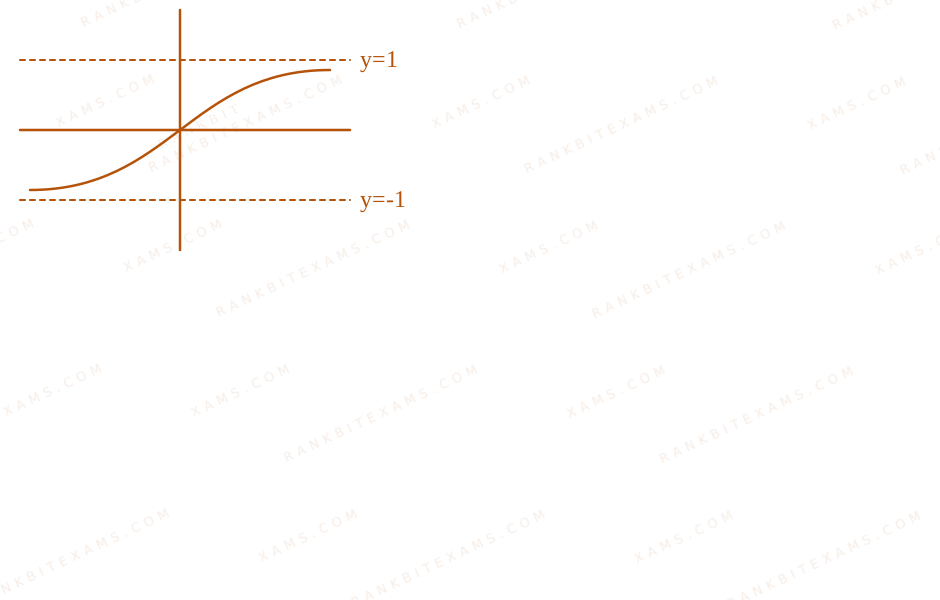
Q8 jee_main_2026_28_january_evening One-One and Many-One Functions
Given below are two statements: Statement I: The function f: R arrow R defined by f(x) = (x)/(1 + |x|) is one-one. Statement II: The function f: R arrow R defined by f(x) = x² + 4x - 30x² - 8x + 18 is many-one. In the light of the above statements, choose the correct answer from the options given below :
  • A. Both Statement I and Statement II are false.
  • B. Both Statement I and Statement II are true.
  • C. Statement I is false but Statement II is true.
  • D. Statement I is true but Statement II is false.

Solution

Core Logic

Statement I: f(x) = (x)/(1+|x|).

f(x) = cases (x)/(1+x) & x ≥ 0 (x)/(1-x) & x < 0 cases

The derivative f'(x) = (1)/((1+|x|)²) > 0 for all x. Since it is strictly increasing, f(x) is one-one. Statement I is true.

Graph of bounded rational function

Execution

Statement II: f(x) = (x² + 4x - 30)/(x² - 8x + 18). Let's evaluate f(0):

f(0) = (-30)/(18) = -(5)/(3)

Set f(x) = -(5)/(3) to find if there are other roots:

(x² + 4x - 30)/(x² - 8x + 18) = -(5)/(3) 3x² + 12x - 90 = -5x² + 40x - 90 8x² - 28x = 0 ⇒ 4x(2x - 7) = 0

x = 0 or x = (7)/(2) (Note: the PDF says on solving x=0, -1, but algebraic check shows x=0, 7/2. Regardless, it maps to multiple points). Since f(0) = f(7/2) = -(5)/(3), the function maps distinct inputs to the same output. It is many-one. Statement II is true.

Step 1: Final Conclusion

Both Statement I and Statement II are true.

Pattern Recognition

Checking x=0 in a rational function y = P(x)/Q(x) provides a quick horizontal line test benchmark. Equating the function to f(0) immediately reveals if it's many-one without computing full derivatives.

Chapter Mix

Class 12 Maths: Relations and Functions

Q15 jee_main_2026_28_january_evening Signum Function Properties
The sum of all the elements in the range of f(x) = Sgn( x) + Sgn( x) + Sgn( x) + Sgn( x), x ≠ (nπ)/(2), n in Z, where Sgn(t) = cases 1, & if t > 0 -1 & if t < 0 cases, is
  • A. 4
  • B. 2
  • C. -2
  • D. 0

Solution

Core Logic

Analyze the signs of trigonometric functions in each quadrant: Quadrant I: x in (0, π/2). , , , are all positive. y = 1 + 1 + 1 + 1 = 4

Quadrant II: x in (π/2, π). positive; , , negative. y = 1 - 1 - 1 - 1 = -2

Quadrant III: x in (π, 3π/2). , positive; , negative. y = -1 - 1 + 1 + 1 = 0

Quadrant IV: x in (3π/2, 2π). positive; , , negative. y = -1 + 1 - 1 - 1 = -2

Execution

The set of unique values produced by f(x) represents its range. Range = -2, 0, 4

The sum of all elements in the range is: -2 + 0 + 4 = 2

Pattern Recognition

When applying signum to all four base trigonometric identities, simply count the number of positive mappings per quadrant (all positive = 4, sine only = -2, tan/cot only = 0, cos only = -2).

Chapter Mix

Class 11 Maths: Trigonometric Functions Class 12 Maths: Relations and Functions

Q54 jee_main_2025_02_april_evening Relations
Let A = 1, 2, 3, , 100 and R be a relation on A such that R = (a, b) : a = 2b + 1. Let (a₁, a₂), (a₂, a₃), (a₃, a₄), , (ak, ak+1) be a sequence of k elements of R such that the second entry of an ordered pair is equal to the first entry of the next ordered pair. Then the largest integer k, for which such a sequence exists, is equal to:
  • A. 6
  • B. 7
  • C. 5
  • D. 8

Solution

Related Formula
Chain definition: aᵢ = 2 aᵢ₊₁ + 1 for i = 1, 2, , k
Core Logic

To find the longest sequence of connected pairs, we trace the relation backward starting from the smallest elements in A.

Step 1: Trace the relations backward

To maximize k, we want the chain of elements to go down as low as possible. Let the final element in the chain be ak+1 in A. Since ak = 2 ak+1 + 1:

  • If ak+1 = 1 ak = 3
  • If ak+1 = 2 ak = 5
  • Let's test the chain starting with ak+1 = 1:

  • ak = 2(1) + 1 = 3
  • ak-1 = 2(3) + 1 = 7
  • ak-2 = 2(7) + 1 = 15
  • ak-3 = 2(15) + 1 = 31
  • ak-4 = 2(31) + 1 = 63
  • ak-5 = 2(63) + 1 = 127 (but 127 A!)
  • Thus, the longest chain within the set A has 6 elements:

63, 31, 15, 7, 3, 1

This chain corresponds to exactly 5 ordered pairs:

(63, 31), (31, 15), (15, 7), (7, 3), (3, 1)

So the maximum number of pairs in the sequence is k = 5.

Step 2: Check alternative chains

If we start with ak+1 = 2:

  • ak+1 = 2
  • ak = 5
  • ak-1 = 11
  • ak-2 = 23
  • ak-3 = 47
  • ak-4 = 95
  • ak-5 = 191 > 100
  • Again, the maximum number of pairs is k = 5. Thus, the largest integer k is 5.

Pattern Recognition

Recursive scaling: Tracing exponential chains of the form xₙ₊₁ = c xₙ + d shows that the elements grow very quickly. Calculating the limits of growth determines the maximum possible depth of the sequence.

Chapter Mix

Class 11 Mathematics: Relations and Functions

More Sets, Relations and Functions Questions — jee_main_2025_04_april_morning

Practice all Sets, Relations and Functions previous-year questions →

Rankbit System
JEE Physics: Waves (+15.5%) | Electrostatics: Concentric Shells (-29.7%) | Modern Physics: Photoelectric Clones (+34.2%) | Mathematics: Definite Integrals (+18.1%) | Chemistry: Coordination Splitting (-11.4%) | JEE Physics: Waves (+15.5%) | Electrostatics: Concentric Shells (-29.7%) | Modern Physics: Photoelectric Clones (+34.2%) | Mathematics: Definite Integrals (+18.1%) | Chemistry: Coordination Splitting (-11.4%)
