JEE Main · Mathematics ↓ Falling

Limits, Continuity and Differentiability appeared 52 times across 3 years — 6% of Mathematics. This question is from Evaluation of Limits using Expansion.

Year 2026 2025 2024 Total
Questions 12 24 16 52

If x → 1⁺((x - 1)(6 + λ (x - 1)) + μ (1 - x))/((x - 1)³) = -1, where λ, μ in R, then \lambda + \mu is equal to

Solution & Explanation

Related Formula

Standard Taylor expansions near zero:

h = 1 - (h²)/(2!) + (h⁴)/(4!) - h = h - (h³)/(3!) + (h⁵)/(5!) -
Core Logic

Let x - 1 = h, where h → 0⁺. The expression transforms into:

h → 0(h(6 + λ h) - μ h)/(h³) = -1

Substitute the expansions into the numerator:

h → 0(h[6 + λ(1 - (h²)/(2))] - μ(h - (h³)/(6)))/(h³) = -1 h → 0((6 + λ - μ)h + (-(λ)/(2) + (μ)/(6))h³)/(h³) = -1
Step 1: Match Coefficients for Existence

For the limit to be finite, the coefficient of h must vanish:

6 + λ - μ = 0 μ - λ = 6 (1)

Equating the h³ term to the given limit value:

-(λ)/(2) + (μ)/(6) = -1 -3λ + μ = -6 (2)
Step 2: Solve System of Equations

Subtract equation (1) from (2):

(-3λ + μ) - (μ - λ) = -6 - 6 -2λ = -12 λ = 6

From (1), μ = 6 + 6 = 12.

λ + μ = 6 + 12 = 18
Pattern Recognition

When dealing with indeterminate form limits involving mixed trigonometric expressions with a non-zero denominator power, polynomial substitution using Taylor series is much cleaner and less prone to differentiation tracking mistakes compared to multiple L'Hôpital cycles.

Chapter Mix

Class 12 Mathematics: Limits, Continuity and Differentiability

Reference Study Guides

More Limits, Continuity and Differentiability Previous-Year Questions — Page 10

Q20 jee_main_2024_30_jan_morning Limits
Let f:[-(π)/(2),(π)/(2)] → R be a differentiable function such that f(0) = (1)/(2). If the x → 0 x ∫₀x f(t) dtex² - 1 = α, then 8α² is equal to:
  • A. 16
  • B. 2
  • C. 1
  • D. 4

Solution

Related Formula
y → 0 (e^y - 1)/(y) = 1

Leibniz Integral Rule:

(d)/(dx) ∫₀^x f(t) dt = f(x)
Core Logic

Given limit is:

α = x → 0 x ∫₀x f(t) dtex² - 1

Multiply and divide the denominator by x² to use standard exponential limit:

α = x → 0 x ∫₀x f(t) dt( ex² - 1x²) · x²

Since x→ 0 ex² - 1x² = 1, the expression simplifies to:

α = x → 0 x ∫₀x f(t) dt1 · x² = x → 0 ∫₀x f(t) dtx
Step 1: Applying L'Hôpital's Rule

This is a 0/0 form. Apply L'Hôpital's Rule by differentiating numerator and denominator w.r.t x:

α = x → 0 (d)/(dx) ∫₀x f(t) dt(d)/(dx)(x) = x → 0 (f(x))/(1)

By continuity of differentiable function f at 0: α = f(0)

Step 2: Final Calculation

We are given f(0) = (1)/(2), so α = (1)/(2). We need to find 8α²:

8α² = 8 ((1)/(2))² = 8 ((1)/(4)) = 2
Pattern Recognition

Standard expansion/limits on isolated terms in denominators immediately reduce the power of x, setting up a trivial Leibniz derivative application.

Chapter Mix

Class 11 Maths: Limits and Derivatives Class 12 Maths: Integrals
Q29 jee_main_2024_30_jan_morning Differentiability
If the function f(x) = cases (1)/(|x|) & ,|x| ≥ 2 ax² + 2b & ,|x| < 2 cases is differentiable on R, then 48 (a + b) is equal to
Numerical Answer. Answer: 15 to 15

Solution

Related Formula
Continuity at x=c: x → c^- f(x) = x → c^+ f(x) Differentiability at x=c: x → c^- f'(x) = x → c^+ f'(x)
Core Logic

Rewrite the piecewise function without absolute values:

f(x) = cases (1)/(x) & , x ≥ 2 ax² + 2b & , -2 < x < 2 -(1)/(x) & , x ≤ -2 cases
Step 1: Applying Continuity

For f(x) to be continuous at x = 2:

x → 2^- (ax² + 2b) = x → 2^+ (1)/(x) a(2)² + 2b = (1)/(2) ⇒ 4a + 2b = (1)/(2) (1)

Because the function is even, continuity at x = -2 yields the exact same equation: 4a + 2b = 1/2.

Step 2: Applying Differentiability

Find the derivative f'(x) for piecewise sections:

f'(x) = cases -(1)/(x²) & , x > 2 2ax & , -2 < x < 2 (1)/(x²) & , x < -2 cases

For f(x) to be differentiable at x = 2:

x → 2^- (2ax) = x → 2^+ (-(1)/(x²)) 4a = -(1)/(4) ⇒ a = -(1)/(16)
Step 3: Finding variables and final target

Substitute a back into equation (1):

4(-(1)/(16)) + 2b = (1)/(2) -(1)/(4) + 2b = (1)/(2) ⇒ 2b = (3)/(4) ⇒ b = (3)/(8)

We need to evaluate 48(a + b):

48(-(1)/(16) + (3)/(8)) = 48((-1 + 6)/(16)) = 48((5)/(16)) = 3 × 5 = 15
Pattern Recognition

Piecewise differentiability forces simultaneous linear equations matching function values and their first derivatives at boundary limits.

Chapter Mix

Class 12 Maths: Continuity and Differentiability

Q10 jee_main_2024_31_jan_evening Limits of Functions
Let f: R → (0, ∞) be strictly increasing function such that x → ∞ (f(7x))/(f(x)) = 1. Then, the value of x arrow ∞ [ (f(5x))/(f(x)) - 1 ] is equal to
  • A. 4
  • B. 0
  • C. 7/5
  • D. 1

Solution

Related Formula
Sandwich / Squeeze Theorem: If g(x) ≤ h(x) ≤ k(x) and g(x) = k(x) = L, then h(x) = L
Core Logic

Since f is a strictly increasing function mapping to (0,∞): For x > 0, we have x < 5x < 7x. Thus, f(x) < f(5x) < f(7x). Divide everything by f(x) (which is strictly positive):

1 < (f(5x))/(f(x)) < (f(7x))/(f(x))

Take the limit as x → ∞:

x→∞ 1 ≤ x→∞ (f(5x))/(f(x)) ≤ x→∞ (f(7x))/(f(x)) 1 ≤ x→∞ (f(5x))/(f(x)) ≤ 1

Therefore, x→∞ (f(5x))/(f(x)) = 1. The required value is:

x arrow ∞ [ (f(5x))/(f(x)) - 1 ] = 1 - 1 = 0
Chapter Mix

Class 11 Maths: Limits and Derivatives Class 12 Maths: Continuity and Differentiability

Q14 jee_main_2024_31_jan_evening Differentiability
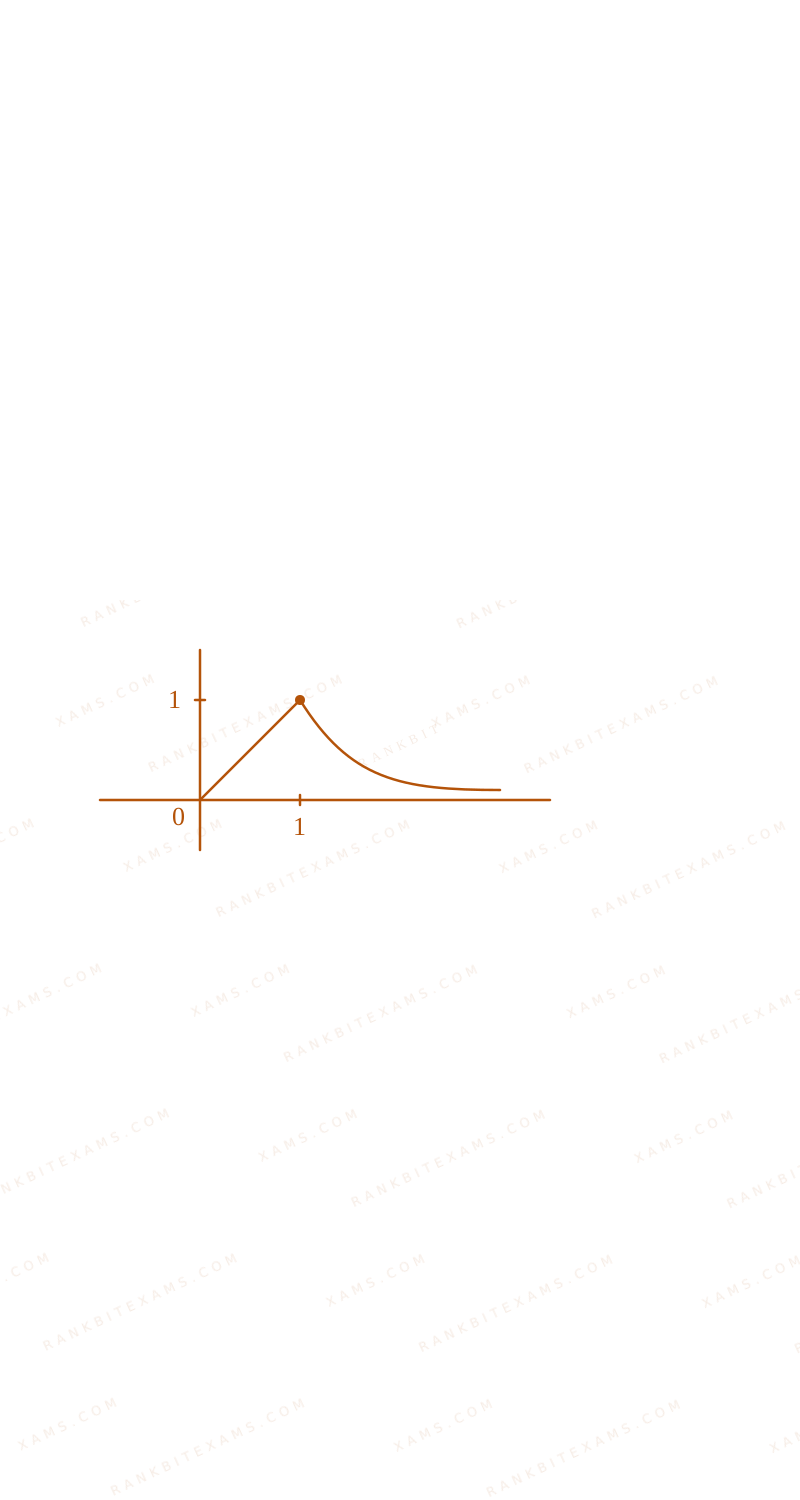
Consider the function f:(0,∞)→ R defined by f(x) = e^-| ₑx|. If m and n be respectively the number of points at which f is not continuous and f is not differentiable, then m + n is
  • A. 0
  • B. 3
  • C. 1
  • D. 2

Solution

Core Logic

Differentiability diagram for Q14 - JEE Main 2024 Evening

The function is f(x) = e-|ln x|. Rewrite piecewise for (0, ∞):

f(x) = cases e-(-ln x) & if 0 < x < 1 e-ln x & if x ≥ 1 cases f(x) = cases eln x = x & if 0 < x < 1 1eln x = (1)/(x) & if x ≥ 1 cases

Check continuity at x = 1:

x → 1^- f(x) = x → 1^- x = 1 x → 1^+ f(x) = x → 1^+ (1)/(x) = 1

f(1) = 1. The function is continuous everywhere on (0, ∞). Thus, m = 0.

Check differentiability at x = 1:

LHD = x → 1^- f'(x) = 1 RHD = x → 1^+ f'(x) = -(1)/(x²)|x=1 = -1

Since LHD ≠ RHD, the function is not differentiable at x = 1. Thus, n = 1.

Finally, m + n = 0 + 1 = 1.

Chapter Mix

Class 12 Maths: Continuity and Differentiability

Q27 jee_main_2024_31_jan_evening Maclaurin Series / L'Hopital
If x → 0 ax²e^x - b ₑ(1 + x) + cxe-xx² x = 1, then 16(a² + b² + c²) is equal to
Numerical Answer. Answer: 81 to 81

Solution

Related Formula
e^x = 1 + x + (x²)/(2!) + ln(1+x) = x - (x²)/(2) + (x³)/(3) - x ≈ x x² x ≈ x³
Core Logic

Expand the numerator terms using Maclaurin series around x=0:

ax² (1 + x + (x²)/(2) + ) - b (x - (x²)/(2) + (x³)/(3) - ) + cx (1 - x + (x²)/(2) - (x³)/(6) + )

Denominator behavior is x³. Group by powers of x: Coefficient of x: -b + c = 0 c = b Coefficient of x²: a + (b)/(2) - c = 0 a = c - (b)/(2) = (b)/(2) Coefficient of x³: a - (b)/(3) + (c)/(2) = 1

Substitute a = b/2 and c = b into the x³ equation:

(b)/(2) - (b)/(3) + (b)/(2) = 1 b - (b)/(3) = 1 (2b)/(3) = 1 b = (3)/(2)

This gives c = (3)/(2) and a = (3)/(4).

Calculate the required value:

16(a² + b² + c²) = 16((9)/(16) + (9)/(4) + (9)/(4)) = 9 + 36 + 36 = 81
Chapter Mix

Class 11 Maths: Limits and Derivatives

More Limits, Continuity and Differentiability Questions — jee_main_2025_04_april_morning

Practice all Limits, Continuity and Differentiability previous-year questions →

Rankbit System
JEE Physics: Waves (+15.5%) | Electrostatics: Concentric Shells (-29.7%) | Modern Physics: Photoelectric Clones (+34.2%) | Mathematics: Definite Integrals (+18.1%) | Chemistry: Coordination Splitting (-11.4%) | JEE Physics: Waves (+15.5%) | Electrostatics: Concentric Shells (-29.7%) | Modern Physics: Photoelectric Clones (+34.2%) | Mathematics: Definite Integrals (+18.1%) | Chemistry: Coordination Splitting (-11.4%)
