For an integer n ge 2, if the arithmetic mean of all coefficients in the binomial expansion of (x + y)^2n - 3 is 16, then the distance of the point P(2n - 1, n^2 - 4n) from the line x + y = 8 is:

Solution & Explanation

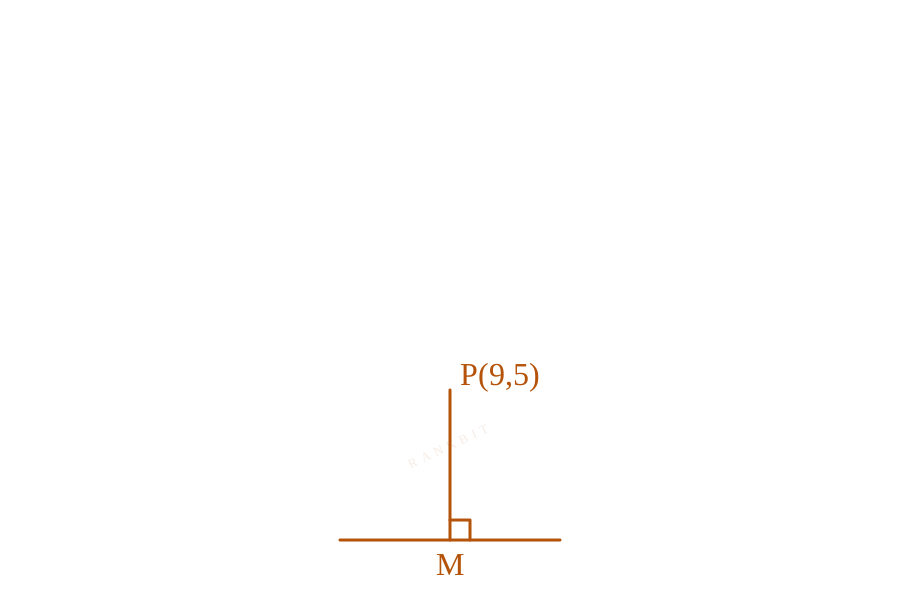
### Related Formula Sum of binomial coefficients for (x+y)^m is 2^m. Total number of terms is m + 1. Perpendicular distance formula from (x_0, y_0) to ax + by + c = 0: d = frac|ax_0 + by_0 + c|sqrta^2 + b^2 ### Core Logic The power is m = 2n - 3. Sum of coefficients = 2^2n - 3. Total terms = 2n - 2. Given Arithmetic Mean: frac2^2n - 32n - 2 = 16 implies frac2^2n - 32(n - 1) = 16 implies 2^2n - 4 = 16(n - 1) Testing integer values, n = 5 satisfies the equation perfectly since 2^6 = 64 and 16(5 - 1) = 64. ### Step 1: Determine Coordinates of Point P Substitute n = 5 into P(2n - 1, n^2 - 4n): x_0 = 2(5) - 1 = 9 y_0 = 5^2 - 4(5) = 5 Thus, P = (9, 5).
Properties of Binomial Coefficients diagram for Q54 - JEE Main 2025 Morning
### Step 2: Calculate Perpendicular Distance Find the distance from (9,5) to the line x + y - 8 = 0: d = left|frac9 + 5 - 8sqrt1^2 + 1^2right| = frac6sqrt2 = 3sqrt2 ### Pattern Recognition Binomial coefficient logic tightly constrains n to small integers. Use inspection quickly when polynomial-exponential configurations arise. ### Evaluation Rubric / Model Answer null ### Chapter Mix Class 11 Mathematics: Binomial Theorem Class 11 Mathematics: Straight Lines

Reference Study Guides

More Binomial Theorem Previous-Year Questions — Page 6

Q26 jee_main_2024_30_jan_morning General Term
Number of integral terms in the expansion of left\7^left(frac12right) + 11^left(frac16right)right\^824 is equal to
Numerical Answer. Answer: 138 to 138

Solution

### Related Formula T_r+1 = binomnr a^n-r b^r ### Core Logic General term in the expansion of left(7^1/2 + 11^1/6right)^824 is: t_r+1 = binom824r (7)^frac824-r2 (11)^r/6 For the term to be integral, both powers must be integers. This means: 1) frac824 - r2 must be an integer, which means r must be even. 2) fracr6 must be an integer, which means r must be a multiple of 6. Since any multiple of 6 is already even, the condition reduces to: r must be a multiple of 6. ### Step 1: Finding valid values of r The possible values for r are 0, 1, 2, dots, 824. Valid r = 0, 6, 12, dots, 822. This forms an arithmetic progression with first term a=0, common difference d=6, and last term L=822. L = a + (n-1)d 822 = 0 + (n-1)6 n - 1 = frac8226 = 137 n = 138 Thus, there are 138 integral terms. ### Pattern Recognition Finding rational/integral terms in a binomial expansion strictly requires finding the LCM of the fractional power denominators, then counting multiples up to n. ### Evaluation Rubric / Model Answer null ### Chapter Mix Class 11 Maths: Binomial Theorem

Q24 jee_main_2024_31_jan_evening Series Expansion
Let the coefficient of x^r in the expansion of (x+3)^n-1 + (x+3)^n-2(x+2) + (x+3)^n-3(x+2)^2 + dots + (x+2)^n-1 be alpha_r. If sum_r=0^n alpha_r = beta^n - gamma^n, where beta, gamma in mathbbN, then the value of beta^2 + gamma^2 equals
Numerical Answer. Answer: 25 to 25

Solution

### Related Formula textSum of coefficients in a polynomial P(x) text is found by putting x=1. textSum of G.P.: S_n = fraca(r^n - 1)r - 1 ### Core Logic Let the expanded polynomial be P(x). The sum of its coefficients is sum alpha_r = P(1). Substitute x = 1 into the given expression: P(1) = 4^n-1 + 4^n-2(3) + 4^n-3(3^2) + dots + 3^n-1 This is a Geometric Progression with first term a = 4^n-1 and common ratio r = 3/4. There are n terms. P(1) = 4^n-1 frac1 - (3/4)^n1 - 3/4 = 4^n-1 frac1 - (3/4)^n1/4 = 4^n left(1 - frac3^n4^nright) = 4^n - 3^n Comparing this with beta^n - gamma^n, we get: beta = 4, quad gamma = 3 Calculate beta^2 + gamma^2: beta^2 + gamma^2 = 4^2 + 3^2 = 16 + 9 = 25 ### Pattern Recognition Substituting x=1 immediately bypasses expanding individual x^r terms for questions asking for sum of coefficients. ### Evaluation Rubric / Model Answer null ### Chapter Mix Class 11 Maths: Binomial Theorem Class 11 Maths: Sequences and Series
Q2 jee_main_2024_31_jan_morning Sum of Coefficients and Limits
Let a be the sum of all coefficients in the expansion of (1 - 2x + 2x^2)^2023 (3 - 4x^2 + 2x^3)^2024 and b = lim_x to 0 left( fracint_0^x fraclog(1 + t)t^2024 + 1 dtx^2 right). If the equations cx^2 + dx + e = 0 and 2bx^2 + ax + 4 = 0 have a common root, where c, d, e in mathbbR, then d : c : e equals
  • A. 2:1:4
  • B. 4:1:4
  • C. 1:2:4
  • D. 1:1:4

Solution

### Core Logic To find the sum of all coefficients in a polynomial expansion, substitute x = 1. a = (1 - 2(1) + 2(1)^2)^2023 (3 - 4(1)^2 + 2(1)^3)^2024 a = (1)^2023 (1)^2024 = 1 ### Step 1: Evaluate Limit for b Evaluate b = lim_x to 0 fracint_0^x fracln(1 + t)1 + t^2024 dtx^2 Using L'Hôpital's Rule (differentiating numerator via Newton-Leibniz): b = lim_x to 0 fracfracln(1 + x)1 + x^20242x = lim_x to 0 fracln(1 + x)x times frac12(1 + x^2024) b = 1 times frac12 = frac12 ### Step 2: Analyze Common Roots The given second equation is 2bx^2 + ax + 4 = 0. Substitute a = 1 and b = frac12: 2left(frac12right)x^2 + 1(x) + 4 = 0 implies x^2 + x + 4 = 0 The discriminant of x^2 + x + 4 = 0 is D = 1 - 16 < 0. Roots are non-real complex conjugates. ### Step 3: Final Ratio Since c, d, e in mathbbR and one root is common with a quadratic having non-real roots, both roots must be common. Thus, the coefficients must be proportional: fracc1 = fracd1 = frace4 This implies d : c : e = 1 : 1 : 4. ### Pattern Recognition If a quadratic equation with real coefficients shares a common root with another quadratic having complex roots (D < 0), both roots must be shared, meaning their coefficients are directly proportional. ### Evaluation Rubric / Model Answer null ### Chapter Mix Class 11 Maths: Binomial Theorem Class 12 Maths: Limits and Derivatives Class 11 Maths: Quadratic Equations
Q25 jee_main_2024_31_jan_morning Coefficients in Expansion
In the expansion of (1 + x)(1 - x^2)left(1 + frac3x + frac3x^2 + frac1x^3right)^5, x neq 0, the sum of the coefficient of x^3 and x^-13 is equal to
Numerical Answer. Answer: 118 to 118

Solution

### Core Logic (1+x)(1-x^2) left( left(1 + frac1xright)^3 right)^5 = (1+x)(1-x)(1+x) frac(x+1)^15x^15 = frac(1-x)(1+x)^17x^15 = frac(1+x)^17 - x(1+x)^17x^15 ### Step 1: Find Coefficient of x^3 To find coeff of x^3 in frac(1+x)^17 - x(1+x)^17x^15, we need the coeff of x^18 in the numerator (1+x)^17 - x(1+x)^17. The maximum power of x in (1+x)^17 is 17, and in x(1+x)^17 is 18. Coeff of x^18 in (1+x)^17 is 0. Coeff of x^18 in x(1+x)^17 is the coeff of x^17 in (1+x)^17, which is binom1717 = 1. Thus, coeff of x^18 in the numerator is 0 - 1 = -1. ### Step 2: Find Coefficient of x^{-13} To find coeff of x^-13, we need the coeff of x^2 in the numerator (1+x)^17 - x(1+x)^17. Coeff of x^2 in (1+x)^17 is binom172. Coeff of x^2 in x(1+x)^17 is coeff of x^1 in (1+x)^17, which is binom171. Value = binom172 - binom171 = frac17 times 162 - 17 = 136 - 17 = 119. ### Step 3: Final Sum Sum of coefficients = -1 + 119 = 118. ### Evaluation Rubric / Model Answer null ### Chapter Mix Class 11 Maths: Binomial Theorem

More Binomial Theorem Questions — jee_main_2025_04_april_morning

Practice all Binomial Theorem previous-year questions →

Rankbit System
JEE Physics: Waves (+15.5%) | Electrostatics: Concentric Shells (-29.7%) | Modern Physics: Photoelectric Clones (+34.2%) | Mathematics: Definite Integrals (+18.1%) | Chemistry: Coordination Splitting (-11.4%) | JEE Physics: Waves (+15.5%) | Electrostatics: Concentric Shells (-29.7%) | Modern Physics: Photoelectric Clones (+34.2%) | Mathematics: Definite Integrals (+18.1%) | Chemistry: Coordination Splitting (-11.4%)