Rankbit System
JEE Physics: Waves (+15.5%) | Electrostatics: Concentric Shells (-29.7%) | Modern Physics: Photoelectric Clones (+34.2%) | Mathematics: Definite Integrals (+18.1%) | Chemistry: Coordination Splitting (-11.4%) | JEE Physics: Waves (+15.5%) | Electrostatics: Concentric Shells (-29.7%) | Modern Physics: Photoelectric Clones (+34.2%) | Mathematics: Definite Integrals (+18.1%) | Chemistry: Coordination Splitting (-11.4%)

For an integer n ge 2, if the arithmetic mean of all coefficients in the binomial expansion of (x + y)^2n - 3 is 16, then the distance of the point P(2n - 1, n^2 - 4n) from the line x + y = 8 is:

Solution & Explanation

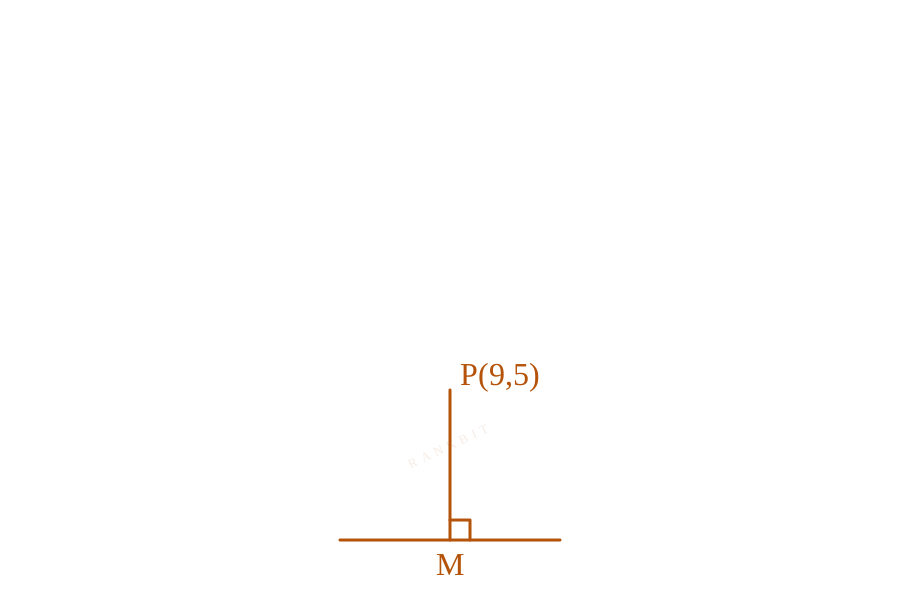
### Related Formula Sum of binomial coefficients for (x+y)^m is 2^m. Total number of terms is m + 1. Perpendicular distance formula from (x_0, y_0) to ax + by + c = 0: d = frac|ax_0 + by_0 + c|sqrta^2 + b^2 ### Core Logic The power is m = 2n - 3. Sum of coefficients = 2^2n - 3. Total terms = 2n - 2. Given Arithmetic Mean: frac2^2n - 32n - 2 = 16 implies frac2^2n - 32(n - 1) = 16 implies 2^2n - 4 = 16(n - 1) Testing integer values, n = 5 satisfies the equation perfectly since 2^6 = 64 and 16(5 - 1) = 64. ### Step 1: Determine Coordinates of Point P Substitute n = 5 into P(2n - 1, n^2 - 4n): x_0 = 2(5) - 1 = 9 y_0 = 5^2 - 4(5) = 5 Thus, P = (9, 5).
Properties of Binomial Coefficients diagram for Q54 - JEE Main 2025 Morning
### Step 2: Calculate Perpendicular Distance Find the distance from (9,5) to the line x + y - 8 = 0: d = left|frac9 + 5 - 8sqrt1^2 + 1^2right| = frac6sqrt2 = 3sqrt2 ### Pattern Recognition Binomial coefficient logic tightly constrains n to small integers. Use inspection quickly when polynomial-exponential configurations arise. ### Evaluation Rubric / Model Answer null ### Chapter Mix Class 11 Mathematics: Binomial Theorem Class 11 Mathematics: Straight Lines

Reference Study Guides

More Binomial Theorem Previous-Year Questions — Page 4

Q68 2025 Properties of Coefficients and Rational Terms
Let the coefficients of three consecutive terms T_r, T_r+1 and T_r+2 in the binomial expansion of (a+b)^12 be in a G.P. and let p be the number of all possible values of r. Let q be the sum of all rational terms in the binomial expansion of (sqrt[4]3+sqrt[3]4)^12 . Then p+q is equal to :
  • A. 283
  • B. 295
  • C. 287
  • D. 299

Solution

### Related Formula General term of binomial expansion (x + y)^n: T_k+1 = binomnk x^n-k y^k Condition for three terms A, B, C to be in G.P.: B^2 = A cdot C ### Core Logic Part 1: Coefficients of T_r, T_r+1, T_r+2 are binom12r-1, binom12r, binom12r+1. Since they are in G.P.: left[binom12rright]^2 = binom12r-1 cdot binom12r+1 fracbinom12rbinom12r-1 = fracbinom12r+1binom12r implies frac12-r+1r = frac12-rr+1 (13-r)(r+1) = r(12-r) implies 13r + 13 - r^2 - r = 12r - r^2 12r + 13 = 12r implies 13 = 0 quad (textNot possible) Thus, no real integer solution for r exists, so p = 0. ### Step 1: Calculate Rational Terms Sum q Part 2: Rational terms in expansion of (3^1/4 + 4^1/3)^12. General term: T_k+1 = binom12k (3^1/4)^12-k (4^1/3)^k = binom12k 3^frac12-k4 4^frack3 For the term to be rational, frac12-k4 and \frac{k}{3} must both be integers: - k must be a multiple of 3: k in \0, 3, 6, 9, 12\ - 12-k must be a multiple of 4, so k must be a multiple of 4: k in \0, 4, 8, 12\ The common values for k are k = 0 and k = 12. - At k = 0: T_1 = binom120 3^3 4^0 = 1 times 27 times 1 = 27 - At k = 12: T_13 = binom1212 3^0 4^4 = 1 times 1 times 256 = 256 Sum of rational terms q = 27 + 256 = 283. ### Step 2: Final Combination p + q = 0 + 283 = 283 ### Pattern Recognition To find common values for divisibility constraints, look for multiples of the least common multiple textlcm(3, 4) = 12 within the range [0, 12]. ### Evaluation Rubric / Model Answer null ### Chapter Mix Class 11 Mathematics: Binomial Theorem
Q58 2025 Number of Integral Terms
The least value of n for which the number of integral terms in the Binomial expansion of left(sqrt[3]7 + sqrt[12]11right)^n is 183, is:
  • A. 2184
  • B. 2148
  • C. 2172
  • D. 2196

Solution

### Related Formula T_r+1 = binomnr a^n-r b^r ### Core Logic The general term in the expansion is: T_r+1 = binomnr (7)^fracn-r3 (11)^fracr12 For the term to be integral, both powers fracn-r3 and fracr12 must be integers. This dictates that r must be a multiple of 12 (r = 12k, where k is a non-negative integer). ### Step 1: Setup total count equation The values r can take are 0, 12, 24, dots, 12k. The total number of terms is given as 183. Since counting starts from k=0, the maximum value of k is: k_textmax = 183 - 1 = 182 ### Step 2: Calculate minimum n The maximum index value r required to achieve this count is: r_textmax = 12 times 182 = 2184 Hence, the least value of n must be 2184 to encompass all 183 integral terms. ### Pattern Recognition Number of terms formula when tracking steps of size L: textTotal Terms = lfloor fracnL rfloor + 1. Isolate n directly to compute bounds rapidly. ### Evaluation Rubric / Model Answer null ### Chapter Mix Class 11 Mathematics: Binomial Theorem

More Binomial Theorem Questions — jee_main_2025_04_april_morning

Practice all Binomial Theorem previous-year questions →

YOUR FIRST PREP STEP STARTS HERE

We Map Every Repeating Question in Competitive Exams.

Say goodbye to generic mock test fatigue. RankBit uses smart analysis to group past exam questions into their foundational Repeating Question Types. Find chapter weightage, track repeating questions, and score higher with targeted practice.

Select Your Target Exam

Choose an exam track below to find formulas per chapter and patterns.

Syncing Exam Intelligence

Mapping formulas and patterns across all tracks…

PATH A — FULL LENGTH PRACTICE

Full Mock Test Hub

Simulate real NTA exam conditions with fully tracked mocks. Time yourself against past papers.

Under Development
PATH B — TARGETED PRACTICE

Topic-wise Practice Hub

Practice past-year questions one chapter at a time. Pick an exam → subject → chapter and get every PYQ for that topic — pulled together from all past papers — with the chapter's key formulas alongside.

Loading Questions... Browse Topics
Latest from the Blog
View all →

Loading articles...