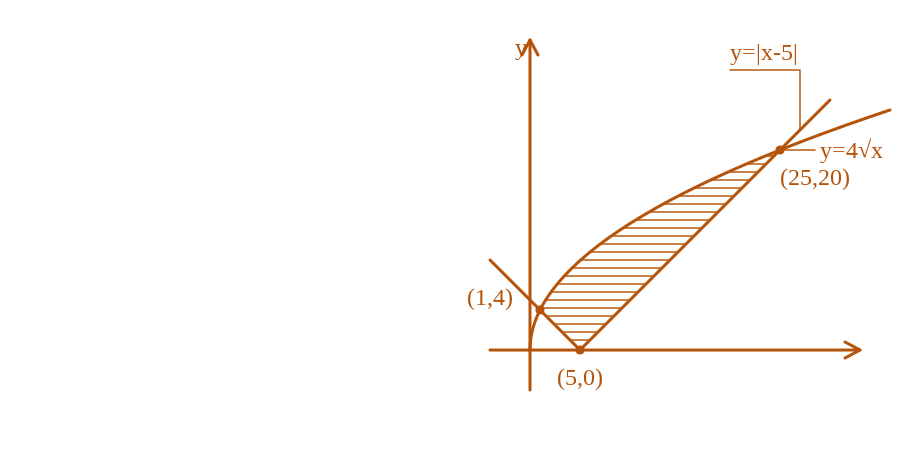
Find the intersections of y = |x - 5|$y = |x - 5|$ and y = 4√(x)$y = 4\sqrt{x}$:
Branch 1: 5 - x = 4√(x) x + 4√(x) - 5 = 0 (√(x) + 5)(√(x) - 1) = 0 x = 1, y = 4$5 - x = 4\sqrt{x} \implies x + 4\sqrt{x} - 5 = 0 \implies (\sqrt{x} + 5)(\sqrt{x} - 1) = 0 \implies x = 1, y = 4$.
Branch 2: x - 5 = 4√(x) x - 4√(x) - 5 = 0 (√(x) - 5)(√(x) + 1) = 0 x = 25, y = 20$x - 5 = 4\sqrt{x} \implies x - 4\sqrt{x} - 5 = 0 \implies (\sqrt{x} - 5)(\sqrt{x} + 1) = 0 \implies x = 25, y = 20$.
Area Bounded by Multiple Curves diagram for Q71 - JEE Main 2025 Morning
Step 1: Set Up Area Definite Integral
Split integration intervals around vertex x = 5$x = 5$ or compute via simple boundary differences:
A = ∫₁²⁵ 4√(x) dx - Area of Left Triangle - Area of Right Triangle$$A = \int_{1}^{25} 4\sqrt{x}\,\mathrm{d}x - \text{Area of Left Triangle} - \text{Area of Right Triangle}$$Area of Left Triangle = (1)/(2) × (5 - 1) × 4 = 8$$\text{Area of Left Triangle} = \frac{1}{2} \times (5 - 1) \times 4 = 8$$Area of Right Triangle = (1)/(2) × (25 - 5) × 20 = 200$$\text{Area of Right Triangle} = \frac{1}{2} \times (25 - 5) \times 20 = 200$$
Subtracting standard geometric triangles beneath linear configurations from total absolute root curves saves significant time compared to managing multiple separate analytical integral pieces.
Q5jee_main_2024_31_jan_morningArea bounded by Parabolas and Inequalities
The area of the region (x,y): y² ≤ 4x, x < 4, (xy(x - 1)(x - 2))/((x - 3)(x - 4)) > 0, x ≠ 3$\left\{(x,y): y^2 \le 4x, x < 4, \frac{xy(x - 1)(x - 2)}{(x - 3)(x - 4)} > 0, x \neq 3\right\}$ is
A.(16)/(3)$$\frac{16}{3}$$
B.(64)/(3)$$\frac{64}{3}$$
C.(8)/(3)$$\frac{8}{3}$$
D.(32)/(3)$$\frac{32}{3}$$
Solution
Core Logic
Given y² ≤ 4x$y^2 \le 4x$ and x < 4$x < 4$.
Analyze the inequality (xy(x-1)(x-2))/((x-3)(x-4)) > 0$\frac{xy(x-1)(x-2)}{(x-3)(x-4)} > 0$ considering y > 0$y > 0$ and y < 0$y < 0$ separately.
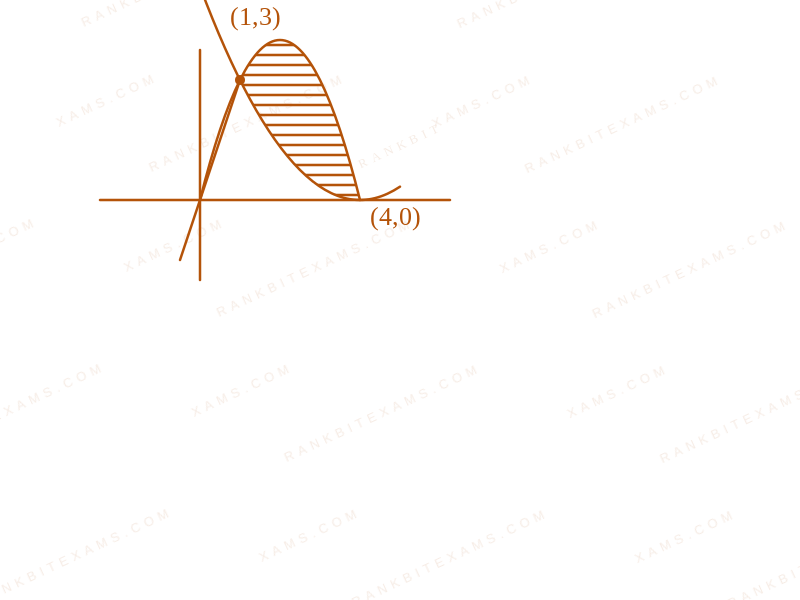
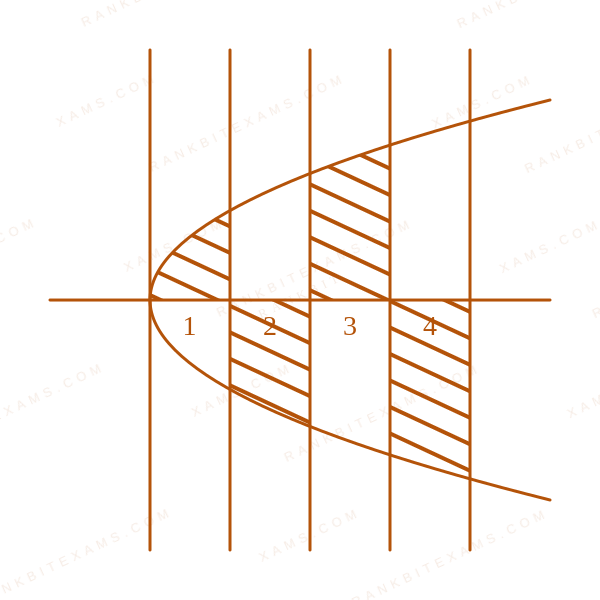
Area bounded by Parabolas and Inequalities diagram for Q5 - JEE Main 2024 Morning
Step 1: Case I (y > 0)
If y > 0$y > 0$, the inequality reduces to (x(x-1)(x-2))/((x-3)(x-4)) > 0$\frac{x(x-1)(x-2)}{(x-3)(x-4)} > 0$.
Using wavy curve method and given x in (0, 4)$x \in (0, 4)$:
x in (0, 1) (2, 3)$x \in (0, 1) \cup (2, 3)$.
Step 2: Case II (y < 0)
If y < 0$y < 0$, the inequality reduces to (x(x-1)(x-2))/((x-3)(x-4)) < 0$\frac{x(x-1)(x-2)}{(x-3)(x-4)} < 0$.
Using wavy curve method and given x in (0, 4)$x \in (0, 4)$:
x in (1, 2) (3, 4)$x \in (1, 2) \cup (3, 4)$.
Step 3: Area Computation
Because the regions map perfectly without overlap in opposite quadrants relative to the x-axis, they form complete parabolic strips when combined:
Area = 2 ∫₀⁴ √(x) dx = 2 · (2)/(3)[x3/2]₀⁴ = (4)/(3) · 8 = (32)/(3)$= 2 \int_{0}^{4} \sqrt{x} dx = 2 \cdot \frac{2}{3}[x^{3/2}]_{0}^{4} = \frac{4}{3} \cdot 8 = \frac{32}{3}$.
Chapter Mix
Class 12 Maths: Area Under Curves
Class 11 Maths: Linear Inequalities
More Area Under Curves Questions — jee_main_2025_04_april_morning
Practice past-year questions one chapter at a time. Pick an exam → subject → chapter and get every PYQ for that topic — pulled together from all past papers — with the chapter's key formulas alongside.