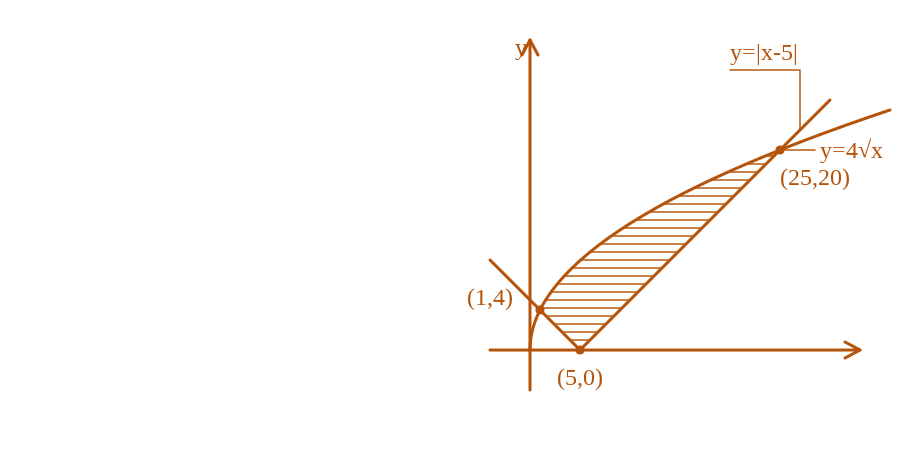
If the area of the region (x,y) : |x - 5| ≤ y ≤ 4√(x) is A, then 3A is equal to

Numerical Answer Type:
Enter a numerical value Answer: 368 to 368 +4 marks

Solution & Explanation

Related Formula

Area tracking equation via horizontal slices or split verticals:

Area = ∫x₁x₂ (yupper - ylower) dx
Core Logic

Find the intersections of y = |x - 5| and y = 4√(x): Branch 1: 5 - x = 4√(x) x + 4√(x) - 5 = 0 (√(x) + 5)(√(x) - 1) = 0 x = 1, y = 4. Branch 2: x - 5 = 4√(x) x - 4√(x) - 5 = 0 (√(x) - 5)(√(x) + 1) = 0 x = 25, y = 20.

Area Bounded by Multiple Curves diagram for Q71 - JEE Main 2025 Morning

Step 1: Set Up Area Definite Integral

Split integration intervals around vertex x = 5 or compute via simple boundary differences:

A = ∫₁²⁵ 4√(x) dx - Area of Left Triangle - Area of Right Triangle Area of Left Triangle = (1)/(2) × (5 - 1) × 4 = 8 Area of Right Triangle = (1)/(2) × (25 - 5) × 20 = 200
Step 2: Complete Computations
∫₁²⁵ 4√(x) dx = [ (8)/(3)x3/2 ]₁²⁵ = (8)/(3)(125 - 1) = (8 × 124)/(3) = (992)/(3) A = (992)/(3) - 208 = (992 - 624)/(3) = (368)/(3)

3A = 368

Pattern Recognition

Subtracting standard geometric triangles beneath linear configurations from total absolute root curves saves significant time compared to managing multiple separate analytical integral pieces.

Chapter Mix

Class 12 Mathematics: Area Under Curves

Reference Study Guides

More Area Under Curves Previous-Year Questions — Page 2

Q19 jee_main_2026_24_january_morning Area Under the Curve
Let A₁ be the bounded area enclosed by the curves y = x² + 2, x + y = 8 and y-axis that lies in the first quadrant. Let A₂ be the bounded area enclosed by the curves y = x² + 2, y² = x, x = 2, and y-axis that lies in the first quadrant. Then A₁ - A₂ is equal to
  • A. (2)/(3)(2√(2)+1)
  • B. (2)/(3)(4√(2)+1)
  • C. (2)/(3)(√(2)+1)
  • D. (2)/(3)(3√(2)+1)

Solution

Related Formula
Area = ∫ₐb (yupper - ylower) dx
Core Logic

For A₁: Intersection of y = x² + 2 and x + y = 8. x + (x² + 2) = 8 ⇒ x² + x - 6 = 0 ⇒ (x+3)(x-2) = 0. In first quadrant, x = 2. Intersection point is (2, 6).
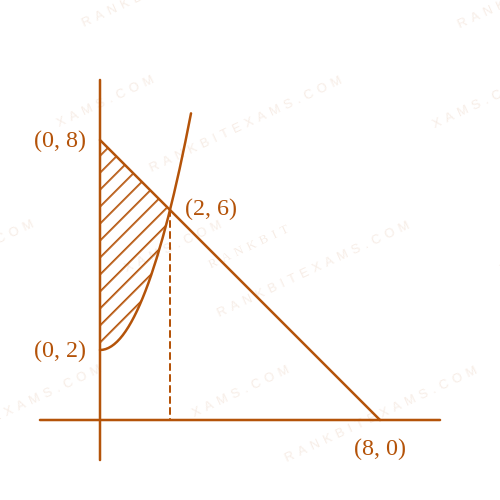
Area A1 boundaries visualization

Step 1: Calculate A1
A₁ = ∫₀² ((8 - x) - (x² + 2)) dx = ∫₀² (6 - x - x²) dx A₁ = [ 6x - (x²)/(2) - (x³)/(3) ]₀² = 12 - 2 - (8)/(3) = 10 - (8)/(3) = (22)/(3)
Step 2: Area A2 Definition

For A₂: Enclosed by y = x² + 2, y = √(x), x=2 and y-axis. Upper curve: y = x²+2, Lower curve: y = √(x).
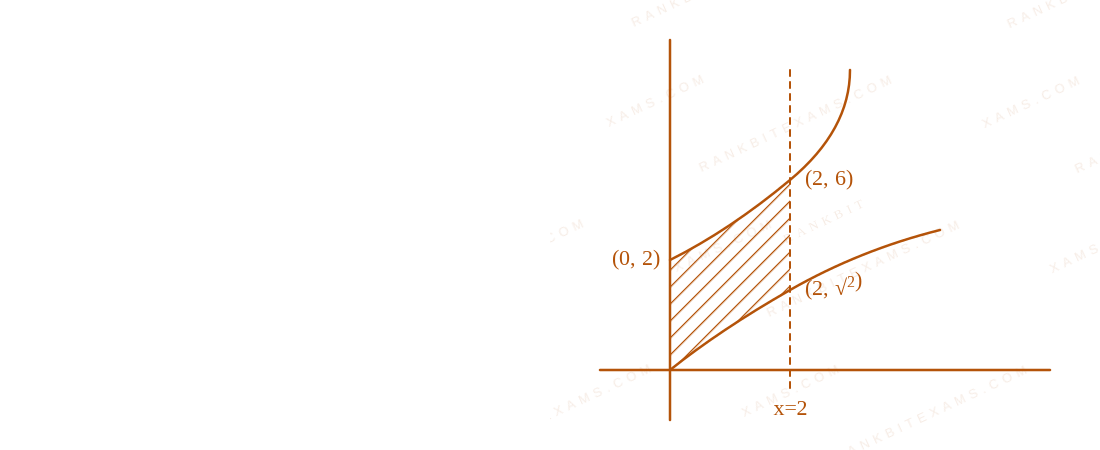
Area A1 boundaries visualization

Step 3: Calculate A2
A₂ = ∫₀² (x² + 2 - √(x)) dx A₂ = [ (x³)/(3) + 2x - x3/23/2 ]₀² A₂ = (8)/(3) + 4 - (2)/(3)(23/2) = (20)/(3) - 4√(2)3
Step 4: Difference of Areas
A₁ - A₂ = (22)/(3) - ( (20)/(3) - 4√(2)3 ) = (2)/(3) + 4√(2)3 = (2)/(3) (1 + 2√(2))
Pattern Recognition

Carefully identify the bounding regions. A₁ uses a line as the upper bound, A₂ strips away a root curve as its lower bound. Integrating separately before subtracting avoids algebraic alignment errors.

Chapter Mix

Class 12 Maths: Application of Integrals
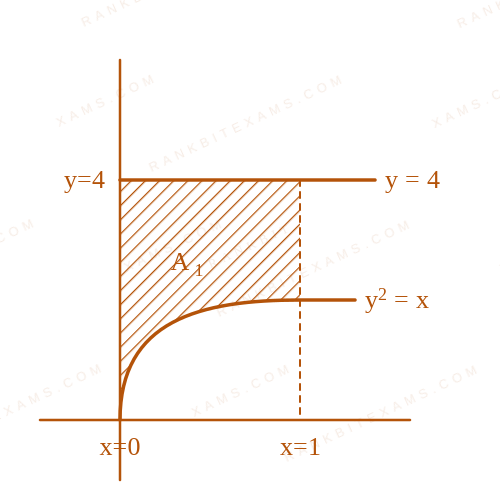
Q12 jee_main_2026_24_january_evening Area bounded by Modulus and Parabola
Let f(α) denote the area of the region in the first quadrant bounded by x = 0, x = 1, y² = x and y = |α x - 5| - |1 - α x| + α x². Then (f(0) + f(1)) is equal to
  • A. 9
  • B. 14
  • C. 7
  • D. 12

Solution

Related Formula
Area = ∫x₁x₂ (yupper - ylower) dx
Core Logic

Evaluate f(0) by setting α = 0 in the function for y.

At α = 0 y = |0· x - 5| - |1 - 0· x| + 0· x²

y = |-5| - |1| = 5 - 1 = 4

So for f(0), the bounded area A₁ is between y = 4, y = √(x), from x = 0 to x = 1.

Area bounded by Modulus and Parabola

Step 1: Calculating f(0)
A₁ = ∫₀¹ (4 - √(x)) dx = [ 4x - x3/23/2 ]₀¹ = 4(1) - (2)/(3)(1) = (10)/(3)

So, f(0) = (10)/(3).

Step 2: Determining curve for f(1)

Evaluate f(1) by setting α = 1 in the function for y.

At α = 1 y = |x - 5| - |1 - x| + x². Since the area is restricted to x in [0, 1]: x - 5 is negative, so |x - 5| = 5 - x. 1 - x is positive, so |1 - x| = 1 - x.

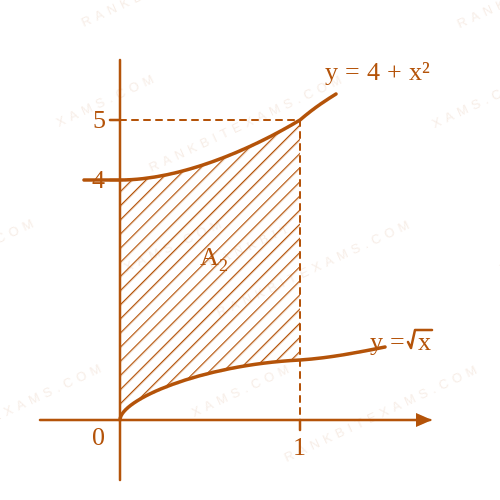
y = (5 - x) - (1 - x) + x² y = 5 - x - 1 + x + x² = 4 + x²

Area bounded by Modulus and Parabola

Step 3: Calculating f(1)

For f(1), the bounded area A₂ is between y = 4 + x² and y = √(x), from x = 0 to x = 1.

A₂ = ∫₀¹ ((4 + x²) - √(x)) dx = [ 4x + (x³)/(3) - x3/23/2 ]₀¹ = ( 4 + (1)/(3) - (2)/(3) ) = 4 - (1)/(3) = (11)/(3)

So, f(1) = (11)/(3).

Step 4: Final Sum
|f(0) + f(1)| = | A₁ + A₂ | = | (10)/(3) + (11)/(3) | = (21)/(3) = 7

Area bounded by Modulus and Parabola

Pattern Recognition

Modulus functions combined with parametric limits should be instantly resolved by plugging in the bounds of x (here [0,1]) to drop the absolute value signs before attempting any integral.

Chapter Mix

Class 12 Maths: Area Under the Curve Class 11 Maths: Modulus Function

Q13 jee_main_2026_28_january_morning Area under Curves
The area of the region R=(x,y):xy≤ 8, 1≤ y≤ x², x≥ 0 is
  • A. (1)/(3)(49 ₑ(2)-15)
  • B. (2)/(3)(20 ₑ(2)+9)
  • C. (2)/(3)(24 ₑ(2)-7)
  • D. (1)/(3)(40 ₑ(2)+27)

Solution

Core Logic

Area under Curves
Area under Curves
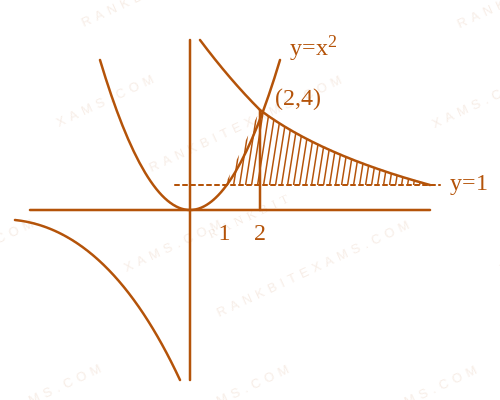
The region is bounded by three primary curves in the first quadrant (x≥0):

  • y ≥ 1 (horizontal line)
  • y ≤ x² (upward-opening parabola)
  • xy ≤ 8 y ≤ (8)/(x) (rectangular hyperbola)
  • Find points of intersection: Intersection of y = x² and y = (8)/(x):

x² = (8)/(x) x³ = 8 x = 2

At x = 2, y = 4. So they meet at (2, 4).

Intersection of y = x² and y = 1:

x² = 1 x = 1

Intersection of y = (8)/(x) and y = 1:

1 = (8)/(x) x = 8

The region spans from x = 1 to x = 8. The upper boundary changes at x = 2.

Step 1: Set up Integrals

For x in [1, 2], the upper curve is y = x² and the lower is y = 1. For x in [2, 8], the upper curve is y = (8)/(x) and the lower is y = 1.

A = ∫₁² (x² - 1) dx + ∫₂⁸ ((8)/(x) - 1) dx
Step 2: Integration

Calculate the first integral:

I₁ = [ (x³)/(3) - x ]₁² = ( (8)/(3) - 2 ) - ( (1)/(3) - 1 ) = (2)/(3) - (-(2)/(3)) = (4)/(3)

Calculate the second integral:

I₂ = [ 8 ln x - x ]₂⁸ = (8 ln 8 - 8) - (8 ln 2 - 2)

Since ln 8 = 3 ln 2:

I₂ = 24 ln 2 - 8 - 8 ln 2 + 2 = 16 ln 2 - 6

Total Area A:

A = (4)/(3) + 16 ln 2 - 6 = 16 ln 2 - (14)/(3) A = (48 ln 2 - 14)/(3) = (2)/(3)(24 ln 2 - 7)
Chapter Mix

Class 12 Mathematics: Application of Integrals

Q11 jee_main_2026_28_january_evening Area Bounded by Parabolas and Lines
Let P₁: y = 4x² and P₂: y = x² + 27 be two parabolas. If the area of the bounded region enclosed between P₁ and P₂ is six times the area of the bounded region enclosed between the line y = α x, α > 0 and P₁, then α is equal to:
  • A. 8
  • B. 15
  • C. 12
  • D. 6

Solution

Related Formula

Area enclosed by y = f(x) and y = g(x) from x=a to x=b:

A = ∫ₐ^b |f(x) - g(x)| dx

Area between x² = 4ay and line x = my is (8a²)/(3m³).

Core Logic

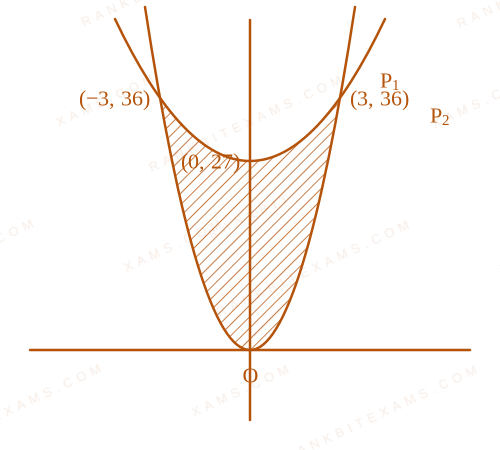
Find Points of Intersection for P₁ and P₂:

4x² = x² + 27 ⇒ 3x² = 27 ⇒ x = ± 3

Parabolas intersection bounds

Area bounded between P₁ and P₂:

A₁ = ∫₋₃³ ((x² + 27) - 4x²) dx = 2 ∫₀³ (27 - 3x²) dx A₁ = 2 [27x - x³]₀³ = 2(81 - 27) = 108 sq. units
Execution

Area between P₁ and y = α x is given as 108 / 6 = 18 sq. units. For x² = 4ay and x = my, area is (8a²)/(3m³). Here, the parabola is x² = (y)/(4) and line is x = (y)/(α). Thus, 4a = (1)/(4) ⇒ a = (1)/(16), and m = (1)/(α).

Parabolas intersection bounds

Applying the formula:

(8(1/16)²)/(3(1/α)³) = 18 (8 / 256)/(3 / α³) = 18 ⇒ (α³)/(96) = 18 α³ = 18 × 96 = 1728

α = 12

Pattern Recognition

Using the standard result (8a²)/(3m³) for the area bounded between x²=4ay and x=my avoids tedious integration for straight lines intersecting parabolas at the origin.

Chapter Mix

Class 12 Maths: Application of Integrals

Q73 jee_main_2025_02_april_morning Area Between Curves
If the area of the region (x, y): | 4 - x ^ 2 | ≤ y ≤ x ^ 2, y ≤ 4, x ≥ 0 is ( 80√(2)α - β), α, β in N, then α + β is equal to ________.
Numerical Answer. Answer: 22 to 22

Solution

Related Formula

Area bounded by functions integrated with respect to y axis:

Area = ∫cd (xright - xleft) dy
Core Logic

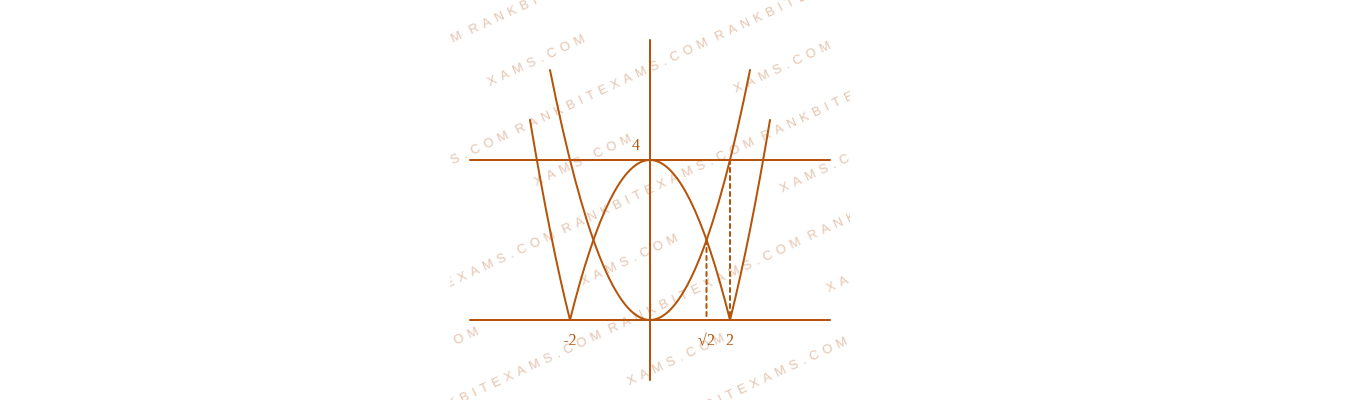
Identify the bounding graphs and intersection coordinates in the first quadrant, then construct standard definite integrals along the vertical axis.

Area Between Curves diagram for Q73 - JEE Main 2025 Morning

Step 1: Unpack Bounding Curves

The condition |4-x²| ≤ y splits into two sections at x=2:

  • For 0 ≤ x ≤ 2 4 - x² ≤ y x² ≥ 4 - y x = √(4-y)
  • For x ≥ 2 x² - 4 ≤ y x² ≤ 4 + y x = √(4+y)
  • Also bounded by y ≤ x² x ≥ √(y), and the outer cap constraint y ≤ 4.

Step 2: Construct the Integral Area Formula

Integrating with respect to y covers the region bounded on the left by √(y) and √(4-y), and on the right by √(4+y):

A = ∫₀⁴ √(4+y) dy - ∫₀² √(4-y) dy - ∫₂⁴ √(y) dy
Step 3: Evaluate the Definite Integrals
A = [ (4+y)3/23/2 ]₀⁴ + [ (4-y)3/23/2 ]₀² - [ y3/23/2 ]₂⁴

Evaluating these values precisely:

A = (2)/(3)(83/2 - 43/2) + (2)/(3)(23/2 - 43/2) - (2)/(3)(43/2 - 23/2) A = 80√(2)3 - 16
Step 4: Solve for Constants

Compare the final value expression to ( 80√(2)α - β):

α = 3, β = 16 α + β = 3 + 16 = 22
Pattern Recognition

Integrating along the vertical axis (y-direction) is significantly faster here because it avoids splitting the domain across multiple vertical segments on the horizontal x-axis.

Chapter Mix

Class 12 Mathematics: Application of Integrals

More Area Under Curves Questions — jee_main_2025_04_april_morning

Practice all Area Under Curves previous-year questions →

Rankbit System
JEE Physics: Waves (+15.5%) | Electrostatics: Concentric Shells (-29.7%) | Modern Physics: Photoelectric Clones (+34.2%) | Mathematics: Definite Integrals (+18.1%) | Chemistry: Coordination Splitting (-11.4%) | JEE Physics: Waves (+15.5%) | Electrostatics: Concentric Shells (-29.7%) | Modern Physics: Photoelectric Clones (+34.2%) | Mathematics: Definite Integrals (+18.1%) | Chemistry: Coordination Splitting (-11.4%)