JEE Main · Chemistry ↑ Rising

Hydrocarbons appeared 35 times across 3 years — 4.1% of Chemistry. This question is from Free Radical Bromination.

Year 2026 2025 2024 Total
Questions 14 12 9 35

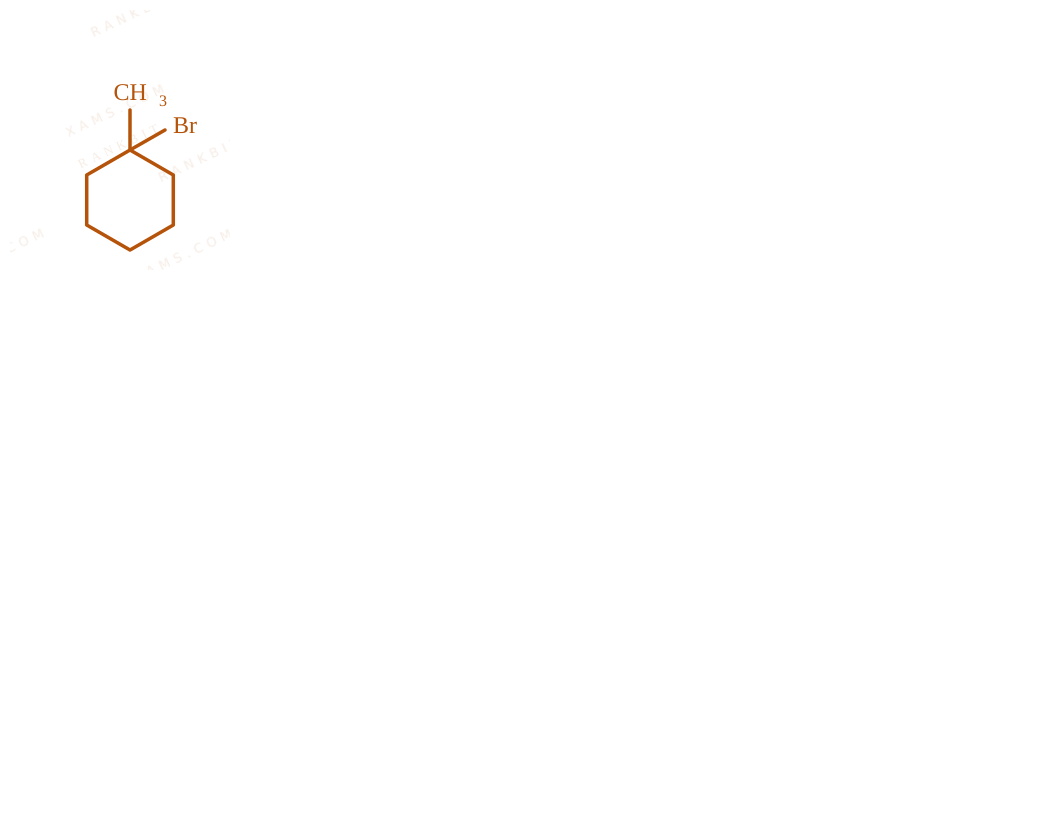
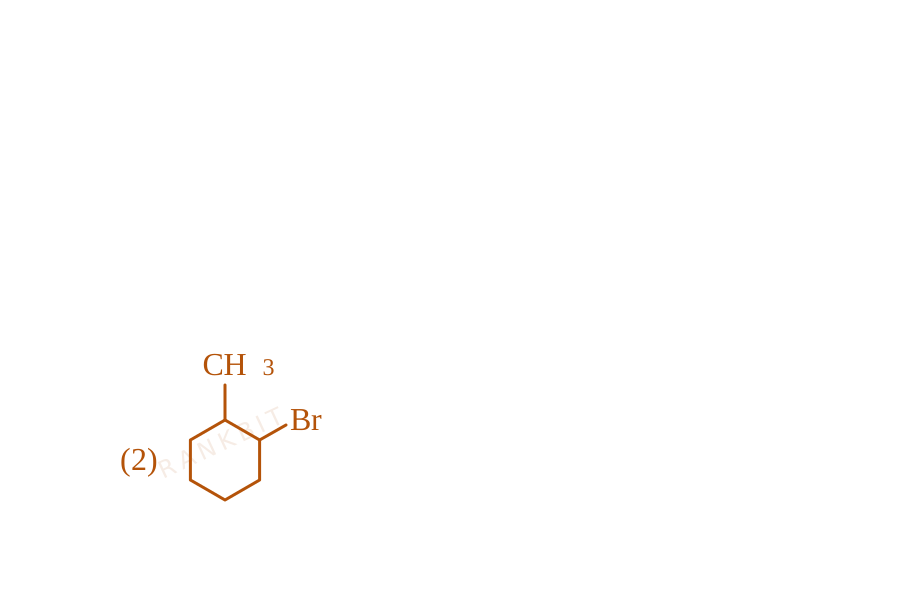
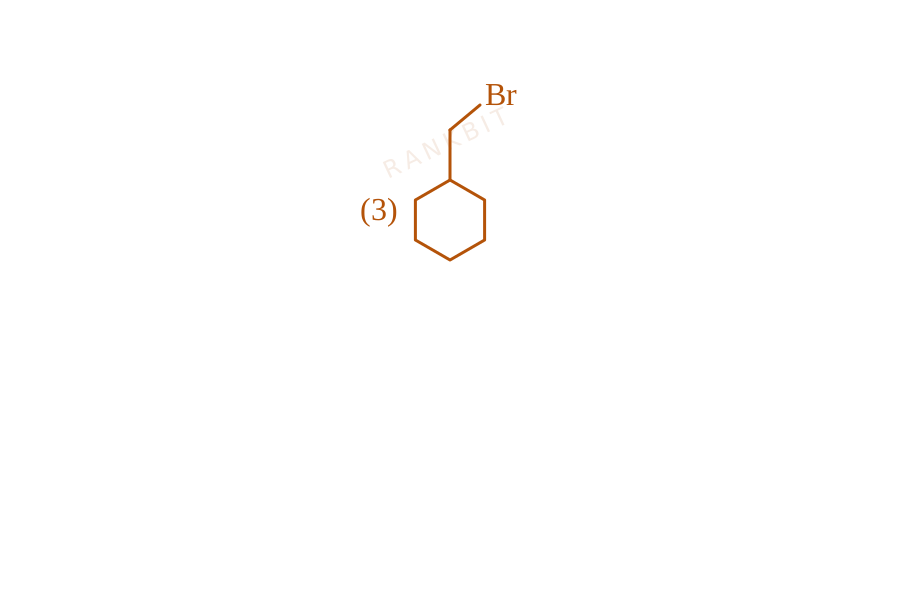
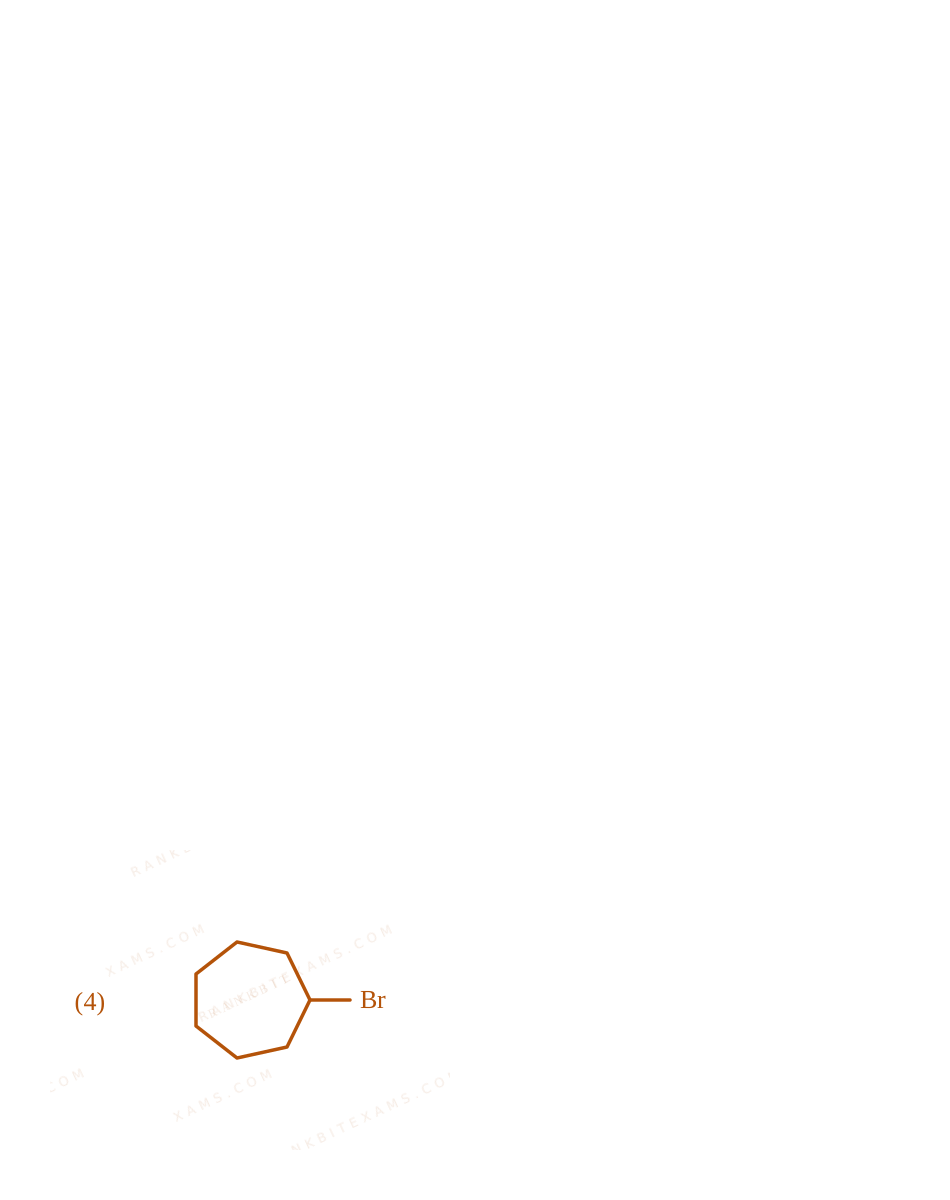
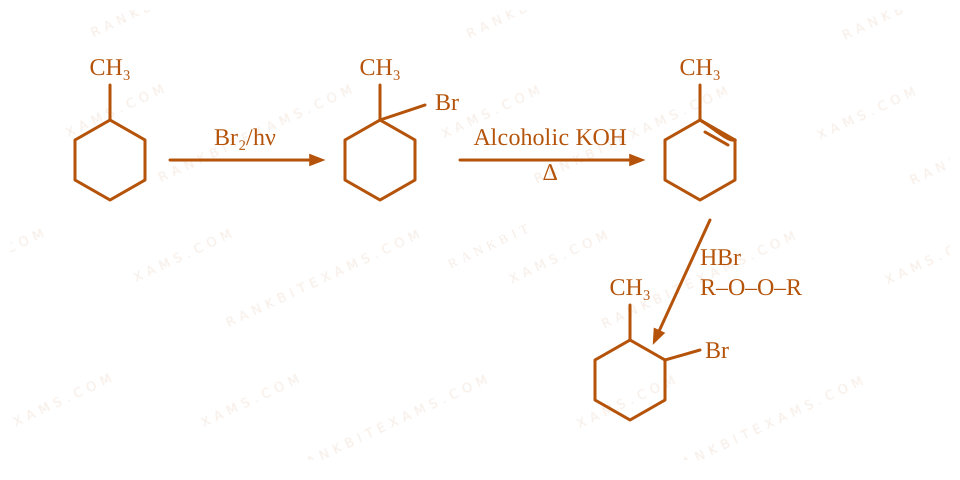
Predict the major product of the following reaction sequence:
Alkyl radical halogenation flowchart matrix for Q42 - JEE Main 2025 Morning
The sequence pathways specify Br2/hv free radical substitution, alcoholic KOH elimination, and HBr/peroxide addition.

Solution & Explanation

Core Logic

Let's analyze the steps of the reaction sequence:

  • Step 1 (Br₂ / hν): Light-induced free radical substitution targeted at the most stable tertiary position, producing 1-bromo-1-methylcyclohexane.
  • Step 2 (Alcoholic KOH, Δ): Dehydrohalogenation occurs via an E2 mechanism. Following Saytzeff's rule, elimination favors the formation of the more highly substituted, stable alkene: 1-methylcyclohexene.
  • Step 3 (HBr / R-O-O-R, hν): Radical hydrobromination across the unsymmetrical alkene. The presence of peroxide shifts addition toward the Anti-Markovnikov path, placing the bromine atom cleanly at the less-substituted secondary carbon to yield 1-bromo-2-methylcyclohexane.
Pattern Recognition

Combining Saytzeff elimination with a peroxide-promoted HBr addition allows you to reposition functional groups from highly substituted tertiary carbons to adjacent secondary positions.

Chapter Mix

Class 11 Chemistry: Hydrocarbons Class 12 Chemistry: Haloalkanes and Haloarenes

Detailed mechanism scheme tracing intermediates for Q42
The sequence pathways specify Br2/hv free radical substitution, alcoholic KOH elimination, and HBr/peroxide addition.

More Hydrocarbons Previous-Year Questions — Page 6

Q29 jee_main_2025_28_jan_evening Alkyne Reactions and Ozonolysis
Identify product [A], [B] and [C] in the following reaction sequence : CH₃-C≡ CH Pd/CH₂arrow[A] (i)O₃(ii)Zn,H₂Oarrow[B]+[C]
  • A. [A]:CH₃-CH=CH₂, [B]: CH₃CHO, [C]: HCHO
  • B. [A]: CH₂=CH₂, [B]: H₃C-CO-CH₃, [C]: HCHO
  • C. [A]:CH₃-CH=CH₂, [B]: CH₃CHO, [C]: CH₃CH₂OH
  • D. [A]: CH₃CH₂CH₃, [B]: CH₃CHO, [C]: HCHO

Solution

Related Formula

Partial hydrogenation of alkynes using Pd/C yields alkenes:

R-C≡ CH + H₂ Pd/C R-CH=CH₂

Ozonolysis cleaves the double bond to form carbonyls:

R-CH=CH₂ (i)O₃, (ii)Zn/H₂O R-CHO + HCHO
Core Logic

Step 1: Controlled reduction of propyne gives propene:

CH₃-C≡ CH Pd/C, H₂ CH₃-CH=CH₂ [A]

Step 2: Reductive ozonolysis of propene ([A]) splits the alkene at the C=C bond, creating ethanal ([B]) and methanal ([C]):

CH₃-CH=CH₂ O₃, then Zn/H₂O CH₃CHO [B] + HCHO [C]
Step 1: Final Identification

Hence, [A] = CH₃-CH=CH₂ [B] = CH₃CHO [C] = HCHO

Pattern Recognition

Whenever an alkyne undergoes partial hydrogenation with regular catalysts, count the carbons to trace the matching alkene framework. Cleaving a terminal alkene like propene always results in formaldehyde (HCHO) as one of the fragment products.

Chapter Mix

Class 11 Chemistry: Hydrocarbons
Q jee_main_2024_29_january_evening Markovnikov Addition Reactions
Which of the following reaction is correct?
  • A.
  • B.
  • C.
  • D.

Solution

Related Formula
Alkene + HX arrow Alkyl Halide (Markovnikov's Rule)
Core Logic

The reaction involving the addition of HI to the double bond follows electrophilic addition mechanism governed by Markovnikov's rule. The proton adds to the less substituted carbon to generate the more stable tertiary carbocation intermediate, which is then attacked by I^- to yield the corresponding major tertiary alkyl iodide.

Step 1: Verification of Choices

Option (2) perfectly captures the sound execution of Markovnikov addition mechanics whereas the remaining choices present invalid product distributions or faulty reaction stoichiometry templates.

Pattern Recognition

Electrophilic addition cleanly forms the most substituted, most stable carbocation before halide attack takes place.

Chapter Mix

Class 11 Chemistry: Hydrocarbons

Q jee_main_2024_29_jan_morning Addition Reactions of Alkenes
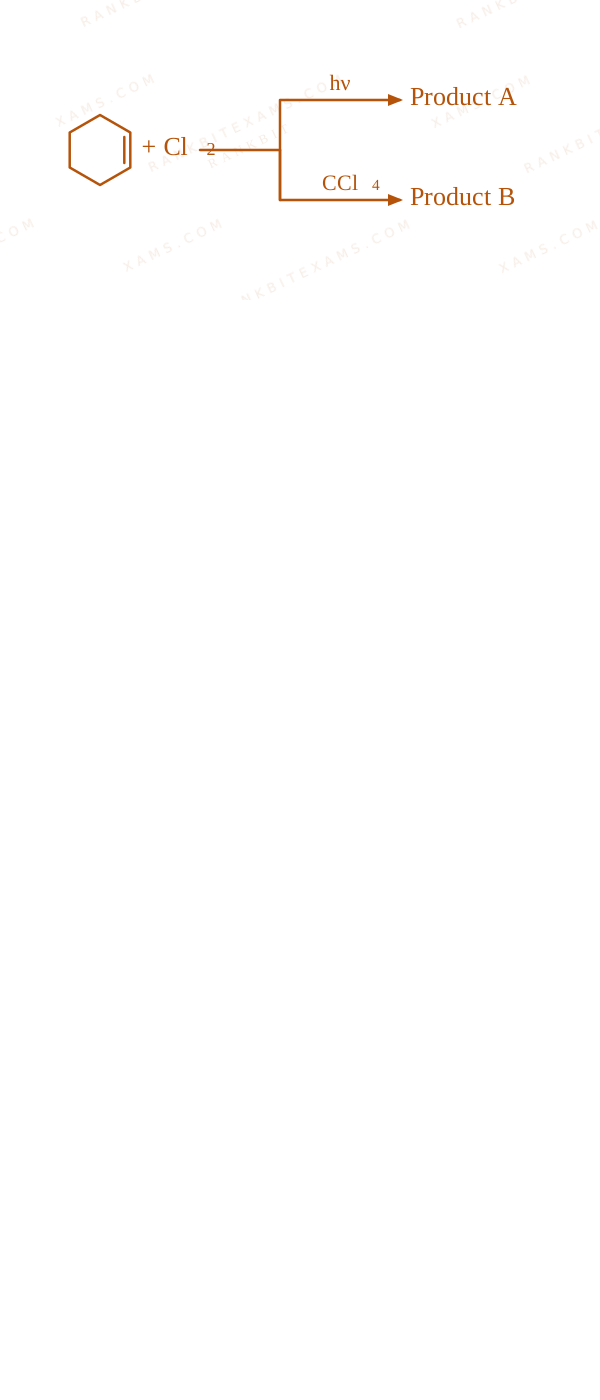
Identify product A and product B :
Addition Reactions of Alkenes diagram for Q71 - JEE Main 2024 Morning
Cyclohexene undergoing chlorination under two different conditions: light (hv) and dark with CCl4 solvent.
  • A.
  • B.
  • C.
  • D.

Solution

Core Logic

The substrate is cyclohexene, which can undergo two distinct types of reactions with chlorine (Cl₂) depending on the reaction conditions.

Reaction 1: Condition hv (Product A) In the presence of light (hν) or high temperature, halogens undergo homolytic cleavage to generate free radicals. This triggers allylic substitution (a free radical substitution mechanism). The allylic position is targeted because the resulting allylic free radical is resonance stabilized. Thus, substitution occurs at the carbon adjacent to the double bond, yielding 3-chlorocyclohexene as Product A.

Reaction 2: Condition CCl₄ (Product B) In the presence of a non-polar solvent like CCl₄ and without light/heat, Cl₂ undergoes an electrophilic addition reaction across the carbon-carbon double bond. A cyclic chloronium ion intermediate is formed, leading to anti-addition of two chlorine atoms. This yields 1,2-dichlorocyclohexane as Product B.

Step 1: Structures of A and B

Addition Reactions of Alkenes diagram for Q71 - JEE Main 2024 Morning
Cyclohexene undergoing chlorination under two different conditions: light (hv) and dark with CCl4 solvent.

Product A preserves the double bond and substitutes a Cl at the allylic position. Product B loses the double bond and adds two Cl atoms adjacently.

Pattern Recognition

X₂ + light (hν) = Free radical Allylic Substitution. X₂ + dark/solvent (CCl₄) = Electrophilic Addition across double bond.

Chapter Mix

Class 11 Chemistry: Hydrocarbons Class 12 Chemistry: Haloalkanes and Haloarenes

Q jee_main_2024_29_jan_morning Reactions of Alkenes Ozonolysis
Consider the given reaction. CH₃-CH=C(CH₃)₂ [(ii) Zn/H₂O](i) O₃ (P) The total number of oxygen atoms present per molecule of the product (P) is
Numerical Answer. Answer: 1 to 1

Solution

Core Logic

The reaction given is the reductive ozonolysis of an alkene, 2-methylbut-2-ene (CH₃-CH=C(CH₃)₂).

In reductive ozonolysis (O₃ followed by Zn/H₂O), the carbon-carbon double bond is completely cleaved. An oxygen atom is placed on each carbon atom of the broken double bond to form carbonyl compounds (aldehydes or ketones).

Step 1: Identifying the Products
CH₃-CH=C(CH₃)₂ O₃ / Zn, H₂O CH₃-CHO + O=C(CH₃)₂

The reaction yields two distinct product molecules:

  • Acetaldehyde (CH₃CHO) - contains 1 oxygen atom.
  • Acetone (CH₃COCH₃) - contains 1 oxygen atom.
  • The question asks for the number of oxygen atoms present per molecule of the product (P). Since any resulting product molecule (either acetaldehyde or acetone) contains exactly 1 oxygen atom, the answer is 1.

Pattern Recognition

Reductive ozonolysis of a simple alkene without other oxygenated functional groups always creates simple aldehydes or ketones. Each resulting discrete molecule formed from the cleaved double bond will have exactly 1 carbonyl group (1 oxygen atom) unless it's a cyclic alkene opening up (which would have 2).

Chapter Mix

Class 11 Chemistry: Hydrocarbons Class 12 Chemistry: Aldehydes Ketones and Carboxylic Acids

Q77 jee_main_2024_30_jan_morning Alkynes
Compound A formed in the following reaction reacts with B gives the product C. Find out A and B. CH₃-C≡ CH + Na arrow A B CH₃-C≡ C-CH₂-CH₂-CH₃ + NaBr
  • A. A=CH₃-C≡ C^-Na^+, B=CH₃-CH₂-CH₂-Br
  • B. A=CH₃-CH=CH₂, B=CH₃-CH₂-CH₂-Br
  • C. A=CH₃-CH₂-CH₃, B=CH₃-C≡ CH
  • D. A=CH₃-C≡ C^-Na^+, B=CH₃-CH₂-CH₃

Solution

Core Logic

Terminal alkynes possess acidic hydrogen. When treated with a strong base or active metal like Sodium (Na), they form sodium acetylide salts. CH₃-C≡ C-H + Na arrow CH₃-C≡ C^-Na^+ + (1)/(2)H₂ So, A is Sodium propynide (CH₃-C≡ C^-Na^+).

Step 1: Analyzing the second step

The product is CH₃-C≡ C-CH₂-CH₂-CH₃. This indicates an SN2 substitution reaction between the acetylide ion (nucleophile) and an alkyl halide (electrophile). Since NaBr is a byproduct, B must be a propyl bromide. CH₃-C≡ C^-Na^+ + CH₃-CH₂-CH₂-Br arrow CH₃-C≡ C-CH₂-CH₂-CH₃ + NaBr

Step 2: Conclusion

A is CH₃-C≡ C^-Na^+ and B is CH₃-CH₂-CH₂-Br (1-Bromopropane).

Chapter Mix

Class 11 Chemistry: Hydrocarbons Class 12 Chemistry: Haloalkanes and Haloarenes

Rankbit System
JEE Physics: Waves (+15.5%) | Electrostatics: Concentric Shells (-29.7%) | Modern Physics: Photoelectric Clones (+34.2%) | Mathematics: Definite Integrals (+18.1%) | Chemistry: Coordination Splitting (-11.4%) | JEE Physics: Waves (+15.5%) | Electrostatics: Concentric Shells (-29.7%) | Modern Physics: Photoelectric Clones (+34.2%) | Mathematics: Definite Integrals (+18.1%) | Chemistry: Coordination Splitting (-11.4%)