Rankbit System
JEE Physics: Waves (+15.5%) | Electrostatics: Concentric Shells (-29.7%) | Modern Physics: Photoelectric Clones (+34.2%) | Mathematics: Definite Integrals (+18.1%) | Chemistry: Coordination Splitting (-11.4%) | JEE Physics: Waves (+15.5%) | Electrostatics: Concentric Shells (-29.7%) | Modern Physics: Photoelectric Clones (+34.2%) | Mathematics: Definite Integrals (+18.1%) | Chemistry: Coordination Splitting (-11.4%)

One mole of an ideal gas expands isothermally and reversibly from 10mathrm~dm^3 to 20mathrm~dm^3 at 300mathrm~K. Delta U, q and work done in the process respectively are: Given: R = 8.3mathrm~J~K^-1~mol^-1, ln 10 = 2.3, log 2 = 0.30, log 3 = 0.48

Solution & Explanation

### Related Formula Delta U = n C_v Delta T w = -n R T lnleft(fracV_2V_1right) Delta U = q + w ### Core Logic Since the expansion step is strictly **isothermal** (Delta T = 0): Delta U = 0 Now compute the work command parameter w: w = -n R T lnleft(fracV_2V_1right) = -1 cdot 8.3 cdot 300 cdot lnleft(frac2010 ight) w = -2490 cdot ln(2) = -2490 cdot (2.3 cdot log 2) w = -2490 cdot (2.3 cdot 0.30) = -2490 cdot 0.69 = -1718.1mathrm~J = -1.718mathrm~kJ Applying the first law equation constraint: q = -w = +1.718mathrm~kJ Hence, Delta U = 0, q = 1.718mathrm~kJ, w = -1.718mathrm~kJ. ### Pattern Recognition Isothermal expansion of an ideal gas ALWAYS yields Delta U = 0. Work is negative (done by system) and heat exchange q matches work magnitude inversely. ### Evaluation Rubric / Model Answer null ### Chapter Mix Class 11 Chemistry: Chemical Thermodynamics

Reference Study Guides

More Chemical Thermodynamics Previous-Year Questions — Page 3

Q28 2025 Lattice Enthalpy and Born-Haber Cycle
The hydration energies of textK^+ and textCl^- are -textx and -textytext kJ/mol respectively. If lattice energy of textKCl is -textztext kJ/mol, then the heat of solution of textKCl is:
  • A. +textx - texty - textz
  • B. textx + texty + textz
  • C. textz - (textx + texty)
  • D. -textz - (textx + texty)

Solution

### Related Formula Delta H_textsol = textLattice Energy (L.E.) + Delta H_texthyd(textCation) + Delta H_texthyd(textAnion) ### Core Logic According to Hess's Law, the dissolution process can be mapped as follows:
Lattice Enthalpy and Born-Haber Cycle diagram for Q28 - JEE Main 2025 Evening
Given parameters: - Lattice Energy of textKCl breaking into gaseous ions = -(-textz) = textztext kJ/mol (since lattice energy released on formation is given as -textz). - Hydration energy of textK^+ = -textxtext kJ/mol - Hydration energy of textCl^- = -textytext kJ/mol ### Step 1: Computation Substituting the values into the governing formulation: Delta H_textsol = textz + (-textx) + (-texty) Delta H_textsol = textz - textx - texty = textz - (textx + texty) ### Pattern Recognition To dissolve an ionic crystal, energy equal to the lattice energy must be supplied (endothermic step, +textz), and hydration releases energy (exothermic steps, -textx and -texty). Net heat of solution is simply the sum of these parts: textz - textx - texty. ### Evaluation Rubric / Model Answer null ### Chapter Mix Class 11 Chemistry: Chemical Thermodynamics Class 11 Chemistry: Chemical Bonding and Molecular Structure
Q33 2025 Standard Enthalpy of Formation
The correct statement amongst the following is:
  • A. textThe term 'standard state' implies that the temperature is 0^circtextC
  • B. textThe standard state of pure gas is the pure gas at a pressure of 1 bar and temperature 273 K
  • C. DeltatextftextH298^thetatext is zero for O(g)
  • D. DeltatextftextH500^thetatext is zero for O2(g)

Solution

### Related Formula DeltatextfH^theta = 0 quad textfor an element in its reference/most stable standard state ### Core Logic - Standard state conditions prescribe a pressure of 1text bar. Temperature is not fixed by definition but is explicitly specified (often reference tables use 298.15text K). - Oxygen naturally and stably exists as diatomic gas molecules (textO_2(g)) at standard thresholds. - The enthalpy of formation of an element in its reference elemental state is identically zero at any reference temperature: DeltatextfH_500^theta[textO2(g)] = 0 Conversely, atomic oxygen gas (textO(g)) is not the reference phase, so its formation enthalpy is non-zero. ### Step 1: Verification of Options Statement (4) accurately aligns with thermodynamic core definitions, while statement (1) and (2) mistakenly conflate standard ambient reference states with STP conditions (273.15text K, 1text atm). ### Pattern Recognition Standard state definitions checklist: Pressure = 1text bar. Temperature is variable/assigned independently. Elements in their most stable natural form take DeltatextfH^theta = 0 at all thermal profiles. ### Evaluation Rubric / Model Answer null ### Chapter Mix Class 11 Chemistry: Chemical Thermodynamics
Q33 2025 Spontaneity and Gibbs Energy Change
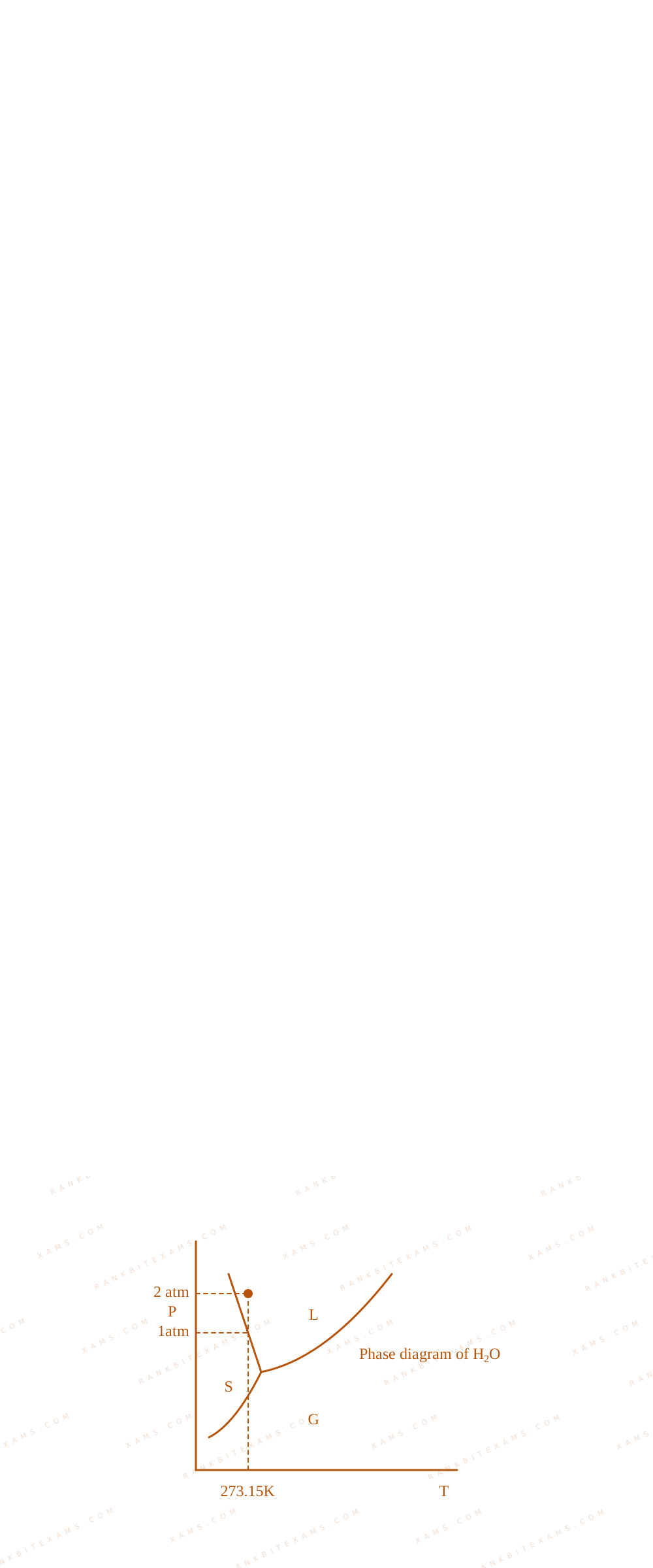
Let us consider an endothermic reaction which is non-spontaneous at the freezing point of water. However, the reaction is spontaneous at boiling point of water. Choose the correct option.
  • A. Both Delta H and Delta S are (+ve)
  • B. Delta H is (-ve) but Delta S is (+ve)
  • C. Delta H is (+ve) but Delta S is (-ve)
  • D. Both Delta H and Delta S are (-ve)

Solution

### Related Formula Delta G = Delta H - TDelta S ### Core Logic An endothermic profile specifies that Delta H > 0. For the system to become spontaneous (Delta G < 0) specifically when shifting to higher temperatures (T), the temperature-dependent entropic subtraction term (-TDelta S) must outweigh the enthalpic barrier. This transition demands a positive structural entropy step, i.e., Delta S > 0. Hence, both Delta H and Delta S are positive. ### Pattern Recognition Spontaneity driven purely by elevated thermal thresholds mandates matching positive signs for enthalpy and entropy. ### Evaluation Rubric / Model Answer null ### Chapter Mix Class 11 Chemistry: Chemical Thermodynamics
Q47 2025 Gibbs Free Energy and Equilibrium Temperature
Standard entropies of mathrmX_2, mathrmY_2 and mathrmXY_5 are 70, 50 and 110 mathrm~J mathrm~K^-1 mathrm~mol^-1 respectively. The temperature in Kelvin at which the reaction frac 12 mathrm X _ 2 + frac 52 mathrm Y _ 2 rightarrow mathrm X Y _ 5 quad Delta mathrm H ^ circ = - 3 5 mathrm k J mathrm m o l ^ - 1 will be at equilibrium is (Nearest integer)
Numerical Answer. Answer: 700 to 700

Solution

### Related Formula Delta S_textrxn^0 = sum S_textproducts^0 - sum S_textreactants^0 quad textand quad T = fracDelta H^0Delta S^0 quad textat equilibrium (Delta G^0 = 0text) ### Core Logic First, calculate the standard entropy change for the reaction system (Delta S_textrxn^0): Delta S_textrxn^0 = S^0(XY_5) - left[ frac12S^0(X_2) + frac52S^0(Y_2) right] Delta S_textrxn^0 = 110 - left[ left(frac12 times 70right) + left(frac52 times 50right) right] = 110 - [35 + 125] Delta S_textrxn^0 = 110 - 160 = -50text J K^-1text mol^-1 At thermodynamic equilibrium, the change in Gibbs free energy drops to zero (Delta G^0 = 0): 0 = Delta H^0 - TDelta S^0 implies T = fracDelta H^0Delta S^0 Convert the enthalpy value into Joules (Delta H^0 = -35 times 10^3text J/mol) and substitute the parameters: T = frac-35000text J mol^-1-50text J K^-1text mol^-1 = 700text Kelvin ### Pattern Recognition Ensure all variables use matching energy units (Joules vs. Kilojoules) before setting up your final division step. ### Evaluation Rubric / Model Answer null ### Chapter Mix Class 11 Chemistry: Chemical Thermodynamics

More Chemical Thermodynamics Questions — jee_main_2025_04_april_morning

Practice all Chemical Thermodynamics previous-year questions →

YOUR FIRST PREP STEP STARTS HERE

We Map Every Repeating Question in Competitive Exams.

Say goodbye to generic mock test fatigue. RankBit uses smart analysis to group past exam questions into their foundational Repeating Question Types. Find chapter weightage, track repeating questions, and score higher with targeted practice.

Select Your Target Exam

Choose an exam track below to find formulas per chapter and patterns.

Syncing Exam Intelligence

Mapping formulas and patterns across all tracks…

PATH A — FULL LENGTH PRACTICE

Full Mock Test Hub

Simulate real NTA exam conditions with fully tracked mocks. Time yourself against past papers.

Under Development
PATH B — TARGETED PRACTICE

Topic-wise Practice Hub

Practice past-year questions one chapter at a time. Pick an exam → subject → chapter and get every PYQ for that topic — pulled together from all past papers — with the chapter's key formulas alongside.

Loading Questions... Browse Topics
Latest from the Blog
View all →

Loading articles...