An organic compound (X) with molecular formula C₃H₆O$C_3H_6O$ is not readily oxidised. On reduction it gives C₃H₈O$C_3H_8O$ (Y) which reacts with HBr$HBr$ to give a bromide (Z) which is converted to Grignard reagent. This Grignard reagent on reaction with (X) followed by hydrolysis gives 2, 3-dimethylbutan-2-ol. Compounds (X), (Y) and (Z) respectively are:
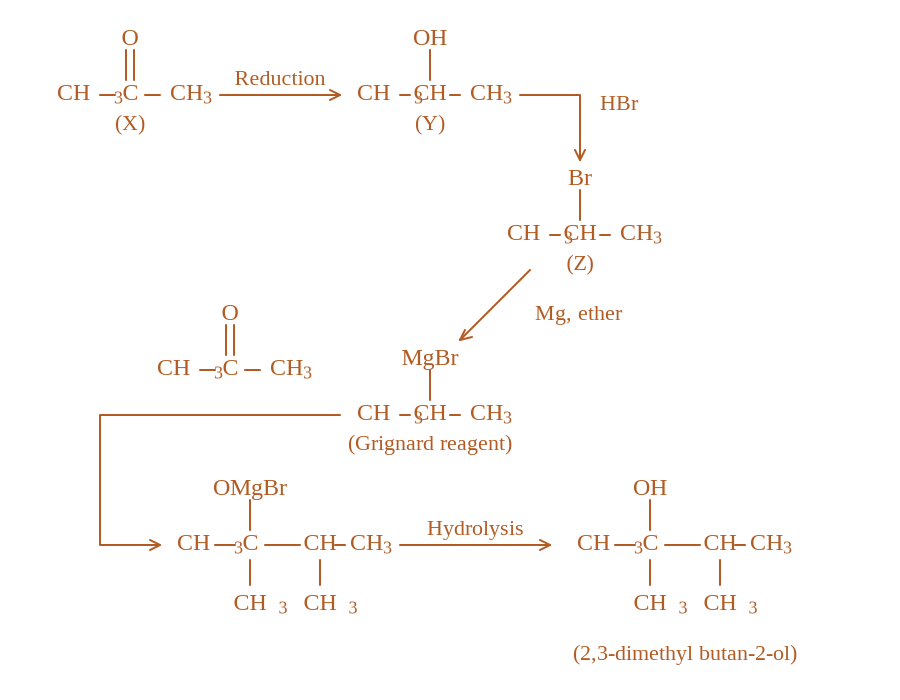
Compound (X) has the formula C₃H₆O$C_3H_6O$ and is resistant to mild oxidation, which identifies it as a ketone: Acetone (CH₃COCH₃$CH_3COCH_3$).
Reduction of Acetone yields a secondary alcohol, Propan-2-ol (CH₃CH(OH)CH₃$CH_3CH(OH)CH_3$, Compound Y).
Treatment of Propan-2-ol with HBr$HBr$ substitutes the hydroxyl group to form 2-Bromopropane (CH₃CH(Br)CH₃$CH_3CH(Br)CH_3$, Compound Z).
Reacting 2-Bromopropane with Magnesium in ether creates the branched Grignard reagent, Isopropylmagnesium bromide ((CH₃)₂CHMgBr$(CH_3)_2CHMgBr$).
Finally, nucleophilic addition of this Grignard reagent to Acetone followed by aqueous workup yields the highly branched tertiary alcohol: 2,3-dimethylbutan-2-ol.
Pattern Recognition
Resistance to mild oxidation immediately distinguishes ketones from isomeric aldehydes. Nucleophilic addition of an isopropyl Grignard to acetone cleanly yields the 2,3-dimethylbutan-2-ol framework.
Chapter Mix
Class 12 Chemistry: Aldehydes, Ketones and Carboxylic Acids
Class 12 Chemistry: Alcohols, Phenols and Ethers
Grignard reaction pathways structural connectivity diagram for Q41
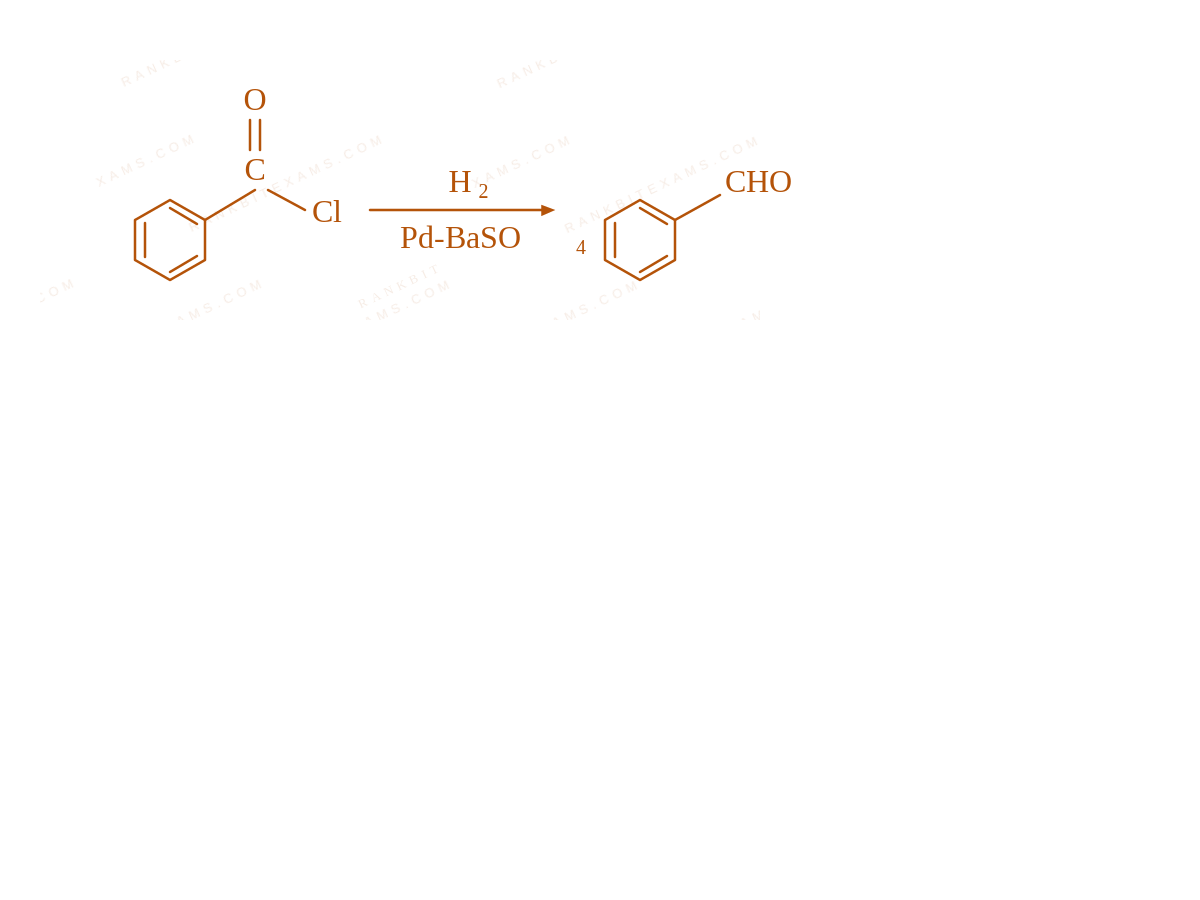
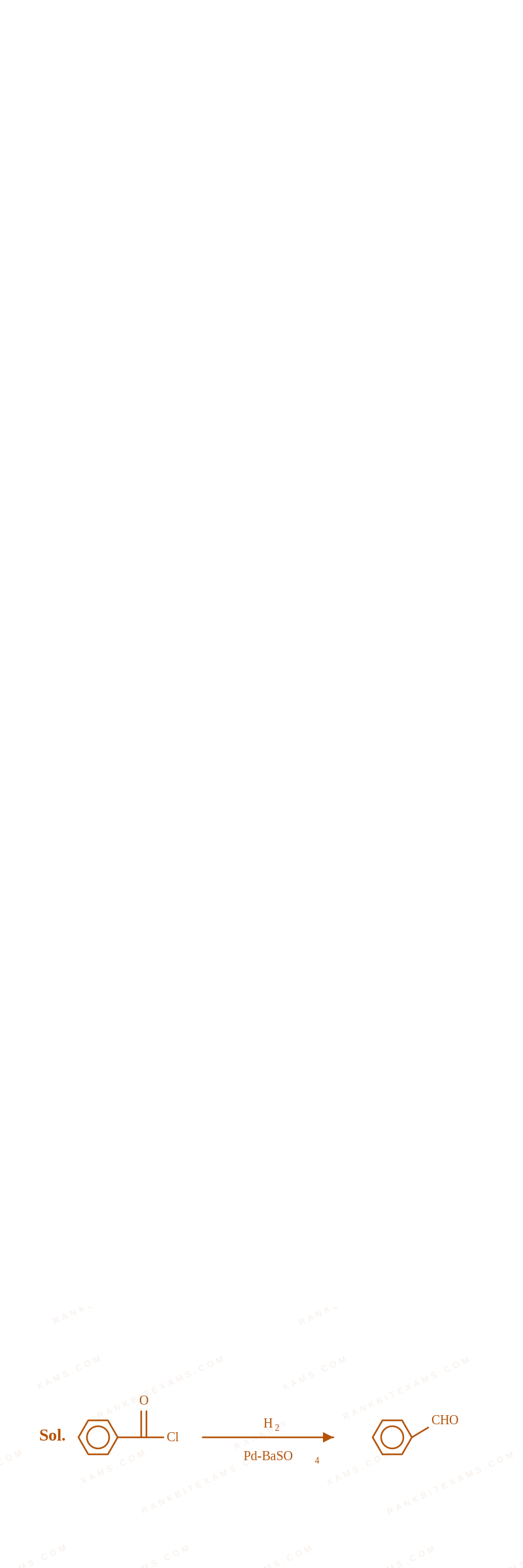
The reaction depicts the partial reduction of an acid chloride (benzoyl chloride) to an aldehyde (benzaldehyde) using hydrogen gas in the presence of a poisoned palladium catalyst (Pd supported on BaSO₄$BaSO_4$).
The image shows the catalytic hydrogenation of benzoyl chloride to benzaldehyde in the presence of Pd-BaSO4.
This specific reaction is known as the Rosenmund reduction.
Pattern Recognition
Acid Chloride + H₂, Pd/BaSO₄$H_2, Pd/BaSO_4$arrow$\rightarrow$ Aldehyde is strictly the Rosenmund reduction. The BaSO₄$BaSO_4$ poisons the catalyst to prevent over-reduction to an alcohol.
Chapter Mix
Class 12 Chemistry: Aldehydes, Ketones and Carboxylic Acids
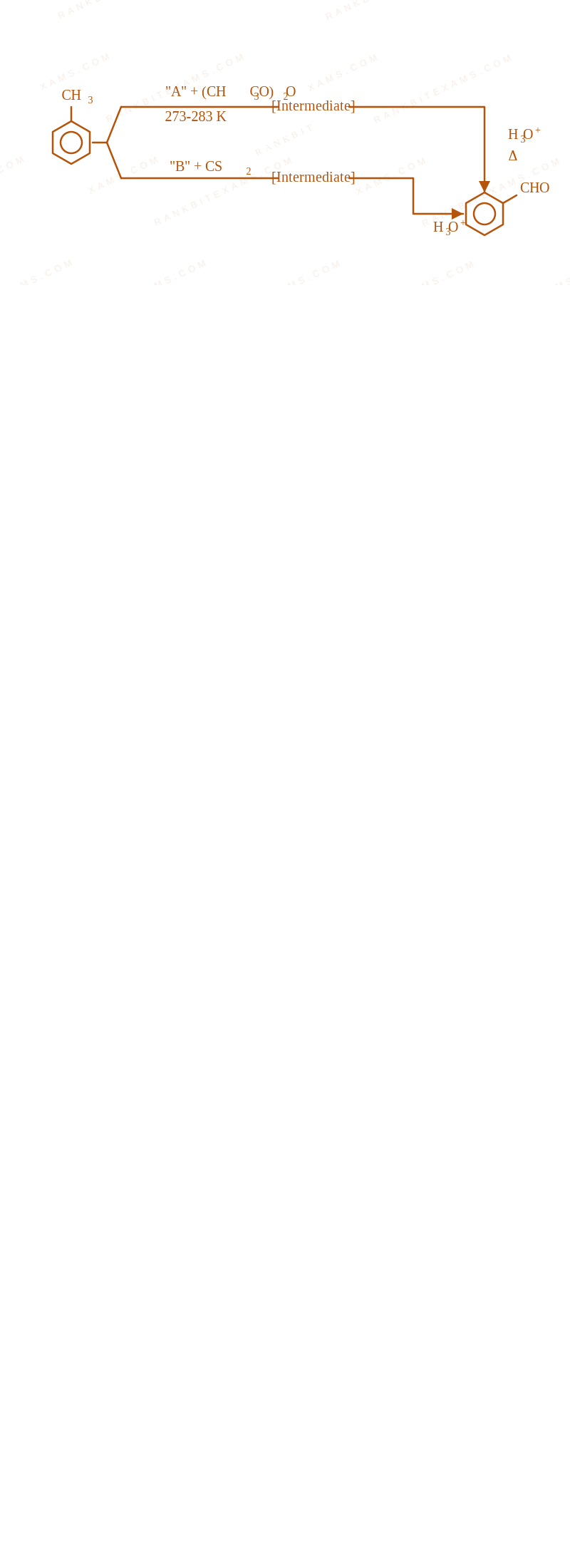
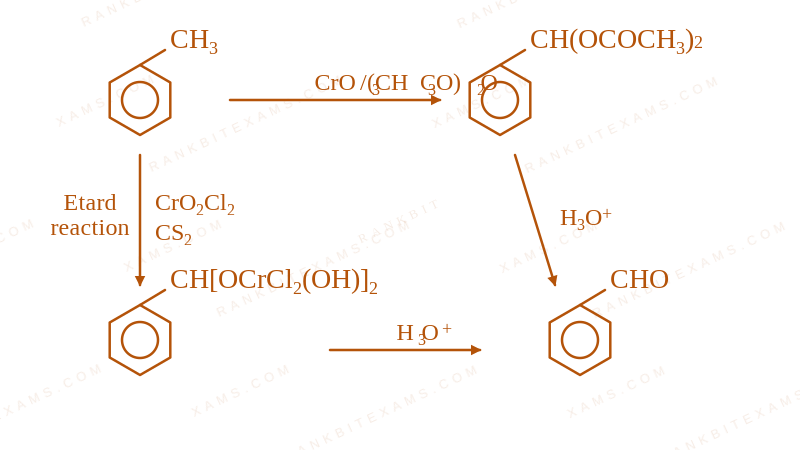
Pathway 1 (Upper): Toluene is treated with Reagent 'A' and acetic anhydride (CH₃CO)₂O$(CH_3CO)_2O$ to form an intermediate (benzylidene diacetate), which on hydrolysis gives benzaldehyde. The reagent used here is Chromic oxide (CrO₃$CrO_3$). Thus, A is CrO₃$CrO_3$.
Pathway 2 (Lower): Toluene is treated with Reagent 'B' in CS₂$CS_2$ to form a chromium complex intermediate, which on hydrolysis yields benzaldehyde. This is the Etard reaction, and the reagent used is Chromyl chloride (CrO₂Cl₂$CrO_2Cl_2$). Thus, B is CrO₂Cl₂$CrO_2Cl_2$.
The image shows the oxidation of toluene to benzaldehyde via two different pathways requiring reagents A and B.
Step 1: Selection
Therefore, A = CrO₃$CrO_3$ and B = CrO₂Cl₂$CrO_2Cl_2$.
Pattern Recognition
Etard reaction always uses Chromyl chloride (CrO₂Cl₂$CrO_2Cl_2$). Oxidation of toluene with acetic anhydride uses Chromic acid (CrO₃$CrO_3$). Both stop the oxidation at the aldehyde stage via intermediate formation.
Chapter Mix
Class 12 Chemistry: Aldehydes, Ketones and Carboxylic Acids
Ethanal (CH₃CHO$CH_3CHO$) reacts with semicarbazide (H₂N-NH-CO-NH₂$H_2N-NH-CO-NH_2$) via nucleophilic addition followed by elimination of water to form a semicarbazone.
Step 1: Product Analysis
The product is Ethanal semicarbazone: CH₃-CH=N-NH-CO-NH₂$CH_3-CH=N-NH-CO-NH_2$.
Counting the nitrogen atoms in this structure:
The imine nitrogen (=N-$=N-$)
The amine nitrogen (-NH-$-NH-$)
The amide nitrogen (-NH₂$-NH_2$)
Total = 3 Nitrogen atoms.
Chapter Mix
Class 12 Chemistry: Aldehydes, Ketones and Carboxylic Acids
Qjee_main_2024_31_jan_eveningPreparation of Aldehydes and Ketones
Identify the name reaction.
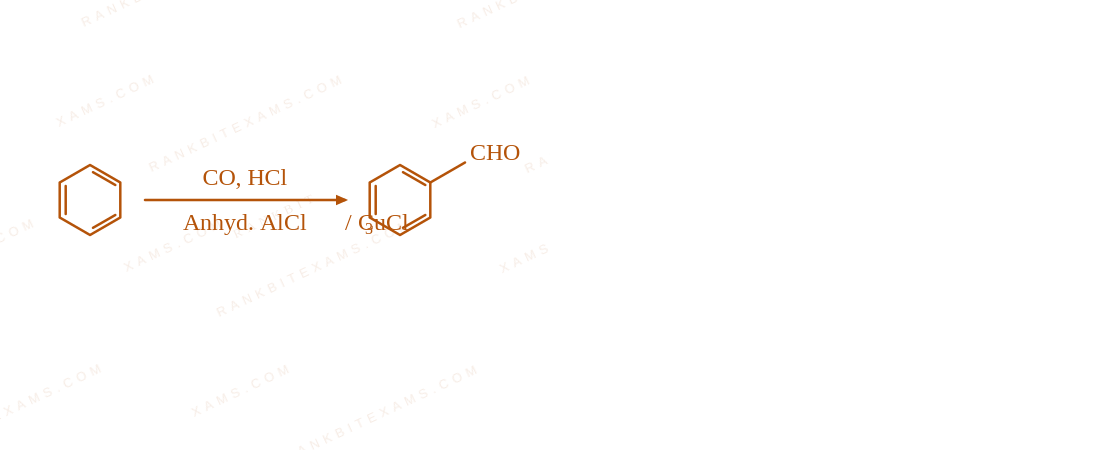
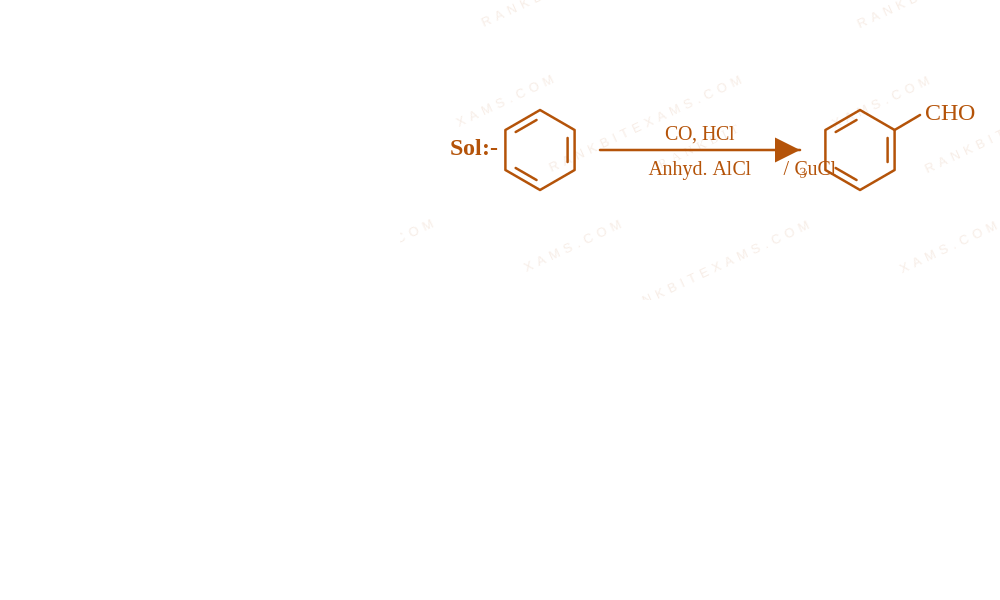
The image shows the conversion of benzene to benzaldehyde using CO, HCl, and Anhydrous AlCl3/CuCl.
The reaction of benzene with carbon monoxide (CO$CO$) and hydrogen chloride (HCl$HCl$) in the presence of anhydrous aluminium chloride (AlCl₃$AlCl_3$) and cuprous chloride (CuCl$CuCl$) to give benzaldehyde is known as the Gatterman-Koch reaction.
The image shows the conversion of benzene to benzaldehyde using CO, HCl, and Anhydrous AlCl3/CuCl.
Pattern Recognition
CO + HCl arrow$CO + HCl \rightarrow$ Formyl chloride intermediate (in situ) with Lewis acid arrow$\rightarrow$ formylation of benzene. This is definitively the Gatterman-Koch formylation.
Chapter Mix
Class 12 Chemistry: Aldehydes, Ketones and Carboxylic Acids
More Aldehydes, Ketones and Carboxylic Acids Questions — jee_main_2025_04_april_morning
Practice past-year questions one chapter at a time. Pick an exam → subject → chapter and get every PYQ for that topic — pulled together from all past papers — with the chapter's key formulas alongside.