A solid sphere with uniform density and radius R is rotating initially with constant angular velocity (ω₁) about its diameter. After some time during the rotation its starts loosing mass at a uniform rate, with no change in its shape. The angular velocity of the sphere when its radius becomes R / 2 is xω₁. The value of x is ________.

Numerical Answer Type:
Enter a numerical value Answer: 32 to 32 +4 marks

Solution & Explanation

Related Formula

Conservation of Angular Momentum (since no external torque acts):

I₁ ω₁ = I₂ ω₂

For a solid sphere, moment of inertia is:

I = (2)/(5)MR²

Mass scales with volume: M ∝ R³

Core Logic

When the radius reduces to R₂ = (R)/(2), the mass scales cubically:

M₂ = M₁ ((R/2)/(R))³ = (M₁)/(8)

Now, compute the new moment of inertia I₂:

I₂ = (2)/(5) M₂ R₂² = (2)/(5) ((M₁)/(8)) ((R)/(2))² = (2)/(5) M₁ R² × (1)/(32) = (I₁)/(32)
Step 1: Compute Final Angular Velocity

Using conservation of angular momentum:

I₁ ω₁ = ((I₁)/(32)) ω₂ ω₂ = 32 ω₁

Hence, the value of x is 32.

Pattern Recognition

Since inertia of a solid sphere scales with M R² and M ∝ R³, the net moment of inertia scales with R⁵. Shrinking the radius by half (1/2) cuts down inertia by a factor of (1/2)⁵ = 1/32. Velocity must scale up by 32 to conserve momentum.

Chapter Mix

Class 11 Physics: Rotational Motion

Reference Study Guides

More Rotational Motion Previous-Year Questions — Page 2

Q49 jee_main_2026_22_january_morning Moment of Inertia of Circular Discs
A circular disc has radius R₁ and thickness T₁. Another circular disc made of the same material has radius R₂ and thickness T₂. If the moment of inertia of both discs are same and R₁R₂ = 2 then T₁T₂ = (1)/(α). The value of α is \_\_\_\_.
Numerical Answer. Answer: 16 to 16

Solution

Related Formula
I = (mR²)/(2), m = π R² T ρ
Core Logic

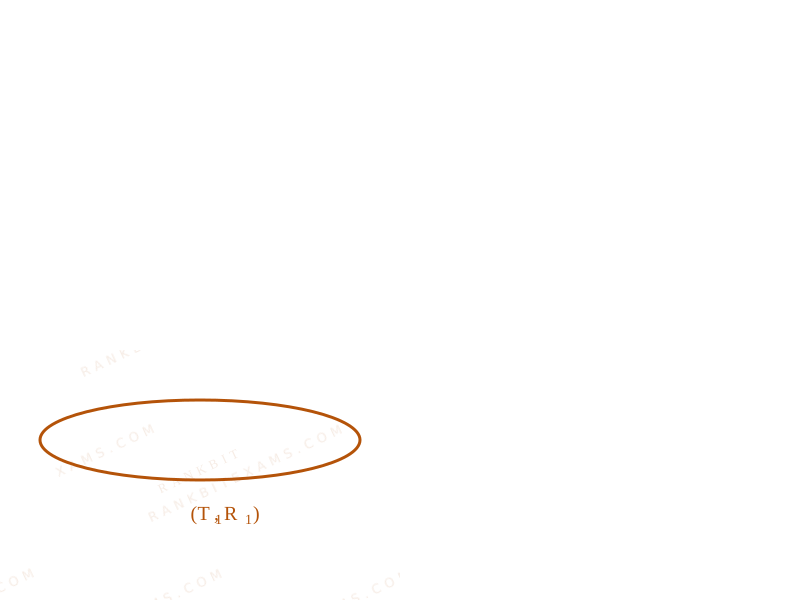
Solution disc moment of inertia diagram for Q49 - JEE Main 2026 Morning

Mass of discs:

m₁ = π R₁² T₁ ρ, m₂ = π R₂² T₂ ρ

Moments of inertia:

I₁ = (m₁ R₁²)/(2), I₂ = (m₂ R₂²)/(2)

Equating I₁ = I₂:

(π R₁² T₁ ρ R₁²)/(2) = (π R₂² T₂ ρ R₂²)/(2) (T₁)/(T₂) = ((R₂)/(R₁))⁴ = ((1)/(2))⁴ = (1)/(16)

Therefore, α = 16.

Pattern Recognition

Sees: Equal moment of inertia for two discs of different radii and thicknesses. Shortcut: Equate mR² expressions and substitute radius ratio (R₁)/(R₂) = 2. Check: Numerical answer is 16. ✓

Chapter Mix

Class 11 Physics: Rotational Motion
Q29 jee_main_2026_22_january_evening Angular Momentum Conservation
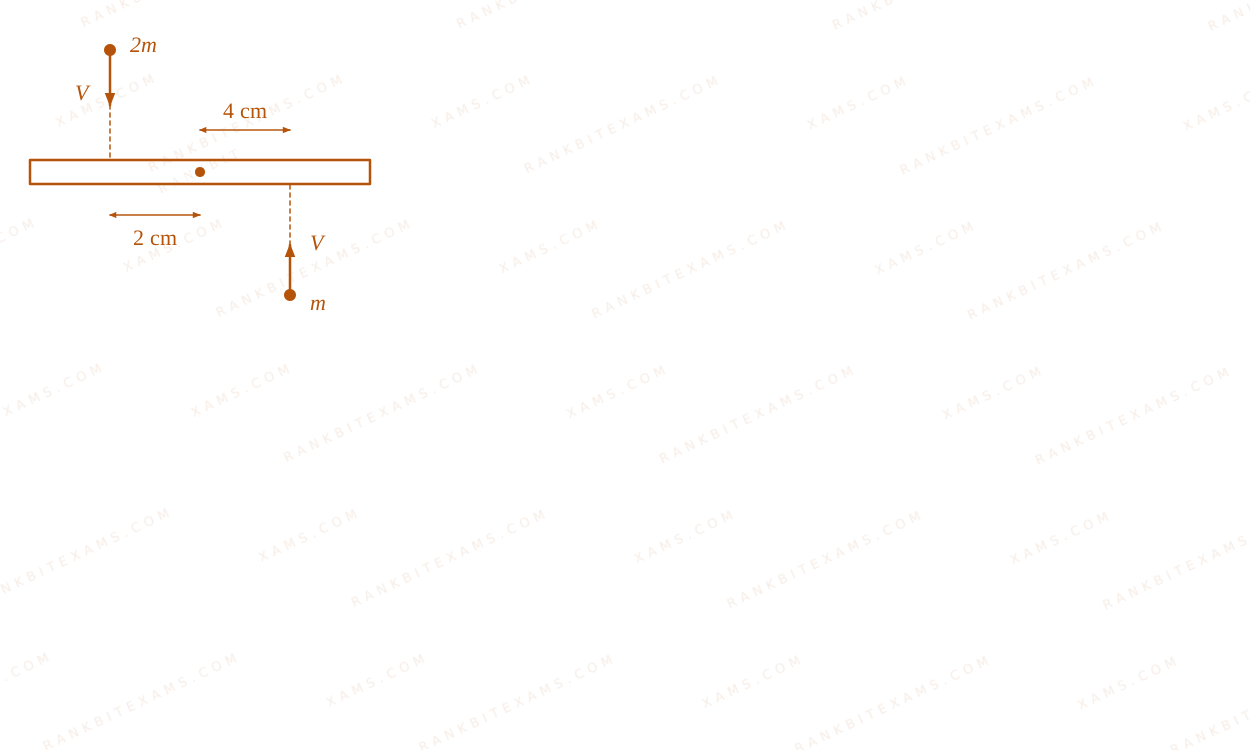
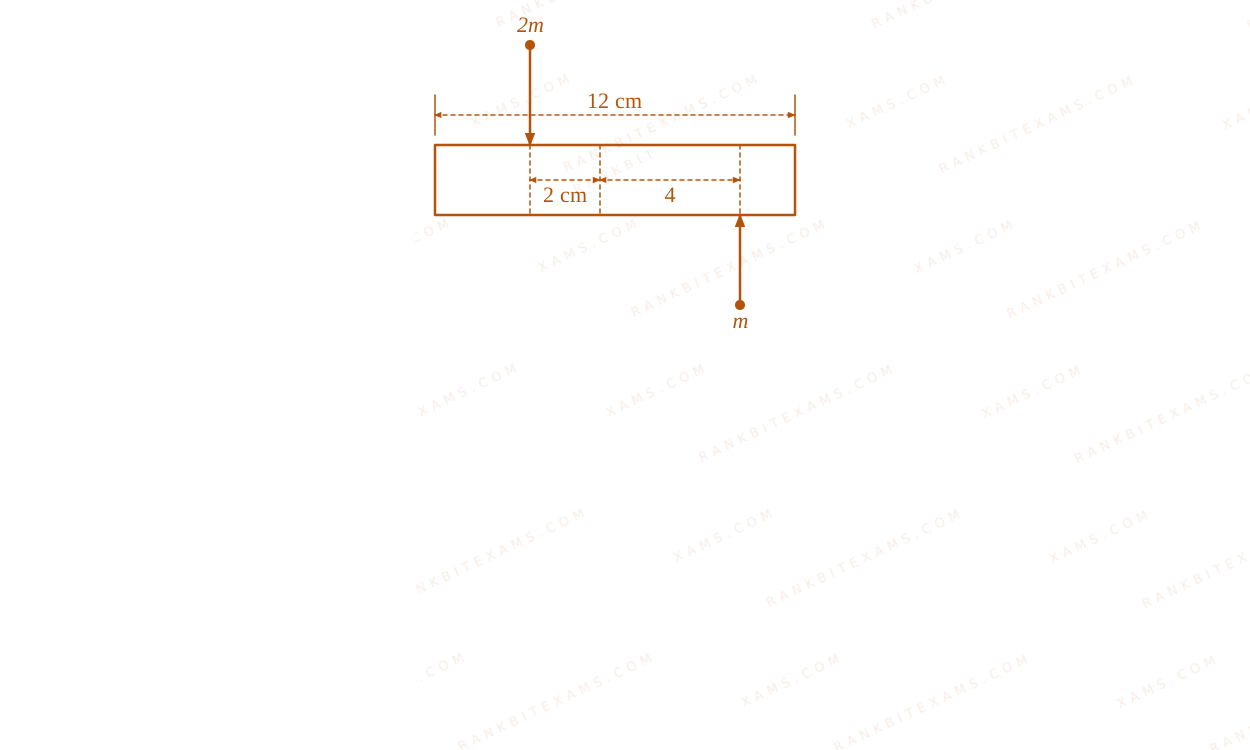
A uniform bar of length 12 cm and mass 20 m lies on a smooth horizontal table. Two point masses m and 2 m are moving in opposite directions with same speed of v and in the same plane as the bar, as shown in figure. These masses strike the bar simultaneously and get stuck to it. After collision the entire system is rotating with angular frequency ω. The ratio of v and ω is :
Angular momentum collision diagram for Q29 - JEE Main 2026 Evening
The figure illustrates a uniform bar of length 12 cm with two point masses m and 2m approaching it perpendicularly from opposite directions.
  • A. 33
  • B. 2√(88)
  • C. 66
  • D. 32

Solution

Related Formula

Lᵢ = Lf

I = M Lbar²12 + Σ mᵢ rᵢ²
Core Logic

Applying angular momentum conservation about the center of mass of the rod:

Lᵢ = m · v · 4 + 2m · v · 2

Calculating total moment of inertia Ifinal after collision:

Ifinal = ( (20m(12)²)/(12) + m(4)² + 2m(2)² ) Ifinal = (240m + 16m + 8m) = 264m

Equating initial and final angular momentum:

4mv + 4mv = 264m · ω 8v = 264 ω (v)/(ω) = (264)/(8) = 33

Rotational dynamics post-collision diagram for Q29 - JEE Main 2026 Evening
The figure illustrates a uniform bar of length 12 cm with two point masses m and 2m approaching it perpendicularly from opposite directions.

Step 1: Final Conclusion

The ratio (v)/(ω) is 33.

Pattern Recognition

Collision on rotating bar: Conserve angular momentum about COM of rod since net external torque about COM is zero during collision.

Chapter Mix

Class 11 Physics: System of Particles and Rotational Motion

Q45 jee_main_2026_22_january_evening Kinetic Energy of Multi-Particle Systems
Given below are two statements : Statement I : For a mechanical system of many particles total kinetic energy is the sum of kinetic energies of all the particles. Statement II : The total kinetic energy can be the sum of kinetic energy of the center of mass w.r.t. to the origin and the kinetic energy of all the particles w.r.t. the center of mass as the reference. In the light of the above statements, choose the correct answer from the options given below :
  • A. Both Statement I and Statement II are true
  • B. Statement I is true but Statement II is false
  • C. Statement I is false but Statement II is true
  • D. Both Statement I and Statement II are false

Solution

Related Formula
Ktotal = Σ (1)/(2) mᵢ vᵢ² Ktotal = (1)/(2) Mtotal vcm² + Krel, cm
Core Logic

Evaluating Statement I: By definition, total kinetic energy of a discrete system of particles is scalar sum of kinetic energies of individual particles: KE = Σ (1)/(2)mᵢ vᵢ². Statement I is true.

Evaluating Statement II: According to König's theorem, total kinetic energy breaks down into kinetic energy of COM translation plus internal kinetic energy relative to COM:

KE = (1)/(2)(m₁+m₂) vcm² + (1)/(2) (m₁ m₂)/(m₁+m₂) | v₁ - v₂|²

Statement II is also true.

Step 1: Final Conclusion

Both Statement I and Statement II are true.

Pattern Recognition

König's Theorem for system of particles: Ktotal = Kcm + Kw.r.t cm. Both definitions represent valid expressions for mechanical energy.

Chapter Mix

Class 11 Physics: System of Particles and Rotational Motion

Q47 jee_main_2026_22_january_evening Pulley-Mass System Dynamics
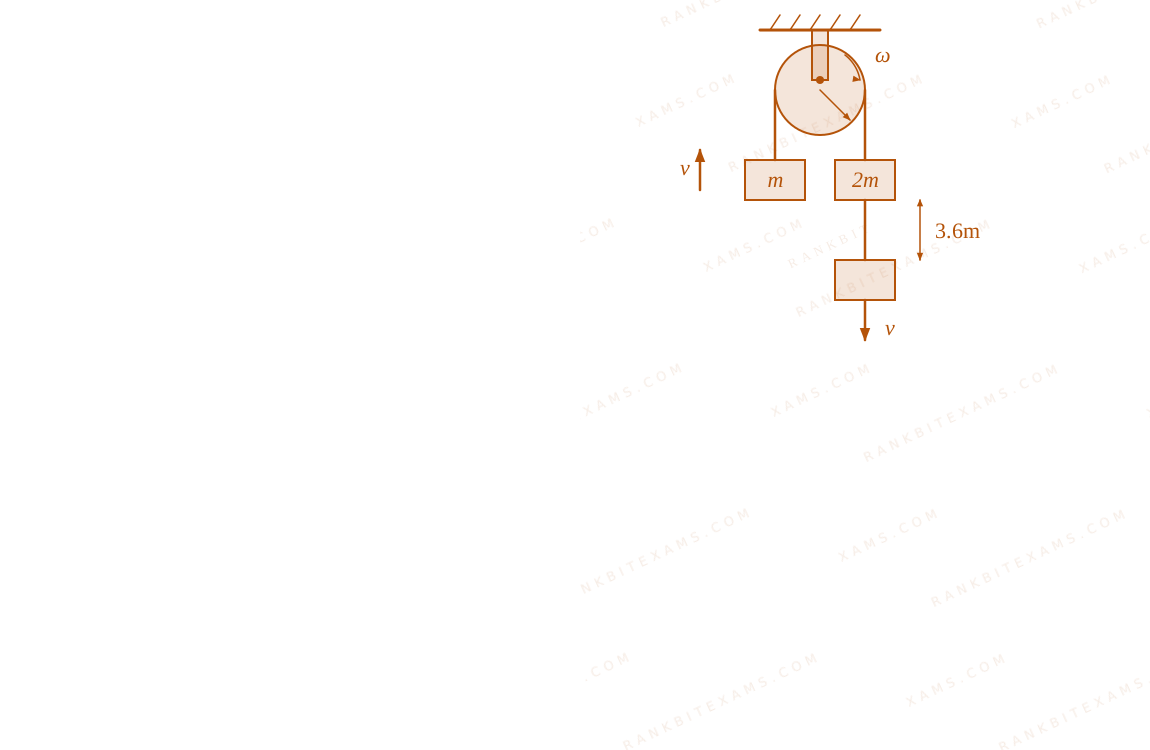
Two masses m and 2m are connected by a light string going over a pulley (disc) of mass 30m with radius r = 0.1 m. The pulley is mounted in a vertical plane and it is free to rotate about its axis. The 2m mass is released from rest and its speed when it has descended through a height of 3.6 m is ____ m/s. (Assume string does not slip and g = 10 m/s²)
Numerical Answer. Answer: 2 to 2

Solution

Related Formula
Δ U + Δ K = 0 Ipulley = (1)/(2) M R² = (1)/(2) (30m) R² = 15m R² ω = (v)/(R)
Core Logic

Using law of conservation of mechanical energy:

Loss in potential energy = Gain in kinetic energy

2m g h - m g h = (1)/(2) m v² + (1)/(2) (2m) v² + (1)/(2) I ω² m g h = (3)/(2) m v² + (1)/(2) (15 m R²) ((v²)/(R²)) m g h = (3)/(2) m v² + (15)/(2) m v² = 9 m v² v = √((g h)/(9))

Substituting g = 10 ~m/s² and h = 3.6 ~m:

v = √((10 × 3.6)/(9)) = √((36)/(9)) = √(4) = 2 ~m/s

Pulley mass system energy conservation diagram for Q47 - JEE Main 2026 Evening

Step 1: Final Conclusion

The speed of the mass is 2 ~m/s.

Pattern Recognition

Energy conservation on pulley system: Net potential loss mgh = sum of linear and rotational kinetic energies 9mv² v = √(gh/9).

Chapter Mix

Class 11 Physics: System of Particles and Rotational Motion

Q33 jee_main_2026_23_january_morning Moment of Inertia
The moment of inertia of a square loop made of four uniform solid cylinders, each having radius R and length L (R < L) about an axis passing through the mid points of opposite sides, is (Take the mass of the entire loop as M):
  • A. (3)/(8)MR² +(7)/(12)ML²
  • B. (3)/(4)MR² +(1)/(6)ML²
  • C. (3)/(4)MR² +(7)/(12)ML²
  • D. (3)/(8)MR² +(1)/(6)ML²

Solution

Related Formula

For a solid cylinder: Parallel to its length passing through center: I = M'R²2 Perpendicular to length through center: I = M'R²4 + M'L²12 Parallel Axis Theorem: I = Icm + M'd²

Core Logic

The square loop is formed by four identical solid cylinders, each of mass M' = (M)/(4). The given axis passes through the mid-points of two opposite cylinders. This means two cylinders have the axis passing perpendicularly through their centers, and the other two cylinders are parallel to the axis at a distance of L/2.

Step 1: Moment of Inertia for cylinders bisected perpendicularly

For the two cylinders perpendicular to the axis of rotation:

I₁ = 2 × ( M'R²4 + M'L²12)
Step 2: Moment of Inertia for cylinders parallel to axis

For the two cylinders parallel to the axis, distance d = L/2. Apply the parallel axis theorem:

I₂ = 2 × [ M'R²2 + M'((L)/(2))²]
Step 3: Total Moment of Inertia
Iₙₑₜ = I₁ + I₂ = 2( M'R²4 + M'L²12) + 2( M'R²2 + M'L²4) Iₙₑₜ = M'R²2 + M'L²6 + M'R² + M'L²2 Iₙₑₜ = 3M'R²2 + 4M'L²6 = 3M'R²2 + 2M'L²3
Step 4: Substitute Total Mass

Substitute M' = M/4:

I = (3)/(2)((M)/(4))R² + (2)/(3)((M)/(4))L² I = (3)/(8)MR² + (1)/(6)ML²
Pattern Recognition

Sees: "square loop of cylinders" + "mass M of entire loop" → Always remember Mᵢ = M/4. Calculate individual moment of inertia carefully considering whether the cylinder is oriented parallel or perpendicular.

Chapter Mix

Class 11 Physics: Systems of Particles and Rotational Motion

More Rotational Motion Questions — jee_main_2025_04_april_evening

Practice all Rotational Motion previous-year questions →

Rankbit System
JEE Physics: Waves (+15.5%) | Electrostatics: Concentric Shells (-29.7%) | Modern Physics: Photoelectric Clones (+34.2%) | Mathematics: Definite Integrals (+18.1%) | Chemistry: Coordination Splitting (-11.4%) | JEE Physics: Waves (+15.5%) | Electrostatics: Concentric Shells (-29.7%) | Modern Physics: Photoelectric Clones (+34.2%) | Mathematics: Definite Integrals (+18.1%) | Chemistry: Coordination Splitting (-11.4%)