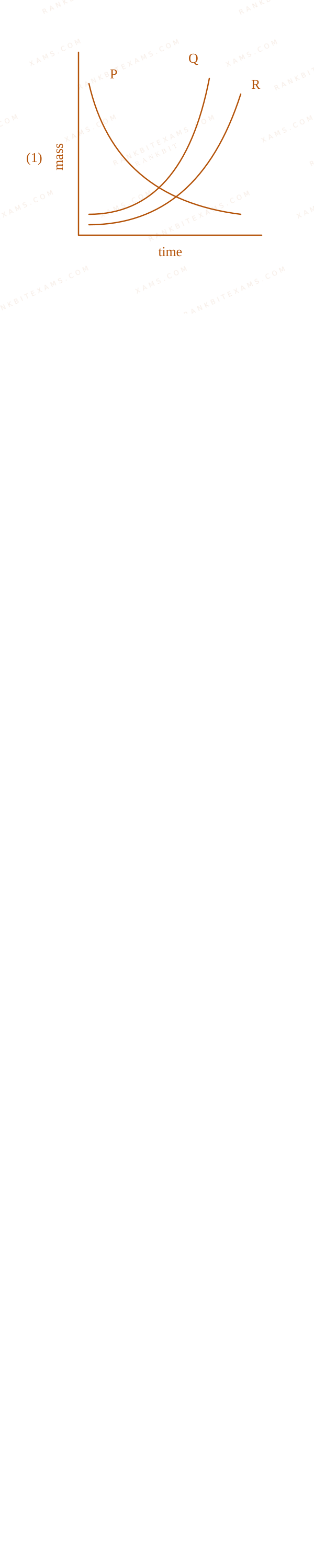
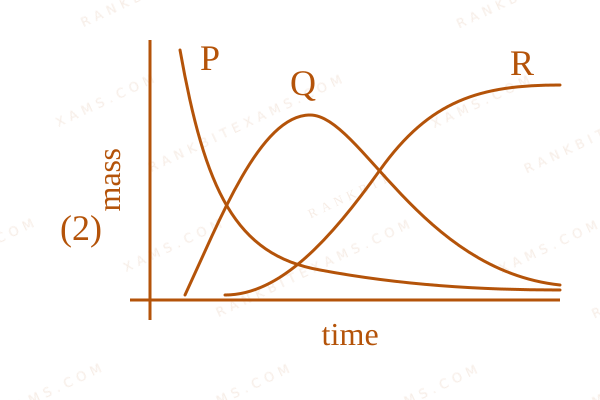
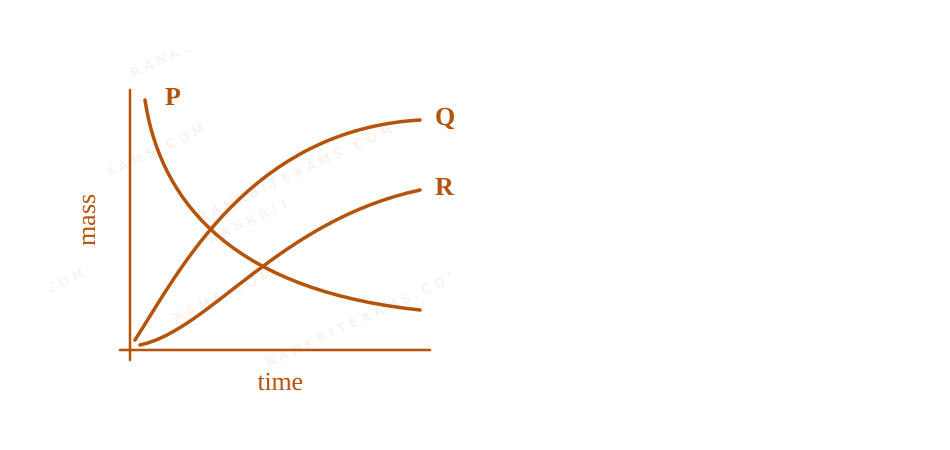
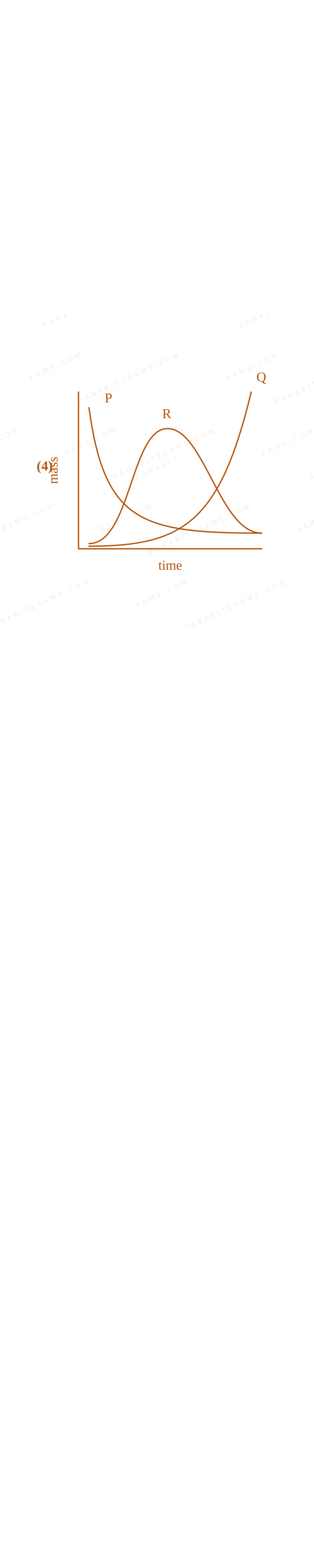
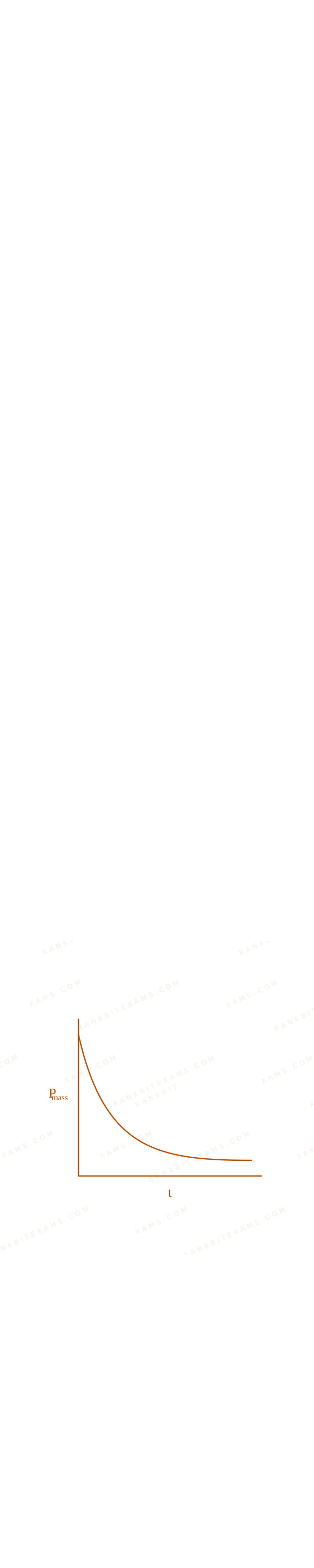
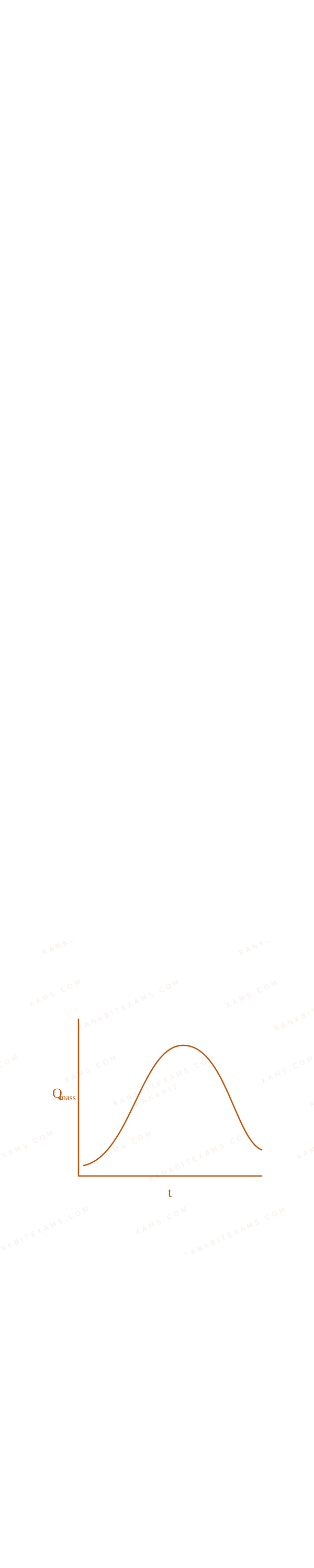
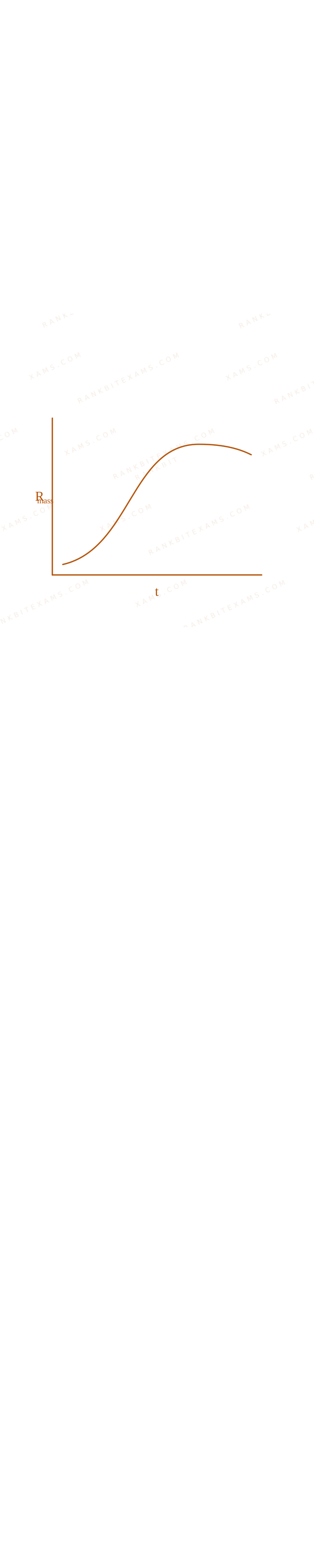
A radioactive material P first decays into Q and then Q decays to non-radioactive material R. Which of the following figure represents time dependent mass of P, Q and R?
A.
Radioactivity
B.
Radioactivity
C.
Radioactivity
D.
Radioactivity
Solution & Explanation
Related Formula
N = N₀ e-λ t$$N = N_0 e^{-\lambda t}$$
where λ$\lambda$ is the decay constant.
Core Logic
Initially, only material P is present, so its mass decreases exponentially from a maximum value to zero.
Material Q is formed from P and then decays into R, so its mass initially increases from zero, reaches a maximum, and then decreases to zero.
Material R is stable and accumulated over time, so its mass increases continuously from zero and levels off at a maximum value equal to the initial mass of P.
Step 1: Graphical Identification
Looking at the options, option (2) correctly depicts the exponential decay of P, the transient rise and fall of Q, and the continuous growth of R to a stable value. Radioactive decay curves for P, Q, and R
Pattern Recognition
For sequential decay P arrow Q arrow R$P \rightarrow Q \rightarrow R$, parent P$P$ always starts at max and drops to 0. Intermediate Q$Q$ starts at 0, peaks, and returns to 0. Final stable product R$R$ starts at 0 and grows asymptotically to max value.
Chapter Mix
Class 12 Physics: Nuclei
Radioactive decay curves for P, Q, and RRadioactive decay curves for P, Q, and R
Since R ∝ A1/3$R \propto A^{1/3}$, scaling R$R$ by k$k$ means scaling A$A$ by k³$k^3$. Half the radius (k = 1/2$k = 1/2$) means 1/8$1/8$th the mass number.
Chapter Mix
Class 12 Physics: Nuclei

Q60jee_main_2024_31_jan_eveningNuclear Size and Density
A nucleus has mass numberA₁$A_1$ and volume V₁$V_1$. Another nucleus has mass numberA₂$A_2$ and volume V₂$V_2$. If relation between mass number is A₂ = 4A₁$A_2 = 4A_1$, then (V₂)/(V₁) =$\frac{V_2}{V_1} =$ ________.
Numerical Answer.Answer: 4 to 4
Solution
Related Formula
R = R₀ A1/3$R = R_0 A^{1/3}$
V = (4)/(3)π R³$$V = \frac{4}{3}\pi R^3$$
Core Logic
Since radius R$R$ is proportional to A1/3$A^{1/3}$, the volume V$V$ (which depends on R³$R^3$) will be directly proportional to the mass numberA$A$.
Nuclear density is constant for all nuclei. Therefore, Mass ∝$\propto$ Volume. Since Mass number (A$A$) represents mass, Volume is strictly linearly proportional to Mass number.
Chapter Mix
Class 12 Physics: Nuclei
Q60jee_main_2024_31_jan_morningMass Defect And Energy
The mass defect in a particular reaction is 0.4 g$0.4\mathrm{\ g}$. The amount of energy liberated is n × 10⁷ kWh$n \times 10^7\mathrm{\ kWh}$ where n =$n =$ _______. (speed of light = 3 × 10⁸ m/s$= 3 \times 10^8\mathrm{\ m/s}$)
Numerical Answer.Answer: 1 to 1
Solution
Related Formula
E = Δ m c²$$E = \Delta m c^2$$1 kWh = 3.6 × 10⁶ J$$1 \text{ kWh} = 3.6 \times 10^6 \text{ J}$$
Core Logic
Given the mass defect:
Δ m = 0.4 g = 0.4 × 10⁻³ kg$$\Delta m = 0.4\mathrm{\,g} = 0.4 \times 10^{-3}\mathrm{\,kg}$$
We need the answer in kWh$\mathrm{kWh}$.
Since 1 kWh = 1000 W × 3600 s = 3.6 × 10⁶ J$1\mathrm{\,kWh} = 1000\mathrm{\,W} \times 3600\mathrm{\,s} = 3.6 \times 10^6\mathrm{\,J}$:
Practice past-year questions one chapter at a time. Pick an exam → subject → chapter and get every PYQ for that topic — pulled together from all past papers — with the chapter's key formulas alongside.