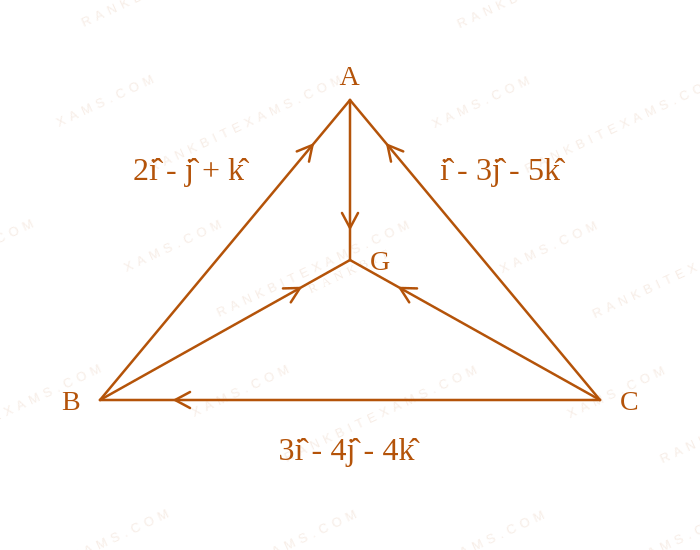
Let the three sides of a triangle ABC$ABC$ be given by the vectors 2 i - j + k$2\hat{i} - \hat{j} + \hat{k}$, i - 3 j - 5 k$\hat{i} - 3\hat{j} - 5\hat{k}$, and 3 i - 4 j - 4 k$3\hat{i} - 4\hat{j} - 4\hat{k}$. Let G$G$ be the centroid of the triangle ABC$ABC$. Then 6(| AG|² + | BG|² + | CG|²)$6\left(|\overline{AG}|^2 + |\overline{BG}|^2 + |\overline{CG}|^2\right)$ is equal to
Numerical Answer Type:
Enter a numerical valueAnswer: 164 to 164+4 marks
Solution & Explanation
Core Logic
Let the vertices of the triangle be A$A$, B$B$, and C$C$. The vectors representing the side paths are:
Notice that AB + CA = (2+1) i + (-1-3) j + (1-5) k = 3 i - 4 j - 4 k = CB$\overline{AB} + \overline{CA} = (2+1)\hat{i} + (-1-3)\hat{j} + (1-5)\hat{k} = 3\hat{i} - 4\hat{j} - 4\hat{k} = \overline{CB}$. This structurally validates vector addition rules.
Vector algebra diagram for Q75 - JEE Main 2025 Evening
Step 1: Finding Position Vectors relative to A
Let's set vertex A$A$ as the origin origin point (Position vector A = 0$\vec{A} = \vec{0}$):
Position vector of B$B$: B = 2 i - j + k$\vec{B} = 2\hat{i} - \hat{j} + \hat{k}$
Position vector of C$C$: Since CA = A - C = - C C = - i + 3 j + 5hatk$\overline{CA} = \vec{A} - \vec{C} = -\vec{C} \implies \vec{C} = -\hat{i} + 3\hat{j} + 5hat{k}$
Now, calculate the position vector of the centroid G$G$:
G = A + B + C3 = 0 + (2 i - j + k) + (- i + 3 j + 5 k)3 = (1)/(3)( i + 2 j + 6 k)$$\vec{G} = \frac{\vec{A} + \vec{B} + \vec{C}}{3} = \frac{\vec{0} + (2\hat{i} - \hat{j} + \hat{k}) + (-\hat{i} + 3\hat{j} + 5\hat{k})}{3} = \frac{1}{3}\left(\hat{i} + 2\hat{j} + 6\hat{k}\right)$$
Step 2: Calculating Squared Lengths to the Centroid
Setting one vector node as the origin point (A = 0$\vec{A} = \vec{0}$) heavily dampens intermediate coordinate math steps, avoiding dealing with an absolute baseline origin orientation.
Chapter Mix
Class 12 Mathematics: Vector Algebra
More Vector Algebra Previous-Year Questions — Page 10
Let a$\vec{a}$ and b$\vec{b}$ be two vectors such that | a| = 1, | b| = 4$|\vec{a}| = 1, |\vec{b}| = 4$ and a · b = 2$\vec{a} \cdot \vec{b} = 2$. If c = (2 a × b) - 3 b$\vec{c} = (2\vec{a} \times \vec{b}) - 3\vec{b}$ and the angle between b$\vec{b}$ and c$\vec{c}$ is α$\alpha$, then 192 ²α$192\sin^2\alpha$ is equal to
Numerical Answer.Answer: 48 to 48
Solution
Core Logic
b · c = b · ((2 a × b) - 3 b)$$\vec{b} \cdot \vec{c} = \vec{b} \cdot ((2\vec{a} \times \vec{b}) - 3\vec{b})$$|b||c| α = 2( b · ( a × b)) - 3|b|²$$|b||c|\cos\alpha = 2(\vec{b} \cdot (\vec{a} \times \vec{b})) - 3|b|^2$$
Since b · ( a × b) = 0$\vec{b} \cdot (\vec{a} \times \vec{b}) = 0$, we have |b||c| α = -3|b|²$|b||c|\cos\alpha = -3|b|^2$.
Practice past-year questions one chapter at a time. Pick an exam → subject → chapter and get every PYQ for that topic — pulled together from all past papers — with the chapter's key formulas alongside.