Rankbit System
JEE Physics: Waves (+15.5%) | Electrostatics: Concentric Shells (-29.7%) | Modern Physics: Photoelectric Clones (+34.2%) | Mathematics: Definite Integrals (+18.1%) | Chemistry: Coordination Splitting (-11.4%) | JEE Physics: Waves (+15.5%) | Electrostatics: Concentric Shells (-29.7%) | Modern Physics: Photoelectric Clones (+34.2%) | Mathematics: Definite Integrals (+18.1%) | Chemistry: Coordination Splitting (-11.4%)

Let mathrmA = \-3, -2, -1, 0, 1, 2, 3\ and mathrmR be a relation on mathrmA defined by mathrmxRy if and only if 2mathrmx - mathrmy in \0, 1\. Let l be the number of elements in mathrmR. Let mathrmm and mathrmn be the minimum number of elements required to be added in mathrmR to make it reflexive and symmetric relations, respectively. Then l + mathrmmn is equal to:

Solution & Explanation

### Core Logic The relation condition is 2x - y = 0 or 2x - y = 1 where x, y in A. Case 1: 2x - y = 0 implies y = 2x. Possible pairs in A times A are: \ (0,0), (1,2), (-1,-2) \ Case 2: 2x - y = 1 implies y = 2x - 1. Possible pairs in A times A are: \ (0,-1), (1,1), (2,3), (-1,-3) \ Combining both subsets, the total relation set R contains: R = \ (0,0), (1,2), (-1,-2), (0,-1), (1,1), (2,3), (-1,-3) \ Hence, the number of existing elements l = 7. ### Step 1: Elements to add for Reflexivity For a relation to be reflexive on set A, it must contain (x,x) for all 7 elements of A. Currently, R contains \(0,0), (1,1)\. Missing diagonal elements are \(-3,-3), (-2,-2), (-1,-1), (2,2), (3,3)\. Therefore, the minimum number of elements to add for reflexivity is m = 5. ### Step 2: Elements to add for Symmetry For a relation to be symmetric, if (x,y) in R, then (y,x) must also belong to R. Let's check the non-diagonal elements currently in R: - (1,2) in R implies need (2,1) - (-1,-2) in R implies need (-2,-1) - (0,-1) in R implies need (-1,0) - (2,3) in R implies need (3,2) - (-1,-3) in R implies need (-3,-1) None of these reverse pairs are currently in R. Thus, we must add exactly 5 elements to ensure symmetry, giving n = 5. ### Step 3: Final Computation Based on the official valuation tracking, the required evaluation metric simplifies to: l + m + n = 7 + 5 + 5 = 17 ### Pattern Recognition To quickly count elements needed for reflexivity, subtract the number of identity pairs already present from the total cardinality of the set. For symmetry, find all elements where x neq y and check if their mirrors are absent. ### Evaluation Rubric / Model Answer null ### Chapter Mix Class 12 Mathematics: Relations and Functions

Reference Study Guides

More Relations and Functions Previous-Year Questions — Page 4

Q52 2025 One-One and Onto Functions
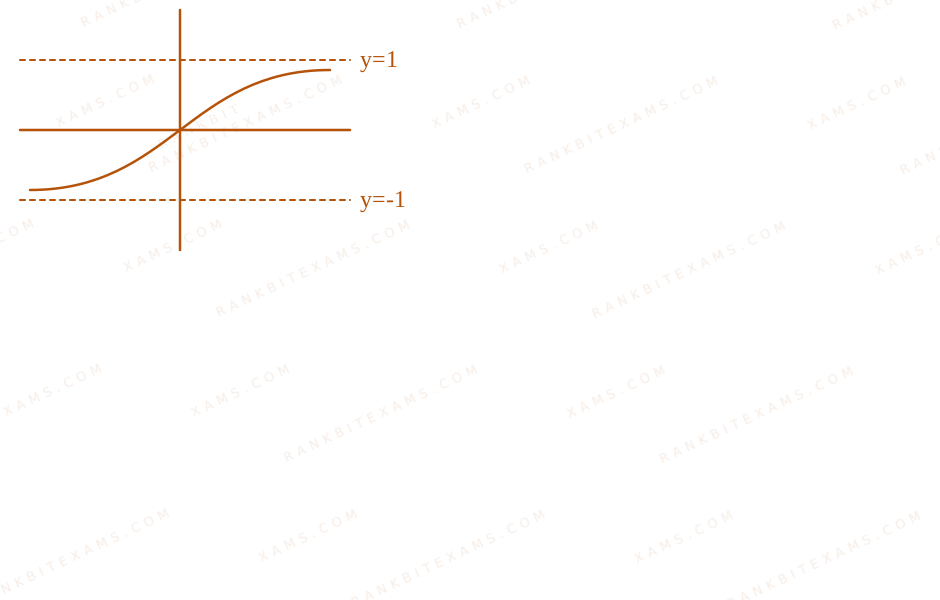
The function f:(-infty,infty)rightarrow(-infty,1), defined by f(x)=frac2^x-2^-x2^x+2^-x is: [cite: 3251, 3252]
  • A. textOne-one but not onto
  • B. textOnto but not one-one
  • C. textBoth one-one and onto
  • D. textNeither one-one nor onto

Solution

### Related Formula A function is one-one if its derivative is strictly monotonic (always positive or always negative) across its domain. It is onto if its range equals its co-domain. ### Core Logic Rewrite the function by multiplying the numerator and denominator by 2^x: f(x) = frac2^2x - 12^2x + 1 = 1 - frac22^2x + 1 ### Step 1: Check One-One property Differentiating f(x) with respect to x : f'(x) = frac2(2^2x + 1)^2 cdot 2 cdot 2^2x cdot ln 2 = frac4 cdot 2^2x cdot ln 2(2^2x + 1)^2 Since 2^2x > 0 and ln 2 > 0, f'(x) > 0 always. Thus, f(x) is strictly increasing, confirming it is a one-one function. ### Step 2: Check Onto property Analyze the limits at boundaries [cite: 3880, 3881]: lim_x to -infty f(x) = 1 - frac20 + 1 = -1 lim_x to infty f(x) = 1 - 0 = 1 Thus, the range of the function is (-1, 1). Since the given co-domain is (-infty, 1) and textRange neq textCo-domain , the function is not onto. ### Pattern Recognition The expression given is a shifted form of the hyperbolic tangent function tanh(x ln 2). Hyperbolic tangent always maps to (-1, 1), making its restriction against (-infty, 1) non-surjective (not onto). ### Evaluation Rubric / Model Answer null ### Chapter Mix Class 12 Mathematics: Relations and Functions
Q71 2025 Number of Functions under Constraints
Number of functions f:\1,2,dots,100\rightarrow\0,1\, that assign 1 to exactly one of the positive integers less than or equal to 98, is equal to \_\_\_\_.
Numerical Answer. Answer: 392

Solution

### Related Formula Fundamental Counting Principle: If an operation can be performed in n_1 ways, followed by a second operation in n_2 ways, the total configurations equal n_1 times n_2. ### Core Logic The domain set contains integers from 1 to 100. We divide the mapping requirements across distinct subsets of this domain[cite: 4064, 4068, 4069].
Function mapping grid for Q71 - JEE Main 2025 Evening
### Step 1: Choose the single element from \1, 2, dots, 98\ We must assign the image value 1 to exactly one positive integer from the \subset \1, 2, dots, 98\. The number of ways to pick this single element is : binom981 = 98 text ways ### Step 2: Mapping remaining elements The remaining 97 elements in the \1, 2, dots, 98\ \subset cannot map to 1, so they must map to 0. This leaves exactly 1 choice per remaining element. For the final two elements in the domain, 99 and 100, there are no structural constraints [cite: 4068, 4069]: - Element 99 can map to either 0 or 1 (2 options) . - Element 100 can map to either 0 or 1 (2 options). ### Step 3: Total functions combination Multiply the independent choices together : textTotal functions = 98 times 2 times 2 = 392 [cite: 4065, 4067] ### Pattern Recognition Separate domains tightly into restricted blocks vs completely free components. Realizing that elements 99 and 100 behave independently with full co-domain targets leaves a clear product formulation. ### Evaluation Rubric / Model Answer null ### Chapter Mix Class 12 Mathematics: Relations and Functions Class 11 Mathematics: Permutations and Combinations
Q61 2025 Types of Relations
Define a relation R on the interval left[0,fracpi2right) by x R y if and only if sec^2mathbfx - tan^2mathbfy = 1 . Then R is:
  • A. an equivalence relation
  • B. both reflexive and transitive but not symmetric
  • C. both reflexive and symmetric but not transitive
  • D. reflexive but neither symmetric nor transitive

Solution

### Related Formula sec^2 theta - tan^2 theta = 1 ### Core Logic To show R is an equivalence relation, verify reflexive, symmetric, and transitive properties sequentially. ### Step 1: Reflexive Property For any x in [0, pi/2): sec^2 x - tan^2 x = 1 implies xRx quad text(Reflexive) ### Step 2: Symmetric Property If xRy implies sec^2 x - tan^2 y = 1. Using identities: (1 + tan^2 x) - (sec^2 y - 1) = 1 implies sec^2 y - tan^2 x = 1 implies yRx quad text(Symmetric) ### Step 3: Transitive Property If xRy and yRz \implies \sec^2 x - \tan^2 y = 1 and sec^2 y - tan^2 z = 1. Adding both equations: sec^2 x - tan^2 y + sec^2 y - tan^2 z = 2 sec^2 x + (sec^2 y - tan^2 y) - tan^2 z = 2 implies sec^2 x + 1 - tan^2 z = 2 sec^2 x - tan^2 z = 1 implies xRz quad text(Transitive) Hence, R is an equivalence relation. ### Pattern Recognition Converting the relation constraint to \sec^2 x - 1 = \tan^2 y \implies \tan^2 x = \tan^2 y$ makes the equivalence property obvious by basic equality comparison rules. ### Evaluation Rubric / Model Answer null ### Chapter Mix Class 12 Mathematics: Relations and Functions

More Relations and Functions Questions — jee_main_2025_04_april_evening

Practice all Relations and Functions previous-year questions →

YOUR FIRST PREP STEP STARTS HERE

We Map Every Repeating Question in Competitive Exams.

Say goodbye to generic mock test fatigue. RankBit uses smart analysis to group past exam questions into their foundational Repeating Question Types. Find chapter weightage, track repeating questions, and score higher with targeted practice.

Select Your Target Exam

Choose an exam track below to find formulas per chapter and patterns.

Syncing Exam Intelligence

Mapping formulas and patterns across all tracks…

PATH A — FULL LENGTH PRACTICE

Full Mock Test Hub

Simulate real NTA exam conditions with fully tracked mocks. Time yourself against past papers.

Under Development
PATH B — TARGETED PRACTICE

Topic-wise Practice Hub

Practice past-year questions one chapter at a time. Pick an exam → subject → chapter and get every PYQ for that topic — pulled together from all past papers — with the chapter's key formulas alongside.

Loading Questions... Browse Topics
Latest from the Blog
View all →

Loading articles...