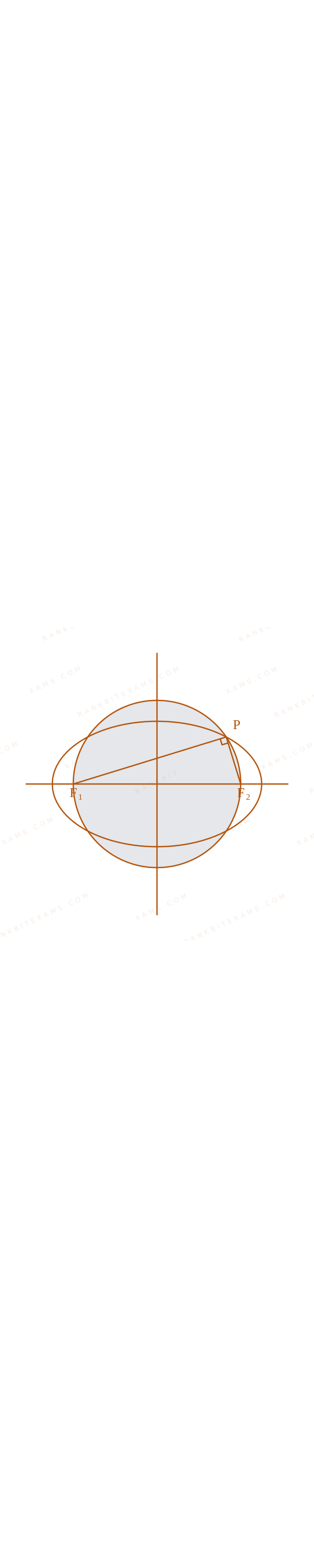
The centre of a circle C$C$ is at the centre of the ellipse E: (x²)/(a²) + (y²)/(b²) = 1, a > b$E: \frac{x^2}{a^2} + \frac{y^2}{b^2} = 1, a > b$. Let C$C$ pass through the foci F₁$F_1$ and F₂$F_2$ of E$E$ such that the circle C$C$ and the ellipse E$E$ intersect at four points. Let P$P$ be one of these four points. If the area of the triangle PF₁F₂$PF_1F_2$ is 30 and the length of the major axis of E$E$ is 17, then the distance between the foci of E$E$ is :
A.26$26$
B.13$13$
C.12$12$
D.(13)/(2)$\frac{13}{2}$
Solution & Explanation
Core Logic
The circle C$C$ has its center at the origin and passes through the foci F₁(-ae, 0)$F_1(-ae, 0)$ and F₂(ae, 0)$F_2(ae, 0)$. This means F₁F₂$F_1F_2$ is the diameter of the circle.
Any point P$P$ lying on this circle satisfies the property that the angle subtended by the diameter is a right angle:
∠ F₁PF₂ = 90^°$$\angle F_1PF_2 = 90^\circ$$
Ellipse properties diagram for Q67 - JEE Main 2025 Evening
Step 1: Using the Area and Ellipse Definition
Since PF₁F₂$\triangle PF_1F_2$ is a right-angled triangle at P$P$:
Therefore, the distance between the foci is 13$13$.
Pattern Recognition
Whenever a circle is circumscribed around the foci of an ellipse, remember Thales' theorem: any intersection point with the ellipse forms a right triangle with the focal diameter, linking focal properties directly to Pythagoras.
Chapter Mix
Class 11 Mathematics: Conic Sections
More Conic Sections Previous-Year Questions — Page 3
Q11jee_main_2026_22_january_eveningHyperbola Properties and Area of Triangle
Let P(10, 2√(15))$P(10, 2\sqrt{15})$ be a point on the hyperbola (x²)/(a²) - (y²)/(b²) = 1$\frac{x^2}{a^2} - \frac{y^2}{b^2} = 1$, whose foci are S$S$ and S'$S'$. If the length of its latus rectum is 8$8$, then the square of the area of Δ PSS'$\Delta PSS'$ is equal to:
Let S$S$ and S'$S'$ be the foci of the ellipse (x²)/(25) + (y²)/(9) = 1$\frac{x^2}{25} + \frac{y^2}{9} = 1$ and P(α, β)$P(\alpha, \beta)$ be a point on the ellipse in the first quadrant. If (SP)² + (S'P)² - SP · S'P = 37$(SP)^2 + (S'P)^2 - SP \cdot S'P = 37$, then α² + β²$\alpha^2 + \beta^2$ is equal to:
Express (SP)² + (S'P)² - SP · S'P$(SP)^2 + (S'P)^2 - SP \cdot S'P$ in terms of (SP+S'P)$(SP+S'P)$ to determine SP · S'P$SP \cdot S'P$ instantly.
Chapter Mix
Class 11 Maths: Conic Sections
Q17jee_main_2026_22_january_eveningLocus of Midpoint of Chord
Let the locus of the mid-point of the chord through the origin O$O$ of the parabola y² = 4x$y^2 = 4x$ be the curve S$S$. Let P$P$ be any point on S$S$. Then the locus of the point, which internally divides OP$OP$ in the ratio 3:1$3:1$, is:
A.3y² = 2x$3y^2 = 2x$
B.2y² = 3x$2y^2 = 3x$
C.3x² = 2y$3x^2 = 2y$
D.2x² = 3y$2x^2 = 3y$
Solution
Related Formula
Section formula for internal division in ratio m:n$m:n$:
R(h,k) = ( (m x₂ + n x₁)/(m+n), (m y₂ + n y₁)/(m+n) )$$R(h,k) = \left( \frac{m x_2 + n x_1}{m+n}, \frac{m y_2 + n y_1}{m+n} \right)$$
Core Logic
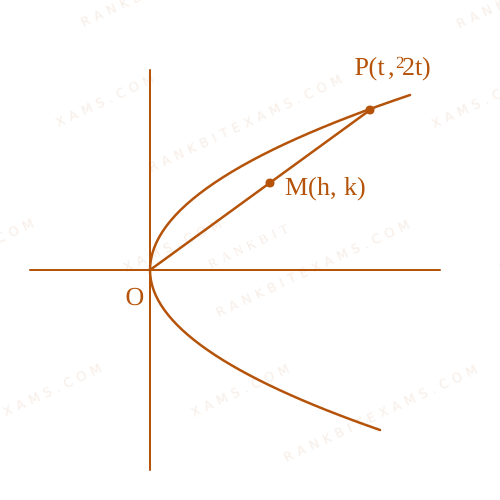
Locus of midpoint diagram for Q17 - JEE Main 2026 Evening
Let chord endpoint be Q(t², 2t)$Q(t^2, 2t)$. Midpoint M(h,k)$M(h,k)$ of OQ$OQ$:
h = (t²)/(2), k = t k² = 2h$$h = \frac{t^2}{2}, \quad k = t \implies k^2 = 2h$$
So curve S$S$ is y² = 2x$y^2 = 2x$.
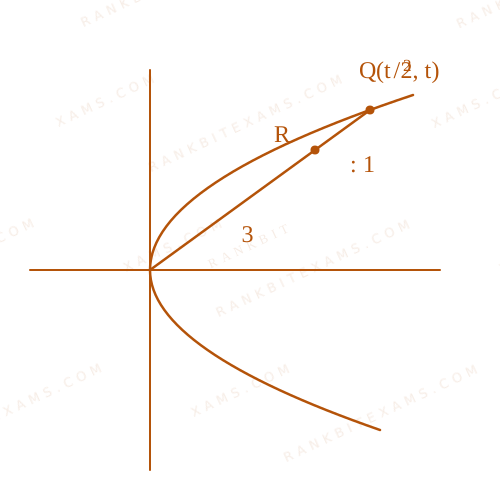
Now P$P$ lies on S: y² = 2x$S: y^2 = 2x$, so P = ((t²)/(2), t)$P = \left(\frac{t^2}{2}, t\right)$.
Point R(h,k)$R(h,k)$ divides OP$OP$ in ratio 3:1$3:1$:
Step 1: Section Formula Application
Locus of midpoint diagram for Q17 - JEE Main 2026 Evening
h = (3(t²/2) + 0)/(4) = (3t²)/(8), k = (3(t) + 0)/(4) = (3t)/(4)$$h = \frac{3(t^2/2) + 0}{4} = \frac{3t^2}{8}, \quad k = \frac{3(t) + 0}{4} = \frac{3t}{4}$$
From k = (3t)/(4) t = (4k)/(3)$k = \frac{3t}{4} \implies t = \frac{4k}{3}$. Substitute into h$h$:
Parametrize midpoint curve S$S$, then re-apply section ratio to derive final locus equation.
Chapter Mix
Class 11 Maths: Conic Sections
Q1jee_main_2026_23_january_morningHyperbola
Let the domain of the function f(x) = ₃ ₅ ₇(9x - x² - 13)$f(x) = \log_3\log_5\log_7(9x - x^2 - 13)$ be the interval (m, n)$(m, n)$. Let the hyperbola (x²)/(a²) - (y²)/(b²) = 1$\frac{x^2}{a^2} - \frac{y^2}{b^2} = 1$ have eccentricity (n)/(3)$\frac{n}{3}$ and the length of the latus rectum (8m)/(3)$\frac{8m}{3}$. Then b² - a²$b^2 - a^2$ is equal to:
Nested logarithmic domains require unpacking from the outside in: ₐ(X) > 0 ⇒ X > 1$\log_a(X) > 0 \Rightarrow X > 1$. Linking function domains to coordinate geometry parameters is a standard JEE cross-topic pattern.
Chapter Mix
Class 11 Maths: Conic Sections
Class 11 Maths: Relations and Functions
Q5jee_main_2026_23_january_morningEllipse
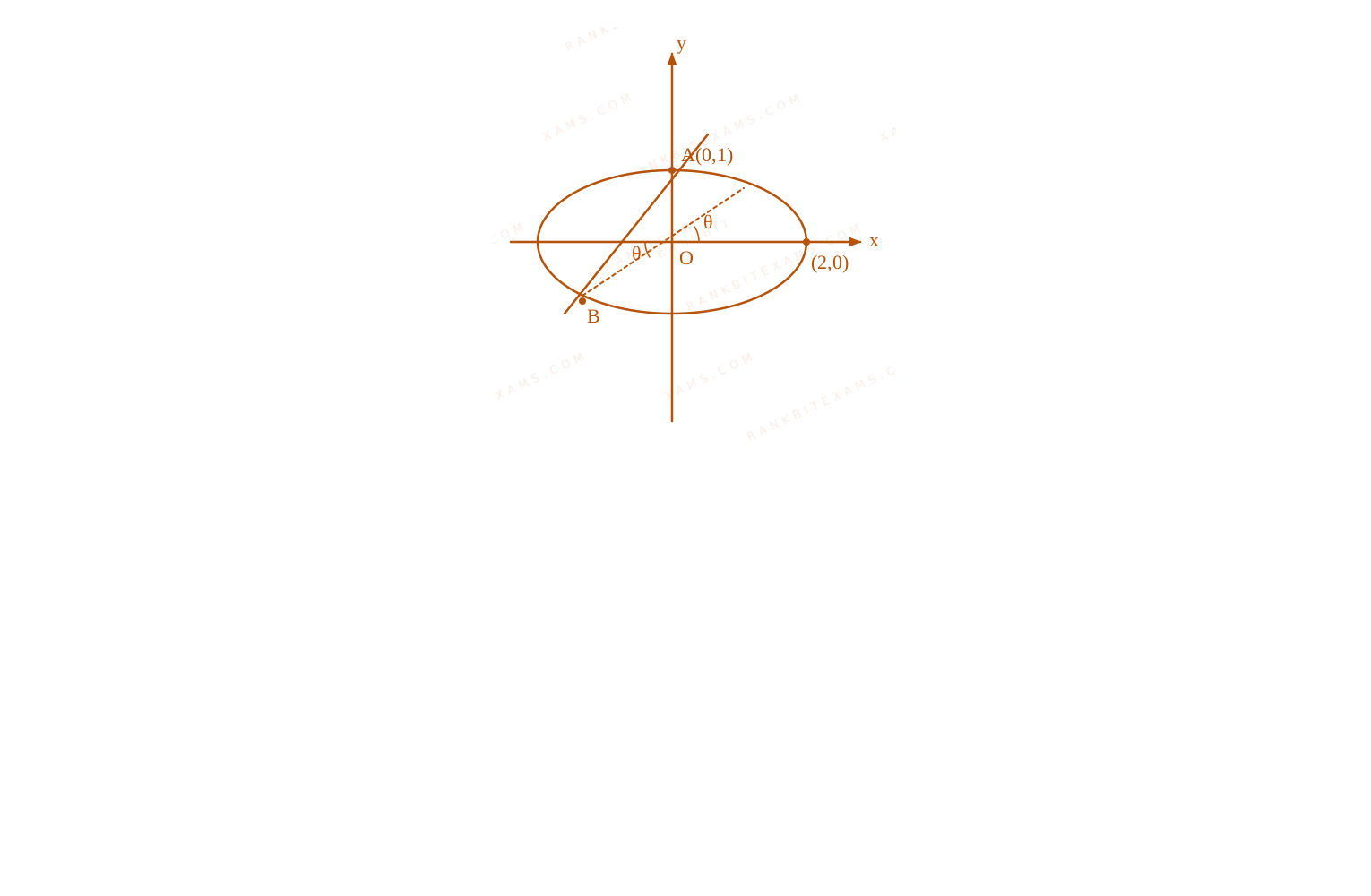
Let the line y - x = 1$y - x = 1$ intersect the ellipse (x²)/(2) + (y²)/(1) = 1$\frac{x^2}{2} + \frac{y^2}{1} = 1$ at the points A$A$ and B$B$. Then the angle made by the line segment AB$AB$ at the center of the ellipse is:
Find the intersection points of the line y = x + 1$y = x + 1$ and the ellipse (x²)/(2) + y² = 1$\frac{x^2}{2} + y^2 = 1$.
Ellipse diagram for Q5 - JEE Main 2026 Morning
Substitute y = x + 1$y = x + 1$ into the ellipse equation:
This gives x = 0$x = 0$ or x = -(4)/(3)$x = -\frac{4}{3}$.
Step 1: Calculate Intersection Points
For x = 0$x = 0$, y = 1 ⇒ A(0, 1)$y = 1 \Rightarrow A(0, 1)$.
For x = -(4)/(3)$x = -\frac{4}{3}$, y = -(4)/(3) + 1 = -(1)/(3) ⇒ B(-(4)/(3), -(1)/(3))$y = -\frac{4}{3} + 1 = -\frac{1}{3} \Rightarrow B\left(-\frac{4}{3}, -\frac{1}{3}\right)$.
Ellipse diagram for Q5 - JEE Main 2026 Morning
Step 2: Find Angle at the Origin
Let O(0,0)$O(0,0)$ be the center of the ellipse. The angle made by segment AB$AB$ at O$O$ is ∠ AOB$\angle AOB$.
The slope of OA$OA$ is m₁ = (1 - 0)/(0 - 0) = ∞$m_1 = \frac{1 - 0}{0 - 0} = \infty$ (which means OA$OA$ is along the y-axis, angle is π/2$\pi/2$).
The slope of OB$OB$ is m₂ = (-1/3 - 0)/(-4/3 - 0) = (1)/(4)$m_2 = \frac{-1/3 - 0}{-4/3 - 0} = \frac{1}{4}$.
The angle of OB$OB$ with the positive x-axis is θ = ⁻¹((1)/(4))$\theta = \tan^{-1}\left(\frac{1}{4}\right)$.
The total angle ∠ AOB$\angle AOB$ is (π)/(2) + θ = (π)/(2) + ⁻¹((1)/(4))$\frac{\pi}{2} + \theta = \frac{\pi}{2} + \tan^{-1}\left(\frac{1}{4}\right)$.
Pattern Recognition
When solving line-conic intersection, explicit extraction of points (A, B)$(A, B)$ is often simpler than using homogenization if the intersection yields simple rational or integer coordinates.
Chapter Mix
Class 11 Maths: Conic Sections
Class 11 Maths: Straight Lines
Practice past-year questions one chapter at a time. Pick an exam → subject → chapter and get every PYQ for that topic — pulled together from all past papers — with the chapter's key formulas alongside.
