Rankbit System
JEE Physics: Waves (+15.5%) | Electrostatics: Concentric Shells (-29.7%) | Modern Physics: Photoelectric Clones (+34.2%) | Mathematics: Definite Integrals (+18.1%) | Chemistry: Coordination Splitting (-11.4%) | JEE Physics: Waves (+15.5%) | Electrostatics: Concentric Shells (-29.7%) | Modern Physics: Photoelectric Clones (+34.2%) | Mathematics: Definite Integrals (+18.1%) | Chemistry: Coordination Splitting (-11.4%)

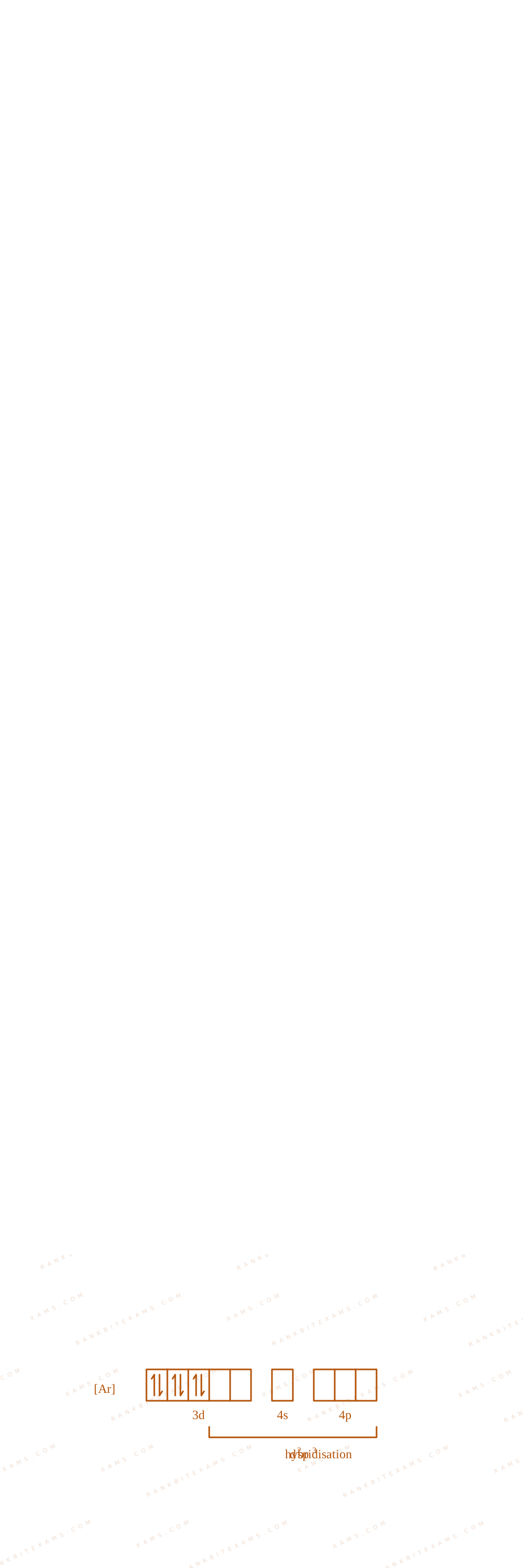
A metal complex with a formula mathrmMCell_4cdot3mathrmNH_3 is involved in mathfraksp^3mathfrakd^2 hybridisation. It upon reaction with excess of mathrmAgNO_3 solution gives 'x' moles of AgCl. Consider 'x' is equal to the number of lone pairs of electron present in central atom of mathrmBrF_5 . Then the number of geometrical isomers exhibited by the complex is

Numerical Answer Type:
Enter a numerical value Answer: 1.9 to 2.1 +4 marks

Solution & Explanation

### Core Logic 1. Determine the value of x: - The central Bromine atom in BrF_5 has 7 valence electrons. It forms 5 single bonds with fluorine, leaving 2 remaining electrons. - Therefore, the number of lone pairs on Br in BrF_5 is exactly 1 implies x = 1. 2. Formulate the coordination sphere formula: - Since x = 1, the complex yields 1 mole of AgCl precipitate upon reaction with excess AgNO_3, meaning exactly 1 chloride ion sits outside the coordination sphere as an counter-ion. - Rearranging the formula components around an octahedral coordination number of 6 gives the complex configuration: [M(NH_3)_3Cl_3]Cl ### Step 1: Isomer Analysis
Facial and meridional isomers representation for Q48
An octahedral complex of the type [Ma_3b_3] exhibits exactly **2 geometrical isomers**: - **Facial (fac)** isomer - **Meridional (mer)** isomer ### Pattern Recognition For [Ma_3b_3] octahedral coordination types, don't waste time looking for optical active configurations. It splits cleanly into exactly two classical geometric forms: facial (all three identical ligands adjacent on a face) and meridional (ligands trace a meridian plane). ### Evaluation Rubric / Model Answer null ### Chapter Mix Class 12 Chemistry: Coordination Compounds Class 11 Chemistry: Chemical Bonding and Molecular Structure
Reference Study Guides

More Coordination Compounds Previous-Year Questions — Page 7

Q36 2025 Valence Bond Theory and Hybridization
Match List-I with List-II.
List-I (Complex)List-II (Hybridisation of central metal ion)
(A) [CoF_6]^3-(I) d^2sp^3
(B) [NiCl_4]^2-(II) sp^3
(C) [Co(NH_3)_6]^3+(III) sp^3d^2
(D) [Ni(CN)_4]^2-(IV) dsp^2
Choose the correct answer from the options given below :
  • A. text(A)-(I), (B)-(IV), (C)-(III), (D)-(II)
  • B. text(A)-(III), (B)-(II), (C)-(I), (D)-(IV)
  • C. text(A)-(I), (B)-(II), (C)-(III), (D)-(IV)
  • D. text(A)-(III), (B)-(IV), (C)-(I), (D)-(II)

Solution

### Related Formula Coordination Number 6 corresponds to either d^2sp^3 or sp^3d^2 configuration templates. Coordination Number 4 corresponds to either sp^3 or dsp^2 configuration templates. ### Core Logic Analyzing metal orbital dynamics under varying ligand fields: - **(A) [CoF_6]^3-**: Co^3+ (3d^6) with a weak field ligand (F^-) rightarrow no pairing occurs rightarrow utilizes outer orbitals rightarrow sp^3d^2. - **(B) [NiCl_4]^2-**: Ni^2+ (3d^8) with a weak field ligand (Cl^-) rightarrow no pairing occurs rightarrow tetrahedral profile rightarrow sp^3. - **(C) [Co(NH_3)_6]^3+**: Co^3+ (3d^6) with a strong field ligand (NH_3) rightarrow electrons pair up rightarrow inner orbital configuration rightarrow d^2sp^3. - **(D) [Ni(CN)_4]^2-**: Ni^2+ (3d^8) with a strong field ligand (CN^-) rightarrow forced pairing opens a 3d slot rightarrow square planar geometry rightarrow dsp^2. ### Step 1: Final Pairing Match The completed matching configuration aligns cleanly with: (A)-(III), (B)-(II), (C)-(I), (D)-(IV). ### Pattern Recognition Isolate coordination frameworks quickly: - Nickel(II) with weak field ligands (Cl^-) yields sp^3, while with strong field ligands (CN^-) it yields dsp^2. - Cobalt(III) with weak field ligands (F^-) yields sp^3d^2, while with strong field ligands (NH_3) it yields d^2sp^3. ### Evaluation Rubric / Model Answer null ### Chapter Mix Class 12 Chemistry: Coordination Compounds

Q50 2025 Magnetic Properties
Total number of molecules/species from following which will be paramagnetic is O_2,\ O_2^+,\ NO,\ NO_2,\ CO,\ K_2[NiCl_4],\ [Co(NH_3)_6]Cl_3,\ K_2[Ni(CN)_4]
Numerical Answer. Answer: 6 to 6

Solution

### Related Formula Paramagnetism requires the presence of one or more unpaired electrons within molecular orbitals or coordination complexes. ### Core Logic Evaluating each entry one by one: 1. **O_2**: Has 2 unpaired electrons in antibonding orbitals (pi^*) rightarrow **Paramagnetic** 2. **O_2^+**: Has 1 unpaired electron according to Molecular Orbital Theory rightarrow **Paramagnetic** 3. **NO**: An odd-electron molecule with 1 unpaired electron rightarrow **Paramagnetic** 4. **NO_2**: An odd-electron species containing 1 unpaired electron rightarrow **Paramagnetic** 5. **CO**: Total of 14 electrons, all paired up rightarrow **Diamagnetic** 6. **K_2[NiCl_4]**: Ni^2+ (3d^8) with weak field Cl^- ligands forms a tetrahedral complex with 2 unpaired electrons rightarrow **Paramagnetic** 7. **[Co(NH_3)_6]Cl_3**: Co^3+ (3d^6) combined with strong field NH_3 ligands causes all electrons to pair up (t_2g^6) rightarrow **Diamagnetic** 8. **K_2[Ni(CN)_4]**: Ni^2+ (3d^8) combined with strong field CN^- ligands creates a square planar complex where all electrons are paired rightarrow **Diamagnetic** ### Step 1: Counting the Paramagnetic Members Wait! Let's double check the list provided in the text solution. The text key lists: `O_2, O_2^+, O_2^-, NO, NO_2, K_2[NiCl_4]` as being paramagnetic, giving a total count of 6. Let's ensure the list matches perfectly: O_2, O_2^+, NO, NO_2, plus K_2[NiCl_4] and check if any other species from the paper's original input is included. The text lists 6 total species. Thus, the total count of paramagnetic species is 6. ### Pattern Recognition Quick rules for electronic profiles: - Odd total electron counts (like NO, NO_2) are always paramagnetic. - O_2 and its simple ions are classical indicators for MOT unpaired configuration analysis. - For transition complexes, match weak field configurations (Cl^- with d^8 rightarrow tetrahedral, 2 unpaired electrons) against strong field environments (CN^-, NH_3) that force spin pairing. ### Evaluation Rubric / Model Answer null ### Chapter Mix Class 12 Chemistry: Coordination Compounds
Q32 2025 Crystal Field Theory and Stability of Complexes
The correct increasing order of stability of the complexes based on Delta_0 value is : (I) left[mathrmMn(mathrmCN)_6 ight]^3- (II) left[mathrmCo(mathrmCN)_6 ight]^4- (III) [mathrmFe(mathrmCN)_6]^4- (IV) [mathrmFe(mathrmCN)_6]^3-
  • A. mathrmII < mathrmIII < mathrmIV
  • B. mathrmIV < mathrmIII < mathrmII
  • C. mathrmI < mathrmII < mathrmIV < mathrmIII
  • D. mathrmIII < mathrmII < mathrmIV < mathrmI

Solution

### Related Formula textCFSE evaluation for octahedral weak/strong arrangements ### Core Logic The stability profile tracks the magnitude of crystal field stabilization energy via Delta_0 values : * (I) [mathrmMn(mathrmCN)_6]^3-: mathrmMn^3+ (d^4, t_2g^4 e_g^0) ightarrow -1.6Delta_0 * (II) [mathrmCo(mathrmCN)_6]^4-: mathrmCo^2+ (d^7, t_2g^6 e_g^1) ightarrow -1.8Delta_0 * (IV) [mathrmFe(mathrmCN)_6]^3-: mathrmFe^3+ (d^5, t_2g^5 e_g^0) ightarrow -2.0Delta_0 * (III) [mathrmFe(mathrmCN)_6]^4-: mathrmFe^2+ (d^6, t_2g^6 e_g^0) ightarrow -2.4Delta_0 Thus, the correct increasing order of stability based on magnitude of CFSE values is: mathrmI < mathrmII < mathrmIV < mathrmIII ### Pattern Recognition For a strong field ligand like mathrmCN^-, maximum stability shifts towards filled or stable subshell profiles (d^6 completely fills the t_2g set providing -2.4Delta_0). ### Evaluation Rubric / Model Answer null ### Chapter Mix Class 12 Chemistry: Coordination Compounds
Q33 2025 Valence Bond Theory
Match List-I with List-II.
List-I (Complex)List-II (Hybridisation & Magnetic character)(A) [mathrmMnBr_4]^2-(I) d^2sp^3 & diamagnetic(B) [mathrmFeF_6]^3-(II) sp^3d^2 & paramagnetic(C) [mathrmCo(C_2O_4)_3]^3-(III) sp^3 & diamagnetic(D) [mathrmNi(CO)_4](IV) sp^3 & paramagnetic Choose the correct answer from the options given below:
  • A. \text{(A)-(III), (B)-(II), (C)-(I), (D)-(IV)}
  • B. \text{(A)-(III), (B)-(I), (C)-(II), (D)-(IV)}
  • C. \text{(A)-(IV), (B)-(I), (C)-(II), (D)-(III)}
  • D. \text{(A)-(IV), (B)-(II), (C)-(I), (D)-(III)}

Solution

### Related Formula Valence Bond Theory utilizes orbital hybridization configurations (sp^3, d^2sp^3, sp^3d^2) along with ligand strengths to predict net magnetic parameters. ### Core Logic Let us analyze each coordination system: * (A) [mathrmMnBr_4]^2-: mathrmMn^2+ (3d^5), weak field mathrmBr^- ightarrow no pairing. Hybridization = sp^3 (4 unpaired electrons, paramagnetic) ightarrow (IV). * (B) [mathrmFeF_6]^3-: mathrmFe^3+ (3d^5), weak field mathrmF^- ightarrow outer orbital complex. Hybridization = sp^3d^2 (paramagnetic) ightarrow (II). * (C) [mathrmCo(C_2O_4)_3]^3-: mathrmCo^3+ (3d^6), chelating oxalate induces strong field pairing ightarrow t_2g^6 e_g^0. Hybridization = d^2sp^3 (diamagnetic) ightarrow (I). * (D) [mathrmNi(CO)_4]: mathrmNi^0 (3d^8 4s^2), strong field mathrmCO forces 4s electrons into 3d ightarrow 3d^10. Hybridization = sp^3 (diamagnetic) ightarrow (III) . Correct match matches option (4): (A)-(IV), (B)-(II), (C)-(I), (D)-(III). ### Pattern Recognition Strong field neutral carbonyl ligands like mathrmCO trigger absolute shift of s-valence pairs into the inner d shell completely matching diamagnetic criteria. ### Evaluation Rubric / Model Answer null ### Chapter Mix Class 12 Chemistry: Coordination Compounds

More Coordination Compounds Questions — jee_main_2025_04_april_evening

Practice all Coordination Compounds previous-year questions →

YOUR FIRST PREP STEP STARTS HERE

We Map Every Repeating Question in Competitive Exams.

Say goodbye to generic mock test fatigue. RankBit uses smart analysis to group past exam questions into their foundational Repeating Question Types. Find chapter weightage, track repeating questions, and score higher with targeted practice.

Select Your Target Exam

Choose an exam track below to find formulas per chapter and patterns.

Syncing Exam Intelligence

Mapping formulas and patterns across all tracks…

PATH A — FULL LENGTH PRACTICE

Full Mock Test Hub

Simulate real NTA exam conditions with fully tracked mocks. Time yourself against past papers.

Under Development
PATH B — TARGETED PRACTICE

Topic-wise Practice Hub

Practice past-year questions one chapter at a time. Pick an exam → subject → chapter and get every PYQ for that topic — pulled together from all past papers — with the chapter's key formulas alongside.

Loading Questions... Browse Topics
Latest from the Blog
View all →

Loading articles...