Rankbit System
JEE Physics: Waves (+15.5%) | Electrostatics: Concentric Shells (-29.7%) | Modern Physics: Photoelectric Clones (+34.2%) | Mathematics: Definite Integrals (+18.1%) | Chemistry: Coordination Splitting (-11.4%) | JEE Physics: Waves (+15.5%) | Electrostatics: Concentric Shells (-29.7%) | Modern Physics: Photoelectric Clones (+34.2%) | Mathematics: Definite Integrals (+18.1%) | Chemistry: Coordination Splitting (-11.4%)

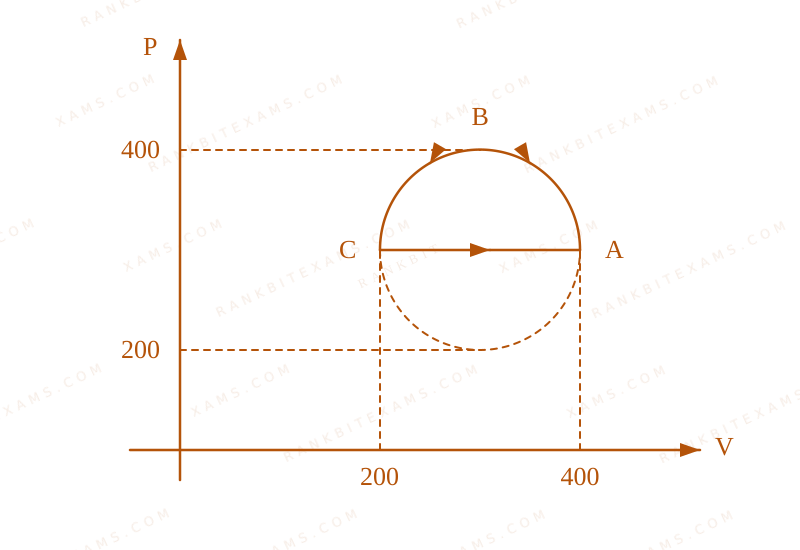
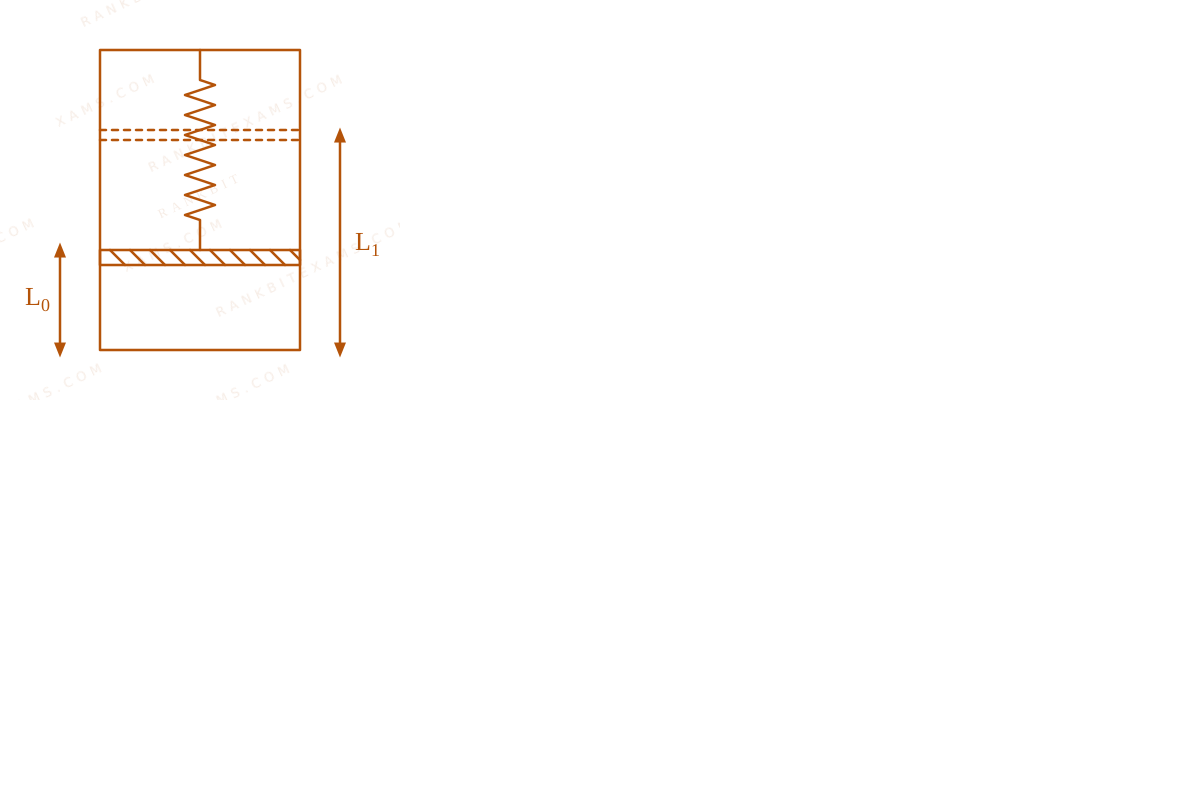
A piston of mass M is hung from a massless spring whose restoring force law goes as F = -kx^3, where k is the spring constant of appropriate dimension. The piston separates the vertical chamber into two parts, where the bottom part is filled with 'n' moles of an ideal gas. An external work is done on the gas isothermally (at a constant temperature T) with the help of a heating filament (with negligible volume) mounted in lower part of the chamber, so that the piston goes up from a height L_0 to L_1, the total energy delivered by the filament is (Assume spring to be in its natural length before heating)
Piston connected to spring with gas underneath for Q11
A schematic of a piston of mass M connected to a spring inside a vertical chamber, separating gas at the bottom from vacuum/atmosphere at the top.

Solution & Explanation

### Related Formula First Law of Thermodynamics: Delta Q = Delta U + W_textby gas Work done by an ideal gas during isothermal expansion: W_textgas = nRTlnleft(fracV_1V_0right) = nRTlnleft(fracL_1L_0 ight) Conservation of Energy (Work-Energy Theorem): Total energy delivered by the heating filament (W_textfilament) must equal the total work needed to lift the piston against gravity and compress the non-linear spring. ### Core Logic Since the process is isothermal, the change in internal energy of the ideal gas is zero (Delta U = 0). Hence: Q = W_textgas By the Work-Energy Theorem for the piston: W_textgas + W_textfilament = Delta U_textgravity + Delta U_textspring Let's evaluate each term: - Increase in gravitational potential energy: Delta U_textgravity = Mg(L_1 - L_0) - Increase in spring potential energy: U_textspring = -int_L_0^L_1 F_textrestoring dx = int_L_0^L_1 kx^3 dx = frack4(L_1^4 - L_0^4) ### Step 1: Finding Total Energy Delivered Isolating W_textfilament (the net external energy delivered to the gas system): W_textfilament = W_textgas + Mg(L_1 - L_0) + frack4(L_1^4 - L_0^4) Since W_textgas = nRTlnleft(fracL_1L_0 ight): W_textfilament = nRTlnleft(fracL_1L_0 ight) + Mg(L_1 - L_0) + frack4(L_1^4 - L_0^4) ### Pattern Recognition Notice how energy conservation instantly frames this complex thermodynamics question. The heating filament's energy simply goes into three distinct stores: the isothermal work of gas expansion, raising the mass against gravity (Mgh), and the potential energy of the spring (integrated from kx^3). Keeping this total energy ledger in mind prevents tedious mathematical tangents. ### Evaluation Rubric / Model Answer null ### Chapter Mix Class 11 Physics: Thermodynamics: First Law Class 11 Physics: Work, Energy and Power: Variable Force Integration

Reference Study Guides

More Thermodynamics Previous-Year Questions — Page 6

Q47 2025 Hess's Law / Enthalpy of Formation
Consider the following data: Heat of formation of CO_2(g) = -393.5mathrm~kJ~mol^-1 Heat of formation of H_2O(l) = -286.0mathrm~kJ~mol^-1 Heat of combustion of benzene = -3267.0mathrm~kJ~mol^-1 The heat of formation of benzene is ______ mathrmkJ~mol^-1 (Nearest integer).
Numerical Answer. Answer: 48 to 48

Solution

### Related Formula Enthalpy of reaction from enthalpy of formation data: Delta H_textreaction = sum Delta H_f(textProducts) - sum Delta H_f(textReactants) ### Core Logic Write out the balanced thermochemical equation for the combustion of benzene (C_6H_6): C_6H_6(l) + frac152O_2(g) rightarrow 6CO_2(g) + 3H_2O(l) Given parameters: - Delta H_c = -3267.0mathrm\ kJ/mol - Delta H_f[CO_2] = -393.5mathrm\ kJ/mol - Delta H_f[H_2O] = -286.0mathrm\ kJ/mol - Delta H_f[O_2] = 0mathrm\ kJ/mol ### Step 1: Applying Hess's Law Substitute these values into the reaction expression: -3267 = [6(-393.5) + 3(-286.0)] - Delta H_f[C_6H_6] -3267 = [-2361.0 - 858.0] - Delta H_f[C_6H_6] -3267 = -3219.0 - Delta H_f[C_6H_6] Delta H_f[C_6H_6] = -3219.0 + 3267.0 = 48mathrm\ kJ/mol ### Pattern Recognition Always set up products minus reactants when using heat of formation data. Pay close attention to stoichiometric coefficients (multiply CO_2 by 6 and H_2O by 3) to ensure accurate bookkeeping. ### Evaluation Rubric / Model Answer null ### Chapter Mix Class 11 Chemistry: Thermodynamics
Q19 2025 Adiabatic Process
The workdone in an adiabatic change in an ideal gas depends upon only : [cite: 1, 2]
  • A. change in its pressure
  • B. change in its specific heat
  • C. change in its volume
  • D. change in its temperature

Solution

### Related Formula Delta W = -Delta U = -n C_v Delta T ### Core Logic In an adiabatic system, no heat exchange occurs (Q=0). By the first law of thermodynamics, Delta W = -Delta U. Since internal energy U depends explicitly on temperature metrics, the total work output shifts uniquely based on temperature variation Delta T. ### Chapter Mix Class 11 Physics: Thermodynamics
More Thermodynamics Questions — jee_main_2025_03_april_morning

Practice all Thermodynamics previous-year questions →

YOUR FIRST PREP STEP STARTS HERE

We Map Every Repeating Question in Competitive Exams.

Say goodbye to generic mock test fatigue. RankBit uses smart analysis to group past exam questions into their foundational Repeating Question Types. Find chapter weightage, track repeating questions, and score higher with targeted practice.

Select Your Target Exam

Choose an exam track below to find formulas per chapter and patterns.

Syncing Exam Intelligence

Mapping formulas and patterns across all tracks…

PATH A — FULL LENGTH PRACTICE

Full Mock Test Hub

Simulate real NTA exam conditions with fully tracked mocks. Time yourself against past papers.

Under Development
PATH B — TARGETED PRACTICE

Topic-wise Practice Hub

Practice past-year questions one chapter at a time. Pick an exam → subject → chapter and get every PYQ for that topic — pulled together from all past papers — with the chapter's key formulas alongside.

Loading Questions... Browse Topics
Latest from the Blog
View all →

Loading articles...