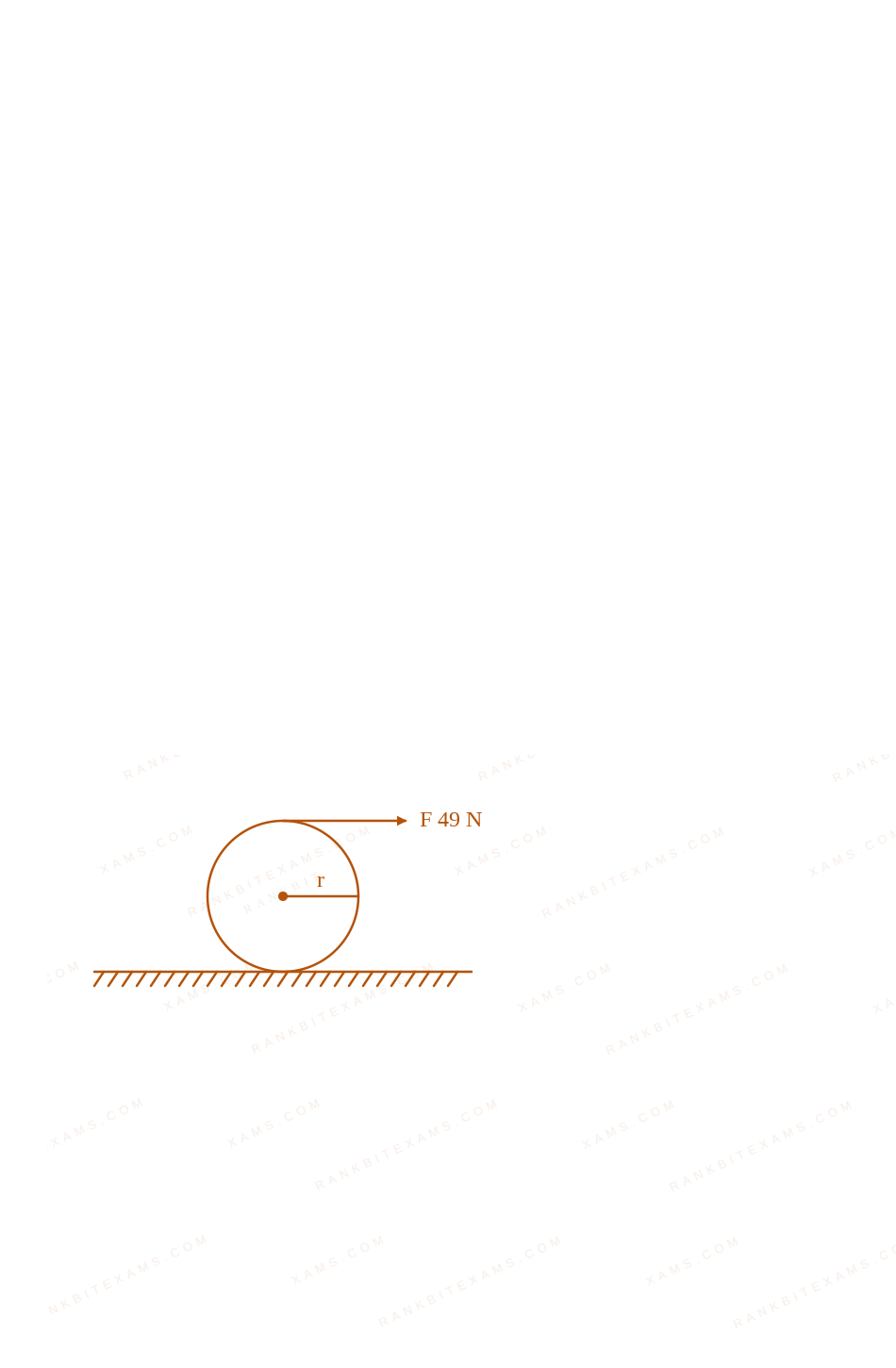
A force of 49~N acts tangentially at the highest point of a sphere (solid) of mass 20~kg, kept on a rough horizontal plane. If the sphere rolls without slipping, then the acceleration of the center of the sphere is:
Solid sphere with tangential force at top point for Q10
A schematic of a solid sphere of mass m resting on a horizontal plane with a force F pointing horizontally to the right at the highest point.

Solution & Explanation

Related Formula

Torque equation about the instantaneous center of zero velocity (bottom contact point P):

τP = IP α

For a solid sphere, the moment of inertia about the center is Ic = (2)/(5)MR². By the parallel axis theorem:

IP = Ic + MR² = (7)/(5)MR²
Core Logic

Since the sphere rolls without slipping, we can conveniently write the torque equation about the lowest point of contact P because static friction passes through this point and exerts zero torque.

  • Distance from point P to the top highest point is 2R.
  • Tangential force F = 49~N.
  • Mass of solid sphere, M = 20~kg.
τP = F × 2R

Substitute τP and IP into the torque equation:

F × 2R = ((7)/(5)MR²) α
Step 1: Solving for Linear Acceleration

For pure rolling, the acceleration of the center of mass a is related to angular acceleration α by a = Rα:

2F R = (7)/(5)MR² ((a)/(R)) 2F = (7)/(5) M a a = (10F)/(7M)

Substitute the numerical values (F = 49~N and M = 20~kg):

a = (10 × 49)/(7 × 20) = (490)/(140) = 3.5~m/s²
Step 2: Analysis of Friction Force Direction

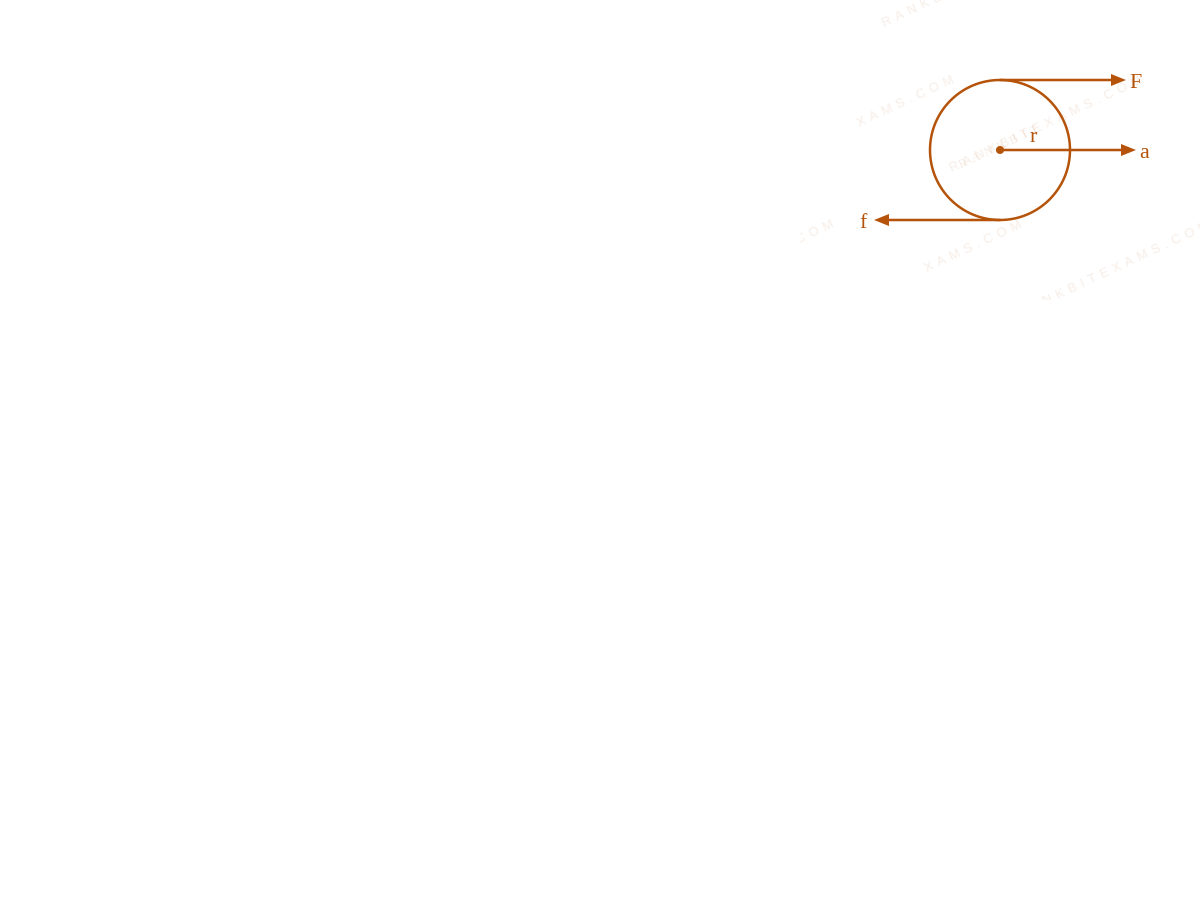
Let's write force equations to verify consistency: F + f = M a

49 + f = 20 × 3.5 = 70 f = 21~N

Since f is positive, static friction acts in the forward direction. Rolling without slipping is fully maintained since the required static friction coefficient is well within realistic limits.

Pattern Recognition

Calculating torque about the bottom contact point is a powerful shortcut for rolling-without-slipping questions! It completely bypasses having to guess or set up equations for the friction direction.

Chapter Mix

Class 11 Physics: System of Particles and Rotational Motion
Free body diagram of solid sphere in pure rolling for Q10
A schematic of a solid sphere of mass m resting on a horizontal plane with a force F pointing horizontally to the right at the highest point.

Reference Study Guides

More Rotational Motion Previous-Year Questions — Page 8

Q12 jee_main_2025_04_april_evening Rolling Motion
A wheel is rolling on a plane surface. The speed of a particle on the highest point of the rim is 8 m/s. The speed of the particle on the rim of the wheel at the same level as the centre of wheel, will be:
  • A. 4√(2) m/s
  • B. 8 m/s
  • C. 4 m/s
  • D. 8√(2) m/s

Solution

Related Formula

Velocity of a point on a rolling wheel at angular position θ from the lowest point:

v = 2 vcm ((θ)/(2))
Core Logic

At the highest point, θ = 180^°, so:

vₜₒₚ = 2vcm = 8 m/s vcm = 4 m/s

For a particle on the rim at the same horizontal level as the center, the angle from the lowest point is θ = 90^°.

Step 1: Compute Speed at Mid-Height

Substituting θ = 90^° into our velocity relation: vmid = 2vcm (45^°) = 2 × 4 × 1√(2) = 4√(2) m/s

Instantaneous center of rotation on rolling wheel

Pattern Recognition

The contact point with the ground is the Instantaneous Center of Rotation (ICR). Distance to top point is 2R, distance to mid-level point is √(R²+R²) = √(2)R. Velocity scales linearly with distance from ICR.

Chapter Mix

Class 11 Physics: Rotational Motion

Q22 jee_main_2025_04_april_evening Conservation of Angular Momentum
A solid sphere with uniform density and radius R is rotating initially with constant angular velocity (ω₁) about its diameter. After some time during the rotation its starts loosing mass at a uniform rate, with no change in its shape. The angular velocity of the sphere when its radius becomes R / 2 is xω₁. The value of x is ________.
Numerical Answer. Answer: 32 to 32

Solution

Related Formula

Conservation of Angular Momentum (since no external torque acts):

I₁ ω₁ = I₂ ω₂

For a solid sphere, moment of inertia is:

I = (2)/(5)MR²

Mass scales with volume: M ∝ R³

Core Logic

When the radius reduces to R₂ = (R)/(2), the mass scales cubically:

M₂ = M₁ ((R/2)/(R))³ = (M₁)/(8)

Now, compute the new moment of inertia I₂:

I₂ = (2)/(5) M₂ R₂² = (2)/(5) ((M₁)/(8)) ((R)/(2))² = (2)/(5) M₁ R² × (1)/(32) = (I₁)/(32)
Step 1: Compute Final Angular Velocity

Using conservation of angular momentum:

I₁ ω₁ = ((I₁)/(32)) ω₂ ω₂ = 32 ω₁

Hence, the value of x is 32.

Pattern Recognition

Since inertia of a solid sphere scales with M R² and M ∝ R³, the net moment of inertia scales with R⁵. Shrinking the radius by half (1/2) cuts down inertia by a factor of (1/2)⁵ = 1/32. Velocity must scale up by 32 to conserve momentum.

Chapter Mix

Class 11 Physics: Rotational Motion

Q jee_main_2025_04_april_morning Torque and Angular Momentum
Which of the following are correct expressions for torque acting on a body? A. τ = r × L B. τ = (d)/(dt)( r × p) C. τ = r × d pdt D. τ = I α E. τ = r × F ( r = position vector; p = linear momentum; L = angular momentum; α = angular acceleration; I = moment of inertia; F = force; t = time) Choose the correct answer from the options given below:
  • A. B, D and E Only
  • B. C and D Only
  • C. B, C, D and E Only
  • D. A, B, D and E Only

Solution

Related Formula

Fundamental mathematical definition of torque:

τ = r × F

Rotational analogue of Newton's second law:

τ = d Ldt = I α

Linear momentum relations:

L = r × p τ = (d)/(dt)( r × p)
Core Logic

Let's check each expression sequentially:

  • A. τ = I × L is dimensionally incorrect (Moment of inertia I is primarily treated as a tensor or scalar placeholder, not crossed directly like this).
  • B. τ = d Ldt = (d)/(dt)( r × p) is fundamentally correct.
  • C. τ = r × F = r × d pdt is correct since F = d pdt.
  • D. τ = I α is the standard scalar component/fixed axis formulation.
  • E. τ = r × F is the true physical vector definition.
  • Thus, statements B, C, D, and E are universally correct representations.

Pattern Recognition

Torque can be represented either through geometric structural parameters (position and force cross products) or via kinematic response properties (rate of change of angular momentum or product of rotational inertia and acceleration).

Chapter Mix

Class 11 Physics: System of Particles and Rotational Motion
Q jee_main_2025_04_april_morning Uniform Circular Motion and Dynamics
If L and P represent the angular momentum and linear momentum respectively of a particle of mass 'm' having position vector r = a( i ω t + j ω t). The direction of force is
  • A. Opposite to the direction of r
  • B. Opposite to the direction of L
  • C. Opposite to the direction of P
  • D. Opposite to the direction of L × P

Solution

Related Formula

Acceleration vector equation via secondary derivation:

a = d² rdt²

Force equation:

F = m a
Core Logic

Given position tracking trace:

r = a( i ω t + j ω t)

Velocity vector v:

v = d rdt = aω(- i ω t + j ω t)
Step 1: Differentiate to find Acceleration
a = d vdt = aω²(- i ω t - j ω t) a = -ω² [ a( i ω t + j ω t) ] = -ω² r
Step 2: Establish Force Direction
F = m a = -mω² r

The minus sign indicates the net centripetal pulling force aligns explicitly opposite to the direction of r.

Pattern Recognition

The expression describes a standard uniform circular motion profile. In circular configurations, acceleration and centripetal forces point radially inward, directly opposing the outbound position tracker vector.

Chapter Mix

Class 11 Physics: Kinematics Class 11 Physics: System of Particles and Rotational Motion

Q21 jee_main_2025_04_april_morning Rolling Motion on an Inclined Plane
A circular ring and a solid sphere having same radius roll down on an inclined plane from rest without slipping. The ratio of their velocities when reached at the bottom of the plane is √((x)/(5)) where x =
Numerical Answer. Answer: 3.5 to 4

Solution

Related Formula

Velocity of a rolling body from mechanical energy conservation:

v = √((2gh)/(1 + (k²)/(R²)))
Core Logic

Evaluate radius of gyration factor coefficients:

  • For a circular ring: (k²)/(R²) = 1
  • For a solid sphere: (k²)/(R²) = (2)/(5)
Step 1: Compute Velocity Expressions
vring = √((2gh)/(1 + 1)) = √(gh) vsphere = √((2gh)/(1 + (2)/(5))) = √((10gh)/(7))
Step 2: Calculate the Velocity Ratio
vringvsphere = √(gh)√((10gh)/(7)) = √((7)/(10)) = √((3.5)/(5))

Matching with the prompt expression format √((x)/(5)) reveals: x = 3.5

Rounding to the nearest integer yields 4.

Pattern Recognition

Objects with lower mass concentration near the center (lower (k²)/(R²) like the sphere) convert gravitational potential energy into translational kinetic energy more efficiently, rolling faster than hollow equivalents.

Chapter Mix

Class 11 Physics: System of Particles and Rotational Motion

More Rotational Motion Questions — jee_main_2025_03_april_morning

Practice all Rotational Motion previous-year questions →

Rankbit System
JEE Physics: Waves (+15.5%) | Electrostatics: Concentric Shells (-29.7%) | Modern Physics: Photoelectric Clones (+34.2%) | Mathematics: Definite Integrals (+18.1%) | Chemistry: Coordination Splitting (-11.4%) | JEE Physics: Waves (+15.5%) | Electrostatics: Concentric Shells (-29.7%) | Modern Physics: Photoelectric Clones (+34.2%) | Mathematics: Definite Integrals (+18.1%) | Chemistry: Coordination Splitting (-11.4%)