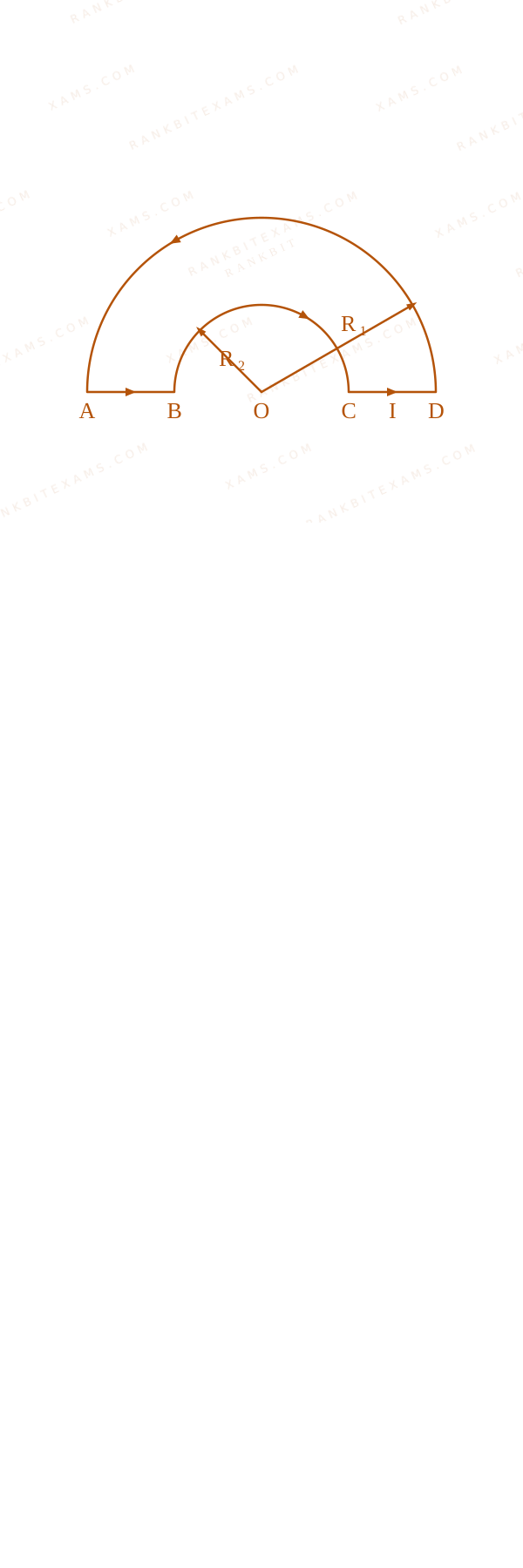
A loop ABCDA, carrying current I = 12~A$I = 12\mathrm{~A}$, is placed in a plane, consists of two semi-circular segments of radius R₁ = 6π~m$R_1 = 6\pi\mathrm{~m}$ and R₂ = 4π~m$R_2 = 4\pi\mathrm{~m}$. The magnitude of the resultant magnetic field at center O is k× 10⁻⁷~T$k\times 10^{-7}\mathrm{~T}$ The value of k is ________. (Given μ₀=4π×10⁻⁷~T· m· A⁻¹$\mu_{0}=4\pi\times10^{-7}\mathrm{~T\cdot m\cdot A}^{-1}$)
A current loop containing two concentric semicircular segments of radii R1 and R2 connected by radial straight segments, with common center O.
Numerical Answer Type:
Enter a numerical valueAnswer: 1 to 1+4 marks
Solution & Explanation
Related Formula
Magnetic field at the center of a circular segment of angle θ$\theta$:
Let's analyze the contributions from each part of the loop to the magnetic field at the center O$O$:
The straight wire segments AB$AB$ and CD$CD$ lie along radial lines passing directly through O$O$. Since d l ∥ r$d\vec{l} \parallel \vec{r}$, their magnetic field contribution is zero:
BAB = BCD = 0$$B_{\text{AB}} = B_{\text{CD}} = 0$$
Semicircular segment of radius R₂ = 4π~m$R_2 = 4\pi\mathrm{~m}$ carries current creating a field pointing out of the page (by right-hand rule):
BR2 = (μ₀ I)/(4 R₂) (Out of page)$$B_{R2} = \frac{\mu_0 I}{4 R_2} \quad (\text{Out of page})$$
Semicircular segment of radius R₁ = 6π~m$R_1 = 6\pi\mathrm{~m}$ carries current creating a field pointing into the page:
Comparing this to k × 10⁻⁷~T$k \times 10^{-7}\mathrm{~T}$:
k = 1$k = 1$
Pattern Recognition
Notice how the radial straight wires never contribute to the magnetic field at the center. Semicircles with opposite currents simply subtract. Symmetrizing the math early by factoring out (μ₀ I)/(4π)$\frac{\mu_0 I}{4\pi}$ makes the calculations incredibly neat and quick.
Chapter Mix
Class 12 Physics: Magnetic Effects of Current: Biot-Savart Law
Keywords:#Biot Savart concentric semicircles#magnetic field circular segment#JEE Main 2025 Morning Q24#resultant magnetic field concentric#magnetic field loop#semicircular segments#Biot Savart law
More Magnetic Effects of Current Previous-Year Questions — Page 5
Q3jee_main_2025_24_jan_eveningMagnetic Force on a Charge
Given below are two statements. One is labelled as Assertion (A) and the other is labelled as Reason (R).
Assertion (A): An electron in a certain region of uniform magnetic field is moving with constant velocity in a straight line path.
Reason (R): The magnetic field in that region is along the direction of velocity of the electron.
In the light of the above statements, choose the correct answer from the options given below:
A.(A)$(A)$ is false but (R)$(R)$ is true
B. Both (A)$(A)$ and (R)$(R)$ are true and (R)$(R)$ is the correct explanation of (A)$(A)$
C. Both (A)$(A)$ and (R)$(R)$ are true but (R)$(R)$ is NOT the correct explanation of (A)$(A)$
D.(A)$(A)$ is true but (R)$(R)$ is false
Solution
Related Formula
F = q( v × B)$$\vec{F} = q(\vec{v} \times \vec{B})$$
Core Logic
For a particle to move with a constant velocity in a straight line inside a magnetic field alone, the net magnetic force must be zero:
F = 0 v ∥ B$$\vec{F} = 0 \implies \vec{v} \parallel \vec{B}$$
This means the angle θ$\theta$ between the velocity vector and the magnetic field vector is either 0°$0^{\circ}$ or 180°$180^{\circ}$. Thus, if the magnetic field is along the direction of velocity, the force is zero, allowing unaccelerated straight-line motion. Both Assertion and Reason are true, and the Reason correctly explains the Assertion.
Pattern Recognition
Magnetic field cannot change the speed of a charged particle, but it changes direction unless v$\vec{v}$ is parallel or anti-parallel to B$\vec{B}$, in which case the magnetic force vanishes entirely.
Chapter Mix
Class 12 Physics: Moving Charges and Magnetism
Q5jee_main_2025_24_jan_eveningAmpere's Circuital Law
A long straight wire of a circular cross-section with radius 'a' carries a steady current I. The current I is uniformly distributed across this cross-section. The plot of magnitude of magnetic field B with distance r from the centre of the wire is given by:
Inside the wire (r < a$r < a$), the magnetic field grows linearly with distance r$r$ from the axis. At the surface (r = a$r = a$), it reaches its maximum value B = (μ₀ I)/(2π a)$B_{\max} = \frac{\mu_0 I}{2\pi a}$. Outside the wire (r > a$r > a$), it decays inversely with r$r$. This combination matches the curve shown in Graph (1). magnetic field variation, ampere law plot, current carrying wire
Pattern Recognition
Solid cylinder current profile: linear inside (B ∝ r$B \propto r$), hyperbolic outside (B ∝ 1/r$B \propto 1/r$).
Chapter Mix
Class 12 Physics: Moving Charges and Magnetism
Q11jee_main_2025_24_jan_eveningAmpere's Circuital Law
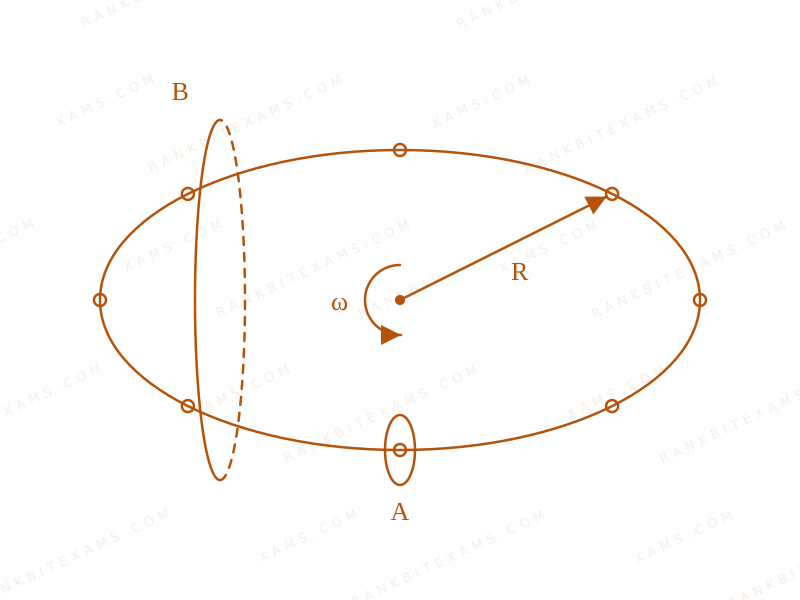
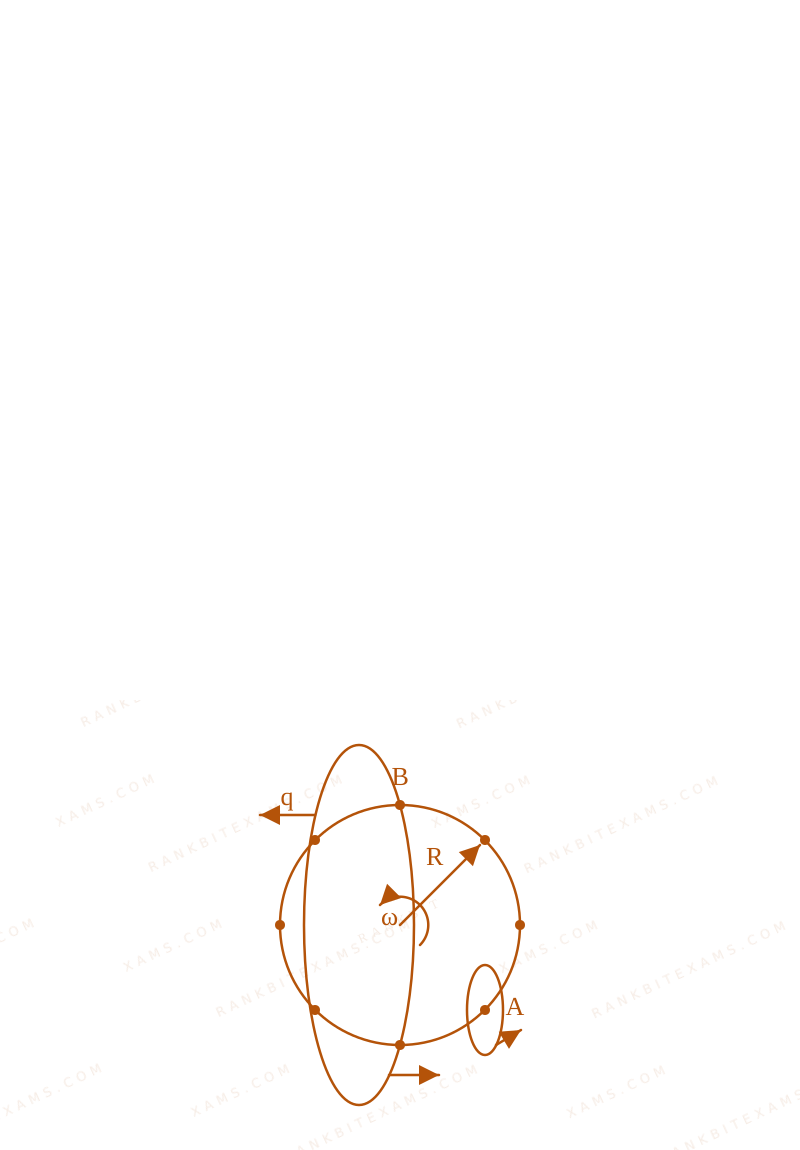
N equally spaced charges each of value q, are placed on a circle of radius R. The circle rotates about its axis with an angular velocity ω$\omega$ as shown in the figure The figure illustrates a rotating ring of charges with two distinct Amperian paths A and B intersecting the ring path.. A bigger Amperian loop B encloses the whole circle where as a smaller Amperian loop A encloses a small segment. The difference between enclosed currents, IA - IB$I_{A} - I_{B}$, for the given Amperian loops is
A.N²2πqω$\frac{N^{2}}{2\pi}q\omega$
B.(2π)/(N)qω$\frac{2\pi}{N}q\omega$
C.(N)/(2π)qω$\frac{N}{2\pi}q\omega$
D.(N)/(π)qω$\frac{N}{\pi}q\omega$
Solution
Related Formula
I = (q)/(T) = (qω)/(2π)$$I = \frac{q}{T} = \frac{q\omega}{2\pi}$$
Core Logic
The loop A encloses one of the moving point charges as it moves past, giving a current contribution localized to that cross-sectional segment intersection:
IA = (Nq)/(((2π)/(ω))) = (Nqω)/(2π)$$I_A = \frac{Nq}{\left(\frac{2\pi}{\omega}\right)} = \frac{Nq\omega}{2\pi}$$
Loop B encloses the entire loop surface coplanar or enclosing the ring structure fully without clipping individual passing current tracks perpendicularly in the same directional fashion, resulting in zero net cross-surface passing enclosed current:
IB = 0$I_B = 0$
Therefore, the difference is:
IA - IB = (Nqω)/(2π)$$I_A - I_B = \frac{Nq\omega}{2\pi}$$The figure illustrates a rotating ring of charges with two distinct Amperian paths A and B intersecting the ring path.
Pattern Recognition
A current loop has net passing current across a large overarching bounding box equal to zero if it doesn't cross the boundary surfaces symmetrically.
Chapter Mix
Class 12 Physics: Moving Charges and Magnetism
Q21jee_main_2025_24_jan_eveningSolenoid
A tightly wound long solenoid carries a current of 1.5 A. An electron is executing uniform circular motion inside the solenoid with a time period of 75ns. The number of turns per metre in the solenoid is ____. The figure details a thick solenoid cylinder with a internal cross section displaying a charge tracking loop.
[Take mass of electron mₑ = 9 × 10⁻³¹$m_e = 9 \times 10^{-31}$ kg, charge of electron |qₑ| = 1.6 × 10⁻¹⁹$|q_e| = 1.6 \times 10^{-19}$ C, μ₀ = 4π × 10⁻⁷ (N)/(A²), 1 ns = 10⁻⁹ s$\mu_0 = 4\pi \times 10^{-7} \frac{N}{A^2}, 1 \text{ ns} = 10^{-9} \text{ s}$]
Numerical Answer.Answer: 250 to 250
Solution
Related Formula
Time period of a revolving charge in a magnetic field:
T = (2π m)/(qB)$$T = \frac{2\pi m}{qB}$$
Magnetic field inside a long solenoid:
B = μ₀ n I$B = \mu_0 n I$
Core Logic
Combining the expressions to isolate n$n$ (turns per meter):
T = (2π m)/(q(μ₀ n I))$$T = \frac{2\pi m}{q(\mu_0 n I)}$$
The circular motion time period depends exclusively on the field magnitude B$B$, completely independent of the orbit's velocity or radius.
Chapter Mix
Class 12 Physics: Moving Charges and Magnetism
Qjee_main_2025_24_jan_morningMagnetic Field due to a Current Element
A current of 5A exists in a square loop of side 1√(2) m$\frac{1}{\sqrt{2}}\text{ m}$ Then the magnitude of the magnetic field B at the centre of the square loop will be p×10⁻⁶ T$p\times10^{-6}\text{ T}$ where, value of p is [Take μ₀=4π×10⁻⁷ T mA⁻¹$\mu_{0}=4\pi\times10^{-7}\text{ T mA}^{-1}$].
Numerical Answer.Answer: 8 to 8
Solution
Related Formula
The magnetic field B₁$B_{1}$ produced by a straight wire segment carrying current I$I$ at a perpendicular distance d$d$ is given by the Biot-Savart relation:
As shown in the square geometric layout Magnetic Field due to a Current Element diagram for Q24 - JEE Main 2025 Morning, the perpendicular distance from any side to the central origin point is exactly half the total side length :
Practice past-year questions one chapter at a time. Pick an exam → subject → chapter and get every PYQ for that topic — pulled together from all past papers — with the chapter's key formulas alongside.