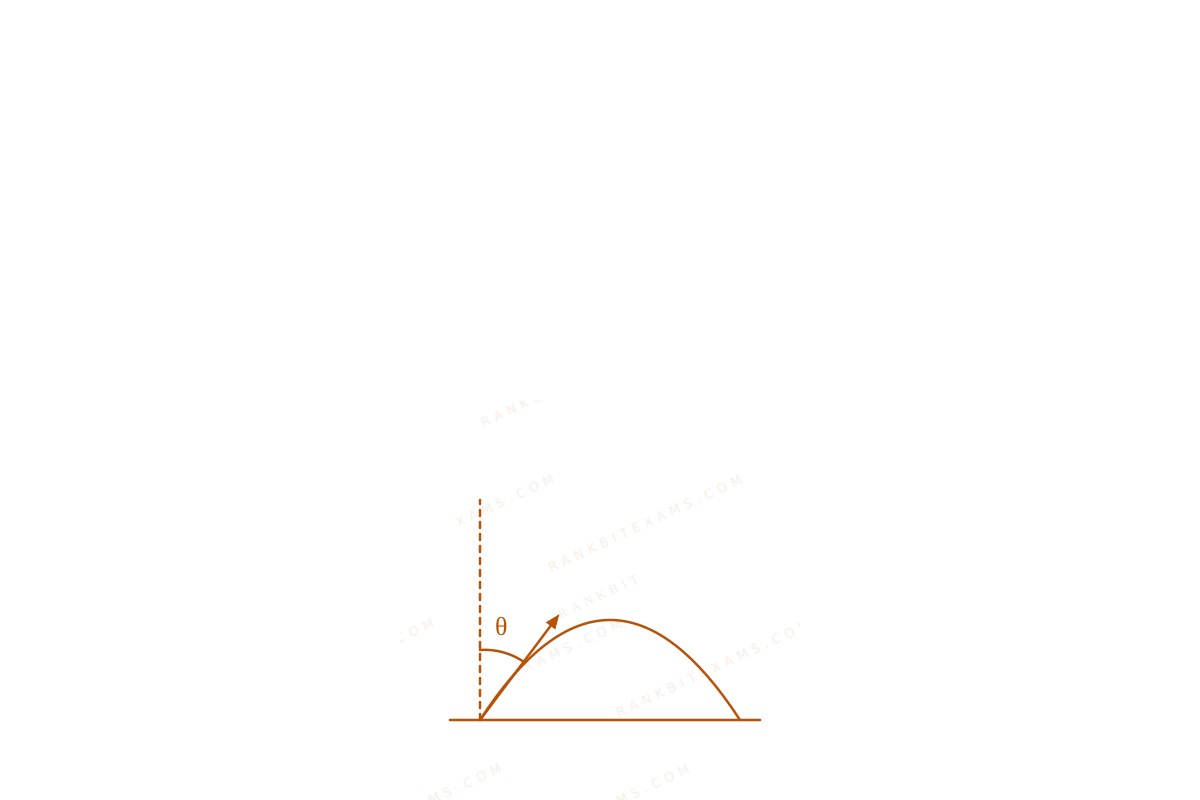
The angle of projection of a particle is measured from the vertical axis as phi$\phi$ and the maximum height reached by the particle is h_m$h_m$. Here h_m$h_m$ as function of phi$\phi$ can be presented as:
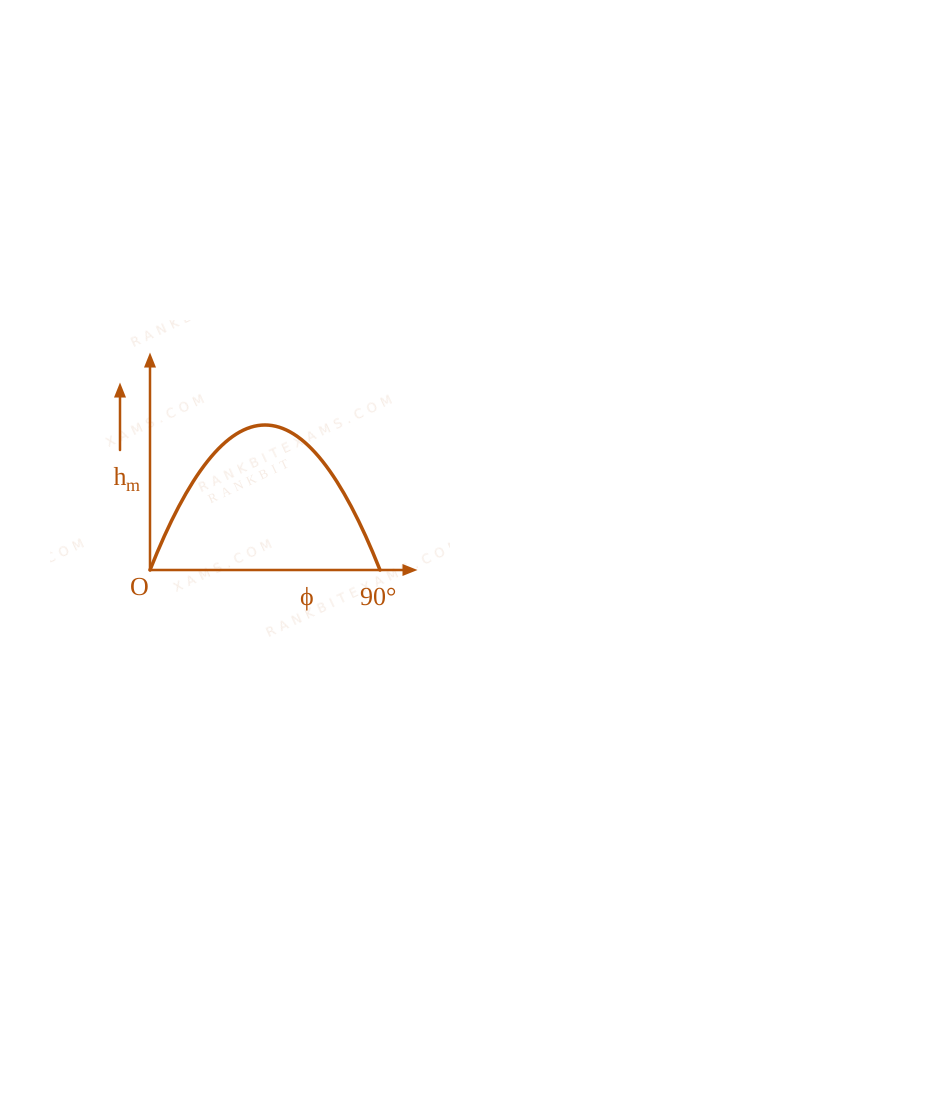
A.Curve (1)
Projectile Motion Maximum Height
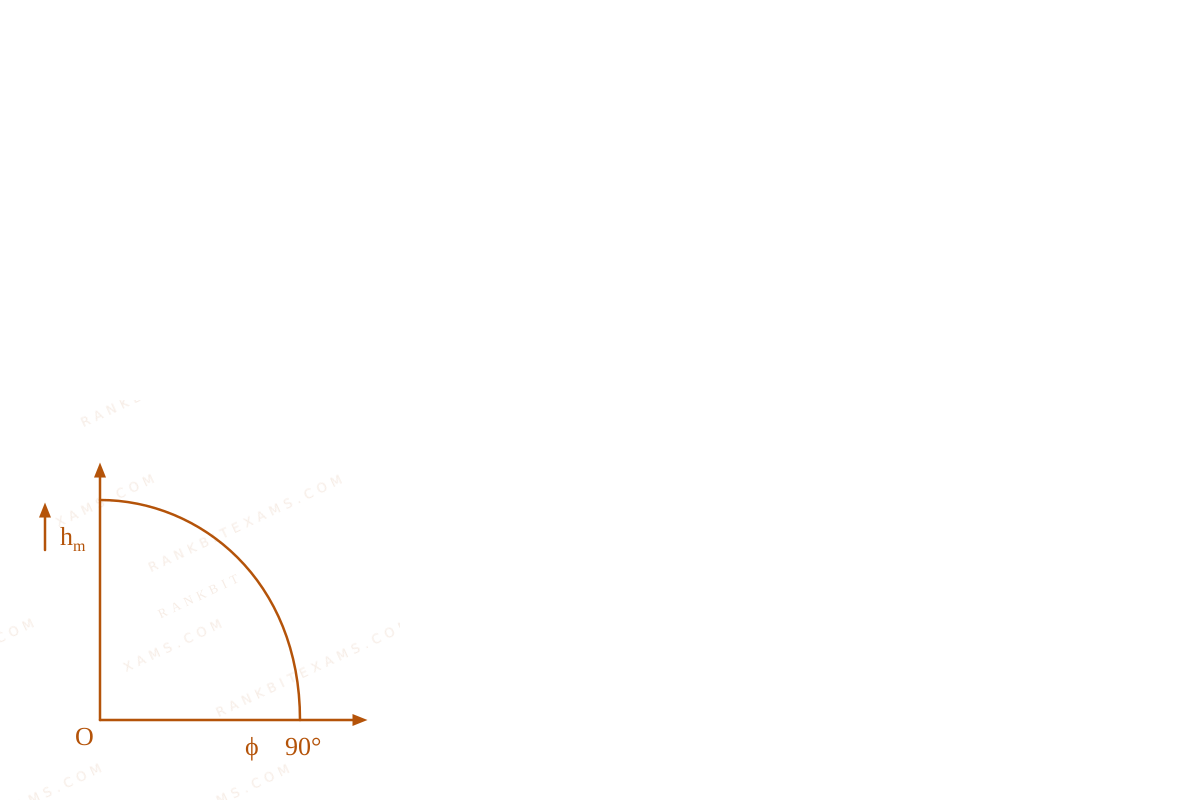
B.Curve (2)
Projectile Motion Maximum Height
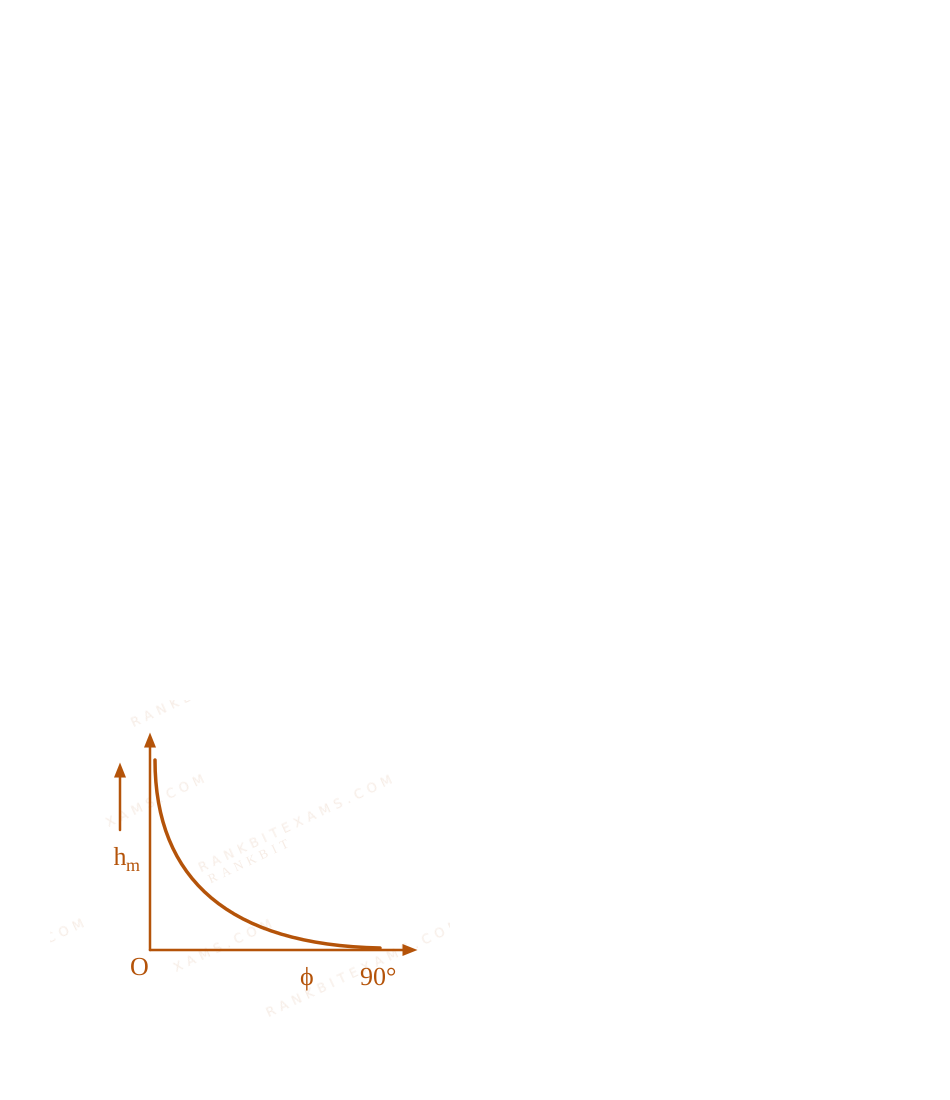
C.Curve (3)
Projectile Motion Maximum Height
D.Curve (4)
Projectile Motion Maximum Height
Solution & Explanation
### Related Formula
Maximum height of a projectile:
H_textmax = fracu^2 sin^2 theta2g$$H_{\text{max}} = \frac{u^2 \sin^2 \theta}{2g}$$
where theta$\theta$ is the angle of projection measured from the horizontal ground.
### Core Logic
The angle of projection in this question is measured from the **vertical axis** as phi$\phi$.
This relates to the horizontal projection angle theta$\theta$ as:
theta = 90^circ - phi$$\theta = 90^{\circ} - \phi$$
Substitute this into the maximum height formula:
h_m = fracu^2 sin^2 (90^circ - phi)2g = fracu^2 cos^2 phi2g$$h_m = \frac{u^2 \sin^2 (90^{\circ} - \phi)}{2g} = \frac{u^2 \cos^2 \phi}{2g}$$h_m(phi) propto cos^2 phi$$h_m(\phi) \propto \cos^2 \phi$$
### Step 1: Analyzing Boundary Conditions
Let's check the boundary values of h_m$h_m$ for phi in [0, 90^circ]$\phi \in [0, 90^{\circ}]$:
- At phi = 0^circ$\phi = 0^{\circ}$ (fired straight up vertically):
h_m(0) = fracu^22g = textMaximum height$$h_m(0) = \frac{u^2}{2g} = \text{Maximum height}$$
- At phi = 90^circ$\phi = 90^{\circ}$ (fired horizontally along the ground):
h_m(90^circ) = 0$$h_m(90^{\circ}) = 0$$
Let's evaluate the behavior of h_m(phi)$h_m(\phi)$:
- At small angles phi approx 0$\phi \approx 0$, the slope fracd h_mdphi = -fracu^22g sin(2phi) approx 0$\frac{d h_m}{d\phi} = -\frac{u^2}{2g} \sin(2\phi) \approx 0$. This means the curve starts with a horizontal slope (flat top).
- As phi$\phi$ increases towards 90^circ$90^{\circ}$, h_m$h_m$ falls smoothly, reaching 0 at 90^circ$90^{\circ}$ with flat slope again.
This sinusoidal falloff perfectly matches **Curve (3)**.
Curve plot of vertical height hm versus launch angle phi for Q19
### Pattern Recognition
Always read the coordinate origin carefully! Measuring angle from the vertical instead of the horizontal turns sin^2theta$\sin^2\theta$ into cos^2phi$\cos^2\phi$. Checking extremes: vertical shot (0^circ$0^{\circ}$) yields maximum height, while flat shot (90^circ$90^{\circ}$) yields zero height.
### Evaluation Rubric / Model Answer
null
### Chapter Mix
Class 11 Physics: Motion in a Plane: Projectile Motion
Q31jee_main_2024_27_jan_morningVelocity and Acceleration in Two Dimensions
Position of an ant (S$S$ in metres) moving in Y-Z plane is given by vecS = 2t^2hatj + 5hatk$\vec{S} = 2t^{2}\hat{j} + 5\hat{k}$ (where t$t$ is in seconds).
The magnitude and direction of velocity of the ant at t = 1$t = 1$ s will be:
A.16text m/s in y-direction$16\text{ m/s in y-direction}$
B.4text m/s in x-direction$4\text{ m/s in x-direction}$
C.9text m/s in z-direction$9\text{ m/s in z-direction}$
D.4text m/s in y-direction$4\text{ m/s in y-direction}$
Solution
### Related Formula
vecv = fracdvecSdt$$\vec{v} = \frac{d\vec{S}}{dt}$$
### Core Logic
Differentiating the position vector with respect to time gives the velocity vector:
vecv = fracddt(2t^2hatj + 5hatk) = 4thatj$$\vec{v} = \frac{d}{dt}(2t^{2}\hat{j} + 5\hat{k}) = 4t\hat{j}$$
### Step 1: Evaluation at given time
Substitute t = 1text s$t = 1\text{ s}$ into the velocity expression:
vecv = 4(1)hatj = 4hatjtext m/s$$\vec{v} = 4(1)\hat{j} = 4\hat{j}\text{ m/s}$$
### Pattern Recognition
Constant term vectors (like 5hatk$5\hat{k}$) drop out during differentiation. The resulting velocity only has a component along the hatj$\hat{j}$ direction, confirming motion purely parallel to the y-axis at that instant.
### Evaluation Rubric / Model Answer
null
### Chapter Mix
Class 11 Physics: Kinematics
Q51jee_main_2024_27_jan_morningMotion in a Plane with Constant Acceleration
A particle starts from the origin at t = 0$t = 0$ with a velocity 5hatitext m/s$5\hat{i}\text{ m/s}$ and moves in the x-y plane under the action of a force which produces a constant acceleration of (3hati + 2hatj)text m/s^2$(3\hat{i} + 2\hat{j})\text{ m/s}^{2}$.
If the x-coordinate of the particle at that instant is 84text m$84\text{ m}$, then the speed of the particle at this time is sqrtatext m/s$\sqrt{a}\text{ m/s}$. The value of a$a$ is ______.
Numerical Answer.Answer: 673 to 673
Solution
### Related Formula
v_x^2 - u_x^2 = 2 a_x x$$v_x^2 - u_x^2 = 2 a_x x$$v_y = u_y + a_y t$$v_y = u_y + a_y t$$
### Core Logic
Analyze the motion along the x-axis first to find the final x-velocity component (u_x = 5text m/s$u_x = 5\text{ m/s}$, a_x = 3text m/s^2$a_x = 3\text{ m/s}^2$, x = 84text m$x = 84\text{ m}$):
v_x^2 - 5^2 = 2(3)(84)$$v_x^2 - 5^2 = 2(3)(84)$$v_x^2 - 25 = 504 implies v_x^2 = 529 implies v_x = 23text m/s$$v_x^2 - 25 = 504 \implies v_x^2 = 529 \implies v_x = 23\text{ m/s}$$
### Step 1: Compute time interval
Using the velocity relation along the x-axis:
v_x = u_x + a_x t implies 23 = 5 + 3t implies 3t = 18 implies t = 6text s$$v_x = u_x + a_x t \implies 23 = 5 + 3t \implies 3t = 18 \implies t = 6\text{ s}$$
### Step 2: Evaluate y-axis velocity component
Since u_y = 0$u_y = 0$ and a_y = 2text m/s^2$a_y = 2\text{ m/s}^2$, calculate v_y$v_y$ at t = 6text s$t = 6\text{ s}$:
v_y = 0 + 2(6) = 12text m/s$$v_y = 0 + 2(6) = 12\text{ m/s}$$
### Step 3: Total net speed calculation
v^2 = v_x^2 + v_y^2 = 23^2 + 12^2 = 529 + 144 = 673$$v^2 = v_x^2 + v_y^2 = 23^2 + 12^2 = 529 + 144 = 673$$v = sqrt673text m/s$$v = \sqrt{673}\text{ m/s}$$
Comparing this with sqrta$\sqrt{a}$ yields a = 673$a = 673$.
### Pattern Recognition
Splitting coordinates explicitly isolates vector calculation lines cleanly, optimizing equation selections relative to independent components.
### Evaluation Rubric / Model Answer
null
### Chapter Mix
Class 11 Physics: Kinematics
Q33jee_main_2024_31_jan_morningDifferentiation In Kinematics
The relation between time 't$t$' and distance 'x$x$' is t = alpha x^2 + beta x$t = \alpha x^2 + \beta x$, where alpha$\alpha$ and beta$\beta$ are constants. The relation between acceleration (a$a$) and velocity (v$v$) is:
A.a = -2alpha v^3$a = -2\alpha v^3$
B.a = -5alpha v^5$a = -5\alpha v^5$
C.a = -3alpha v^2$a = -3\alpha v^2$
D.a = -4alpha v^4$a = -4\alpha v^4$
Solution
### Related Formula
v = fracdxdt$$v = \frac{dx}{dt}$$a = fracdvdt = vfracdvdx$$a = \frac{dv}{dt} = v\frac{dv}{dx}$$
### Step 1: Differentiate with respect to time
Given the equation:
t = alpha x^2 + beta x$$t = \alpha x^2 + \beta x$$
Differentiating with respect to time t$t$:
fracdtdt = fracddt(alpha x^2 + beta x)$$\frac{dt}{dt} = \frac{d}{dt}(\alpha x^2 + \beta x)$$1 = 2alpha x fracdxdt + beta fracdxdt$$1 = 2\alpha x \frac{dx}{dt} + \beta \frac{dx}{dt}$$1 = (2alpha x + beta) v$$1 = (2\alpha x + \beta) v$$v = (2alpha x + beta)^-1$$v = (2\alpha x + \beta)^{-1}$$
### Step 2: Calculate Acceleration
Now, acceleration a = fracdvdt$a = \frac{dv}{dt}$. Differentiating v$v$ with respect to time t$t$:
a = fracddt left[ (2alpha x + beta)^-1 right]$$a = \frac{d}{dt} \left[ (2\alpha x + \beta)^{-1} \right]$$a = -1(2alpha x + beta)^-2 cdot fracddt(2alpha x + beta)$$a = -1(2\alpha x + \beta)^{-2} \cdot \frac{d}{dt}(2\alpha x + \beta)$$a = -(2alpha x + beta)^-2 cdot (2alpha) fracdxdt$$a = -(2\alpha x + \beta)^{-2} \cdot (2\alpha) \frac{dx}{dt}$$
Substitute v$v$ and (2alpha x + beta)^-2 = v^2$(2\alpha x + \beta)^{-2} = v^2$:
a = -(v^2) cdot (2alpha) cdot v$$a = -(v^2) \cdot (2\alpha) \cdot v$$a = -2alpha v^3$$a = -2\alpha v^3$$
### Pattern Recognition
Standard kinematic shortcut: Whenever t = Ax^2 + Bx$t = Ax^2 + Bx$, v = (2Ax+B)^-1$v = (2Ax+B)^{-1}$ and a = -2A v^3$a = -2A v^3$. Memorizing this directly saves derivation time during the exam.
### Evaluation Rubric / Model Answer
null
### Chapter Mix
Class 11 Physics: Kinematics
Q55jee_main_2024_31_jan_morningProjectile Motion
A body starts falling freely from height H$H$ hits an inclined plane in its path at height h$h$. As a result of this perfectly elastic impact, the direction of the velocity of the body becomes horizontal. The value of fracHh$\frac{H}{h}$ for which the body will take the maximum time to reach the ground is
Numerical Answer.Answer: 2 to 2
Solution
### Related Formula
t = sqrtfrac2dg$$t = \sqrt{\frac{2d}{g}}$$
### Core Logic
Projectile Motion diagram for Q55 - JEE Main 2024 Morning
The body falls freely from height H$H$ to height h$h$. The distance fallen is (H - h)$(H - h)$.
Time taken to fall this distance:
t_1 = sqrtfrac2(H - h)g$$t_1 = \sqrt{\frac{2(H - h)}{g}}$$
After elastic impact, the vertical velocity becomes zero (the entire velocity is directed horizontally). From height h$h$, it now acts as a horizontal projectile.
The time taken to reach the ground vertically from height h$h$ is:
t_2 = sqrtfrac2hg$$t_2 = \sqrt{\frac{2h}{g}}$$
Total time of flight T = t_1 + t_2$T = t_1 + t_2$:
T = sqrtfrac2(H - h)g + sqrtfrac2hg$$T = \sqrt{\frac{2(H - h)}{g}} + \sqrt{\frac{2h}{g}}$$
### Step 2: Maximizing Time
To find the maximum time T$T$, differentiate T$T$ with respect to h$h$ and equate to zero:
fracdTdh = sqrtfrac2g left( frac-12sqrtH - h + frac12sqrth right) = 0$$\frac{dT}{dh} = \sqrt{\frac{2}{g}} \left( \frac{-1}{2\sqrt{H - h}} + \frac{1}{2\sqrt{h}} \right) = 0$$frac12sqrth = frac12sqrtH - h$$\frac{1}{2\sqrt{h}} = \frac{1}{2\sqrt{H - h}}$$sqrtH - h = sqrth$$\sqrt{H - h} = \sqrt{h}$$
Squaring both sides:
H - h = h$H - h = h$H = 2h$H = 2h$fracHh = 2$$\frac{H}{h} = 2$$
### Evaluation Rubric / Model Answer
null
### Chapter Mix
Class 11 Physics: Kinematics
More Kinematics Questions — jee_main_2025_03_april_morning
We Map Every Repeating Question in Competitive Exams.
Say goodbye to generic mock test fatigue. RankBit uses smart analysis to group past exam questions into their foundational Repeating Question Types. Find chapter weightage, track repeating questions, and score higher with targeted practice.
Select Your Target Exam
Choose an exam track below to find formulas per chapter and patterns.
Syncing Exam Intelligence
Mapping formulas and patterns across all tracks…
PATH A — FULL LENGTH PRACTICE
Full Mock Test Hub
Simulate real NTA exam conditions with fully tracked mocks. Time yourself against past papers.
Practice past-year questions one chapter at a time. Pick an exam → subject → chapter and get every PYQ for that topic — pulled together from all past papers — with the chapter's key formulas alongside.